How rovers fail
The failure record holds 54 sourced entries from 15 teams plus the judges’ field-wide statements, set against 162 finals team-years. Forty-eight entries name a mechanism or a symptom inside a known subsystem and six are zeros whose cause was never published. The record does not say that comms is the problem in the way the judges describe it. It says that the largest and most persistent loss in the field is an autonomy capability gap, and that the most expensive single failures are the ones that take several missions down at once.
Key takeaways
- Autonomy is the largest points sink in the field. Sixty-seven of 162 finals entries scored exactly zero on autonomy, 41 % of the sample, worth about 610 of the roughly 945 mission points the field forgoes each year. It is a capability gap, not a broken rover: 58 % of those zeros were the team’s only zero.
- A large share of the rest is one broken rover. Equipment and Delivery zeros coincide in 12 of 162 team-years, 2.9 times the independent expectation, and only 11 % of Equipment zeros were a team’s only zero.
- The counts measure publication, not occurrence. The arm and comms tie at seven entries each, while the judges call comms “far and away the most common problem” S-URC-ADVICE. Both statements are true about different things.
- The emptiest rows are the most dangerous. Power has one sourced electrical failure in five years and dust has none, yet one electrical fault can end a whole event. Those rows record unquantified risk, not proven absence of risk.
The database and its three biases
Every count on this page is a count of write-ups. Three biases shape the record and each is worth stating before a number is used.
Survivor bias in team reports. System acceptance videos are a qualification deliverable, so they show successes. Teams explain a failure mainly when it drove a redesign; a 2023 failure that ended a season and was never written up leaves no trace. The competition publishes no did-not-finish cause codes and no judging sheets.
Attribution bias in news releases. A release names the incident but rarely the mechanism. A “communication loss” is a symptom, not a cause, and where the team itself gave the mechanism, as WVU did for a damaged cable in 2026, that is the entry used S-WVU-NEWS2026.
A zero is not one thing. A zero can mean attempted and failed, did not attempt, or withdrew, and the score sheets do not distinguish them S-URC22-SCORES S-URC26-SCORES. Every causal reading on this page is therefore an inference rather than a measured cause.
The taxonomy
Counts are entries, not incidents: one bad mission can produce two, as Missouri S&T’s 2024 Delivery did with a failed signal mechanism and a failed arm axis. “Mechanism confirmed” means the source names the physical mechanism rather than only the score.
| Class | Entries | Mechanism confirmed | Where it fires | Typical cost | Share of the points lost to zeros |
|---|---|---|---|---|---|
| T1 Comms and RF | 7 | 7 | Delivery, servicing, autonomy recovery, setup | 40–50 points, or the whole event at the start line | Not separable in the score data |
| T5 Arm and end effector | 7 | 6 | Servicing, Delivery, science | 30–65 points | Hides inside servicing and Delivery zeros |
| T4 Drivetrain and mechanical | 6 | 5 | All, because a broken drivetrain zeroes everything | 25–100 points, often across three missions | Not separately measurable |
| T6 Software and autonomy | 6 | 3 | Autonomy | 0–70 points | About 65 %, or 610 of 945 |
| T12 Design process | 6 | 5 | Every mission, by construction | A whole season | Indirect, because it causes the others |
| T3 Connector, harness, transport | 4 | 3 | Servicing, arm, setup | 45 points to the entire event | Under-counted |
| T7 Sensor and perception | 4 | 4 | Delivery search, servicing tags, waypoint tags | 15–65 points | Feeds Delivery zeros |
| T10 Operator and human factors | 3 | 3 | Delivery, autonomy | The whole run | Not visible as zeros |
| T11 Logistics and time | 2 | 1 | Servicing, all | 25–70 points or the event | Indirect, through stage time-outs |
| T8 Thermal | 2 | 1 | Compute, drive | Minutes of degraded autonomy; a dead motor | Small and under-instrumented |
| T2 Power, battery, electrical | 1 | 0 | All | Event-ending | Presumed large, evidenced thinly |
| T9 Dust and ingress | 0 | 0 | No sourced entry | Not applicable | Zero sourced entries |
| U Outcome only | 6 | 0 | No named cause | A task to the whole event | The residual the taxonomy cannot explain |
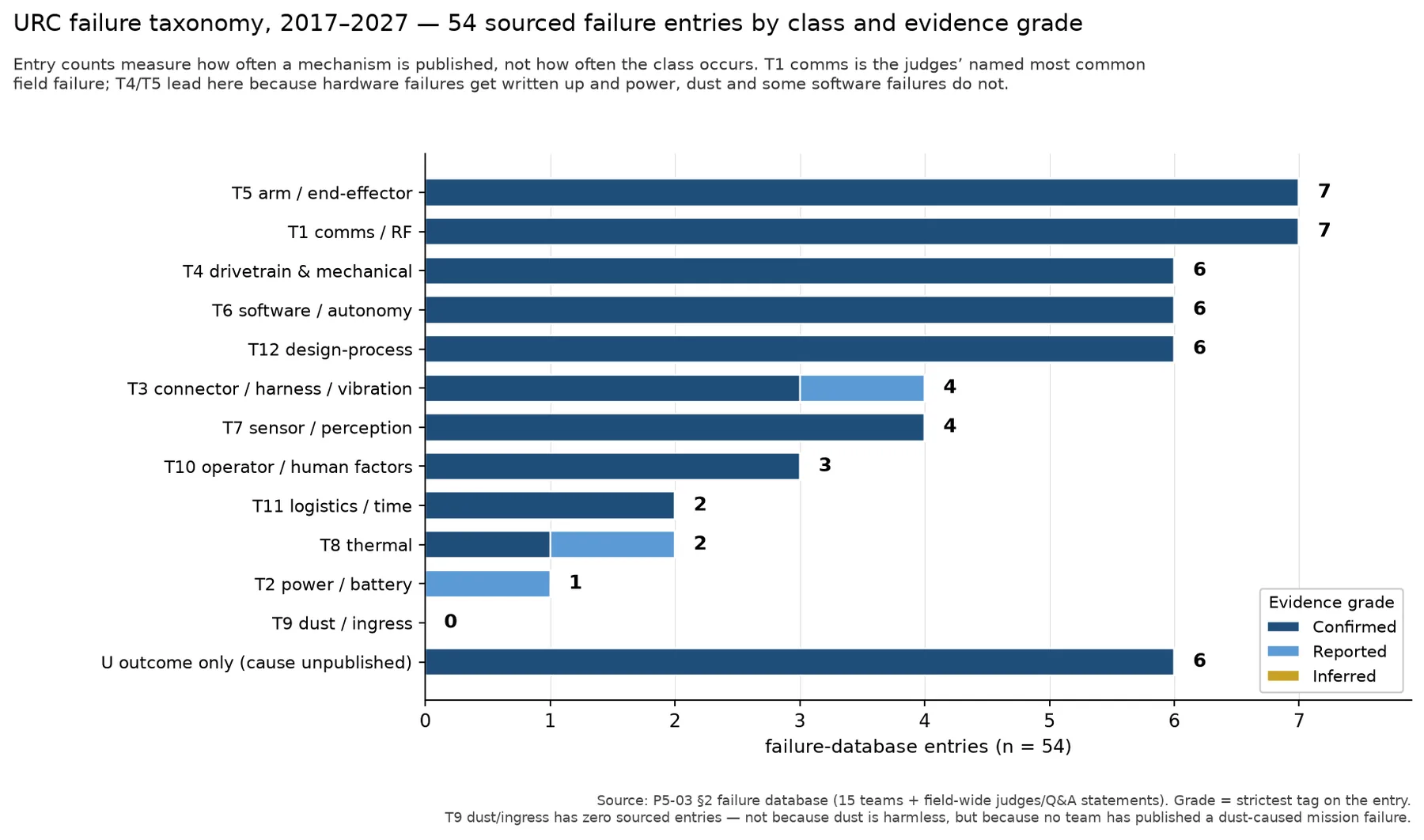
The count measures publication, not occurrence
The class with the most entries is not the class the judges name. The arm class and the comms class tie at seven. That is not evidence that the arm breaks as often as the link, because the judges state that comms is “far and away the most common problem that stops a team from being a top contender” S-URC-ADVICE. It is evidence of which failures get written up: a team explains a broken gearbox because it redesigned the gearbox, and explains a loose connector less often because the fix was a cable tie in a car park.
The same caution applies to the thin rows. Power has one sourced electrical failure in five years and dust has none at all, despite every subsystem study recommending sealed bearings, rated connectors and protected lenses. Two readings are possible and the data cannot separate them: those failures are rare, or they are fatal and under-published. Given that the judges describe rovers dying from a loose wire as routine, the second reading is at least as likely. The design consequence is to build to the mechanism rather than to the count.
Three further caveats belong with every percentage below. The database is a publication census rather than an incident census. Three teams account for 24 of the 54 entries because they are the best documented, and the zero rates are an upper bound on failure frequency and a lower bound on capability gaps.
The zero-score record
| Year | n | Science zeros | Delivery zeros | Servicing zeros | Autonomy zeros |
|---|---|---|---|---|---|
| 2022 | 26 | 0 | 8 (31 %) | 6 (23 %) | 12 (46 %) |
| 2023 | 31 | 0 | 2 (6 %) | 7 (23 %) | 15 (48 %) |
| 2024 | 34 | 0 | 2 (6 %) | 5 (15 %) | 17 (50 %) |
| 2025 | 35 | 0 | 1 (3 %) | 4 (11 %) | 7 (20 %) |
| 2026 | 36 | 0 | 12 (33 %) | 5 (14 %) | 16 (44 %) |
| Pooled | 162 | 0 | 25 (15.4 %) | 27 (16.7 %) | 67 (41.4 %) |
Multiplying each zero rate by the mean non-zero score in that mission, 27.9 for Delivery, 36.3 for servicing and 45.5 for autonomy, gives the field’s points forgone: about 945 mission points a year, of which about 610 are autonomy, 196 servicing and 140 Delivery S-URC22-SCORES S-URC23-SCORES S-URC24-SCORES S-URC25-SCORES S-URC26-SCORES. It is an upper bound, because a team that scored zero might have scored below the mean rather than at it.
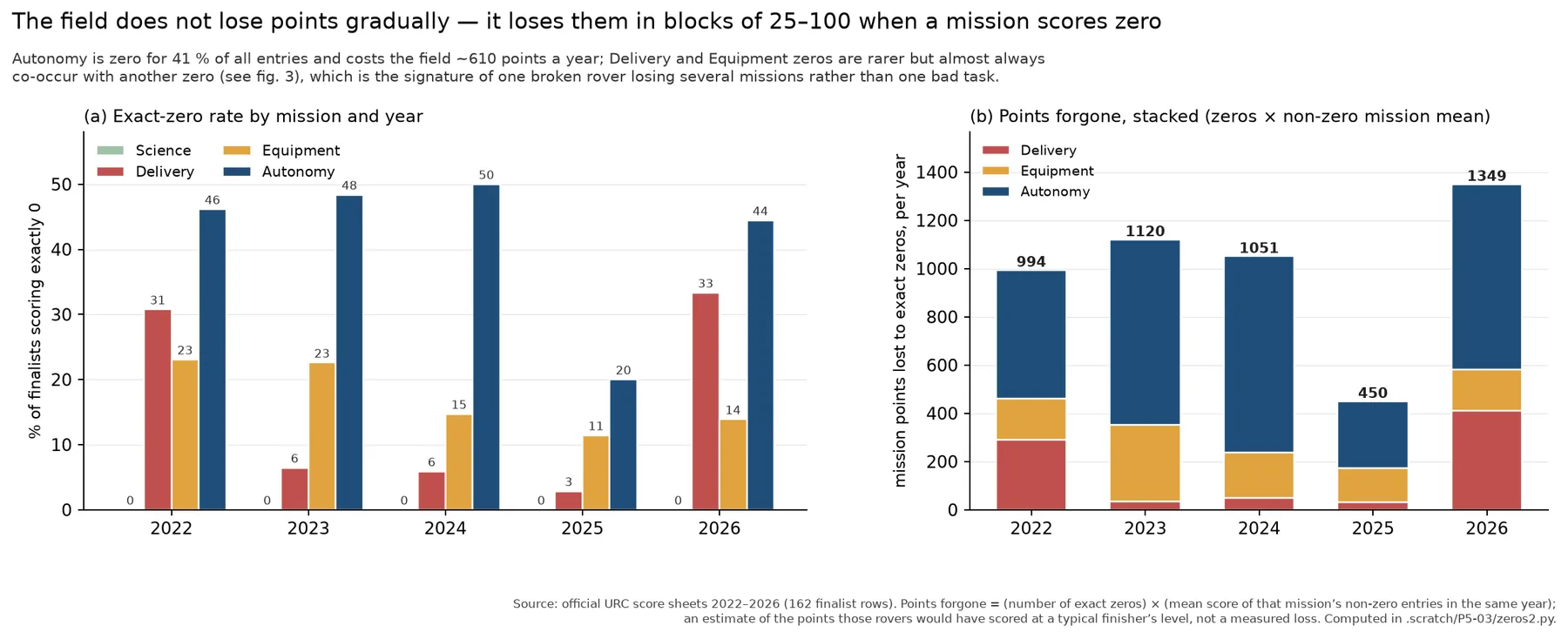
Science has scored no zero since 2022, and the review element has never explained more than 5.7 % of the spread in nine years. The 300 points in Delivery, servicing and autonomy are where the field is decided, and all three are all-or-nothing for a substantial share of teams.
What the zeros are made of
If the three missions failed independently, servicing and Delivery zeros would coincide in about 2.6 % of team-years. The observed count is 12 of 162, or 7.4 %, 2.9 times the independent expectation.
| Conditional rate | Observed | Base rate | Lift |
|---|---|---|---|
| Delivery zero given a servicing zero | 44 % | 15 % | 2.9× |
| Autonomy zero given a servicing zero | 85 % | 41 % | 2.1× |
| Autonomy zeros that were the team’s only zero | 58 % (39 of 67) | No base rate applies | Capability gap |
| Servicing zeros that were the team’s only zero | 11 % (3 of 27) | No base rate applies | Rover-level failure |
Twenty-nine of 162 team-years had two or more zeros and eleven had three or more. Those are the rover-level failures, and they are where the one broken rover story lives. The isolated autonomy zero is the opposite case: the rover drove, serviced and sampled, then scored nothing when it had to drive itself.
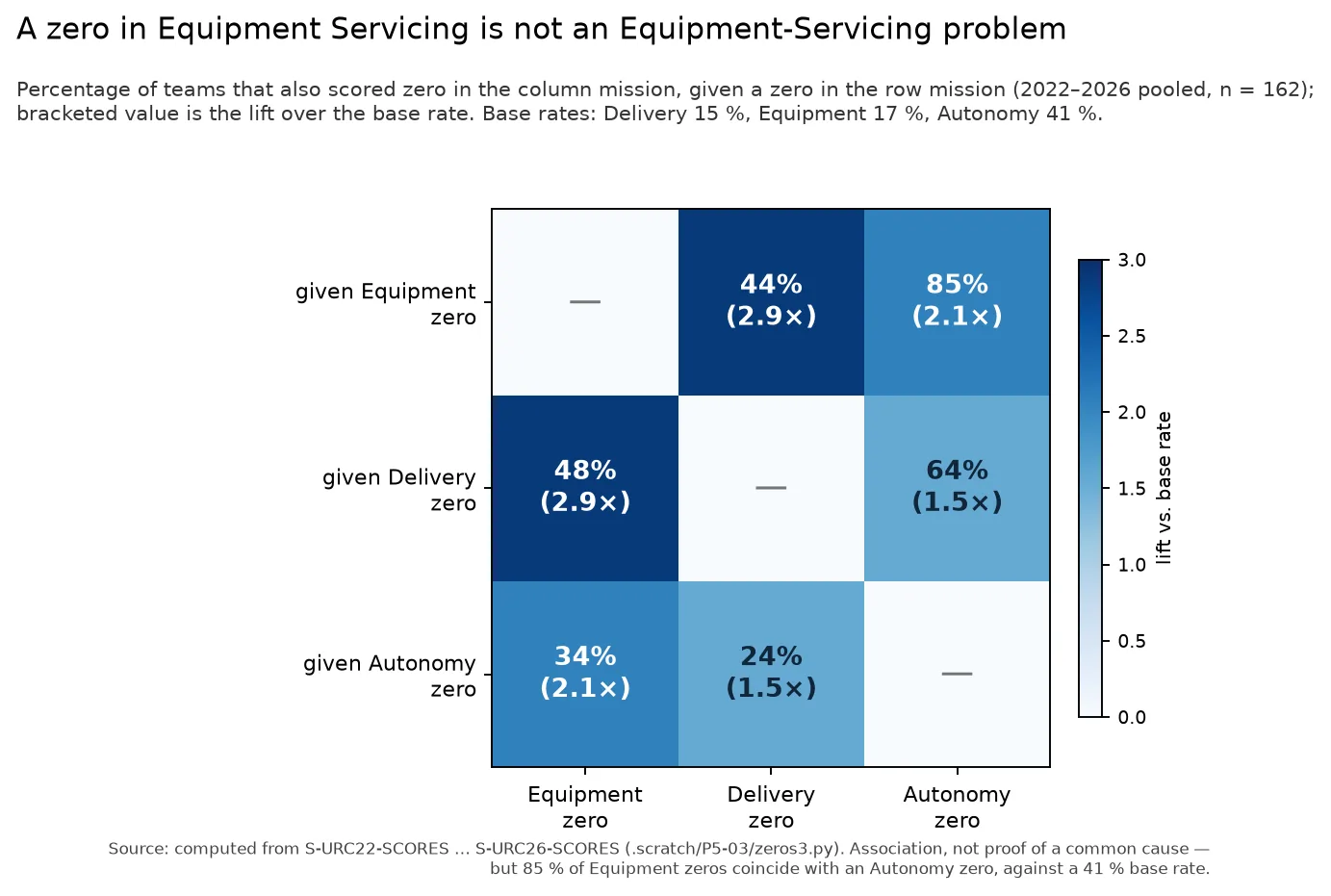
That produces two failure economies with different investments. The blocks of 100 are drivetrain, power, connectors and the arm as a single point: they cost several missions at once and are bought off with redundancy, retention and test. The recurring 45 is autonomy, a capability 41 % of the field never demonstrates, bought with one simple planner that finishes. A first-season team that fixes the first and ignores the second lands near the median of about 230–260 points S-URC-RESULTS.
The decision behind each class, and the cheapest fix
Each row names the design decision that makes the class likely, not the component that broke. Cost is relative within this table only.
| Class | The decision that makes it likely | The mechanism | Cheapest design change | The test that reveals it | Cost |
|---|---|---|---|---|---|
| T1 comms | A link added late, sized by free-space loss at line of sight, with one radio and no mast | Terrain diffraction collapses range: measured 850 to 300 m, and 750 to 164 m | Radio at the mast, a 900 MHz recovery plane on its own antenna, a rehearsed behaviour on loss of link | Drive the full course out of sight and log signal strength and packet loss | $$$ |
| T2 power | A pack sized to energy and not to sag, with the trip current below the sum of legitimate stall currents | An 8S4P pack sags about 4.6 V at 145 A; a two-joint arm stall looks like a fault | Per-joint current limit, brakes so holding is free, wide-input converters | Log bus voltage at 100 Hz through a simultaneous climb and arm stall | $$ |
| T3 connectors | Hobby-grade connectors on an exterior harness with no strain relief and no post-transport check | Vibration work-hardens crimps; one damaged USB-C cable took out cameras and two motors in 2026 | Latched rated connectors, service loops, one connector maximum in any safety path, a post-transport check | Shake the packaged rover for 30 minutes, then power on every peripheral | $ |
| T4 drivetrain | Single-shear joints, one fastener per wheel, no secondary retention | Shock loads at a rock impact are 3–10 times static | Bolted flange and a retention ring on every wheel, double shear on every load path | Drop 0.5 m onto one wheel and drive 20 km of rock field, then check fasteners | $ |
| T5 arm | An arm designed for static, table-top loads with no absolute encoders and no current limit | The arm that scored 94 in servicing failed under driving loads; belts slip; a lost zero needs a re-home | Absolute encoder on every joint, belt tensioner and spare, current clamp, lift before retract | Drive 500 m with the arm in carry pose, then run servicing without re-homing | $$$ |
| T6 autonomy | The planner with the best paper performance, changed in the season it must work, with no progress monitor | Monash went 0, 14 and 86 across 2024 to 2026 by simplifying | One conservative planner, a progress checker, bounded recovery, a keep-out halo around posts | Ten full-length autonomy runs from cold boot; count completed gates | $ |
| T7 perception | One camera, fixed exposure, one tag scale, no yaw search at the waypoint | A tag needs about 18–24 pixels to decode, and sun, dust and edge-on geometry remove it | Sunshade on every camera, exposure bracketing, slow yaw search at the waypoint, a second wide camera | Arrive with the sun behind the tag and the tag edge-on; require detection within 30 s | $ |
| T8 thermal | Sealing the electronics in a black box and sizing cooling on a fan on the lid, with no temperature telemetry | 40 W in a sealed box at 38 °C ambient implies about 77 °C internal without forced air | Size for sustained mode, filtered inlet and fan, white skin, log die temperature with an alarm | A 40-minute run at 40 °C in direct sun under full autonomy load | $$ |
| T9 dust | Component ingress ratings treated as a system guarantee, no lens protection, filter behind the fan | Clay dust bridges contacts and blinds encoder windows, and each failure looks like software | Recessed lens with a sacrificial window, contactless encoders, external filter with access, drip loops | A two-hour dust loop, then inspect every connector and re-run calibration | $ |
| T10 operator | The person holding the clock also driving, with no tilt limit and no geofence | Rovers have been driven into gulleys and flipped; a close approach invites an astronaut E-stop | Low centre of gravity, wide track, a tilt limit in firmware, a commander who never touches a control | Ten field trials with a stopped clock and an abort decision called aloud | $ |
| T11 logistics | Building until the week before, an unrehearsed setup order, no freeze date | A slipped arm bought a year late; stage gates convert a slow start into a fixed low score | Order by long-lead date, an eight-minute setup drill, a freeze six weeks out, spares traced to the failure list | A full dress rehearsal with setup, both missions and teardown, timed | $$ |
| T12 design process | Changing the architecture in the season it must win, testing at the event, treating the review as paperwork | Three of the four largest single-year losses follow a whole-system change | One system per season, a dated freeze, a known-good tag | A log showing each mission run end to end before departure | $ |
The root cause in one line: rovers fail where a single element is load-bearing and untested under field loads. The field under-tests exactly those elements, because testing them is boring, slow and happens in a car park rather than a laboratory.
The four load-bearing single points
The lift matrix says a servicing zero drags Delivery and autonomy with it, so reliability effort belongs on the elements that can zero three missions at once.
| Single point | What it does | The evidence | The mitigation |
|---|---|---|---|
| Wheel retention | Loses the drivetrain, and therefore every mission | BYU lost wheel mounts and fixed the symptom trackside with ties around the rims S-BYU-2025-SAR | Bolted flange, secondary retention ring, double shear, nothing below the contact plane |
| The connector in the safety path | Kills the rover or silently disables the E-stop | A damaged USB-C cable cost WVU 45 points of servicing and cascaded to cameras and two motors S-WVU-NEWS2026 | One connector maximum in the safety path, lockwire, continuity check every field day |
| Pack sag under peak current | Browns out the computer mid-run and loses the logs | A 156 A legitimate peak against an 80 A trip at 10 ms, and a published 3 s auto-restore S-MST-2023-POWER | Size for sag, a trip with a delay, converters rated below the sagged voltage, bulk capacitance |
| The arm’s joint zero | Makes servicing and typing impossible without a re-home | A power glitch leaves the arm without a reference, and a re-home under time pressure can cost a mission | Absolute encoders or backed-up counters, the last pose in memory, a hands-off homing routine |
The FMEA tripwires that follow from these rows are FMEA-02, the connector, at 560; FMEA-06, pack sag, at 384; FMEA-05, spectrum congestion, at 336; FMEA-16, the arm zero, at 336; and FMEA-20, the one-metre arrival, at 294. FMEA-31, an untested feature shipped the week before the event, is also at 294 and is the row that creates the others.
Failure modes the 2027 rules add
No team has hit these yet, because the task did not exist in this form. They belong in the failure list before the field discovers them.
| 2027 change | The failure mode nobody has hit | Why it is newly possible | The cheapest countermeasure |
|---|---|---|---|
| A bioassay is mandatory, with two life-detection capabilities and at least one bioassay | An assay that runs but cannot answer the life question, a chemistry demonstration rather than a bioassay | Chemical methods alone do not satisfy the requirement, and a dry instrument is no longer enough | A room-temperature assay with a documented positive and negative control, justified before the SAR |
| Wet chemistry on every science payload | A leak in motion, or a waste path that spills when the rover tilts | The no-spill rule now binds on the scoring path, in a desert with limited water | Closed fluid path, sealed waste, an inversion test with power off, a drip tray |
| Astronaut following, graded by command modality | A modality that works at 3 m but not at the 20 m the judges use, or a gesture fired by a bystander | Detection range is a hard requirement in daylight, and quiet is required for the gesture path | Audio as the primary, device as backup, gesture only after outdoor testing |
| One-metre route-finding accuracy | Arriving but stopping 1.1 m out, or a base-coordinate error that puts both targets off by a metre | Two targets at 25 points each, and the tag must also be read to indicate arrival | Own base station surveyed the day before, terminal approach at 0.3 m/s, stop at 0.6 m and hold |
| The second route target is deliberately out of radio sight | The rover stops dead behind the hill, and the recovery routes eat the score | Loss of line of sight is designed into the mission rather than incidental | Autonomous return as a planned behaviour, rehearsed with the recovery radio off |
| Servicing may begin ten minutes after another mission | Thermal and state carry-over: a hot arm, a pack at 40 %, the previous mode still latched | Back-to-back scheduling removes the cool-down that teams assume | A between-missions checklist in eight minutes, rehearsed as a pair |
What a first build should do first
- The reliability budget belongs on the failure that zeroes three missions, not on the one that costs a task. The four single points above are the whole first season’s effort, and each is a small change compared with a redesign.
- The rover should be instrumented before the evidence is needed. No team publishes measured link, thermal or bus data. Signal strength, bus voltage at 100 Hz and enclosure temperature with an alarm turn every field day into data.
- Autonomy points are cheaper with simplicity than with sophistication. The cleanest natural experiment in the dataset is Monash’s autonomy score of 0 in 2024, 14 in 2025 and 86 in 2026, with the last step explicitly a simplification S-MONASH-SAR2025 S-MONASH-SAR2026. One planner, a progress checker, bounded recovery and ten cold-boot full runs beat a better algorithm.
- The transport leg is a mission of its own. The judges name it, Michigan found damaged parts on arrival and IIT Madras found a burned board S-UMICH-AERO-2026 S-IITM-URC2017-REPORT. A packaged shake test and a post-arrival check are the cheapest reliability measures available.
- The freeze date is written down before travel. Design-process entries appear at every level of the field, and three of the four largest single-year losses follow a whole-system change.
- Recovery is rehearsed as well as success. WVU’s requirement that each operator train at least 30 hours turned a damaged cable into 22.5 points instead of a zero S-WVU-NEWS2026.
Open problems
- The database is a census of write-ups. Fifty-four entries from 15 teams against 162 finals team-years in five years means absence of an entry is absence of documentation, not absence of failure.
- The zero-to-cause link is an association. The lift matrix cannot separate one broken rover from one team that had a bad weekend; a published intervention log would settle it in one table.
- Three teams supply 24 of the 54 entries, which is a documentation bias rather than a claim that those programmes fail more.
- No team publishes measured thermal, link or bus data, so the thermal and electrical classes are argued from mechanism rather than from field measurement.
- A new failure mode appears with each rule change, and the 2027 bioassay and astronaut tasks need wet rehearsal and a suited trial, neither of which can be arranged at short notice.
Further reading
- Mass and power carries the pack sag and the peak-current chain behind the power failures.
- Interfaces and couplings explains why a connector in the safety path is an interface rather than a component.
- Risk register turns these classes into a ranked register.
- Environment, dust and thermal covers the classes the field documents least.
- Missouri S&T, Monash and WVU hold the best-documented loss records.
Sources for this page
- S-URC-ADVICEURC Advice (judges' systems-engineering lessons)Original Archived copy
- S-WVU-NEWS2026WVU robotics team places fourth overall, earns top marks at international University Rover ChallengeOriginal
- S-URC22-SCORESURC2022 Official ScoresOriginal
- S-URC26-SCORESURC2026 Official ScoresOriginal Archived copy
- S-URC23-SCORESURC2023 Official ScoresOriginal
- S-URC24-SCORESURC2024 Official ScoresOriginal
- S-URC25-SCORESURC2025 Official ScoresOriginal
- S-URC-RESULTSURC official scores 2022–2026, compiled CSVPrint copy
- S-BYU-2025-SARBYU Mars Rover, SAR 2025 (video; rocker-bogie, custom PU treads, wheel-mount failure and zip-tie reinforcement)Original
- S-MST-2023-POWERRemote Power System Monitoring and Management of a Teleoperated Mars Rover (ITC 2023)Original
- S-MONASH-SAR2025Monash Nova Rover, URC SAR 2025 (video, 5:00)Original
- S-MONASH-SAR2026Monash Nova Rover, URC SAR 2026 (video, 5:09)Original
- S-UMICH-AERO-2026"MRover Student Team Takes Inaugural Award at International Competition" (includes the INCOSE judges' comment on the winner)Original
- S-IITM-URC2017-REPORTTeam Anveshak, URC 2017 report (team post-mortem; failures and improvised repairs)Original