Where the competition is going
The 2027 rover must do more than the 2019 rover inside the same 50 kg, the same 1.2 m cube and the same off-grid field. That is the shape of the competition’s history: the physical envelope froze, the scored content inside it kept moving, and the median score has not improved for five years. This page plots the quantitative record from 2013 to 2026, separates what is frozen from what moves one way and what churns every season, and states a labelled outlook to 2030.
Key takeaways
- The physical envelope has not moved since 2019: 50 kg per deployed configuration, a 1.2 m cube and a 70 kg fielded limit. A 40 % oversize penalty is larger than the winner-to-median gap in most years.
- The top is separating and the median is not. The last five medians sit inside a 33-point band; the winning total rose from 389.0 to 469.6.
- Difficulty is concentrated rather than drifting. Delivery, Equipment Servicing and Autonomy carry zero shares of 15.4 %, 16.7 % and 41.4 %, and together they explain 82.6 % of the variance; the review carries a 0 % zero share and 2.8 % of the variance.
- Every 2027 capability change lands on the three missions that are already bimodal, which is why the scope decision outweighs the architecture decision.
The series and what it cannot support
The series covers eleven comparable editions: 2013 to 2019, excluding 2016, taken from the archived official score pages, and 2022 to 2026 from the official score spreadsheets S-URC13-SCORES S-URC14-SCORES S-URC15-SCORES S-URC17-SCORES S-URC18-SCORES S-URC19-SCORES S-URC22-SCORES S-URC23-SCORES S-URC24-SCORES S-URC25-SCORES S-URC26-SCORES. No finals were held in 2020 or 2021 S-URC-HISTORY.
Four limits apply to every number on this page. Cross-era pooling is invalid: the 2013 to 2016 tasks were different objects under different scoring, and those totals include a scored presentation, so each series is read year by year and never as an average since 2013. 2016 ran two brackets, with winners on 452.3 and 255.0, and is excluded from every line S-URC16-SCORES. The score sheet is not the registration list: the 2022 to 2026 sheets hold 36 to 38 rows against 99 to 116 registrants. And a change in difficulty cannot be separated from a change in who was in the field, so no causal claim rests on a single year’s move.
The top is separating, the median is not
| Year | n | Winner | Median | SD | Winner − median |
|---|---|---|---|---|---|
| 2013 | 10 | 492.8 | 206.5 | 115.3 | 286.3 |
| 2014 | 23 | 368.0 | 187.0 | 81.1 | 181.0 |
| 2015 | 23 | 460.0 | 228.0 | 108.4 | 232.0 |
| 2017 | 36 | 403.4 | 194.7 | 75.0 | 208.8 |
| 2018 | 36 | 374.2 | 205.5 | 61.5 | 168.7 |
| 2019 | 36 | 362.9 | 222.4 | 66.2 | 140.5 |
| 2022 | 26 | 389.0 | 233.6 | 71.6 | 155.3 |
| 2023 | 31 | 425.4 | 253.0 | 73.9 | 172.3 |
| 2024 | 34 | 392.8 | 246.8 | 65.1 | 146.0 |
| 2025 | 35 | 412.3 | 257.8 | 65.6 | 154.5 |
| 2026 | 36 | 469.6 | 224.6 | 84.6 | 245.0 |
Totals out of 500. 2016 is omitted because it ran two non-comparable brackets.
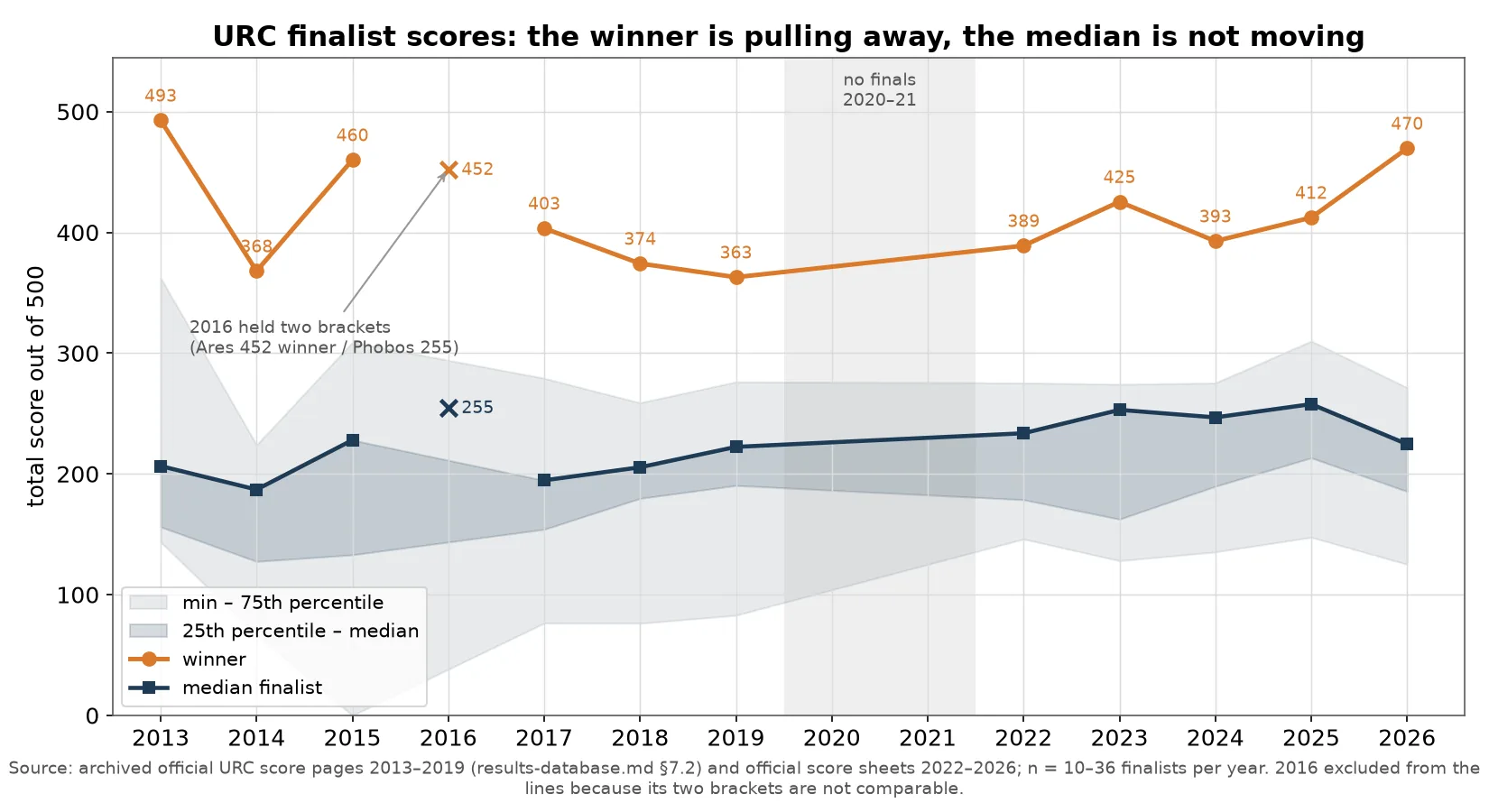
Fitted over 2017 to 2026, the median rises 5.2 points a year (R² = 0.61) and the winner 6.7 (R² = 0.46), but the last five medians sit inside a 33-point band with no monotone trend and the 2026 median is 30 points below its own fit line. The defensible statement is that the top is separating, not that the field is improving. The winning margin is noise rather than trend: first-to-second gaps across the modern era run 67.1, 35.2, 33.4, 8.4, 70.5, 1.0, 16.1 and 57.2 points, so a single good or bad run still decides a title.
The last-place total is a reliability statistic, not a capability measure. It runs 125.1 to 147.5 across 2022 to 2026, and the 2015 low of 0.0 is a team that scored only its presentation. The 2013 total of 492.8 is also not a high-water mark: ten teams, five tasks, and one team scoring 100 on four of the five S-URC13-SCORES.
Mission means are static while the review rises
| Mission family | 2013–15 (n = 55) | 2017–19 (n = 106) | 2022–26 (n = 162) | Direction |
|---|---|---|---|---|
| Science | 66.8 | 77.3 | 76.9 | one step up, then flat for nine years |
| Delivery | 16.5 | 26.9 | 23.6 | low and stuck |
| Servicing | 29.3 | 24.6 | 30.3 | flat, very wide (SD 22–34) |
| Autonomy | not a mission | 11.0 | 26.7 | new in 2017, up 143 % since |
| Review | 80.4 | 84.3 | 88.9 | up, and tighter |
Means per family, with renamed tasks mapped onto a common line: Sample Return and Science Cache to Science, Astronaut Assistance and Extreme Retrieval and Delivery to Delivery, CDR and SAR to Review. Autonomy did not exist before 2017, and the 2013 to 2015 presentation is the review’s predecessor.
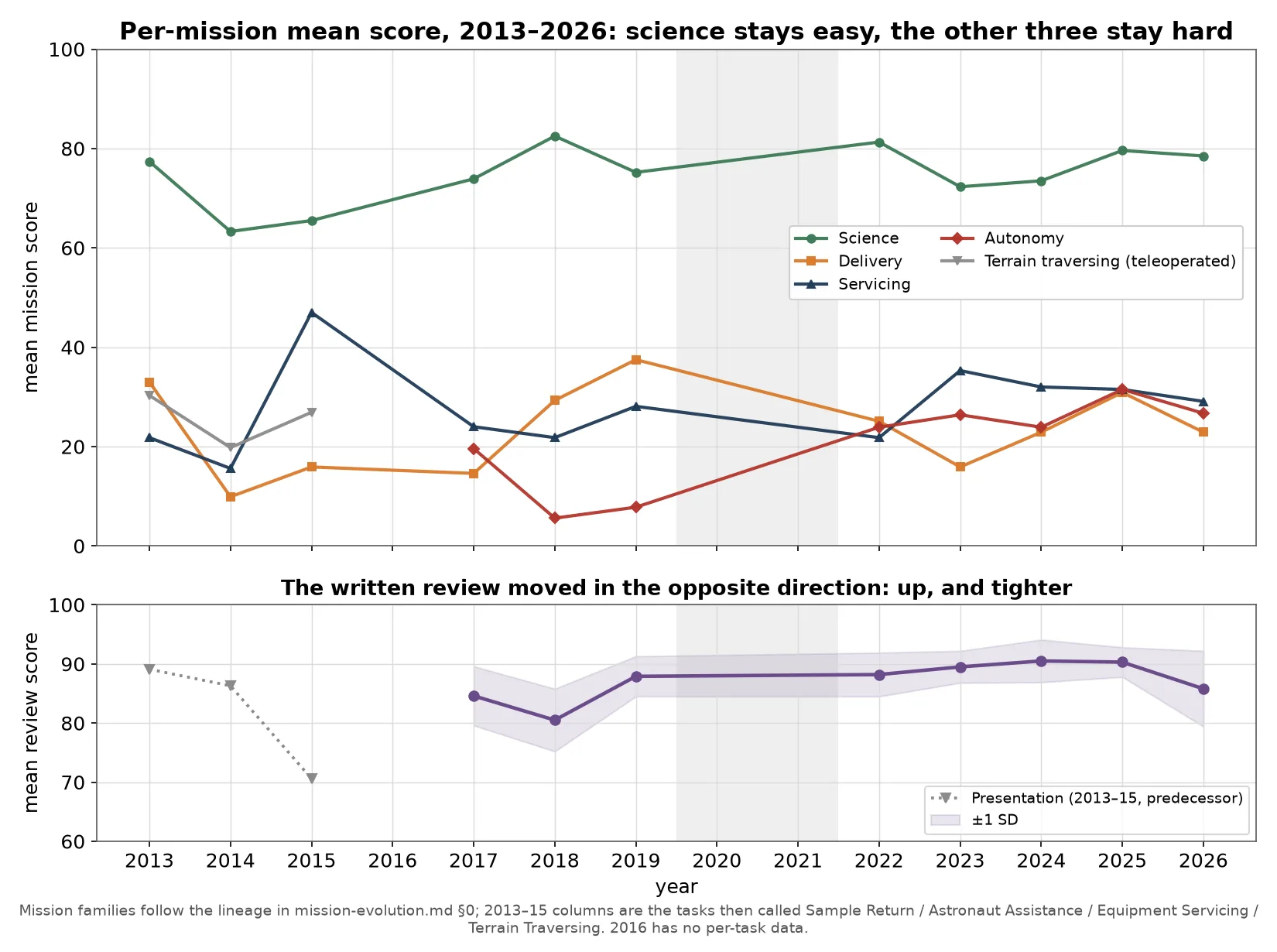
The review has become the most generous and most compressed component. Its 2022 to 2026 mean is 88.9 with a standard deviation of 4.5, 95 % of finalists clear 80 and none score zero; the mission standard deviations are 16 to 28. It has never explained more than 5.7 % of the spread of final scores in nine years, and 2.8 % pooled over 2022 to 2026 S-URC-RESULTS. It gates entry and contributes 100 points, and once a team is in the field it does not predict position. The review is a gate that can lose a season and cannot win one. The 2026 re-base is the one exception to the compression: the mean fell from 90.3 to 85.8, the standard deviation rose from 2.5 to 6.4, and it was the first year since 2018 that fewer than 95 % of finalists cleared 80.
Difficulty is concentrated, not rising
Pooled over 2022 to 2026, the zero shares are 0 % for Science, 15.4 % for Delivery, 16.7 % for Equipment Servicing and 41.4 % for Autonomy. Delivery, Servicing and Autonomy therefore carry 300 points that are all-or-nothing, and they explain 82.6 % of the variance in final totals; the review’s 100 points explain 2.8 % S-URC-RESULTS.
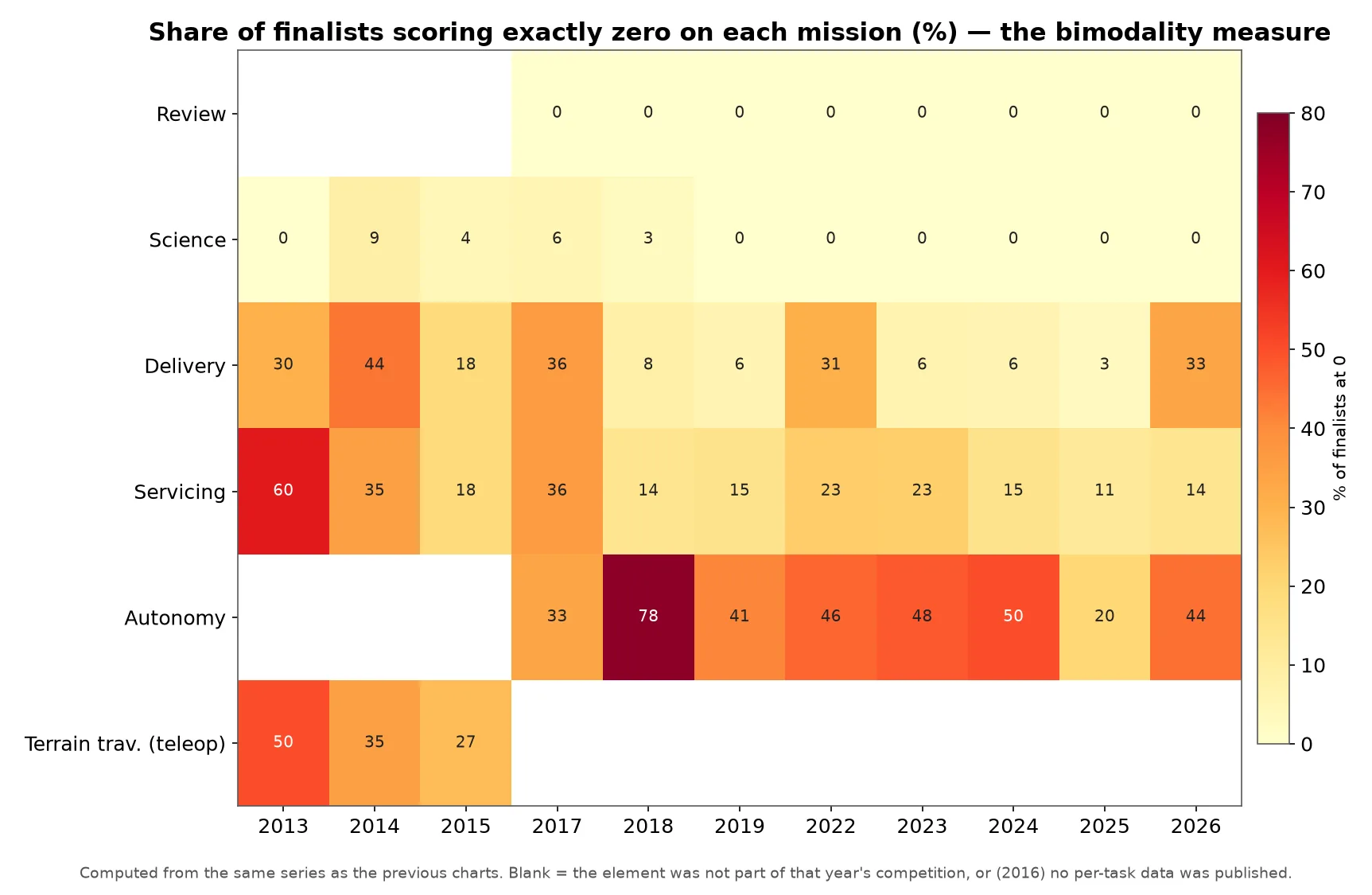
Autonomy is the hardest mission and it improves slowly. Its zero share was 51 % pooled over 2017 to 2019 and 41 % pooled over 2022 to 2026, but 2026 rebounded to 44 % after a 2025 low of 20 %, and only 14 % of the 2026 field cleared 80. A high zero share is a joint product of task difficulty, an all-or-nothing scoring rule and course design, so the measure is not difficulty alone. The 2018 result of 78 % zeros followed the first full year of a scored autonomy mission, and 2027 replaces more of the mission than 2018 did, so 2018 is the closest available comparison rather than a prediction.
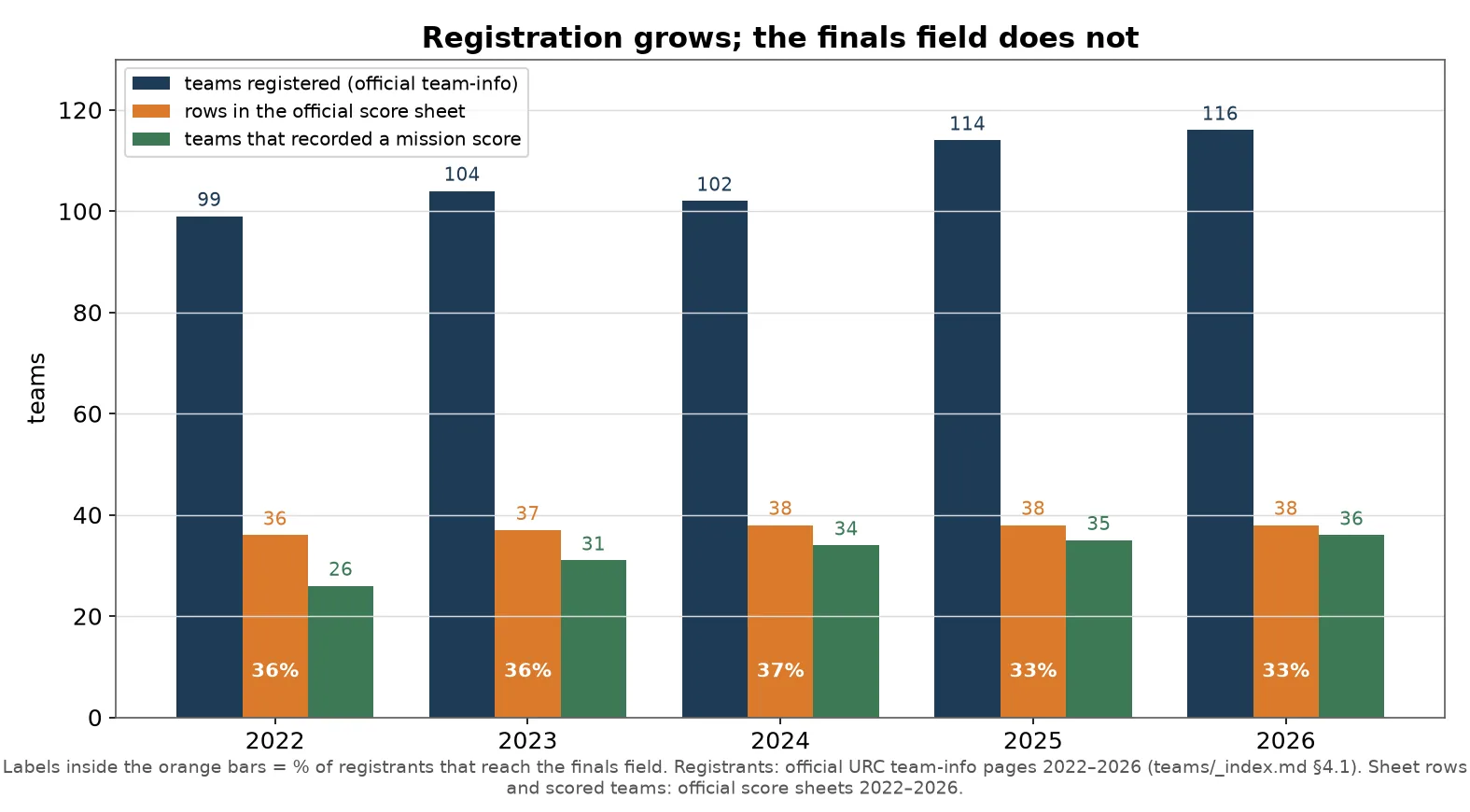
The funnel is narrowing
| Year | Registered | Score-sheet rows | Recorded a mission score | Rows ÷ registered |
|---|---|---|---|---|
| 2022 | 99 | 36 | 26 | 36 % |
| 2023 | 104 | 37 | 31 | 36 % |
| 2024 | 102 | 38 | 34 | 37 % |
| 2025 | 114 | 38 | 35 | 33 % |
| 2026 | 116 | 38 | 36 | 33 % |
Registrations from S-URC22-TEAMS S-URC23-TEAMS S-URC24-TEAMS S-URC25-TEAMS S-URC26-TEAMS; sheet rows and scored teams from the official score spreadsheets.
Registration grew 17 % in four years while the finals field stayed at 36 to 38 rows and the top-36 cut has been unchanged since 2019 S-URC19-RULES S-URC27-RULES §1.a.iii §3.a.iii. The funnel therefore narrowed from about 2.8 to 1 to about 3.1 to 1. Between 33 % and 37 % of registrants appear in the score sheet at all, and the number that recorded a mission score grew from 26 to 36 while the field itself stabilised.
The field is also narrower than the registrant base. It is drawn from 10 country labels in 2022 to 2025 and 12 in 2026, against 15 registered countries in 2022 S-URC22-TEAMS S-URC-RESULTS. The United States share of the field runs 29 % to 45 % and fell in team count from 2024 to 2026, while the United States mean total of 264.4 is barely above Poland’s 266.3. Making the field is the hard part; once there, the United States advantage is headcount, not performance. Registrations before 2022 were not recovered, so any claim that the competition used to be easier to enter is unsupported.
The envelope has not moved since 2019
Three rules set the physical design, and none has changed in eight years or more:
- 50 kg per deployed configuration, with a penalty of 5 % of the points scored per kilogram over, rounded down, since 2011 S-URC07-RULES-L1 S-URC11-RULES S-URC27-RULES §2.b §2.a.iii.
- 70 kg of fielded equipment, in force from 2015 S-URC15-RULES S-URC27-RULES §2.a.iii.
- A 1.2 m cube at weigh-in, in any orientation, including wheels and antenna, with folding allowed and disassembly not, and a 40 % penalty for exceeding it, in force from 2019 S-URC19-RULES S-URC27-RULES §2.a.ii §2.a.ii.
The cube is the most consequential mechanical rule for a new team, because 40 % of a 400-point score is 160 points, more than the median-to-winner gap in most years of the series (140.5 to 245.0 in the modern era). A rover that is excellent and 1.3 m long scores 60 % of what it earns. The 2027 rover is the 2019 rover’s envelope with 2027’s perception and sample handling inside it, and that is the strongest single predictive statement about any design decision made now.
What moves inside the envelope
Autonomy: from optional to a human-centred mission
Autonomy was not a scored requirement before 2017: the early rulebooks say the rover need not be autonomous at all, and the 2017 text still limits the requirement to the new Autonomous Traversal task S-URC07-RULES-L1 S-URC15-RULES S-URC17-RULES §2.c. The 100-point mission arrived in 2017, the same year the CDR became scored. It ran on staged legs between physical markers from 2019, with the most explicit per-leg partial-credit scale URC has published in 2021, then on AR-tag waypoints and object recognition at 3 m and 2 m tolerances from 2022 S-URC19-RULES S-URC21-RULES S-URC26-RULES §3.e §3.e §1.f. 2027 replaces the course with two 50-point sub-missions, astronaut assistance and route-finding to two AR posts at 1 m tolerance S-URC27-RULES §1.e.
The technical content of the change is the modality ladder. One 15-point Follow task pays 5 for a carried command device, 5 for a visual sign, 10 for a spoken word and 15 for a silently given beckoning gesture S-URC27-RULES §1.e.vi. That is a perception problem, audio and gesture classification from a rover several metres away, replacing a radio problem, and it is the first time the rules have made the command modality itself worth points.
Science: three rewrites in five years
Science was rewritten from a presentation task to a cache-selection task in 2023, and the mean fell from 81.3 to 72.3 with the share above 80 falling from 50 % to 42 %. The 2024 rewrite changed everything at once: 10 cm depth, 5 g minimum, a sealed cache, a two-site comparison and a mandatory stratigraphic profile. The mean held at 73.5 but only one team reached 90 and the share above 80 fell from 42 % to 24 %, the lowest in the series. The 2027 rules demand two life-detection capabilities with at least one bioassay and delete the stratigraphic profile S-URC27-RULES §1.b. There is no 2027 result to measure; the closest analogue is 2024, when a comparable rewrite depressed the share above 80 by 18 points for one year before teams learned the task.
Communications: harder every year, in three ways
Spectrum scope has widened monotonically. The 900 MHz Low, Mid and High sub-band scheme with an 8 MHz maximum dates from 2014, 2025 removed the 2.4 GHz restrictions in the only relaxation in the record, and 2027 extends the 900 MHz rule from the command station and rover to every link between the station, rover, drone and astronaut, including the suit’s video and audio, inside the same 8 MHz S-URC14-RULES S-URC25-RULES S-URC27-RULES §3.b §3.b.vi §2.c.v. Line-of-sight guarantees have shrunk over the same period: 2026 promised line of sight for Science, Equipment Servicing and Autonomous Navigation and “not more than 50 %” for Delivery, while 2027 keeps it only for Astrobiology and Equipment, says autonomy is likely not line of sight and makes later Delivery tasks intentionally obstructed S-URC26-RULES S-URC27-RULES §2.b §3.d.ii. And the operating window has not grown while the equipment count has: command-station setup fell from 25 minutes to 15 by 2017 and stayed there, while the deployed equipment grew to include a 900 MHz link, a 25 m cable run, a drone and, in 2027, a suited astronaut with video and audio S-URC11-RULES S-URC27-RULES S-URC27-RULES §3.g §1.a.ii §3.e.viii.
The drone: consulted, then regulated for five years
The drone entered as an optional, unscored demonstration in 2022, when the rules invited teams to comment on making it a scored event S-URC22-RULES S-URC22-RULES §4.a §4.g. In 2023 it could fly instead of the rover in autonomy S-URC23-RULES. From 2024 to 2026 it was a Delivery assistant, launched from the rover or from a start location near the command station S-URC26-RULES §1.d.iv. In 2027 it moves from the Delivery mission to the equipment regulations, launches only from a designated pad, carries an unwaivable dummy mass within a 5 kg allowance, and an airframe over 5 kg “will not be permitted to be used” S-URC27-RULES §2.b. The five-year direction is tightening, not loosening, and the drone is a strategic option rather than a default: it can help on two of four missions and it costs 5 kg of the 50 kg limit, an airframe, a pilot, a spotter and pad discipline.
Documentation: from a presentation to a hard gate
The review element has been redesigned more often than any mission. A video presentation carried 100 points from 2011 to 2014; the 2015 CDR was pass-fail; the 2017 CDR was scored at 100 of 500; 2018 renamed it the SAR and added the PDR; and the top-36 cut has stood since 2019 S-URC15-RULES S-URC17-RULES S-URC18-RULES S-URC19-RULES §1.h.iii §3.a.ii §1.i §1.a.iii. Three consequences are still true in 2027. Documentation is a fifth mission worth as much as any field mission, and it gates the other 400 points. The documentation load grows as documents rather than as points: 2027 adds a dated Astrobiology Plan due 2027-05-21 and a communications document due 2027-04-30 on top of the PDR, the SAR and the expense report S-URC27-RULES S-URC27-RULES S-URC27-RULES §1.b.i §2.c.iv §3.c.ix. And the rubric rewards specific artefacts, with the science page worth about 15 % of the SAR report and the payload 6 % of its video S-URC26-SAR.
The object list churns every year
Six Equipment Servicing sub-tasks have been introduced and then deleted inside eight years, and three of the 2027 tasks are new in 2026 or 2027. The keyed tubular pin-tumbler lock, in which a key is removed, inserted into a second lock and turned, appears in 2027 only, and the insertion it replaced, a USB-C cable, is gone S-URC19-RULES S-URC22-RULES S-URC26-RULES S-URC27-RULES §3.d §3.d.i §1.e.ii §1.d.ii. What recurs every year is the underlying skill set: reach 1.5 m to ground level, grasp a 5 to 10 cm object, apply torque, insert something and read a 1 to 2 cm fiducial marker. The Delivery grasp feature has also widened from 5 cm in 2018 to 2025 to 7.5 cm in 2026 and 2027, and the rules now say objects will come in a variety of sizes, shapes and weights S-URC26-RULES S-URC27-RULES §1.c.iii §1.c.iii. The competition is telling teams that its objects are becoming less predictable, not more.
What 2027 changes
| 2027 change | What the rule says | What it forces on the design |
|---|---|---|
| Bioassay mandatory | Two life-detection capabilities, at least one a bioassay S-URC27-RULES §1.b.v | Fluid handling with containment, a no-spill regime for every onboard chemical, a pre-approved hazardous-chemicals plan, and an assay inside a 20 to 30 minute window that also covers two site visits and a sample of at least 10 cm S-URC27-RULES §1.b |
| Astronaut assistance | Suit camera and microphone in the command station (5 points), stop within 3 m (5), Follow graded 5, 5, 10 and 15 by modality, Stay beyond 20 m (5), Fetch a rock-pick hammer with teleoperated pickup scoring zero (10), Come (5), Give (5) S-URC27-RULES §1.e | Audio and gesture perception of a target that is not a fiducial marker, arm precision to a hammer with no teleoperated fallback, and a human-safe stop behaviour |
| 1 m route-finding | Two AR posts worth 25 each, stop within 1 m and indicate arrival, target 2 behind a hill and out of line of sight, a 1 m digital elevation model provided S-URC27-RULES §1.e | Terrain traversability mapping on board, 1 m absolute accuracy from RTK-grade localisation or visual servoing, and autonomy that works with the link down |
| Key and lock | Remove a key from a tubular pin-tumbler lock, insert it into a second lock and turn it, with a 1 × 1 cm ArUco marker on key and keyhole S-URC27-RULES §1.d.ii | Sub-centimetre visual servoing on a 1 cm marker, a grasp of a small flat key, and torque applied while alignment is held |
| Autonomy then servicing | Servicing may begin as soon as 10 minutes after Autonomy, at the same command station and on an adjacent course S-URC27-RULES S-URC27-RULES §1.a.iv §1.d.i | A configuration change in 10 minutes including a possible re-weigh, with stowage and quick-change designed in |
| Comms scope widens | The 900 MHz 8 MHz sub-band covers every link between station, rover, drone and astronaut, with line of sight guaranteed only for Astrobiology and Equipment and later Delivery tasks intentionally obstructed S-URC27-RULES S-URC27-RULES §2.c §3.d.ii | A written frequency plan, rehearsed loss-of-link behaviour and less reliance on video at range |
| Drone pad-only | A designated field pad only, 5 kg including an unwaivable dummy mass, and an over-5 kg airframe “will not be permitted to be used” S-URC27-RULES §2.b | A separate operating system with an airframe, a pilot, a spotter and pad discipline, not a rover accessory |
The penalties for losing the link are rising at the same time as the course moves behind hills. Teleoperating back from route-finding costs 50 % of that mission’s points, against 20 % before, and the autonomy abort signal costs 20 % S-URC27-RULES §1.e.
The labelled outlook to 2030
Nothing in this section is a statement about a published future rule. URC amends its rules annually and has published no roadmap. Every row is an inference from a published rule or score series, and the confidence is a judgement about how likely the pattern is to repeat.
Three regimes explain why some things can be forecast at all.
| Regime | Contents | Behaviour, 2013–2027 | Forecast |
|---|---|---|---|
| Frozen | 50 kg, the 1.2 m cube, 70 kg fielded, the four-mission architecture, the top-36 cut, the 20 % intervention penalty, no tether, no direct view, dust | no change found over 8 to 20 years | trust through 2030, high confidence |
| Ratcheted | autonomy content and tolerance, comms scope, science payload requirement, documentation count | one direction, with two exceptions: the 2.4 GHz relaxation in 2025 and the drone scope narrowing in 2024 | one more notch in 2028 to 2030, medium-high confidence |
| Churning | servicing sub-tasks, the delivery menu, autonomy targets | six sub-tasks added then deleted in eight years; three 2027 tasks new in 2026 or 2027 | the 2027 object list is not assumed to survive to 2029, high confidence |
| Forecast for 2028 to 2030 | Extrapolated from | Confidence |
|---|---|---|
| The physical envelope does not change | 20 years of the 50 kg limit and 8 years of the cube, with no exception found | high |
| Attendance limits stay and are enforced | the 2027 clause gives a reason outside the competition, permitting and environmental impact S-URC27-RULES §3.b.iii | high |
| Human-robot interaction becomes larger and more independent | 2027 already grades command modality 5, 5, 10 and 15, and every past autonomy change has added content | medium-high |
| Science deepens toward quantitative, multi-site life detection with a control | the 2027 bioassay clause, the Q&A ruling that a chemical method on its own is insufficient S-URC27-QA AQ9, and the 2024 precedent of adding depth a year after a simpler rule | medium |
| The stratigraphic-profile class of task does not return | it was removed and deweighted in 2027 after three years | medium-high |
| Comms gets stricter, including an explicit behaviour on loss of link | 2027 extends the 900 MHz rule to the astronaut and says autonomy is likely not line of sight; the rules have recommended a heartbeat monitor since 2024 S-URC24-RULES §3.a.v | medium |
| The drone stays a regulated field asset, not its own scored mission | 2027 moves drones into the equipment class and removes rover launch and the wind waiver; the 2023 substitution was not repeated | medium |
| More all-or-nothing scoring blocks and fewer quality-judged elements | 2027 scores autonomy in discrete blocks and deletes three judgement-heavy tasks | medium |
Each row has an obvious falsifier, and a falsified row should be deleted rather than reinterpreted. A 2028 rulebook that relaxes the 900 MHz scheme, removes the astronaut content, lowers the payload count or restores stratigraphy deletes the corresponding forecast.
What the forecast means for a design
Designing for 2027 and designing for 2030 are mostly the same job, because the frozen regime dominates the mass, volume, power and thermal allocations. The forecast changes three decisions, and each is cheap to keep open:
- Payload bay and fluid handling sized for a second assay and a control. That is the most likely margin to be needed, and it is a volume and containment problem rather than an instrument problem.
- Perception compute and audio sized for human interaction, not for AR tags. Audio and gesture classification is compute-hungry in a way that waypoint navigation is not.
- Autonomy tested with the link down, not merely weak. If loss-of-link behaviour becomes a scored requirement, only teams that have already tested it will score.
One thing the forecast should not change: the 2027 object list is not a design target. The same clause that added the key and the lock deleted a USB-C insertion, and the 2028 list is at least as likely to differ as to repeat.
Three ways a first-time team loses a season
Ranked by probability and damage, with one upstream cause: attempting too much of the new content.
- It never reaches the Utah field. Between 33 % and 37 % of registrants appear in a score sheet at all, and 25 team-years in 2022 to 2026 carry a review score and no finals result, at 84 to 93; MIST Mongol Barota’s 92.85 in 2022 would have been third-best among that year’s 26 finalists S-URC22-SCORES. In 2027 the science plan must describe two life-detection capabilities including a bioassay and is due 2027-05-21, and a communications document is due 2027-04-30.
- It reaches the field with nothing that works reliably. The 300 points in Delivery, Servicing and Autonomy are bimodal, and each intervention costs a further 20 % of that mission’s points with the clock running. The roughly 240-point median is the profile of a team with everything working and an autonomy score of 30 to 50.
- It over-reaches on the new content. 2027 adds four capability families at once on an unchanged envelope. Rule discontinuities show up as one-year collapses: the first full scored autonomy year, 2018, had 78 % zeros, and the first rewritten science year, 2024, dropped the share above 80 from 42 % to 24 % and produced one team at 90 or above against 13 in 2026. A first build that meets a discontinuity in its rookie year has no recovery year.
Further reading
- What separates the top from the rest measures the score gap and the cost of a zero.
- How rovers fail collects the failure record that produces the zero shares.
- Mass and power turns the frozen envelope into a mass and energy allocation.
- Rule history, 2007 to 2027 carries the full year-by-year rule record.
- How the missions evolved explains the family mapping used in the tables above.
- What 2027 invalidates works each 2027 change through to the design decisions it forces.
- 70 risks puts the failure modes of this page into a ranked register.
Sources for this page
- S-URC13-SCORESURC2013 Final Score BreakdownOriginal
- S-URC14-SCORESURC2014 ScoresOriginal
- S-URC15-SCORESURC2015 Scores (official Place column)Original
- S-URC17-SCORESURC2017 Scores (CDR + 4 missions)Original
- S-URC18-SCORESURC2018 Scores (SAR + 4 missions)Original
- S-URC19-SCORESURC2019 Scores (SAR + 4 missions, alphabetical)Original
- S-URC22-SCORESURC2022 Official ScoresOriginal
- S-URC23-SCORESURC2023 Official ScoresOriginal
- S-URC24-SCORESURC2024 Official ScoresOriginal
- S-URC25-SCORESURC2025 Official ScoresOriginal
- S-URC26-SCORESURC2026 Official ScoresOriginal Archived copy
- S-URC-HISTORYURC History indexOriginal
- S-URC16-SCORESURC2016 Scores (Ares + Phobos finals, semi-final seeds)Original
- S-URC-RESULTSURC official scores 2022–2026, compiled CSVPrint copy
- S-URC22-TEAMSURC2022 Team List ("URC2022 Featured 99 Teams, 15 Countries")Original
- S-URC23-TEAMSURC2023 Team ListOriginal
- S-URC24-TEAMSURC2024 Team ListOriginal
- S-URC25-TEAMSURC2025 Team ListOriginal
- S-URC26-TEAMSURC2026 Team ListOriginal Archived copy
- S-URC19-RULESUniversity Rover Challenge 2019 – Requirements and GuidelinesOriginal
- S-URC27-RULESUniversity Rover Challenge 2027 – Requirements and GuidelinesOriginal Archived copy
- S-URC07-RULES-L1University Rover Challenge 2007, Level 1 Requirements and GuidelinesPrint copy
- S-URC11-RULESUniversity Rover Challenge 2011 – Requirements and GuidelinesOriginal
- S-URC15-RULESUniversity Rover Challenge 2015 – Requirements and GuidelinesOriginal
- S-URC17-RULESUniversity Rover Challenge 2017 – Requirements and GuidelinesOriginal
- S-URC21-RULESUniversity Rover Challenge 2021 – Requirements and Guidelines (Finals cancelled)Original
- S-URC26-RULESUniversity Rover Challenge 2026 – Requirements and GuidelinesOriginal Archived copy
- S-URC14-RULESUniversity Rover Challenge 2014 – Requirements and GuidelinesOriginal
- S-URC25-RULESUniversity Rover Challenge 2025 – Requirements and Guidelines (Drive file University Rover Challenge Rules 2025.pdf)Original
- S-URC22-RULESUniversity Rover Challenge 2022 – Requirements and GuidelinesOriginal
- S-URC23-RULESUniversity Rover Challenge 2023 – Requirements and Guidelines (Drive file University Rover Challenge Rules 2023.pdf)Original
- S-URC18-RULESUniversity Rover Challenge 2018 – Requirements and GuidelinesOriginal
- S-URC26-SARURC2026 System Acceptance Review Requirements + SAR Q&AOriginal
- S-URC27-QAURC2027 Questions & Answers (updated through 2026-10-11)Original Archived copy
- S-URC24-RULESUniversity Rover Challenge 2024 – Requirements and Guidelines (Drive file University Rover Challenge Rules 2024.pdf)Original