System Acceptance Review
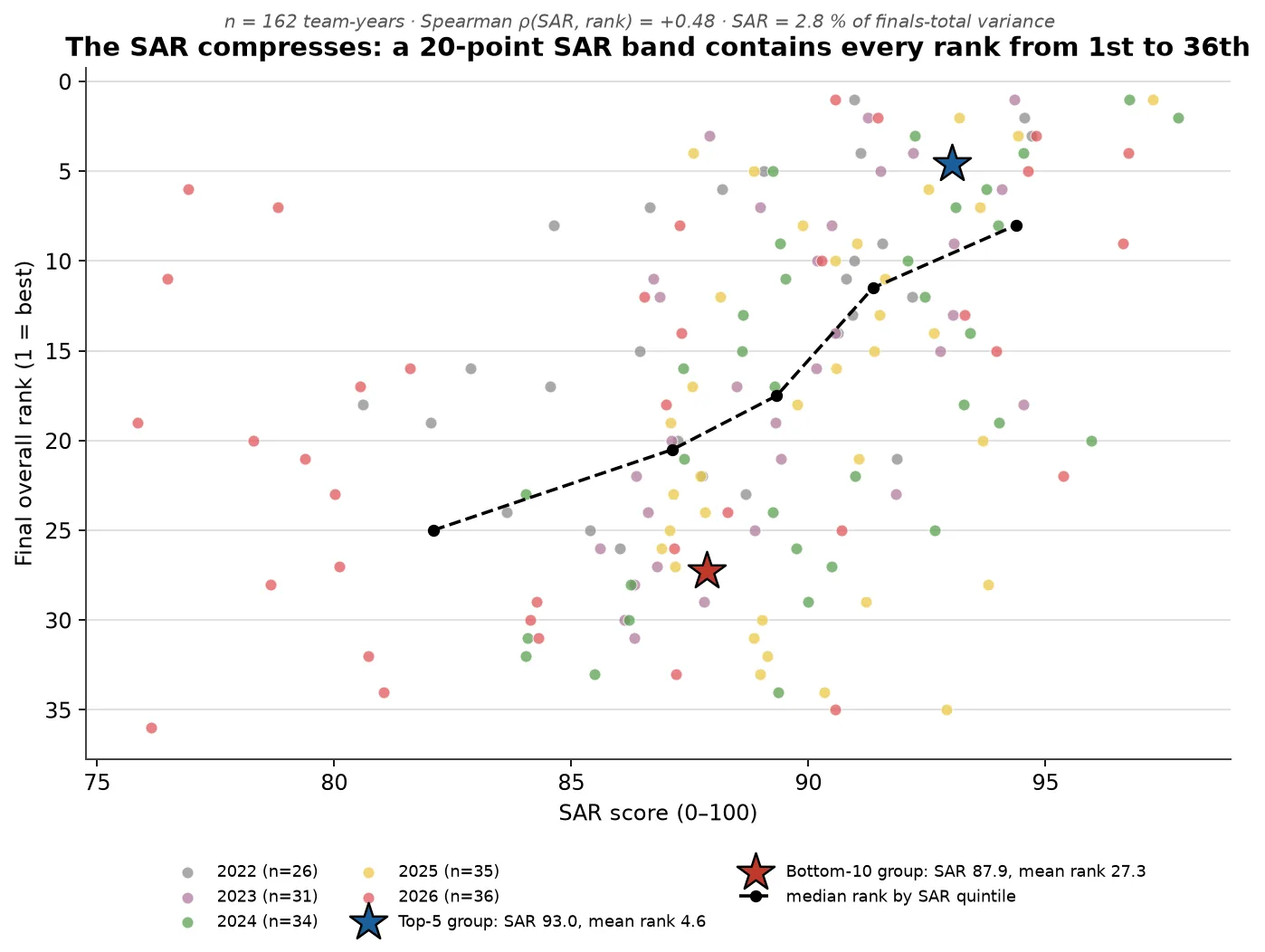
The System Acceptance Review is the mission that decides whether there is a field season at all. A written report and a five-minute video, due 2027-03-05, are worth 100 of the 500 points and are the only route to the other 400, because only the teams with the highest scores are invited. It is also the least discriminating score in the competition.
Key takeaways
- The gate matters more than the score. The review is 20 % of the maximum, and only the top 36 scores reach the field. A good package cannot win the competition; a weak one ends the season at a desk.
- It is the least discriminating element. A standard deviation of 4.5 on a 100-point score, and 2.8 % of finals-total variance, against 16–28 points of spread on each field mission S-URC22-SCORES S-URC26-SCORES.
- The cut sits within a few points of the median. In 2023–2025 the admitted set stopped between 3.4 and 5.8 points below the field median. The 2026 numbers are not comparable, because the lowest admitted score fell about nine points in the year the rubric was rewritten.
- The strongest teams run a production line. West Virginia averaged 94.61 and Missouri S&T 94.23 over five seasons, while mid-field teams swung 16–17 points.
What the review demands
Two components, both mandatory: a written report and a video, submitted as one package, with original content and full attribution. URC takes plagiarism seriously enough to make it grounds for disqualification S-URC26-SAR. The 2027 rulebook fixes the character of the review: “The SAR will focus on demonstration of the capabilities and customization of the rover systems/sub-systems to perform each of the missions.” The review is competitive against other teams, and the 36 highest scores are invited S-URC27-RULES §3.a.iii.
The 2027 rubric itself is not published, and the page that will carry it promises a release in early 2027 S-URC27-SAR. The preparation that survives an unpublished rubric is evidence plus traceability, not narrative.
How 100 points enter the final score
Each mission and the review are worth 100 points for a total of 500 S-URC27-RULES §1.a.i. Penalties are additive and a mission cannot score below zero. So the review is 20 % of the maximum, and it is the only part of the score that can be earned before the rover works.
What the cut actually looked like
The official result sheets carry a review score for every finalist, which makes the lowest admitted score visible even though rejected packages are not published. That gives an upper bound on the cut line.
| Year | Lowest among teams that competed | Median | Highest | Standard deviation |
|---|---|---|---|---|
| 2022 | 80.60 | 88.42 | 94.71 | 3.71 |
| 2023 | 85.61 | 89.31 | 94.54 | 2.71 |
| 2024 | 84.04 | 89.87 | 97.80 | 3.57 |
| 2025 | 86.90 | 90.33 | 97.27 | 2.54 |
| 2026 | 75.86 | 86.77 | 96.75 | 6.39 |
Derived from the review column in the five result sheets S-URC22-SCORES S-URC23-SCORES S-URC24-SCORES S-URC25-SCORES S-URC26-SCORES. Among all 37 teams admitted in 2023, the lowest was 85.10, for a team that was admitted and did not compete.
Three readings matter for planning.
- The cut line sat 3.4 to 5.8 points below the median on the 2023–2025 rubrics. A first build needs to be close to the field median to be safe, by inference from the table.
- 2026 is not comparable. The lowest admitted score fell about nine points in the year the requirements were described as significantly updated S-URC26-SAR, and the standard deviation nearly doubled. A 2027 package should be benchmarked against its own rubric coverage, not against 2025’s 86.90.
- The nominal field is 36 and the real field is larger. The field was expanded to 37 in 2023 and 38 in 2024, 2025 and 2026, and there is no stand-by list for withdrawals. The design target is a cut at 36, without relying on the expansion.
What the field rewards
The 2026 rubric is the best available model of what 2027 will reward, and its weights are published.
| Component | Weight | Sub-criterion | Sub-weight |
|---|---|---|---|
| Report | 40 % | System overview and architecture | 8 % |
| Integration and testing | 6 % | ||
| Project management, including a Gantt chart and a budget table | 11 % | ||
| Science plan, one page | 15 % | ||
| Video | 48 % | Rover mobility and terrain | 8 % |
| Arm and end effector | 8 % | ||
| Autonomous navigation | 6 % | ||
| Science payload | 6 % | ||
| Overall integration | 12 % | ||
| Communications, C2 and operations | 8 % | ||
| Judges’ assessment | 12 % | Readiness to compete by late May | 4 % |
| Ruggedness for the MDRS environment | 4 % | ||
| Novelty and scope of work | 4 % |
2026 rubric S-URC26-SAR, the only published model; the 2027 rubric is promised for early 2027. The weights total 100 %.
The consequence is structural. Forty-eight of the 100 points are won or lost in a five-minute video, the written report is worth 40, and a subjective judges’ assessment is worth 12. The video is also where the review is easiest to lose, because of a single published rule: if something is not specifically shown, the judges cannot award points for it S-URC26-SAR. A zoomed shot of an end effector with no rover in frame earns nothing, and a separate demonstration of each subsystem does not show integration.
The 2026 format requirements are a usable template for 2027.
- The report is seven pages, with pages 1–4 free, page 5 the Gantt chart only, page 6 the budget table only and page 7 the science plan only. Nothing after page seven is considered.
- The video is five minutes or less, publicly accessible, with a month and year caption on every clip. Footage from before September of the current cycle is treated as weak evidence of maturity, and a clip of a superseded architecture is treated as inapplicable.
- Audio quality matters more than video quality, in the judges’ own words, and music is discouraged.
- The science page is read by scientists and the rest by engineers. The judges state that science judges may only skim the non-science pages and non-science judges may only skim the science page, so the video should show the systems that execute the science rather than explain the science S-URC26-SAR.
Design implications for a first build
| Decision | Option A applies when | Option B applies when |
|---|---|---|
| Documentation framework | One spreadsheet and one page of traceability for the first season | A model-based systems framework only if the team already uses one; nothing larger fits the page budget |
| Evidence strategy | Test reports, failure logs and mission footage generated during the build | A last-month writing sprint, which the 2026 revision punished for teams with no artefacts |
| Science content | About one page of science plan plus video time, expanding into the May plan S-URC27-QA AQ1 | A full plan inside the review, which is wasted effort because it is rewritten in May |
| Modularity story | One integrated rover with a two-bolt end-effector swap | A front-half payload swap, only with a large team and a spare chassis |
| Mass evidence | Allocation at concept, a CAD roll-up at the preliminary review and a scale at integration, with the 1.2 m box built early | Weighing only at the end |
A final Rover Expense Report in work-breakdown form is due 2027-05-26, and the fielded rover is capped at $26,000 S-URC27-RULES §3.c.ii §3.c.iii. The report is a different document from the project budget table inside the review, and it covers only the rover as the rules define it.
Minimum viable versus stretch
- The minimum that clears the gate: a package that maps one to one onto the four missions, shows at least one measured test result per mission family, carries the one-page science plan, and states honestly what does not yet work.
- The stretch: a traceability figure, a mass budget with margin, a test matrix, failure logs with corrective actions, and footage of every mission attempted on analog terrain. That is the West Virginia and Missouri S&T pattern.
- The timing trap: the May science plan expands the one-page version submitted in March, so the writing starts twice and the second version is the scored one in Astrobiology.
Risks to retire early
| Risk | Why it is real | The countermeasure |
|---|---|---|
| The rubric is replaced | The 2026 standard deviation of 6.39 and the nine-point drop in the cut show what a rewrite does to a field | Preparation against evidence of capability, which every version of the rubric has rewarded |
| A strong rover, a weak package | The cut sits inside a ±3-point band, so a strong team can miss the field with 400 points of rover on the floor | Evidence built during the build, with the package reviewed monthly against the rubric |
| The science plan owner cannot speak at the mission debrief | AQ8 limits the mission debrief to members who stayed in C2 | The plan owner and the debrief speaker are two different people, and the plan owner stays in C2 all day |
| The video shows CAD and talk | The rubric rewards demonstrated capability and the judges discount renders | Footage on analog terrain, with the rover integrated and every clip captioned with month and year |
| Format penalties | Page limits, page roles and video length are hard limits | A format check against the published template before submission |
Further reading
- Review, judging and awards carries the full rubric, the format rules and the award structure.
- Systems engineering and integration covers the artefacts the review asks for.
- 155 engineering requirements is the traceability table the report is meant to show.
- What 2027 invalidates explains why two new requirements must be demonstrated in the review by March.
- Deadlines and milestones places the review among the fixed dates for the season.
Sources for this page
- S-URC22-SCORESURC2022 Official ScoresOriginal
- S-URC26-SCORESURC2026 Official ScoresOriginal Archived copy
- S-URC26-SARURC2026 System Acceptance Review Requirements + SAR Q&AOriginal
- S-URC27-RULESUniversity Rover Challenge 2027 – Requirements and GuidelinesOriginal Archived copy
- S-URC27-SARURC System Acceptance Review page, states "URC2027 SAR Requirements will be posted in early 2027!"Original
- S-URC23-SCORESURC2023 Official ScoresOriginal
- S-URC24-SCORESURC2024 Official ScoresOriginal
- S-URC25-SCORESURC2025 Official ScoresOriginal
- S-URC27-QAURC2027 Questions & Answers (updated through 2026-10-11)Original Archived copy