A.S.T.R.A. (University of Alabama in Huntsville)
The University of Alabama in Huntsville founded its rover programme in February 2020, reached the finals in its first attempt in 2022 and finished sixth. The record since then is a plateau with two spikes: a best total of 301.56 for tenth in 2025, and a science score of 97 in both the debut year and 2026. What makes A.S.T.R.A. worth reading is not the score sheet but a 64-slide public design review of the 2022 arm and a GitHub organisation that publishes the current arm’s kinematics and firmware, which together make this the most inspectable arm programme in the census.
What this team shows
- The public arm review is the only subsystem-level design review published in this collection of dossiers. It carries requirements traced to rule clauses, three actuator trades, a CAD mass budget with margin, a 603 W power budget and a seven-test plan.
- Its central number is a warning. A four-axis arm built from aluminium T-slot and linear actuators came to 27.44 kg against a 28 kg allocation, which is 56 % of the 2027 mass limit spent before the rover exists.
- The 2025 redesign answered that number with architecture rather than trimming: rotary joints on cycloidal gearboxes, and a six-axis arm that the published model puts at 11.2 kg.
- Two seasons of evidence say the constraint is mission execution, not payload. Science scored 97 in 2026 while Delivery scored 8 and Autonomy scored 0.
Identity and results
A.S.T.R.A. stands for Adaptable Service Transport and Research Apparatus on the team’s site. An earlier review deck uses a different expansion, Autonomous Science Target Recognition and Analysis, and the site version is the current one S-UAH-SITE S-UAH-ARMPDR. The team grew from 21 members in 2022 to more than 50 by 2025.
| Year | Rover | Total | Rank | SAR | Science | Delivery | Equipment | Autonomy |
|---|---|---|---|---|---|---|---|---|
| 2022 | ASTRA | 286.37 | 6 | 88.17 | 97 | 35 | 55 | 11.2 |
| 2023 | ASTRA | 251.04 | 17 | 88.48 | 76.56 | 15 | 43 | 28 |
| 2024 | ASTRA | 278.00 | 8 | 94.00 | 83 | 35 | 24 | 42 |
| 2025 | ASTRA | 301.56 | 10 | 90.56 | 94 | 56 | 47 | 14 |
| 2026 | ASTRA | 228.83 | 18 | 86.99 | 97 | 8 | 36.84 | 0 |
The shape of the record is unusual. The debut season delivered sixth place and a science score of 97, and the team has not finished that high since. Four seasons produced four different weakest missions: Autonomy at 11.2 in 2022, Delivery at 15 in 2023, Equipment Servicing at 24 in 2024, Autonomy at 14 in 2025 and then Delivery at 8 with Autonomy at 0 in 2026 S-URC22-SCORES S-URC23-SCORES S-URC24-SCORES S-URC25-SCORES S-URC26-SCORES. The programme has no stable second mission.
The one external honour in the record went to a person rather than the rover: Grant Quartuccio, the team’s science officer, won the John Barainca Memorial Award for Outstanding Scientist at the 2026 competition S-URC26-NEWS.
Rover generations
2022: the modular first rover. Swappable mission modules, two lithium-polymer packs with a marked disconnect key, a Jetson Xavier NX with a Teensy 4.1 on a secondary board, ethernet between modules, and a 2.4 GHz primary link with a 900 MHz backup verified to 500 m line of sight. The chassis was welded aluminium tube on an undamped aluminium rocker, with 3D-printed TPU wheels, brushless drive through a timing-belt reduction and skid steering S-UAH-SITE S-UAH-SAR22.
2023: the least documented season. The review film for that year is unavailable and the team site stops in March 2022. The official scores are the whole record: Science 76.56, Delivery 15, Equipment 43, Autonomy 28 S-URC23-SCORES.
2024: three subsystems remade. The team redesigned and remanufactured the arm, the biosensor system and the wheels. New compute moved to an Intel NUC 13, the chassis combined welded aluminium with a carbon-fibre averaging suspension, drive moved to REV NEO 550 motors with SparkMax controllers at 100:1, and the arm kept the 2022 layout of three linear actuators and a servo wrist. The review score reached its best value, 94, and Equipment Servicing fell to 24 S-UAH-NEWS24 S-UAH-SAR24.
2025: a full core rebuild. A carbon-fibre and foam sandwich chassis with the electronics inside the sandwich volume, a CAN bus with ESP32 controllers, and a new six-axis arm with a bearing-stack turret and cycloidal gearboxes chosen for low backlash. Delivery reached 56 and Equipment Servicing 47, both the best in the team’s record, and Autonomy fell to 14 S-UAH-SAR25.
2026: optimisation and a new operator station. Mass came down through redesigned wheels and suspension members and machined arm gears, with composites laid up in house. The software build moved to Nix, and the operator station moved to a Steam Deck running Godot, with the displaced single-board computer repurposed as a tracking antenna. The field result was the worst of the five seasons S-UAH-SAR26.
Subsystems
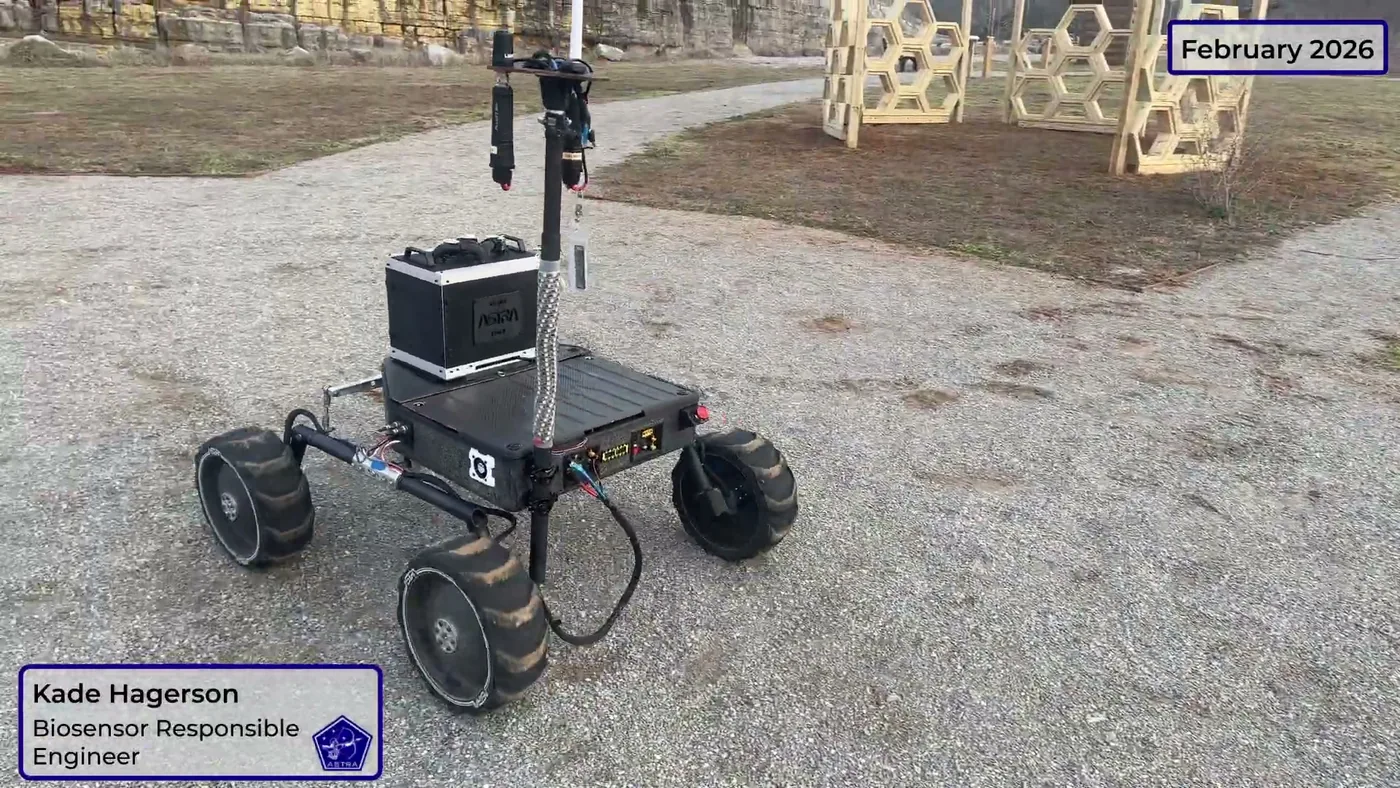
Mobility. Four wheels on a rocker with an averaging bar, skid steered, deliberately undamped: the team states the choice was made to give the arm a steady platform S-UAH-SITE. The published kinematic model encodes exactly that arrangement, with one suspension member per side and an averaging bar between them, so this is a four-wheel rocker rather than a six-wheel rocker-bogie S-UAH-GH-DESC. The 2026 wheel geometry in that model bounds at 347.8 mm diameter and 128.7 mm width, with a mass of 5.74 kg per wheel. The 2026 mass reduction came from redesigning the wheels and suspension members, so the 2025 wheels were at least as heavy S-UAH-SAR26.
Arm and end effectors. The 2022 arm is documented down to the part. Axis 1 was a 47:1 geared stepper driving a slewing ring; axes 2 to 4 were three linear actuators with built-in Hall sensors; the structure was 4040 and 4080 T-slot extrusion. Forward kinematics sized the geometry at required strokes of about 202, 199 and 153 mm and peak actuator forces of 1063, 776 and 186 N at a 5 kg load, which is why the frame uses 4080 sections S-UAH-ARMPDR. The 2025 and 2026 arms replaced that with rotary joints: NEO 550 motors through cycloidal gearboxes, absolute encoders and a bearing-stack turret, with reach reduced from 1.9 m to 1.25 m S-UAH-SAR24 S-UAH-SAR25.
The 2026 arm’s published geometry gives a 470 mm shoulder-to-elbow link, a 394 mm elbow-to-wrist link and a 177 mm wrist offset, with six revolute joints and two prismatic fingers S-UAH-GH-DESC. Its control firmware runs a proportional-only loop at a 50 ms period on absolute magnetic encoders, with default joint limits of ±115° S-UAH-GH-ARMEMB.
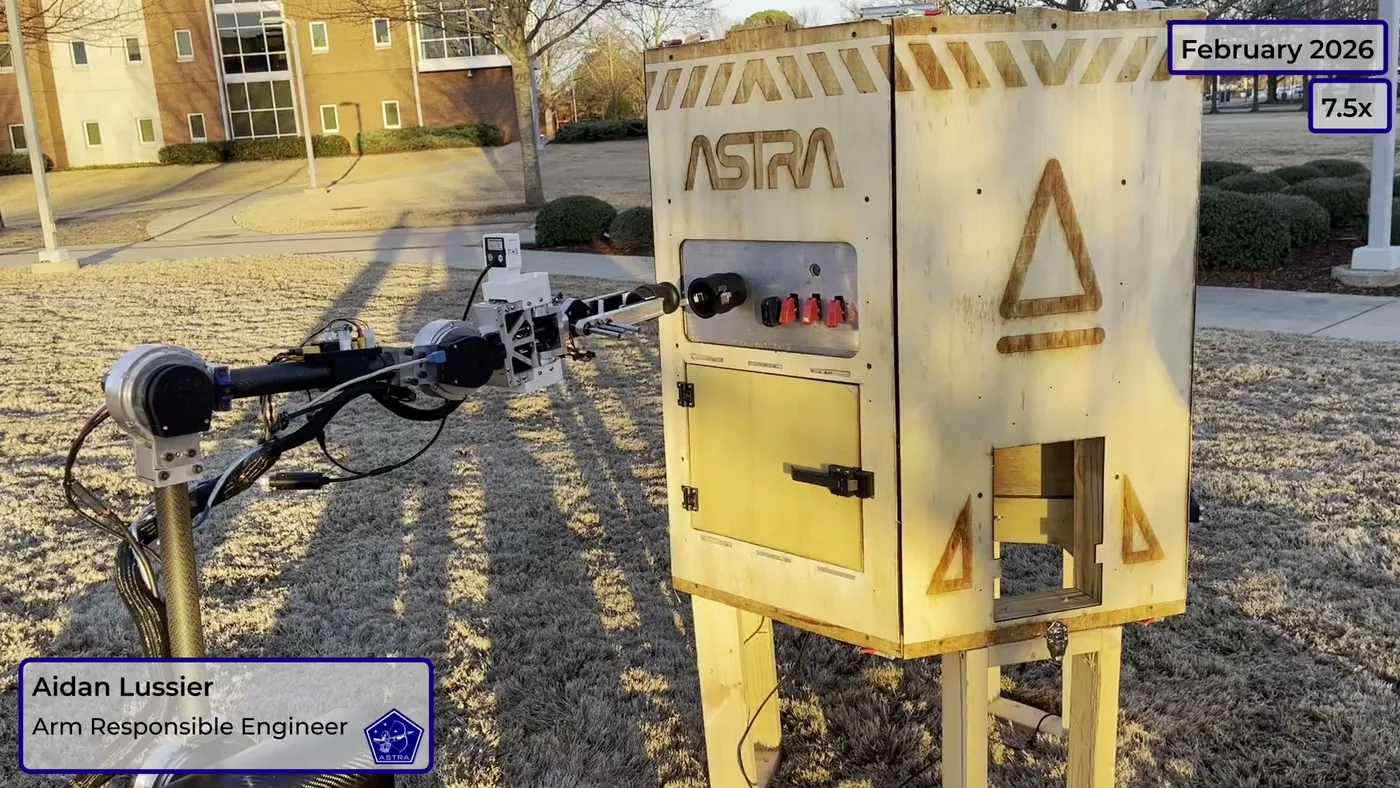
Science. The payload runs four wet-chemistry tests rather than one instrument: a protein assay, an acid test for carbonates, methylene blue for perchlorates, and nitrate, nitrite, ammonia and pH strips. Glucose oxidase was added in 2026, with laser-induced breakdown spectroscopy in development S-UAH-SAR24 S-UAH-SAR26. Surface sampling uses a vacuum and a cyclonic separator that splits soil into three tubes per site, and subsurface sampling uses an auger on the end effector that seals in situ at 10 cm with a temperature and humidity probe inside it S-UAH-SAR24 S-UAH-SAR25. Ten centimetres is shallow against a 2027 rubric that rewards depth, which puts a ceiling on the science score.
Communications. A 2.4 GHz Ubiquiti Bullet M2 forms the primary link, with a 2.4 and 5 GHz dual-band radio behind a managed switch and a 900 MHz backup carried over from 2022. The team claimed 1 km of operating distance in 2025 and added a belt-driven tracking antenna in 2026 S-UAH-SAR22 S-UAH-SAR24 S-UAH-SAR25 S-UAH-SAR26. The modules are addressed peer to peer over ROS 2, so the base station can talk to one module directly rather than through the rover computer S-UAH-SAR24.
Power and safety. A four-cell lithium-polymer pack, with capacity unpublished, feeds per-module boards over CAN. The arm interface in the 2020 review specified 24 to 36 V at up to 25 A and 600 W, which does not match a four-cell pack, so either the arm specification changed with the 2025 redesign or a boost stage exists S-UAH-ARMPDR S-UAH-SAR26. The arm’s own power budget came to 603.19 W peak, with 53 % of it in three actuators S-UAH-ARMPDR. An emergency stop moved from a chassis pull switch to a button between 2024 and 2025, and a low-voltage cutoff was still being implemented at the 2026 review S-UAH-SAR25 S-UAH-SAR26.
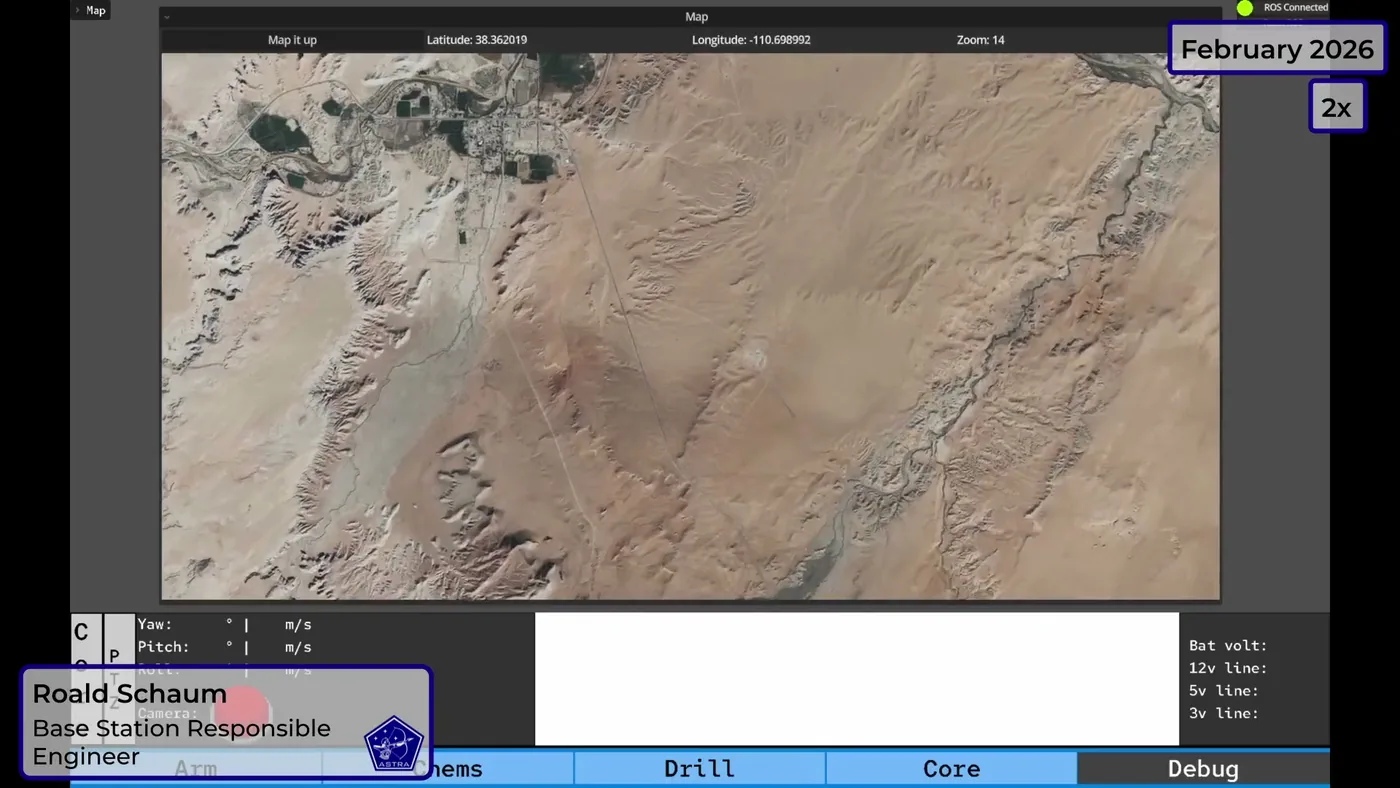
Compute and autonomy. The stack is ROS 2 Humble with Nav2 for navigation and MoveIt 2 with ros2_control for the arm. Perception uses a ZED 2i for point clouds and a YOLO detector trained on the team’s own images for mallets, bottles and AR tags; satellite navigation is fused with wheel odometry, an inertial unit and visual odometry through an extended Kalman filter S-UAH-SAR24 S-UAH-SAR26. The 2022 claim of 3 m satellite accuracy, without real-time kinematic correction, is far too coarse for the 2027 autonomy target.
The drone. A separate module rather than a rover subsystem. The 2025 airframe used a carbon frame, high-efficiency motors and an analogue first-person camera to scout terrain and read field signs; 2026 added a pan-tilt gimbal S-UAH-SAR25 S-UAH-SAR26. Mass and flight time are unpublished.
Mission performance
The 2026 result is the most instructive row in the table. The same year produced a science score of 97, the team’s joint best, beside a Delivery score of 8 and an Autonomy score of zero. The 2026 rover was an optimisation of the 2025 machine rather than a new design, and the systems that scored 56 and 47 in 2025 were largely carried over S-UAH-SAR26. A team that scores 97 in one mission and 8 in another in the same event has an execution problem: time, set-up, operator workload or an autonomy regression, and the public record does not say which.
The 2024 row shows the opposite failure. Equipment Servicing fell to 24, the team’s worst, in the season it remade the arm, and rose to 47 the year the arm was rebuilt again with rotary joints S-UAH-SAR24 S-UAH-SAR25. On this record the arm’s architecture and the servicing score move together.
There is no disqualification and no no-show between 2022 and 2026: every season carries mission scores S-URC22-SCORES S-URC26-SCORES.
Lessons for a first build
- Budget the arm before the rover. A 28 kg allocation for four axes on a 50 kg rover is over half the mass limit, and the 2020 review reached 27.44 kg with a 5 % margin. T-slot extrusion and linear actuators are a heavy starting point. The same team reached 11.2 kg for six axes once it moved to rotary joints S-UAH-ARMPDR S-UAH-GH-DESC.
- Make one module testable on its own. The arm was given its own computer, its own power input and its own ethernet pass-through so it could be built and tested without the rover, for an extra $50 and more complexity. That boundary survived into production as separate arm software, firmware and electrical work S-UAH-ARMPDR S-UAH-GH.
- Take cross-subsystem trades deliberately. The suspension is undamped because the arm needed a steady platform. That is a mobility decision taken on behalf of manipulation, and it is the kind of trade the 2027 rules reward. The team tested it with its own shake test S-UAH-SITE S-UAH-ARMPDR.
- Make the software rebuildable. The 2026 stack moved to Nix, which the team says allows the main computer to be destroyed and restored in under an hour S-UAH-SAR26. Losing the rover computer is one of the most common field failures, and a recovery procedure is cheaper than a spare.
- Profile the operator station. A rewrite of the base-station link layer was credited with a tenfold improvement in start-up time S-UAH-SAR26. Set-up time is competition time, and it is measurable before the event.
- Check what a reach figure measures. The arm’s reach fell from 1.9 m to 1.25 m in a precision-for-reach trade. Both figures meet a 1.5 m ground-to-arm target only when the mounting height is added, so a quoted reach is only comparable with the mount height beside it S-UAH-SAR24 S-UAH-SAR25.
What remains uncertain
No competition mass is published for any A.S.T.R.A. rover. The only figures in public are the 2022 arm at 27.44 kg of CAD mass and a 2026 kinematic model that sums to 102.9 kg, which is a simulation asset rather than a weighed rover. A 2021 site note projected the competition rover at about 30 times a 1.5 kg prototype, implying roughly 45 kg, and that is a projection rather than a measurement S-UAH-SITE S-UAH-GH-DESC.
Battery capacity, radio transmit power, antenna gain, link latency, top speed, drone mass, mast height and stowed dimensions are all unpublished, and the team’s own latency measurement node has no published result. The 2023 season has no design record at all. The gearbox behind the stated “NEO 550 at 100:1” drive is unnamed, and the 100:1 ratio on that motor implies a custom or multi-stage reduction.
Team sources
- A.S.T.R.A. team site, the team’s own page, current to March 2022.
- A.S.T.R.A. programme page, the university’s page for the project.
- Full-scale robot arm base preliminary design review, 64 slides, 2020.
- SHC-ASTRA on GitHub, 35 public projects including the arm kinematics and firmware.
- 2026 System Acceptance Review, the primary film for the 2026 rover.
- 2024 System Acceptance Review, the linear-actuator arm generation.
Sources for this page
- S-UAH-SITESHC – ASTRA (Google Sites team site, single page)Original
- S-UAH-ARMPDRASTRA Full-Scale Robot Arm Base PDR (64-slide Google Slides deck; PPTX export)Original
- S-URC22-SCORESURC2022 Official ScoresOriginal
- S-URC23-SCORESURC2023 Official ScoresOriginal
- S-URC24-SCORESURC2024 Official ScoresOriginal
- S-URC25-SCORESURC2025 Official ScoresOriginal
- S-URC26-SCORESURC2026 Official ScoresOriginal Archived copy
- S-URC26-NEWSURC2026 News (champions, 38 finalists, INCOSE award announcement, ProtoSpace credit)Original
- S-UAH-SAR22ASTRA System Acceptance Review – URC 2022 SAR (YouTube, 5:03)Original
- S-UAH-NEWS24UAH team places eighth internationally in 2024 University Rover ChallengeOriginal
- S-UAH-SAR24ASTRA System Acceptance Review – URC 2024 (YouTube, 5:02)Original
- S-UAH-SAR25ASTRA System Acceptance Review – URC 2025 (YouTube, 4:54)Original
- S-UAH-SAR26ASTRA System Acceptance Review – URC 2026 (YouTube, 5:00)Original
- S-UAH-GH-DESCastra_descriptions, ROS 2 URDF/meshes for Clucky and Testbed (AGPL-3.0)Original
- S-UAH-GH-ARMEMBarm-embedded, arm/digit ESP32 firmware (AGPL-3.0)Original
- S-UAH-GHSHC-ASTRA GitHub organisation (35 public repos; rover software + KiCad)Original