ARES Project (Tohoku / Keio, Japan)
ARES Project is Japan’s first student team at the University Rover Challenge, founded in March 2022 by three students with no fund, no sponsor and no university support. It finished 32nd in 2024, 30th in 2025 and eighth in 2026. That is the widest rank variation in the 2022–2026 field, and the cause is visible in the mission columns: each season one mission worked and the rest did not, until 2026, the first year in which all four scored at once.
What this team shows
- The organisational idea is the transferable one. Tohoku builds the rover body, a second campus builds the arm, and a shared science group draws on both, so no single university carries the whole integration burden.
- The cost of a fresh rover every season is visible in the score sheet. Eight generations in four years buys speed and inherits nothing, which is why the results swing between 32nd and 8th.
- A team can start from nothing and reach the finals field in two seasons. That is the most directly relevant precedent in the census for a new programme.
- The written review was never the problem. Its score moved from 84.04 to 89.01 to 87.28 across the three appearances while the missions moved from two zeros to none.
Identity and results
| Year | Rover | Total | Rank | SAR | Science | Delivery | Equipment | Autonomy |
|---|---|---|---|---|---|---|---|---|
| 2024 | ARES 7, later ARES 8 | 166.04 | 32 | 84.04 | 73 | 9 | 0 | 0 |
| 2025 | ARES 8, later ARES 9 | 199.01 | 30 | 89.01 | 12 | 0 | 56 | 42 |
| 2026 | ARES 9 | 324.59 | 8 | 87.28 | 90 | 50 | 62.11 | 35.2 |
The team registered for the 2023 competition but appears in no result row for that year S-URC23-TEAMS S-URC23-SCORES. Its 2024 debut made it the first Japanese team in the finals, and it left with the Spirit Award and the Science Mission Presentation Excellence Award alongside 32nd place S-ARES-UNISEC. It won the Grand Prize at the Tottori Rover Challenge in March 2025 S-ARES-UNISEC.
The 2026 total of 324.59 is higher than the eighth-placed total in 2024, which makes eighth place in 2026 a stronger result than the rank alone suggests S-URC24-SCORES S-URC26-SCORES.
Rover generations
The team counts eight rover generations designed and tested in four years, and dates two of them precisely: ARES 7 in March 2024 and ARES 8 in December 2024 S-ARES-ERC2026 S-ARES-UNISEC. The naming is not consistent between sources, and the 2024 European profile calls the same lineage “AR-09” S-ARES-ERC2024.
ARES 5, 2023. A mobility test platform, exercised at a dune site in the Tottori Sand Dunes. It never reached a URC finals.
ARES 7 and ARES 8, 2024. The debut vehicle and its mid-season replacement. The team’s own account of the competition says “huge damage to rover”, which explains the two zero mission scores better than a missing capability does, and the deck does not say which subsystem was damaged S-ARES-UNISEC.
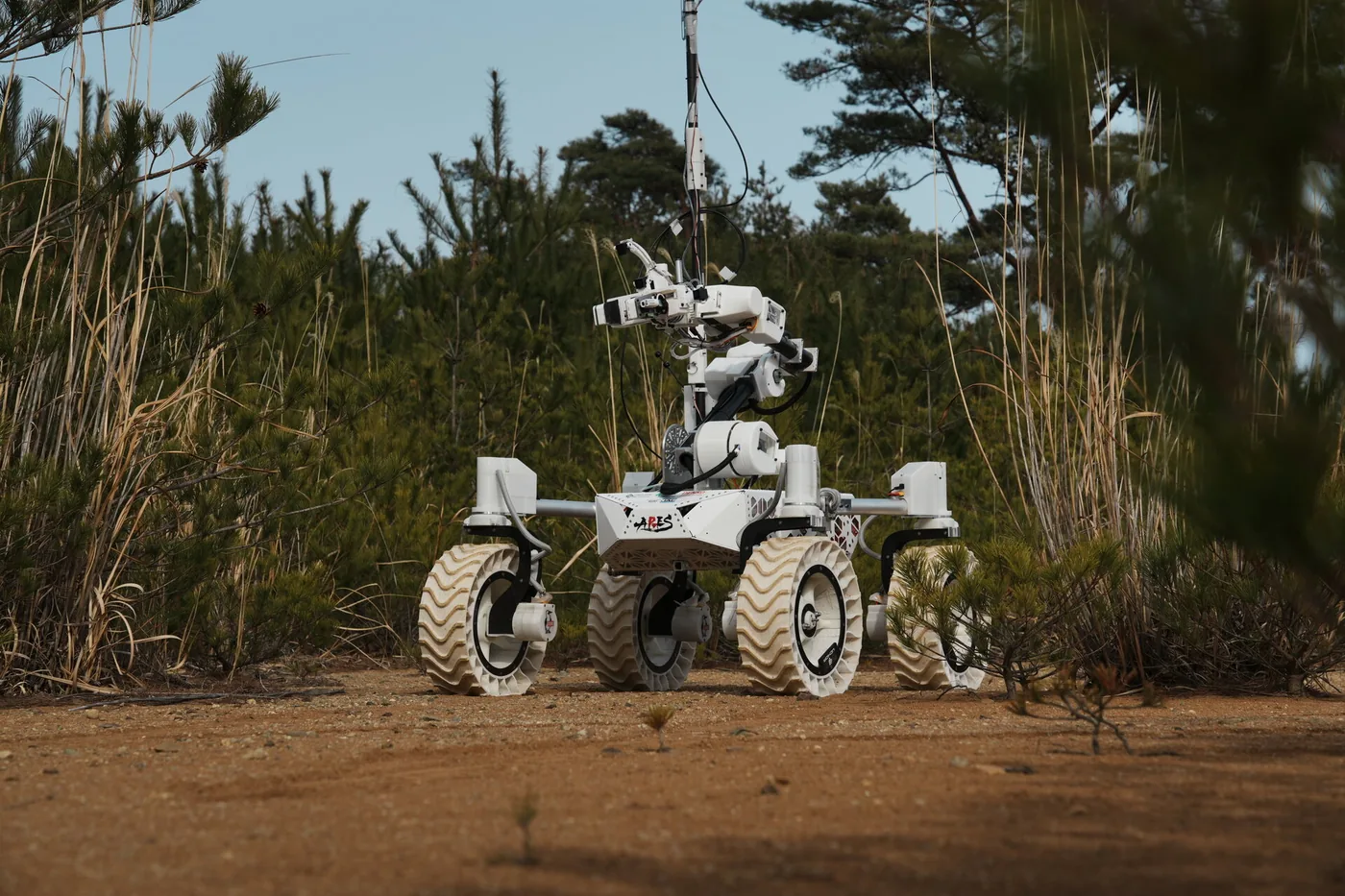
ARES 9, 2026. The rover photographed in the team’s official release: six chevron-tread tyres on white spoked rims, a drive pod at each hub, a white faceted chassis with perforated panels, a tall mast and the arm stowed above the deck S-ARES-SITE.
Subsystems
The public record here is a conference deck, two competition profiles and a set of official photographs. No design document, no CAD and no code are published, and a GitHub account under the project name could not be tied to the team S-ARES-GH. What follows is what those sources and the 2026 review film support.
Work split. The rover body is built by the Tohoku group and the arm by the Tokyo group, with science modules and outreach shared across the consortium S-ARES-ERC2024 S-ARES-UNISEC. This is a design decision about people, not hardware, and it is the part of the project most worth copying.
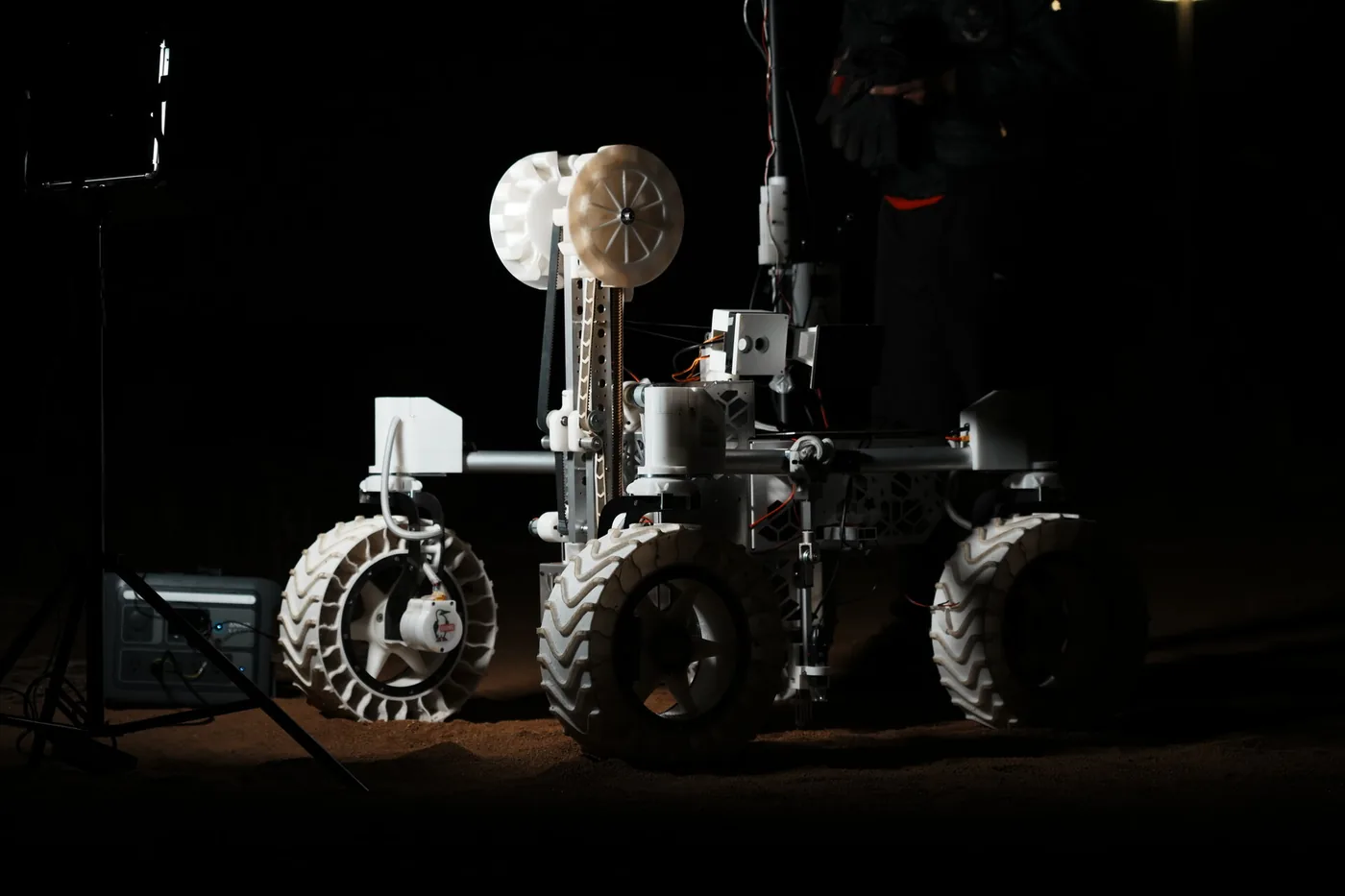
Mobility. Six wheels with chevron tread on white spoked rims, each driven from a housing at the hub, on a white faceted chassis with triangulated and perforated panels. The front and rear wheels are carried on short transverse links off the chassis ends rather than on a full rocker-bogie S-ARES-SITE. Tyre construction, wheel diameter, motor and gearbox models, and mass are unpublished.
The mast assembly. The official photographs show a tall mast carrying two spools and a lead-screw carriage beside the arm, with a rail section above it S-ARES-SITE. Its function, whether tether, sampling winch or sensor deployment, is not described anywhere in the public record.
Manipulation. A multi-link white arm with a camera at the wrist and a gripper, stowed folded above the chassis. The 2026 review film gives the arm two chapters of its own, “Robotic Arm Hardware” at 0:45 and “Robotic Arm Software” at 1:19, which is a stronger statement of intent than any specification the team publishes S-ARES-SAR2026. Joint count, reach and actuator family are unpublished.
Comms, power and compute. The 2026 film runs a combined “Communication & Electrical Systems” chapter from 2:14 to 2:53, so the team treats the two as one subsystem S-ARES-SAR2026. No radio, battery or computer model is published. The sponsor list, which includes a semiconductor maker, a radio maker, a bearing maker and a motor maker, is consistent with a conventional industrial bill of materials, but the team states none of it and the inference should not be used as a specification S-ARES-UNISEC.
The drone. The 2026 review film gives the UAV its own chapter at 3:25, which makes ARES one of the few teams in the field with a documented aircraft as a first-class mission module S-ARES-SAR2026. Airframe, flight controller and autonomy level are unpublished.
Autonomy. Zero in 2024, 42 in 2025 and 35.2 in 2026 S-URC24-SCORES S-URC25-SCORES S-URC26-SCORES. No account of the stack exists. A conference slide lists reinforcement-learning simulation transfer as a research interest, which is a research direction rather than a deployed capability S-ARES-UNISEC.
Mission performance
2024: a damaged rover in 32nd place. Science 73 and Delivery 9, with Equipment Servicing and Autonomy at zero. The team’s deck pairs the result with the words “huge damage to rover” and draws “significant insights into technical development and team management” from it S-ARES-UNISEC. The awards for team spirit and for the science presentation are the counterweight: the judges rewarded the story that year, and the score sheet rewarded a rover that stayed intact.
2025: the payload collapsed. Science fell from 73 to 12 while Equipment Servicing rose from 0 to 56 and Autonomy from 0 to 42 S-URC25-SCORES. This is the mirror image of 2024: the mechanical and software missions improved and the science mission failed on a team whose science presentation had won an award the year before.
2026: integration. 90 in Science, 50 in Delivery, 62.11 in Equipment and 35.2 in Autonomy, every mission above 35 S-URC26-SCORES. The 35.2 in autonomy is the figure to watch: eighth place came with the mission that separates the top of the field, where the winner scored 86, from the middle. A team in the top ten with an autonomy score in the thirties is winning on breadth rather than on any single strength.
The team runs test campaigns between URC appearances, including the dune mobility trials and the Tottori event, which is a plausible mechanism for the 2026 jump because it raises field time per rover generation S-ARES-UNISEC S-ARES-ERC2026. The team does not claim that as the cause, and the record cannot prove it.
Lessons for a first build
- Split the work where the people are. A chassis group at one campus and an arm group at another let a young consortium cover a whole rover. The price is interface risk between two sites, and the 2024 damage is a reminder that integration between locations has to be scheduled as work, not assumed.
- Start with nothing and schedule two seasons. Three students in March 2022 were in the finals field by 2024. What the record does not show is a shortcut: the 2024 result was 32nd, and the good result came in the third season.
- Count what a new rover costs. Eight generations in four years produced a fast-moving vehicle and three wildly different results. A first team with fewer people should consider carrying a platform for two seasons and spending the second one on the missions that scored zero.
- Give the drone a chapter, not a bullet. A dedicated film section is how a team proves an aircraft is integrated rather than promised. The 2027 rules make the drone a scoring item, so the chapter is worth rehearsing.
- Keep the written review while the hardware changes. The review score barely moved across three seasons of redesign. That continuity is the cheapest thing on the page to copy.
What remains uncertain
Almost every physical number is missing: mass, stowed dimensions, wheel diameter, drive motors, gearbox ratios, battery chemistry and capacity, radio model and power, computer board, arm degrees of freedom, reach, payload and the UAV airframe. The 2026 review film’s rover overview and UAV chapters are the obvious place to look, and they were not readable for this page.
Two questions matter more than the rest. The first is what the two-spool mast assembly does, since a tether or winch system changes what the rover can attempt. The second is how a multi-site consortium runs integration and field testing, which is the detail another team copying the model would most need and the one the team has not published.
Team sources
- arespjt.jp, the official site, in Japanese and English, with the ARES 9 photographs.
- Team page, founding, size and main campus bases.
- European Rover Challenge 2026 profile, rover name, on-site team size and sponsors.
- European Rover Challenge 2024 profile, the work split between campuses.
- YouTube channel, annual review films from 2023.
- 2026 System Acceptance Review, six chapters including the UAV.
Sources for this page
- S-URC23-TEAMSURC2023 Team ListOriginal
- S-URC23-SCORESURC2023 Official ScoresOriginal
- S-ARES-UNISEC"Challenge of ARES Project, The First Japanese Student Team Developing Mars Rover", 34-slide deck, 55th UNISEC virtual meeting, founding by 3 members with "no fund, no sponsor, no university support"; team split (Tohoku rover / Tokyo arm / science / PR); rover timeline ARES 5 (2023) → ARES 7 (2024-03) → ARES 8 (2024-12); URC 2024 = 38 finalists of 102 teams, 23 members travelled, Spirit Award + Science Mission Presentation Excellence Award, "Huge damage to Rover"; Tottori Sand Dunes "Lunaterrace" mobility test; Tottori Rover Challenge Grand Prize 2025-03Original
- S-URC24-SCORESURC2024 Official ScoresOriginal
- S-URC26-SCORESURC2026 Official ScoresOriginal Archived copy
- S-ARES-ERC2026European Rover Challenge 2026 team profile, rover name ARES 9, 20 on-site members, founded March 2022 by three members, "over 40 engineers", "designed and tested eight rover generations", status QualifiedOriginal
- S-ARES-ERC2024European Rover Challenge 2024 team profile, rover "AR-09", 30–40 students; "Tohoku group mainly develops the rover body, while Tokyo group develops the arm"; sponsor listOriginal
- S-ARES-SITEARES Project official site (JA/EN; JS-rendered nav), "From Japan, a World-Class Mars Rover"; hosts the official rover photographs /images/ares9_01.jpg and /images/ares9_02.jpg used as assets; sponsor wall incl. STMicroelectronics, Digi, NSK, Mabuchi Motor, OptoSigma, MISUMI, Autodesk, Creality, EasyEDA, Mazak, HiKOKI, DensoOriginal
- S-ARES-GHGitHub account ares-project, could not be tied to the team; no usable source repositoriesOriginal
- S-ARES-SAR2026ARES ProjectPrint copy
- S-URC25-SCORESURC2025 Official ScoresOriginal