title: Rules, limits and the field description: The 2027 rulebook clause by clause: mass, size, spectrum, deadlines, terrain and penalties, with every hard limit in one place. part: The competition chapter: "2.1" toc_depth: 3 tags: - rules - limits - penalties - field
Rules, limits and the field
The 2027 rulebook is written as competition clauses, and most of them are read during a design meeting rather than on the field. This page keeps the clauses in order and states what each one fixes: the scoring frame, the envelope of all four missions, the mass, size, power and spectrum limits, the milestone calendar, the site and the penalty arithmetic. Each section points to the page that takes the detail further. Where a number the design needs is missing from the rulebook, the gap is named rather than filled.
Key takeaways
- The 2027 rulebook renumbers the clauses: §1 holds the missions, §2 holds rover equipment, §3 holds the competition. Every citation written against the 2026 numbering has moved.
- Mass is measured before every mission and rounds down, so 50.9 kg records as 50 kg. The design target is not that edge, because the penalty is 5 % of points earned for each whole kilogram over.
- The oversize penalty is 40 %, and both the mass and size penalties apply to points earned rather than to the 100 available. A bad mission makes a penalty cheap; a good mission makes it expensive.
- Several numbers a design depends on are simply absent from the rulebook: slope and step limits, task weights, object dimensions and insertion forces. The last section lists them.
How the 2027 rulebook is organised
The 2027 rulebook has three parts, and the renumbering matters because the 2026 cycle put competition rules in §2 and rover rules in §3 S-URC27-RULES S-URC26-RULES.
| Part | Clauses | What it governs |
|---|---|---|
| Part 1: missions | 1.a to 1.e | Scoring frame, schedule, and the four mission envelopes |
| Part 2: rover equipment | 2.a to 2.c | Mass, size, power, safety, drones and communications |
| Part 3: competition | 3.a to 3.e | Milestones, the field, the expense report, the environment, penalties |
Each clause group below carries an anchor, so a reference such as §2.a.iii anywhere on this site lands on the section that explains it.
Part 1: the missions
Part 1 sets the scoring frame, the calendar and the four mission envelopes. The detail behind each mission is on Missions and scoring.
Clause 1.a: points, penalties and the clock
The total is 500 points: four missions at 100 points each plus the System Acceptance Review at 100 S-URC27-RULES §1.a.i. Mission scores are independent and cannot fall below zero, and penalties are additive fractions of the points earned, not of the maximum:
mission score = max(0, points earned × (1 − sum of penalty fractions))
total score   = sum of the four mission scores + the SAR score
Two additive penalties of 10 % and 20 % therefore leave 70 % of the points earned, not 72 % S-URC27-RULES §1.a.i. The practical consequence runs opposite to intuition: a penalty costs least on a mission that scores badly, and most on a mission that scores well.
Time is fixed at both ends of every mission. The window before the rover moves and the window after the clock stops are as binding as the mission itself, and every limit below is a rule limit S-URC27-RULES.
| Window | Limit | Note |
|---|---|---|
| C2 setup to ready | 15 min | Includes communications, weighing and measuring (§1.a.ii; §2.a.ii) |
| Teardown | 10 min | Radios off immediately (§1.a.ii) |
| Post-mission retrieval | 10 min | Rover, drone and deployed items (§1.a.iii) |
| Autonomy to Equipment Servicing | 10 min | Same C2 station, adjacent course (§1.a.iv; §1.d.i) |
| Astrobiology | 20–30 min | Plus 5 min for cache removal (§1.b.ii; §1.b.vii) |
| Delivery | 30–60 min | Fixed stage times; total includes both stages (§1.c.i) |
| Equipment Servicing | 30 min | Includes up to 100 m of travel to the lander (§1.d.i) |
| Autonomy | 40 min | Both sub-missions, in any order (§1.e.i) |
A team that competes in Astrobiology or Delivery competes in only one mission that day (§1.a.iv). The field schedule is issued about a week before the first field day and the order of tasks is drawn per team, so the sequence differs between teams at the same event S-URC27-QA CQ4.
Clauses 1.b to 1.e each set a task list and a numeric envelope. What follows is the operating envelope a design has to fit, not the point values.
Clause 1.b: Astrobiology
Every requirement below is a rule requirement, and the clause links carry the exact text S-URC27-RULES.
- The rover investigates at least two sites within 0.5 km of the C2 station in 20–30 minutes (§1.b.ii).
- Analysis happens on the rover. Samples may not be returned to the team for laboratory work (§1.b.iv).
- The cache sample comes from one site, at least 10 cm deep and at least 5 g, and the portion below 10 cm determines the mass (§1.b.vi).
- Two life-detection capabilities are required, at least one of them a bioassay that detects a biomolecule S-URC27-RULES S-URC27-QA §1.b.v AQ9.
- The cache must not spill when laid on its side or inverted, must be removable within 5 minutes after roving, and must be openable by the judges (§1.b.vii).
- Every site investigated needs a panorama with cardinal directions and scale, a close-up with scale, and GNSS coordinates with elevation and accuracy range (§1.b.iii).
- Chemicals, water and reaction products stay on the rover. Hazardous chemicals need a pre-approved safety plan S-URC27-RULES S-URC27-QA §1.b.ix AQ4.
- A debrief follows the cache handover even if the mission failed (§1.b.x). The Science Plan is due 2027-05-21 and counts toward the score (§1.b.i).
Clause 1.c: Delivery
The envelope below is set by four clauses and the cross-mission sight rule S-URC27-RULES.
- The mission has two stages. A minimum score in Stage 1 is required to proceed, and remaining Stage-1 time is added to Stage 2 (§1.c.i).
- Total time on course is 30–60 minutes. The 2027 stage times and the Stage-1 minimum are not published (§1.c.i).
- Objects are up to 5 kg, smaller than 40 × 40 × 40 cm, with a grasp feature no larger than 7.5 cm (§1.c.iii).
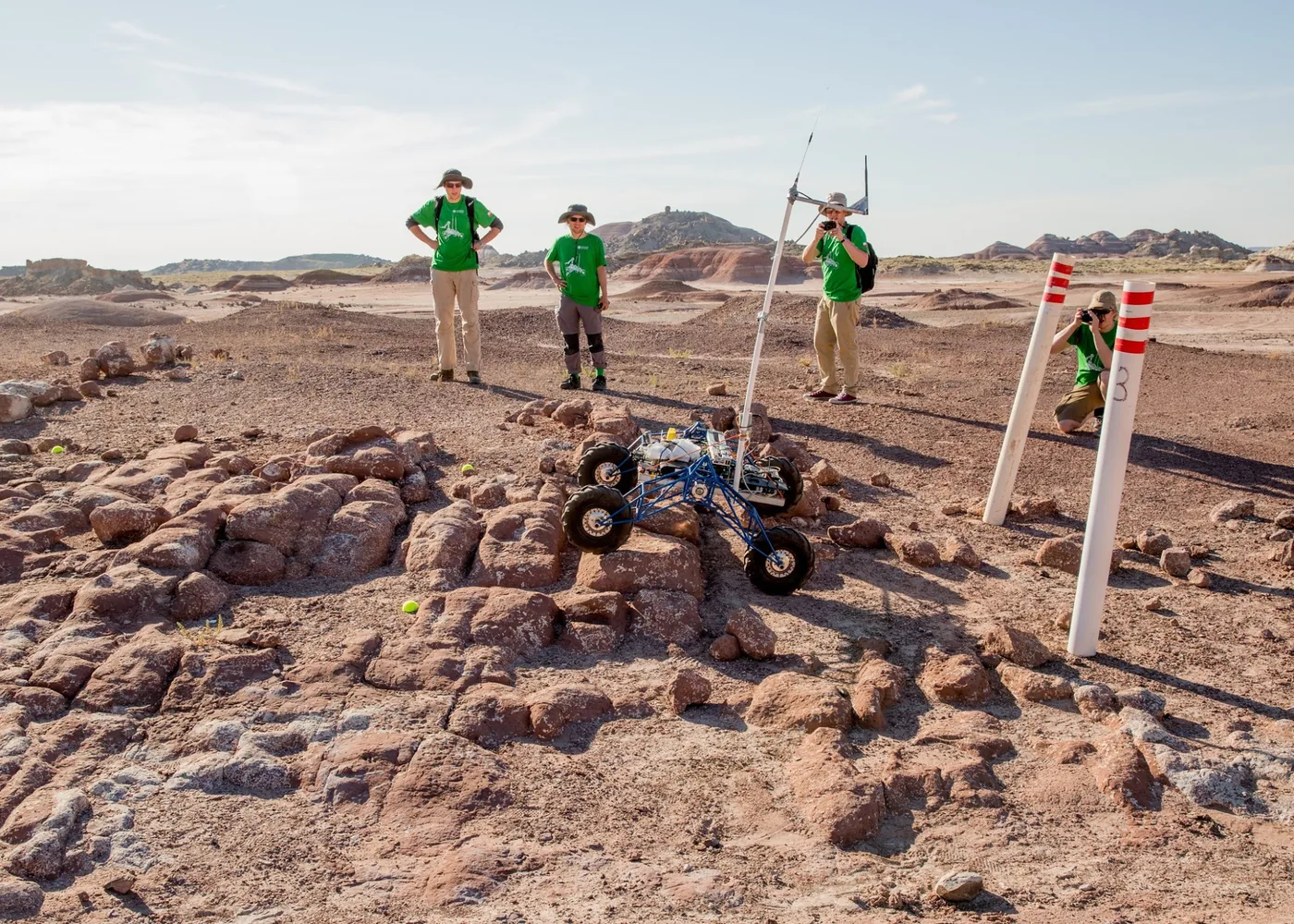
- The course extends up to 1 km from the start gate, over soft sand, gravel, stony ground, boulder fields, vertical drops and steep loose slopes (§1.c.ii).
- Line of sight is not guaranteed for more than 50 % of the course, and later tasks are deliberately beyond it (§3.d.ii).
- Working GNSS is essential, but coordinates for pickup and delivery are only approximate (§1.c.iv).
- A drone may assist. No other mobile deployable, including a mini-rover, may be used (§1.c.i).
Clause 1.d: Equipment Servicing
The rover travels up to 100 m across relatively flat ground and works on a mock lander, with interactive equipment between ground level and 1.5 m S-URC27-RULES §1.d.i. Nine task families are listed, and they may be performed in any order (§1.d.ii).
| Task family | What the rover must do |
|---|---|
| Sample tube | Pick up a test-tube-sized tube, insert it into a cache, close the lid, turn the lock |
| Cache transport | Carry a cache with a handle at least 10 cm long and no more than 5 cm in diameter, under 5 kg |
| Drawer | Open a lander drawer, insert the cache into a tight space, close the drawer |
| Latch and panel | Undo a latch on a hinged panel and open it |
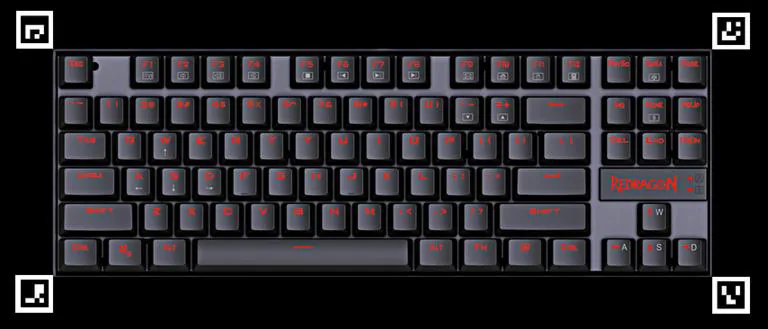
| Autonomous typing | Type a 3–6 letter launch key on a vertically mounted keyboard with no hands on it |
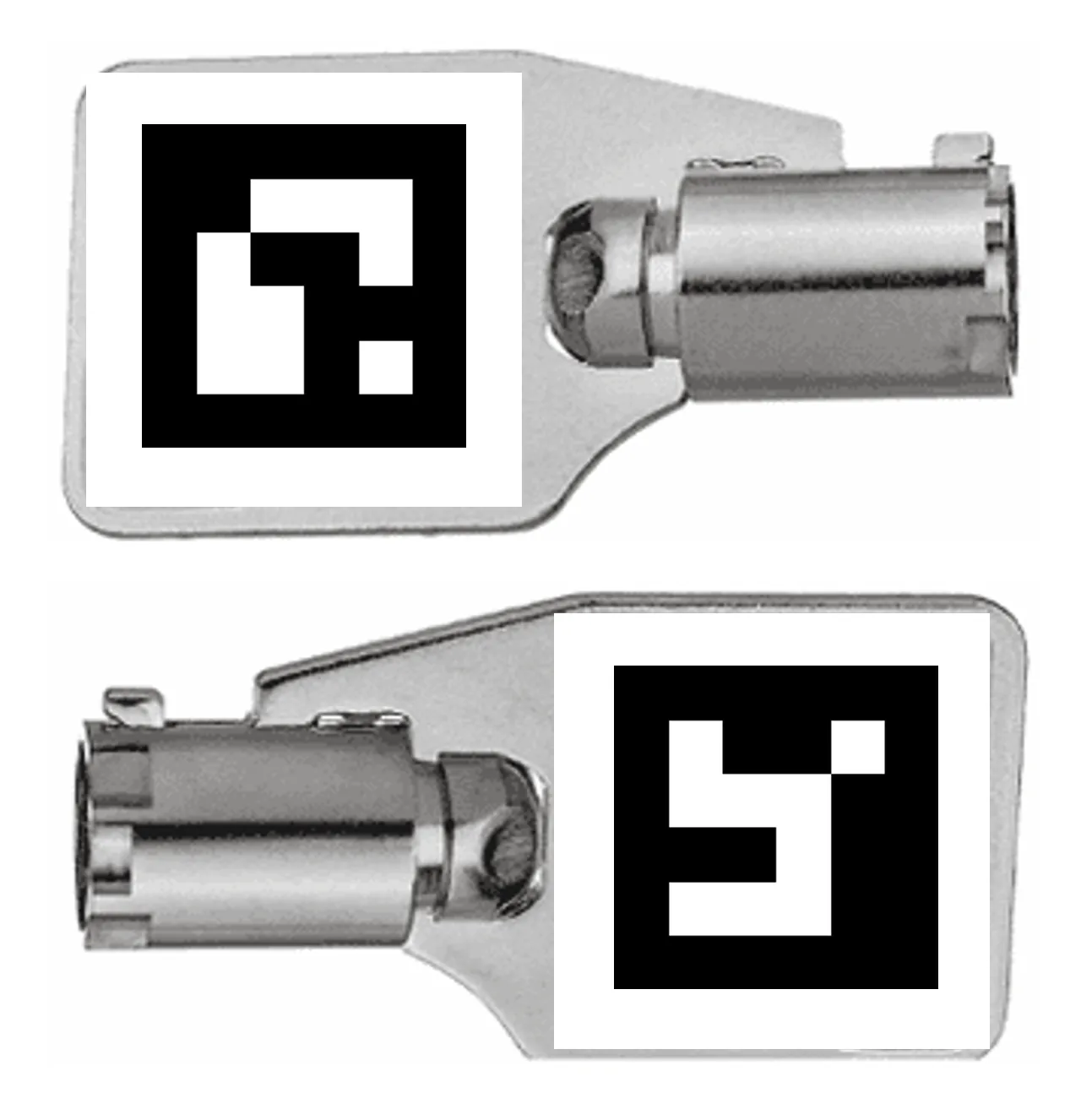
| Key transfer | Remove a key from a panel-mounted tubular pin tumbler lock, insert it into another lock and turn it |
| Hose | Push a 1.5 inch cam-lock fitting on, with the sealing gasket cut to half thickness |
| Valve | Turn a quarter-turn lever handle |
| Controls | Push buttons, flip switches, turn knobs |
The keyboard carries 2 × 2 cm ArUco markers at its corners, and the key and the keyhole face carry 1 × 1 cm markers (§1.d.ii). Typing allows multiple attempts and carries no penalty for aborting, but the operators must be hands-off while the rover types. The rulebook deliberately leaves the task objects unspecified beyond these interfaces; the stated design intent is that every task should be possible for an astronaut with a single gloved hand S-URC27-QA EQ1.
Equipment Servicing may start as soon as 10 minutes after the Autonomy Mission, from the same C2 station (§1.a.iv). A fresh weigh-in and measurement are required inside that window unless the rover is unchanged and already compliant, or the team accepts the same penalty S-URC27-QA EQ4.
Clause 1.e: Autonomy
- The mission runs 40 minutes and holds two 50-point sub-missions, which may be attempted in any order (§1.e.i).
- Astronaut assistance runs the commands Follow, Stay, Fetch, Come and Give, in that order S-URC27-QA AUQ13. The Follow command is graded by modality: a device carried by the astronaut and a visual sign are worth 5 points, spoken audio 10, and a beckoning gesture 15 (§1.e.vi).
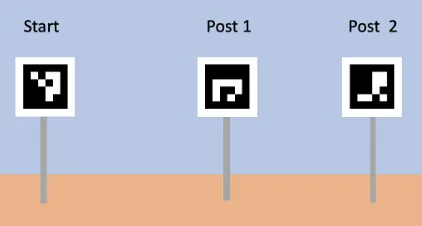
- Route finding sends the rover to two targets, 25 points each, reached by autonomously stopping within 1 m and signalling arrival (§1.e.xvii). One target sits on a hill where not all approaches are navigable, and the second is behind the hill, out of radio line of sight (§1.e.xv; §1.e.xvi).
- Targets are marked with three-sided posts carrying 20 × 20 cm ArUco faces in the 4x4_50 library, with 2.5 cm cells and a one-cell white border, set 0.5–1.5 m above the ground (§1.e.xii).
- A rear LED must show red for autonomous, blue for teleoperation and flashing green on arrival (§1.e.ii). There is no photometric specification, so daylight visibility has to be demonstrated S-URC27-QA AUQ3.
- Programming is allowed while the rover is stopped, including waypoints and stay-out zones, but not while it drives (§1.e.iii).
- Aborting to autonomous stop or return costs 20 % of that task, teleoperating back costs 50 %, and the autonomy-exit penalty is capped at 50 % (§1.e.xi; §1.e.xviii).
- The drone may reconnoitre during astronaut assistance but must land at the designated pad before route finding begins (§1.e.xiv).
Part 2: rover equipment
Part 2 holds the limits that decide whether a rover competes at all, plus the rules for drones and radio equipment.
Clause 2.a: mass and size
Clause 2.a carries the limits that disqualify a rover regardless of how well it drives S-URC27-RULES.
| Constraint | 2027 requirement | Consequence |
|---|---|---|
| Mission mass | 50 kg or less when deployed for any mission | 5 % of points earned per kilogram over, in each mission affected (§2.a.iii) |
| Total fielded mass | 70 kg of all fielded parts | Strict; parts are removed until the total is under (§2.a.iii) |
| Rounding | Weight rounds down to the whole kilogram | 50.9 kg records as 50 kg; 51.0 kg records as 51 kg (§2.a.iii) |
| Stowed size | Inside a 1.2 m cube in any orientation | 40 % penalty at weigh-in (§2.a.ii) |
| Folding | Folding and articulating allowed, disassembly not | Wheels, mast, antenna and every protrusion count (§2.a.ii) |
| After weigh-in | Expand to any size | Only the stowed measurement is limited (§2.a.ii) |
| Weigh-in frequency | Before every mission, during setup | A re-weigh may fall inside the 10-minute Autonomy-to-Equipment window (§2.a.ii) |
| Configurations | May differ between missions | Each configuration at or below 50 kg, total at or below 70 kg (§2.a.iii) |
| Deployed items | Sub-rovers, cameras and relays count toward mass | Spares used to prepare the rover do not (§2.a.iii) |
| Tethers | No tethered power or communications to C2 | Tethers between rover and deployables are allowed (§2.a.i) |
| Start | One rover leaves the gate carrying its deployables, except the drone | Deployables may not be pre-placed (§2.a.i) |
| Air-breathing systems | Prohibited for power or propulsion | Cooling fans and gas from a tank are allowed (§2.a.iv) |
One push button, all power off
The E-stop is a red push button on the exterior, visible and reachable, not a rotating switch. It must stop movement and cease all power draw from every battery in one action, and every rover system must be off afterwards S-URC27-RULES §2.a.v. Any mobile deployable needs its own E-stop; a fuse is enough for a device that cannot move on its own, and the drone is exempt (§2.a.vi).
The size limit is a packaging requirement in practice. By simple geometry, at 250 mm wheels, a 0.9 m wheelbase and a 1.0 m track, a six-wheel rover is already about 1.15 m long and 1.20 m wide before the arm, mast or antenna, which leaves the stowed height and every protrusion to be managed by design rather than by folding.
Clause 2.b: drones
Drone rules apply across missions, and most of them are gates rather than scoring conditions S-URC27-RULES.
- A drone is optional, and full mission points are possible without one (§2.b.i). It may assist Delivery and Autonomy only S-URC27-QA RQ9.
- It must be rotary-wing and able to hover. Lighter-than-air and fixed-wing craft are excluded (§2.b.iii).
- It starts from the designated landing pad and may take off and land again as the judges allow (§2.b.iv).
- It carries an inert dummy mass equal to its battery mass at all times, and the 2027 rules do not waive that in high wind (§2.b.v; §2.b.vi).
- Mass is 5 kg or less including the dummy. A heavier drone may not be used (§2.b.vii).
- The drone is excluded from the rover’s 50 kg and 1.2 m limits (§2.b.vii).
- Wind capability of 48 km/h is strongly suggested, which calls for a top speed of at least 64 km/h (§2.b.vi).
- Flight follows FAA rules: registration above 250 g, Remote ID, a TRUST certificate, below 120 m (400 ft) above ground, class G airspace, no flight in a national park and a visual spotter (§2.b.vii to §2.b.xii).
Clause 2.c: communications and the spectrum
The radio rules apply to every link the team operates S-URC27-RULES.
- There is no wireless internet at the field and satellite internet is not allowed (§2.c.i). Teams set up their own GNSS base station because no correction service is reachable S-URC27-QA RQ11.
- A local repeater or a drone relay is allowed and encouraged S-URC27-QA RQ5.
- 900 MHz operation is limited to 8 MHz of bandwidth inside three sub-bands: 902–910, 911–919 and 920–928 MHz, with the sub-band assigned at the event (§2.c.v).
- The restriction covers every link, including the C2 network, the rover, the drone and the astronaut (§2.c.v).
- The base antenna may be at most 3 m high, its base must be within 5 m of the C2 station, and teams bring at least 25 m of cable (§2.c.iv).
- 2.4 GHz has no URC-specific restriction, and normal radio regulation applies (§2.c.vi).
- Communications documentation and operator licences go to the URC Director by 2027-04-30, and later changes must be reported (§2.c.ii).
- Communications equipment is powered down at event sites when the team is not competing (§2.c.i).
Part 3: the competition
Part 3 holds the calendar, the field, the expense report, the site conditions and the penalty rules.
Clause 3.a: milestones and review gates
The calendar is fixed in the rulebook, and two of its dates are gates rather than deadlines in the ordinary sense S-URC27-RULES.
| Milestone | Date | What it requires | What it controls |
|---|---|---|---|
| Registration | 2026-10-30 | Intent and team details | Eligibility (§3.a.i) |
| Preliminary Design Review (PDR) | 2026-12-02 | Team, resources, project management and design state | Readiness assessment, not scored (§3.a.ii) |
| System Acceptance Review (SAR) | 2027-03-05 | Written and video package | 100 points; the top 36 are invited (§3.a.iii) |
| Communications documentation | 2027-04-30 | Devices, bands and licences | Compliance (§2.c.ii) |
| Science Plan | 2027-05-21 | Written plan expanding the review version | Feeds the Astrobiology score (§1.b.i) |
| Rover Expense Report | 2027-05-26 | Expenses in work-breakdown format; update allowed 2027-06-02 | 10 % of total points per day late (§3.c.ii) |
| Finals | 2027-06-02 to 2027-06-05 | Four missions at MDRS | 4 × 100 points (§3.a.iv) |
The review is not a formality. It is 20 % of the score, and failing to reach the field costs the other 80 % as well. The detail is on Review, judging and awards.
Clause 3.b: the field and the C2 station
The field rules fix what the operators can see, where they sit and when the rover may be touched S-URC27-RULES.
- C2 stations are metal trailer units or MDRS structures with the course view blocked, supplied with 120 V at 60 Hz, tables and chairs (§3.d.i).
- Operators stay in C2, and following the rover for feedback is prohibited (§3.b.iv).
- Attendance at the finals is 24 students and 2 advisors, 14 people on site per day, and no more than 6 students in C2 at once S-URC-LOGISTICS.
- Nothing may be tested at MDRS before, during or after the event. Testing happens in town or in designated off-road areas (§3.d.iv).
- The field schedule is published about a week before the first field day, and task order is drawn per team S-URC27-QA CQ4.
Clause 3.c: the expense report
The financial side of the competition is a submission requirement, and it is enforced with the largest single penalty in the rules.
| Rule | 2027 value |
|---|---|
| Project Budget Table | Required in both the PDR and the SAR (§3.c.i) |
| Final Rover Expense Report | Due 2027-05-26; an updated record may be submitted on 2027-06-02 (§3.c.ii) |
| Late penalty | 10 % of total points per day (§3.c.ii) |
| Missing report | Disqualified if not submitted by the end of the event on 2027-06-05 (§3.c.ii) |
| Cap on fielded equipment | $26,000 of cash spent (§3.c.iii) |
| Inside the cap | Rover, modules, power sources, communications equipment, drone, astronaut EVA suit, base station, antennae, transceivers and all C2 equipment (§3.c.iii) |
| Outside the cap | Travel, accommodation, equipment transport, general hardware, non-fielded prototypes and one-for-one spare parts (§3.c.v) |
| Valuation | Used equipment at as-bought price; reused equipment at original cost or the current cost of an equivalent; rented equipment at purchase cost; donations at full value; shipping and tax included (§3.c.vi to §3.c.ix) |
| Non-US teams | The equivalent of $26,000 at a documented conversion rate between 2026-08-01 and 2027-06-02 (§3.c.x) |
| Receipts | May be demanded (§3.c.xi) |
The report must follow a work-breakdown structure, and URC publishes a template for it S-URC27-REQPAGE S-URC-EXPENSE-TEMPLATE. The template’s top-level nodes run from 0.0 total rover cost through 1.0 frame, suspension and chassis, 2.0 drive and energy, 3.0 electronics and processing, 4.0 command, control and communications, 5.0 arm, 6.0 science payload, and 7.0 miscellaneous parts. Each line carries a manufacturer, a vendor, a unit cost, a quantity and a cost rule that records how the value was obtained.
Two categories the 2027 cap explicitly covers have no node in the published template: the drone and the astronaut EVA suit. A team reporting either has to add a top-level line rather than fold them into miscellaneous parts.
Clause 3.d: site, environment and coordinates
The conditions below hold every competition day S-URC27-RULES.
| Condition | 2027 value | Design implication |
|---|---|---|
| Air temperature | Up to 37.8 °C (100 °F) | Thermal derating, sun load, electronics cooling (§3.d.iii) |
| Dust | Winds frequently lift dust | Sealing, optical cleanliness, filter maintenance (§3.d.iii) |
| Rain | Light rain must be tolerated | Basic ingress protection; no heavy-rain requirement (§3.d.iii) |
| Light | All events in full daylight | Camera dynamic range and a daylight-visible LED (§3.d.i) |
| Altitude | 1,309 m (4,295 ft) at MDRS | Air cooling and fan performance derated S-URC-LOGISTICS |
| Terrain | Soft sand, gravel, stony ground, boulder fields, vertical drops and loose slopes up to 1 km | Traction, tip resistance, ground clearance and suspension travel (§1.c.ii) |
| Coordinates | WGS 84, in decimal degrees, degrees decimal minutes or degrees, minutes, seconds | Site records also need elevation and accuracy range (§3.d.v; §1.b.iii) |
| Testing | Prohibited at MDRS | Terrain and environment must be checked before travel (§3.d.iv) |
Clause 3.e: penalties and interventions
Penalties are fractions of the points earned. They are added together, and the result floors at zero (§1.a.i) S-URC27-RULES.
| Event | Penalty | Applies to |
|---|---|---|
| Overweight rover | 5 % per kilogram over 50 kg | Each mission affected (§2.a.iii) |
| Rover outside the 1.2 m cube | 40 % | That mission (§2.a.ii) |
| Team touches the rover or a deployable | 20 % per intervention, additive | That mission, with the clock running (§3.e.viii) |
| Spectator touches the rover unrequested | Counted as an emergency stop | That mission, with points preserved (§3.e.ii) |
| Operator stops an autonomy task | 20 % on that task | That task (§1.e.xi) |
| Teleoperating back to a visited location | 50 % on that task | That task, capped at 50 % (§1.e.xviii) |
| Physical intervention in Autonomy | 20 % each, not capped by the autonomy limit | That mission (§1.e.xi; §3.e.viii) |
| Late expense report | 10 % of total points per day | Total score (§3.c.ii) |
The autonomy cap is easy to misread. The 50 % ceiling applies to penalties for exiting autonomous mode on a task. A physical intervention is a separate penalty on the mission and is not capped, so one abort and one intervention cost 40 % rather than 20 %.
Some consequences have no stated points value: exceeding 70 kg, a 900 MHz violation, late communications documentation, a chemical spill and contact with the astronaut or an AR post S-URC27-QA S-URC27-QA RQ2 AUQ1. Those are compliance and safety questions that judges handle case by case, and the absence of a formula is not permission to plan for them.
What the rulebook does not fix
A design needs numbers the 2027 rulebook does not publish. Each item below is a real gap in the rules.
- Task weights for three missions. Astrobiology, Delivery and Equipment Servicing each carry 100 points, but only Autonomy publishes task-level values. The four Astrobiology scoring components and the nine Equipment Servicing tasks have no stated weight (§1.b.xi; §1.d.i).
- Delivery stage times and the Stage-1 minimum. The 2027 course description is promised before the competition, and until it appears the stage clock and the gate score are unknown (§1.c.i).
- Slope, step and drop limits. The rules describe the terrain and decline to quantify it. When asked, URC said that multiple routes exist at different inclinations and the values are not provided S-URC27-QA AUQ17.
- Task object dimensions and forces. The sample tube, cache, key, hose fitting, valve, switches and hammer have no published size, mass or force. Judge-like mockups are the only source (§1.d.ii).
- The Equipment Servicing cache. The rules do not say whether the cache the arm carries to the lander is the team’s own Astrobiology cache or a judge-provided one, so the arm has to handle both (§1.d.ii).
- Whether one instrument can satisfy two life detections. The Q&A defines a bioassay and allows a biochemical assay correlated with biomolecule detection, but does not settle whether a single combined instrument counts as both required capabilities S-URC27-QA AQ9.
- The penalty above 70 kg. The rule gives a percentage only for the 50 kg mission limit; the 70 kg total is described as strict with no formula S-URC27-RULES S-URC27-QA §2.a.iii RQ2.
- The 2027 review documents. The PDR, review and Science Plan pages are still pending, and the 2027 rubrics will follow them S-URC27-PDR-PAGE S-URC27-SAR-PAGE S-URC27-SCIPLAN-PAGE.
Further reading
- Missions and scoring turns these clauses into the point values and the penalty arithmetic.
- Review, judging and awards covers the milestones and every document that feeds them in full.
- The 2027 competition places the calendar and the limits in the wider season.
- 155 engineering requirements is the clause-by-clause translation into testable statements.
- The Q&A record collects the rulings that change a design choice.
- Site and field constraints covers travel, altitude and the event site.
Sources for this page
- S-URC27-RULESUniversity Rover Challenge 2027 – Requirements and GuidelinesOriginal Archived copy
- S-URC26-RULESUniversity Rover Challenge 2026 – Requirements and GuidelinesOriginal Archived copy
- S-URC27-QAURC2027 Questions & Answers (updated through 2026-10-11)Original Archived copy
- S-URC-LOGISTICSURC LogisticsOriginal Archived copy
- S-URC27-REQPAGEURC2027 Requirements & Guidelines landing page (Rover Expense Report WBS requirement)Original
- S-URC-EXPENSE-TEMPLATEURC "Template Work Breakdown Structure Financial Report" (Google Sheet)Original
- S-URC27-PDR-PAGEURC2027 Preliminary Design Review (page stub)Original
- S-URC27-SAR-PAGEURC2027 System Acceptance Review (page stub)Original
- S-URC27-SCIPLAN-PAGEURC2027 Science Plan (page stub)Original