The 68-team census
The census is the team list behind every statistic in this part of the reference: 68 teams and 187 team-years drawn from the five official URC score sheets of 2022 to 2026. Each team carries a tier derived only from its results and from whether it publishes design material, never from reputation. The page sets out the rule, the table and the nineteen teams that publish too little to support a profile of their own.
Key takeaways
- The census holds 68 teams over five seasons, and thirteen of them appear in every edition S-CENSUS.
- Sixty-two of the 68 recorded at least one finals result. Of the six that did not, five hold only a SAR-only row and one, UBC Rover, still carries a profile.
- Nineteen census teams have no profile: their public record is a score-sheet line and little more. Eighteen hold at most one finals appearance, and thirteen hold exactly one.
- Tiering depends on results first. Documentation can move a team one band, and only when its results are already close to the band above.
- A zero in the score sheet is not a diagnosis, and a missing season is not a decline. Both readings are explained below.
What the census counts
The unit is a team, not a club name. The census keeps one row per team, with the seasons it appears in a score sheet, its finals results, its best rank, its mean final total and the website that URC listed for it S-CENSUS.
Two counts run through every page of this part:
- 187 team-years. Every row of the five score sheets, 2022 to 2026, after normalising team names.
- 68 teams. The number of distinct programmes those rows resolve to.
Of the 187 rows, 162 record a mission score and count as finals results. The other 25 carry a SAR score and no mission score, so they appear in the census but not in any ranking S-CENSUS.
How the table was assembled
Three properties of the source material matter for anyone using the numbers.
Ranks are derived, not published. No score sheet has a rank column. Each sheet is printed with teams in descending total, followed by teams holding only a SAR score, and the rank in the census comes from that row order among teams with mission scores. This is an inference from the official ordering, not a published field S-CENSUS.
Team names are not stable. The same programme appears under two or three names across seasons: Northeastern University Mars Rover Team, Northeastern Mars Rover Team and Northeastern Mars Rover are one club. Every merge is recorded with the evidence that justifies it, and pairs that look similar but are different teams were deliberately kept apart, such as A.S.T.R.A. of Alabama-Huntsville and Astra Robotics of RV College of Engineering S-CENSUS.
A zero is not a diagnosis. A mission score of zero can mean attempted and failed, did not attempt, or withdrew. The sheets cannot separate those cases, so any causal account of a specific failure comes from a report, a video or a news item, not from the score S-CENSUS.
The tiering rule
The rule is applied mechanically to the census. It uses four inputs per team: best finals rank, number of finals appearances, mean finals rank, and a public-documentation flag.
| Tier | Condition, applied in order | Teams |
|---|---|---|
| A | Any podium in 2022–2026; or a mean finals rank of 6.0 or better over two or more finals; or a best rank of 6 or better with a full public report set | 8 |
| B | Not A, and a mean finals rank of 20.0 or better over two or more finals, or a best rank of 12 or better, or a public documentation page with a finals record | 24 |
| C | Everything else, including every team that never recorded a mission score | 36 |
Tier counts from the census S-CENSUS.
Three features of the rule are deliberate. A team that never reached the finals cannot rise above C, whatever its SAR score, because qualifying is the first test. Documentation never buys a tier on its own: it can move a team one band, and only if that team is already close to the band above. And the inputs are all public, so any team’s label can be recomputed from the score sheets.
The census
The table carries 70 records: the 68 census teams, plus two registered teams that hold no finals result and are profiled because they publish design material. It filters by tier and country, and searches team, university and country.
Fields: team, university, country, tier, seasons in a score sheet, finals appearances, best finals rank and mean final total. The two registered teams carry a registration-only season record and no rank. Tier labels follow the rule above S-CENSUS.
The nineteen teams without a profile
Nineteen census teams carry no dossier. In almost every case the public record is one score-sheet line and a team website, with no design report, paper or code archive behind it. Eighteen of the nineteen hold at most one finals appearance; eight have at least one SAR-only season; five never recorded a mission score at all.
| Team | Country | Seasons in the sheet | What is public |
|---|---|---|---|
| Zeus (Université de Sherbrooke) | Canada | 2022, 17th | Team site |
| RoverOva (VSB-TUO) | Czechia | 2023, 18th | Team site |
| Project Kratos | India | 2022, 20th; SAR-only 2023 and 2024 | Team site |
| MR2 (KAIST) | South Korea | 2026, 22nd | Documentation site |
| BILL-EE (Cal Poly Pomona) | United States | 2024, 23rd | Team site |
| Zenith Space (SeoulTech) | South Korea | 2026, 26th | Team site |
| RoboJackets (Georgia Tech) | United States | 2024, 26th; 2025, 34th | Club site |
| OzU Rover | Türkiye | 2023, 26th; SAR-only 2022 | Documentation page |
| Inferno DTU | India | 2022, 26th | Team site |
| Society of Martian Engineers, Team Sofia (USU) | United States | 2025, 27th | No site listed |
| GTU Rover Team | Türkiye | 2023, 31st; SAR-only 2022 | Team site |
| AAUB Rover71 | Bangladesh | 2026, 34th | Social page |
| NAFT Mars Rover | Japan | 2026, 35th | Project site |
| Team DIANA (Politecnico di Torino) | Italy | 2026, 36th | Team site |
| Team RoverX | India | SAR-only 2023 and 2024 | Team site |
| Team RUDRA (SRM Mars Rover) | India | SAR-only 2026 | Team site |
| Pharaohs Team | Egypt | SAR-only 2022 and 2023 | No site listed |
| AIUB Robotic Crew (ARC) | Bangladesh | SAR-only 2022 | Club site |
| METU ROVER | Türkiye | SAR-only 2022 | Team site |
Seasons, ranks and the public record of each team from the census and the official season lists S-CENSUS. MR2 and OzU Rover each maintain a documentation page, but neither publishes a design report or a paper.
The two teams with a documentation page but no dossier, MR2 and OzU Rover, are the closest to a future profile. The seventeen others are thinner still: at most two seasons on a sheet, usually one, and a website that describes the club rather than the rover.
Teams that never reached the field
The census counts score-sheet rows, so it excludes teams that registered and never appeared in a sheet. That group is large and worth naming, because it carries the strongest evidence about where a season is actually lost.
Fifty-four teams appear on two or more official team lists and in no score sheet from 2022 to 2026 S-CENSUS. Twenty of them registered in three or more editions. SuRover and Titan Rover appear in all five; Sun Devil Robotics, Team Deimos, TrickFire Robotics and UNAM Space appear in four; Berkeley’s BEAR, the Boston University Mars Rover Club, GU Robotics, Maverick Rover Team, Panther Robotics, PROJECT AV, Vicharaka, Boiler Robotics, CU Rover Team, Lehigh University Space Initiative, PolyOrbite, RIT Space Exploration, SJSU Robotics and uORover appear in three each. Several are large, long-running university clubs.
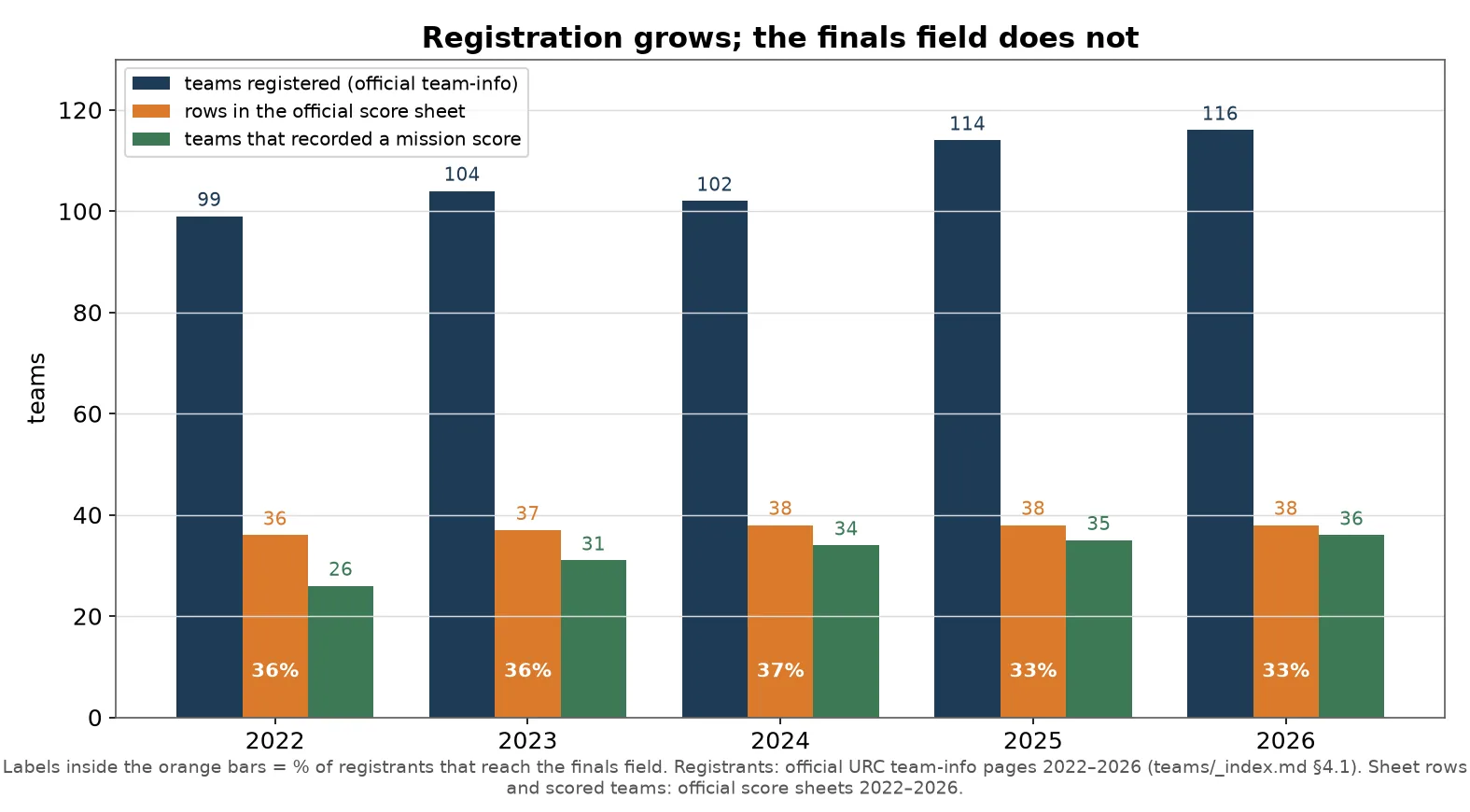
Two readings are consistent with the data. The score sheet may list the invited field, in which case the teams absent from it were cut or withdrew before travelling. Or the sheet may list only teams that recorded a finals result, in which case the SAR-only rows are finalists that withdrew. The 2023 season, where 37 sheet rows match 37 announced finalists, favours the first reading for that year; the other seasons are inferred S-URC23-NEWS.
Why a team is absent cannot be determined from the public record. The possible causes include a SAR that was not submitted, a SAR below the cutting line, a qualified team that could not travel, a withdrawal, or a name that matched nothing in the merge table. The list is therefore not a list of weak teams. It is the clearest available evidence that the binding constraint for a first-time entrant is the desk rather than the desert.
What the census cannot settle
- The rank derivation. A published rank column, or a finalist list for 2022 and 2024–2026, would replace the inferred ordering.
- The Robocol and Ceres question. Both are Universidad de los Andes teams and both appear in the sheets; no document states a rename, so they are counted as two teams S-CENSUS.
- The documentation flag. It records what was reachable on a given day, not a judgement of a team’s engineering. A team can move one band on a second look.
- The missing seasons. URC held no finals in 2020 or 2021, and complete per-mission scores before 2022 were not recovered, so the census covers five seasons rather than the full history S-URC-HISTORY.
Where to go next
- The URC landscape places these 68 teams in the wider field.
- Results explorer, 2022–2026 works the 187 rows directly.
- Team browser filters the same records into cards.
- Team dossiers lists the 51 profiles by tier.