Mission-by-mission backfit
URC 2027 is four field missions and one written gate, and each of the five rewards a different kind of work. These pages take the tasks one at a time: what each physically demands, what the strongest teams did on the equivalent task between 2022 and 2026, whether the 2027 change invalidates that approach, and which subsystem options serve it. One warning governs the whole part. Task weights are published only for Autonomy, so every other point figure below is either an exact Autonomy value or an explicit statement that the weight is not published.
Key takeaways
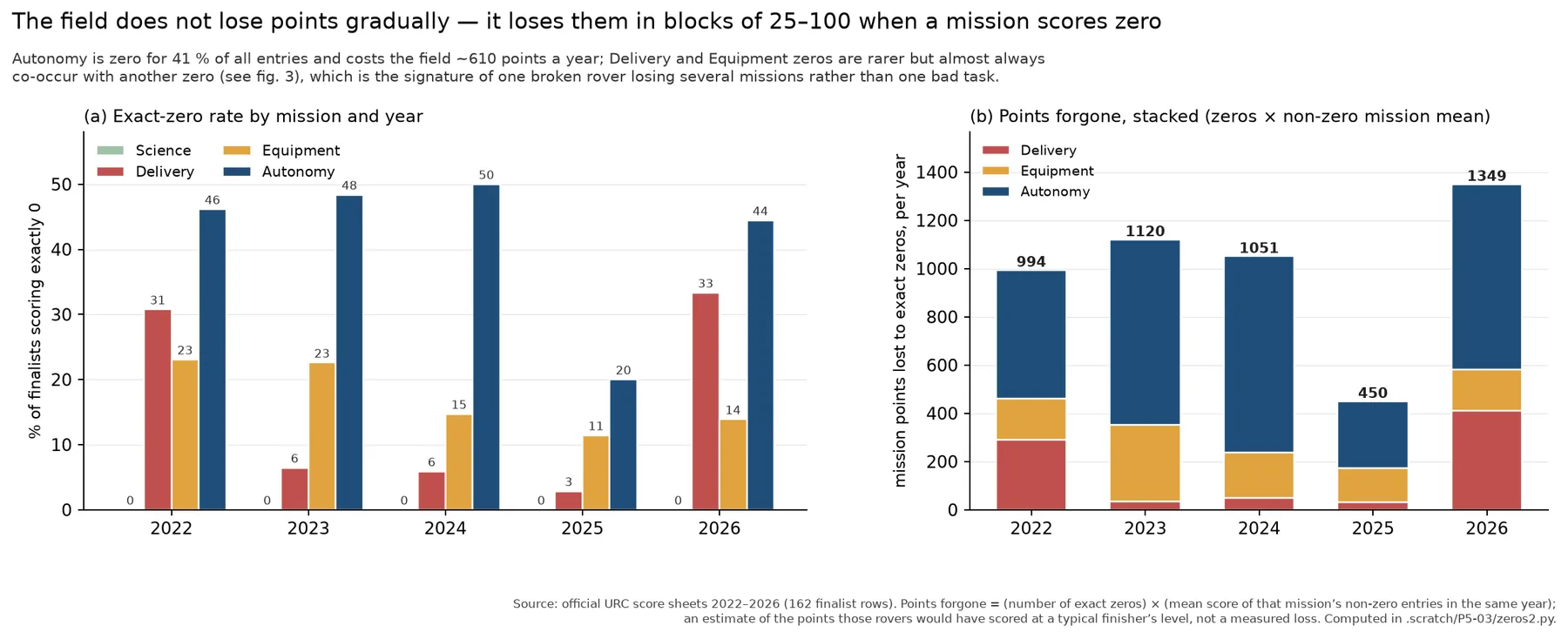
- The four missions have four score shapes, and the shape matters more than the mean. Astrobiology has never produced a zero in 162 team-years. Autonomy produced 67.
- Variance, not average, decides rank. Autonomy explains 30.6 % of finals-total variance, Equipment 27.7 %, Delivery 24.3 %, Science 14.4 % and the SAR 2.8 % S-URC22-SCORES S-URC26-SCORES.
- The cheapest points in the competition are in Autonomy. A team suit with a camera and microphone on a C2 display is 5 exact points for a coverall and a video link S-URC27-RULES §1.e.iv.
- 2027 invalidates more payload than robotics. The bioassay definition, the key-and-lock and hose hardware, and the commanded astronaut interaction are the three genuinely new requirements. The rest carries forward with a raised bar.
The four missions have four score shapes
Across 162 finals team-years from 2022 to 2026, the official score sheets describe not which mission is hardest but how each one distributes its points. Astrobiology is a high-floor, low-ceiling mission. Delivery and Equipment Servicing give broad partial credit but a thin top. Autonomy is close to all-or-nothing.
| Mission | Mean | Median | Exact zeros | Scores ≥80 | Standard deviation | Shape |
|---|---|---|---|---|---|---|
| Astrobiology (Science) | 76.9 | 78.5 | 0 | 46 % | 16.4 | High floor, low ceiling |
| Delivery | 23.6 | 15.0 | 25 (15 %) | 4 % | 22.3 | Bimodal, gate-structured |
| Equipment Servicing | 30.3 | 25.4 | 27 (17 %) | 5 % | 24.7 | Broad partial credit, thin top |
| Autonomy (Autonomous Navigation) | 26.7 | 22.4 | 67 (41 %) | 7 % | 27.8 | All-or-nothing |
| SAR | 88.9 | 89.3 | 0 | 86 % | 4.5 | Compressed, high stakes |
Pooled 2022–2026 finalist scores, derived from the five official result sheets S-URC22-SCORES S-URC23-SCORES S-URC24-SCORES S-URC25-SCORES S-URC26-SCORES. A zero is not always a capability zero: it can be a weigh-in penalty, a no-show or a mission the rover never reached, and the score sheet cannot separate those.
Three readings change how a first build is planned.
- Astrobiology is where a team’s process pays first. No team in 162 team-years scored zero, and the median is about 79 %. A rover that reaches a site, documents it and gives an honest debrief earns credit even when sampling fails, because the debrief happens regardless S-URC27-RULES §1.b.x. The 2027 bioassay is the one new technical gate in an otherwise process-driven mission.
- Delivery and Autonomy are where seasons are lost. Delivery has a Stage-1 gate that turns a slow start into 15/100; in 2023 14 of 31 teams scored exactly 15 S-URC23-SCORES. Autonomy is worse: 41 % of all scores are zero, because autonomy either works or does not.
- The SAR is the least discriminating score and the most important gate. A standard deviation of 4.5 against 16–28 for the missions means a good package cannot win the competition, but a weak one means no field at all, because only the top 36 are invited S-URC27-RULES §3.a.iii.
Caution on 2026 Autonomy
Five teams scored exactly 86.0 in 2026 and nobody scored higher S-URC26-SCORES. That is a rubric ceiling, not 86 % capability, so the 2026 Autonomy column ranks teams but does not measure how much of the task a team could complete.
The master table
Points are exact only in Autonomy; where a 2027 weight is unpublished, the cell says so. Best past evidence cites the highest-scoring team-year observed and, where it matters, the failure that shows the risk is real. The rule or Q&A clause is cited wherever a row turns on a specific clause.
| Task | 2027 points | Required capability | Best past evidence | 2027 design implication | Main risk |
|---|---|---|---|---|---|
| A1 Science Plan | not published | About 5 pages, with background science [AQ1] | Every high-scoring Astrobiology team files one | One owner; due 2027-05-21 | The plan owner is then ineligible for the debrief (AQ8) |
| A2 Two or more sites documented | not published | Panorama with cardinal directions and scale, close-up, GNSS with elevation and accuracy | West Virginia 2025 built this workflow into its science plan | Automated north arrow and scale overlay; a heading source on board | Missing cardinal or scale reference |
| A3 Sample of 10 cm and 5 g | not published | A 10 cm stroke, depth evidence, 5 g from below 10 cm, hard soil | West Virginia 30 cm drill; UIU auger; Monash depth-confirmed 2026 | Body-mounted drill on a linear stage, with a scoop fallback | One rock ends the sample (KARURA 2024) |
| A4 Two life detections, one bioassay | not published | Two orthogonal biomolecule channels S-URC27-QA AQ9 | UIU 2025 Bradford protein (100); West Virginia 2023 chlorophyll (100); Missouri S&T 2022 DNA and protein (96) | Two assays on one detector, with the AQ9 justification written | A 94-point 2026 payload fails AQ9 unchanged |
| A5 Sealed cache and 5-minute handover | not published | No spill when inverted, removable by hand, openable by judges | Unchanged since 2024; no documented URC failure | 50 mL screw-cap in a holster, inversion-tested | Spill; cache trapped by the arm |
| A6 Debrief | not published | Results, depth and contamination, site reasoning, life and habitability, Mars | KARURA 2024 salvaged 74 after losing its sampler | Two staff: a C2-only operator and a debrief speaker | The speaker leaves C2 (AQ8) |
| D1 Stage-1 gate | not published; 2026 proxy 40/100 | Two or three fast tasks banked early | 2023: 14 of 31 teams at exactly 15 | Sequenced by points per minute; the riskiest task does not go first | A 60/100 becomes 15/100 |
| D2 Open a hinged-lid box | not published | Hook or pinch; latch force not measured | Routine where the object comes to the end effector | Non-slip hook; wrist camera on the seam | Lid springs shut; grip slips |
| D3 Pick, carry and deliver 5 kg | not published | About 25 N·m at the shoulder for 5 kg at 0.5 m, estimated; retention over rough ground | West Virginia 2023 8 kg lift for 90; Missouri S&T 2026 Delivery 100 | 100–110 mm jaw plus a hook or pin; carry-pose lock | Dropped object; centre of gravity outside the jaw |
| D4 Read a sign | not published | Character or ArUco recognition at range in sun | Sign reading was a Delivery task 2017–2026 | Zoom lens or drone; a team-owned ArUco fallback | Glare, distance, angle |
| D5 Search a large or poor-radio area | not published | Sweep pattern, detection at range, link survival | West Virginia 2023 found the target with 90 s left (90); Monash 2023 scored 15 | Sweep, detection range and abandon rule fixed before the mission | Search eats the clock; the detector fails outdoors |
| D6 Traverse 1 km with more than half out of sight | not published | 1.0–1.5 m/s on flat gravel, 0.4–0.6 m/s on 25–30°, by inference; a link in terrain shadow | West Virginia 2025 at 1.6 m/s for Delivery 80; BRACU comms rebuild to 61 | Passive six-wheel with printed wheels; a 900 MHz recovery band | Stuck, rollover, link loss |
| E1 Tube into cache, lid, lock | not published | Pinch, insert, close, rotate | ARES 2025 banked several Equipment tasks | A cache designed for one approach pose | Tube dropped; lock torque |
| E2 Cache transport | not published | A 5 kg grasp and a 100 m drive | Missouri S&T 2026 Equipment 100; ARES 10.4 kg lift | Stowed for the drive, or a vibration-proof grasp | Drop during the traverse |
| E3 Drawer open, insert and close | not published | One-axis pull; sub-centimetre insertion | Monash 2022 opened at 32:08 and closed at 32:52 | Compliance or vision in the insertion axis | Friction jam; rover pulled |
| E4 Latch and hinged panel | not published | Release, then hold the panel open | Monash 2022 lost about 9 minutes to two panel closures | An end effector and pose that prop the panel | Panel closes mid-task |
| E5 Autonomous typing | not published | Few-millimetre repeatability, about 0.44 N over 2 mm, 2 cm ArUco, no auto-repeat | Missouri S&T 2026 100 requires it; BYU ViSP; ARES YOLO; UIU 72.63 | Two-stage visual servo and a compliant tip, with each key confirmed | Backlash of 4.4–5.2 mm at 1 m exceeds the target |
| E6 Key in a tubular lock | not published | Grasp a flat key, align to a 1–2 mm keyway with a 1 cm tag in view, then turn | No URC precedent | Chamfered funnel end effector; wrist camera; a tethered key | A dropped key ends the task |
| E7 Cam-lock hose, half gasket | not published | Axial push with compliance and alignment | BYU listed a hose connection in 2026, on hardware without a gasket | An exact half-gasket mock, with force measured against depth | Force and travel unmeasured; jams |
| E8 Quarter-turn valve | not published | 90° rotation, torque not measured | Present 2022–2026; routine | A cheap early score | Lever slips; reach blocked |
| E9 Buttons, switches, knobs | not published | Push, flip, rotate; no manual keyboard contact | Monash 2022 completed all of them | Lowest risk, sequenced first | Wrong button; tip slides |
| F1 Suit with camera and microphone | 5 | Team suit and a live feed on a C2 display | No precedent for a monitored suit feed | Coverall, cooling vest and an analogue 5.8 GHz pod | Feed not on screen means judged absent |
| F2 Drive to the astronaut within 3 m | 5 | Autonomous GNSS waypoint and stop | 2011–2013 required delivery within 1 m from a fix of ±25 m | A stop at 1.5 m internally, with visual acquisition for the last 25 m | Stopping short; base offset |
| F3 Follow! | 15 max: device 5, sign 5, audio 10, gesture 15 | Person tracking on natural terrain, stopping within 3 m | No precedent for a commanded follow | A fallback ladder, so the worst case is 5 and the best 15 | A false positive drives at a person |
| F4 Stay! beyond 20 m | 5 | A latched hold with no creep | No precedent; nearest is a waypoint hold | Planner disabled in the hold; encoder zero-motion check | Drift; a re-plan moves the rover |
| F5 Fetch! the hammer | 10 | Detect and grasp a 0.91 kg, 300 mm steel hammer; teleoperation scores zero | Missouri S&T trained a RockPick class; West Virginia reached the 80th percentile of mAP across four implement classes |
Wide jaw or a hook; lift 100 mm before moving | Low-profile grasp; drag on retract |
| F6 Come! within 3 m | 5 | Drive to a person at least 20 m away and in the field of view S-URC27-QA AUQ7 | No precedent, but the geometry is guaranteed | Person detection or a suit-carried GNSS beacon | Person not detected at 20 m |
| F7 Give! | 5 | Place or drop at ground level | No precedent | Release at 10 cm and confirm on the ground | Still in the gripper at time-out |
| R1 Target 1, on the hill, within 1 m | 25 | A hill route where not every approach is navigable, a 1 m stop and an arrival signal | Five teams at the 86 ceiling in 2026; Missouri S&T used an elevation map and LiDAR; Monash used navfn | Slope costmap; terminal approach at 0.3 m/s; stop at 0.6 × the tolerance | Overshoot; the planner refuses the gap |
| R2 Target 2, out of radio sight, within 1 m | 25 | Autonomous continuation with no link; an arrival LED | No documented intentional out-of-sight run in 2022–2026 | Keep planning on board; never gate the drive on the radio link | One link-status check costs 25 points |
| R3 Penalties and arrival LED | −20 %, −50 %, cap 50 %, physical uncapped | A daylight LED on red, blue and green; hands-off discipline | An LED and hands-off operation were already required in 2026 | LED on the authoritative mode topic, with a sunshade | A judge misses red; a reflex touch |
| S1–S3 SAR report, video and gate | 100 plus the top-36 gate | Evidence for each mission and about one page of science plan [AQ1] | The cut was decided inside a ±3-point band in 2023–2025 | The report maps to the four missions and shows test data | A good rover that never reaches the field |
Where the points actually are
The ranking below is an engineering judgement built from the rule numbers and the score distributions. It is not a rule quantity, and where the 2027 weight is unpublished the entry says so.
| Rank | Capability | Worth | Risk |
|---|---|---|---|
| 1 | EVA suit with camera and microphone | 5 exact | Very low |
| 2 | Short autonomous behaviours: drive, Stay, Come, Give | 20 exact | Low to medium |
| 3 | Astrobiology documentation and debrief | not published; historically the difference between about 40 and about 80 | Low |
| 4 | Equipment cheap tasks: buttons, switch, knob, valve, latch | not published | Low |
| 5 | Follow! by sign or device | 5 exact | Low |
| 6 | Fetch! | 10 exact | Medium |
| 7 | Autonomous typing | not published | Medium to high |
| 8 | Route targets at 1 m | 25 each, exact | High |
| 9 | Gesture Follow! | +10 over the device modality | High |
| 10 | Key in lock | not published | Very high |
| 11 | Cam-lock hose with a half gasket | not published | High |
The sequencing consequence is the largest schedule risk in this part. Two of the three genuinely new 2027 requirements, the bioassay payload and the astronaut interaction, must be demonstrated in the SAR by 2027-03-05, about three months before mission rehearsals can begin. The robotics can improve until June; the assay chemistry, a suit and an operator-training dataset cannot. The schedule must front-load the two least-familiar subsystems and back-load the most familiar ones, which is the opposite of the natural build order.
The ordering that follows
The guaranteed-floor work comes first: documentation, sample, cache and debrief in Astrobiology, and the suit plus the four short autonomous behaviours in Autonomy. That floor is not traded for the high-ceiling work of 1 m route targets, gesture Follow! or the key in the lock.
The mission pages
- Astrobiology mission: the 20-minute clock, the mandatory bioassay and the payload that a 2026 score of 94 would fail.
- Delivery mission: the staged gate, the 5 kg object over 1 km and the task list still to come.
- Equipment servicing: nine task families, millimetre precision and the two hard tasks that change in 2027.
- Autonomy: astronaut assistance: fifty points, five commands and a fallback ladder that spans 5 to 15 points.
- Autonomy: route finding: two targets, one deliberately out of radio sight and a 1 m stop.
- System Acceptance Review: 100 points and the only route to the other 400.
- What 2027 invalidates: the synthesis of what changes, what carries forward and what the schedule has to do about it.
Further reading
- Missions and scoring carries the rule clauses, task lists and deadlines behind every row above.
- What separates the top from the rest derives the variance shares and zero rates used on this page.
- 110 engineering problems turns each design implication in the master table into a task with an acceptance test.
- Mass and power sizes the rover that carries all four missions.
Sources for this page
- S-URC22-SCORESURC2022 Official ScoresOriginal
- S-URC26-SCORESURC2026 Official ScoresOriginal Archived copy
- S-URC27-RULESUniversity Rover Challenge 2027 – Requirements and GuidelinesOriginal Archived copy
- S-URC23-SCORESURC2023 Official ScoresOriginal
- S-URC24-SCORESURC2024 Official ScoresOriginal
- S-URC25-SCORESURC2025 Official ScoresOriginal
- S-URC27-QAURC2027 Questions & Answers (updated through 2026-10-11)Original Archived copy