BYU Mars Rover (Brigham Young University)
Brigham Young University is the best-documented telemetry programme in the field: three peer-reviewed papers on the same rover’s communications architecture, from 2018 to 2025, with measured link figures. Its rover also holds the only perfect science score in 2024 and the best autonomy score in 2025. The record then ends with a 13th place in 2026, an autonomy zero and an equipment score of 22.11, in the same year the team described its most advanced software stack.
What this team shows
- Telemetry is treated as a publishable discipline. Three papers, each with measured numbers, alternatives and a stated list of future work, are the record that makes this team reconstructable at all S-BYU-ITC18 S-BYU-ITC22 S-BYU-ITC25.
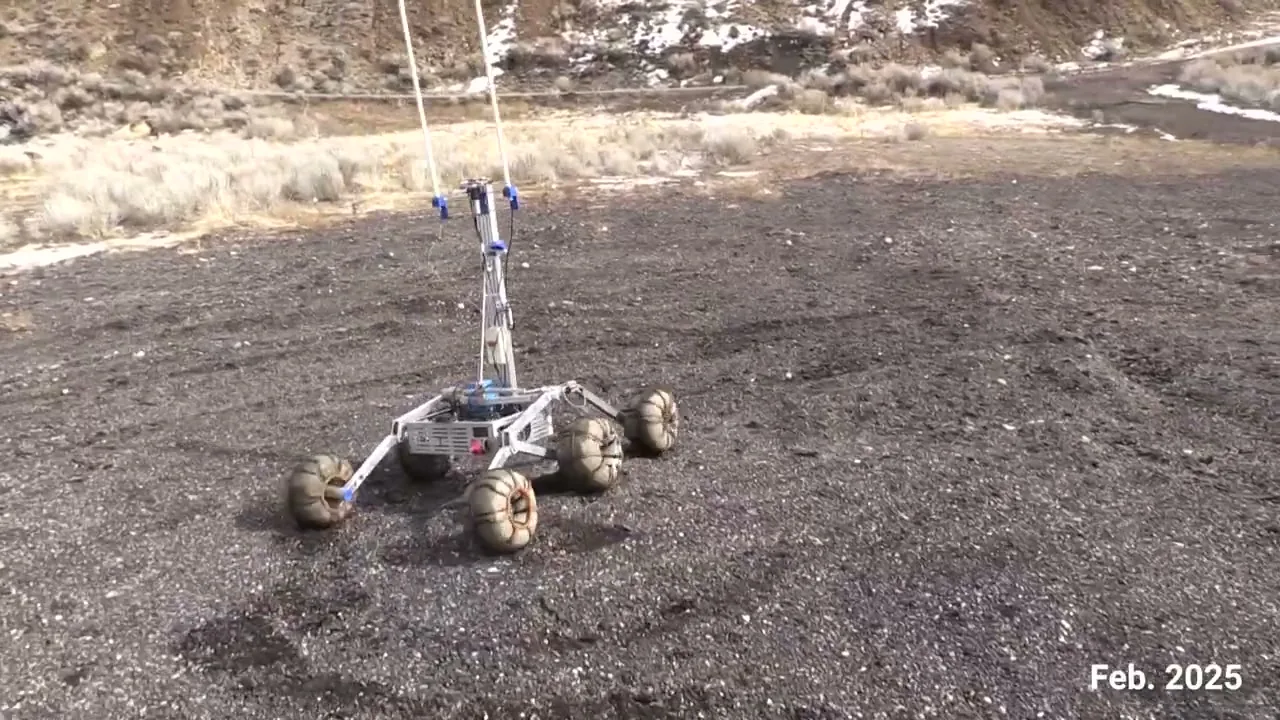
- The mobility answer is cheap and tolerant: six air-filled wheels with moulded tread bands on a folding rocker-bogie. Losing a wheel in 2024 did not stop the run S-BYU-NEWS24.
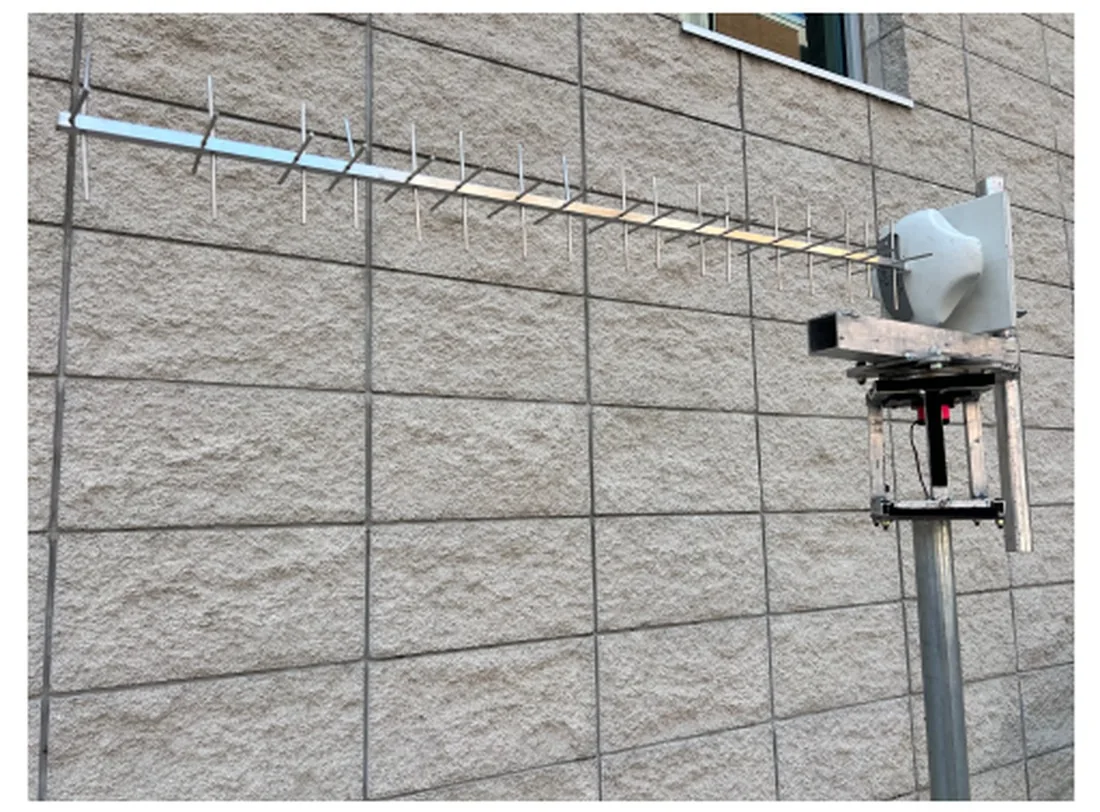
- A servo-tracked Yagi at the base station and 2.5 m dipoles on the rover were reported as the largest single range improvement, because the base antenna is capped at 3 m S-BYU-ITC25.
- The programme is a senior capstone cohort, so the team has documented its own turnover problem since 2018. Results are non-monotonic as a consequence S-BYU-ITC18 S-URC26-SCORES.
Identity and results
| Year | Total | Rank | SAR | Science | Delivery | Equipment | Autonomy |
|---|---|---|---|---|---|---|---|
| 2022 | 268.75 | 9 | 91.55 | 91 | 15 | 18 | 53.2 |
| 2023 | 344.09 | 3 | 87.91 | 99.18 | 15 | 58 | 84 |
| 2024 | 374.24 | 3 | 92.24 | 100 | 45 | 95 | 42 |
| 2025 | 356.76 | 4 | 87.56 | 71 | 53 | 59.2 | 86 |
| 2026 | 248.40 | 13 | 93.29 | 93 | 40 | 22.11 | 0 |
The platform has no name. It is rebuilt each year by a capstone design team and described by the team as a platform built on more than a decade of successive capstone work S-BYU-ITC25. The team placed 4th in 2017 and 5th in 2018, entered the 2022 field in 9th, then ran 3rd, 3rd and 4th before the 2026 fall S-BYU-ITC18 S-URC22-SCORES.
Three claims in the team’s own material were checked against the score sheets and hold: the 2024 perfect science score is the field maximum, the 30.15-point improvement over 2023 matches the printed totals, and the 2025 autonomy score of 86 was the field’s best S-BYU-NEWS24 S-BYU-ITC25. One does not: the papers and the 2026 feature give field sizes of 38 teams where the official sheets show 35 and 36 teams with mission scores S-BYU-ITC25 S-BYU-USG26.
Rover generations
2018 to 2021: the comms generation. The 2018 paper is an electrical team report. The 2017 rover ran 2.4 GHz, which the team judged unreliable out of line of sight, and two tasks were left uncompleted, which drove a move to 900 MHz: a Ubiquiti airMAX Yagi at the base, an 8 dBi omnidirectional antenna on the rover, and Rocket M900 radios. The base antenna was rotated on a Lazy Susan bearing by a 100:1 stepper, and the derived requirements were 10 frames per second and 1 Mbit/s at 1 km plus strong signal at 60° out of line of sight S-BYU-ITC18. A 2020 paper on the same rover class attacks wheel slip with a genetic algorithm and arm geometry error with a constrained kinematic calibration, and names visual servoing as the intended use of the calibration S-BYU-ZENODO20.
2022: the 1.2 m cube rebuild. A new size rule forced the change. Rather than start over, the mechanical team made the wheel assemblies fold inward around the central electrical housing, with a topology-optimised clamp. The height problem was the elevator that gives the arm its vertical range: a 180° belt-and-pulley drive cut that drive’s vertical envelope from 156 mm to 28.35 mm on a rail cut to 1.15 m, reaching a maximum gripper height of 1.531 m while stowing under 1.2 m S-BYU-CORDON. Printed circuit-board antennas were tried for mass and cost and gave over 700 m without consistent line of sight S-BYU-ITC22. Result: 9th.
2023: sensing and the SCARA arm. Aluminium legs and chassis with carbon-fibre arm tubing, a rocker-bogie with folding joints, under 50 kg in any configuration and under 70 kg in total, a 48 V battery, all components controlled through a custom board in the chassis, and a kill switch on the back S-BYU-SAR23. The arm is described fully for the first time: six degrees of freedom in a SCARA layout on a vertical power screw, ground to 1.2 m, 5 kg lift, a gripper to 15 cm, and honeycomb polyurethane pads. Vision is four cameras plus a stereo camera, real-time kinematic GPS, public terrain data, an unscented Kalman filter and a 10 cm waypoint claim, with an LED array signalling red for autonomous, blue for teleoperation and green for complete. Science runs three life-detection tests and four augers. Result: 3rd, science 99.18.
2024: the science year, and the wheels come off. A new science module carries a microscope, cameras, moisture and temperature probes, a sheath drill and auger to 15 cm, and a printed cache that seals below 10 cm, with the fluorescence assay read through the transparent cache wall S-BYU-SAR24. The rover adds an off-the-shelf first-person-view camera on its own 5.8 GHz channel, a custom quadcopter with a 1.3 kg inert mass and 15 minutes of flight, an object detector on bottles and mallets, stereo depth for potential-field avoidance, and a six-axis arm on the central elevator with geared brushless motors. Result: 3rd, science 100 and equipment 95. The same season produced three wheels falling off with the rover still driving, a GPS malfunction during delivery, a blank video feed during servicing, and a science module broken the night before its mission and repaired by 2 a.m. S-BYU-NEWS24.
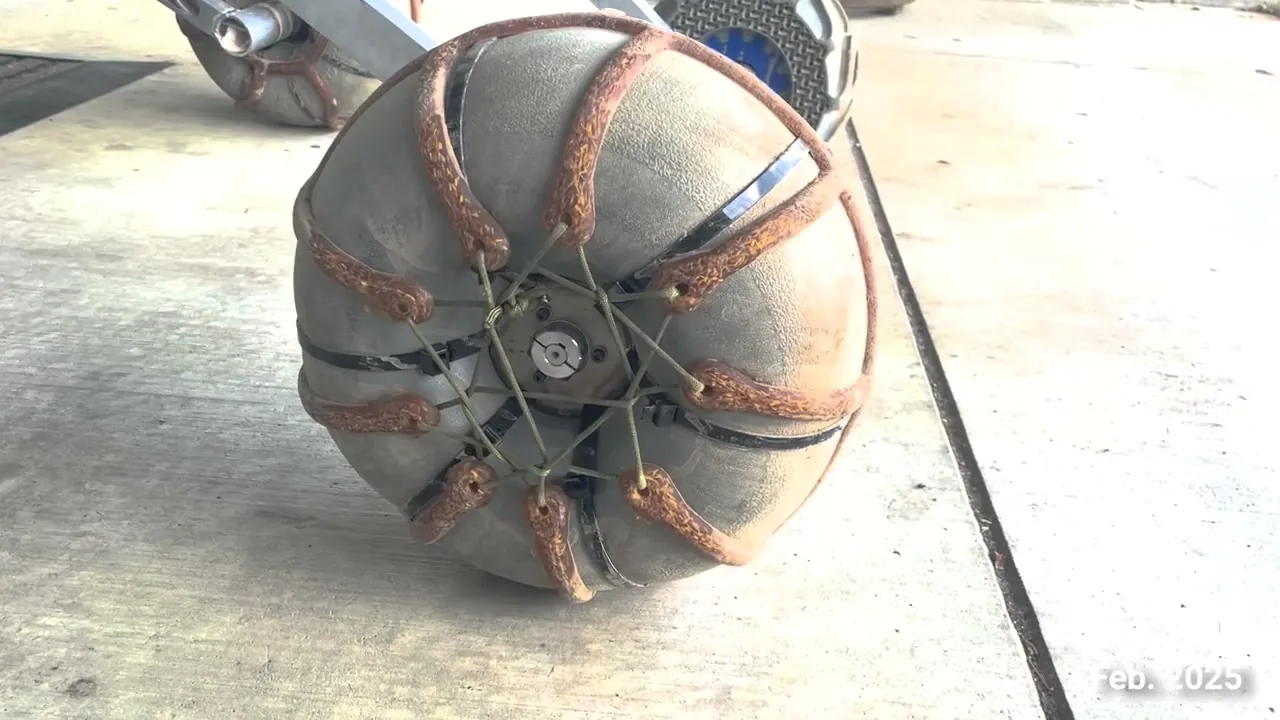
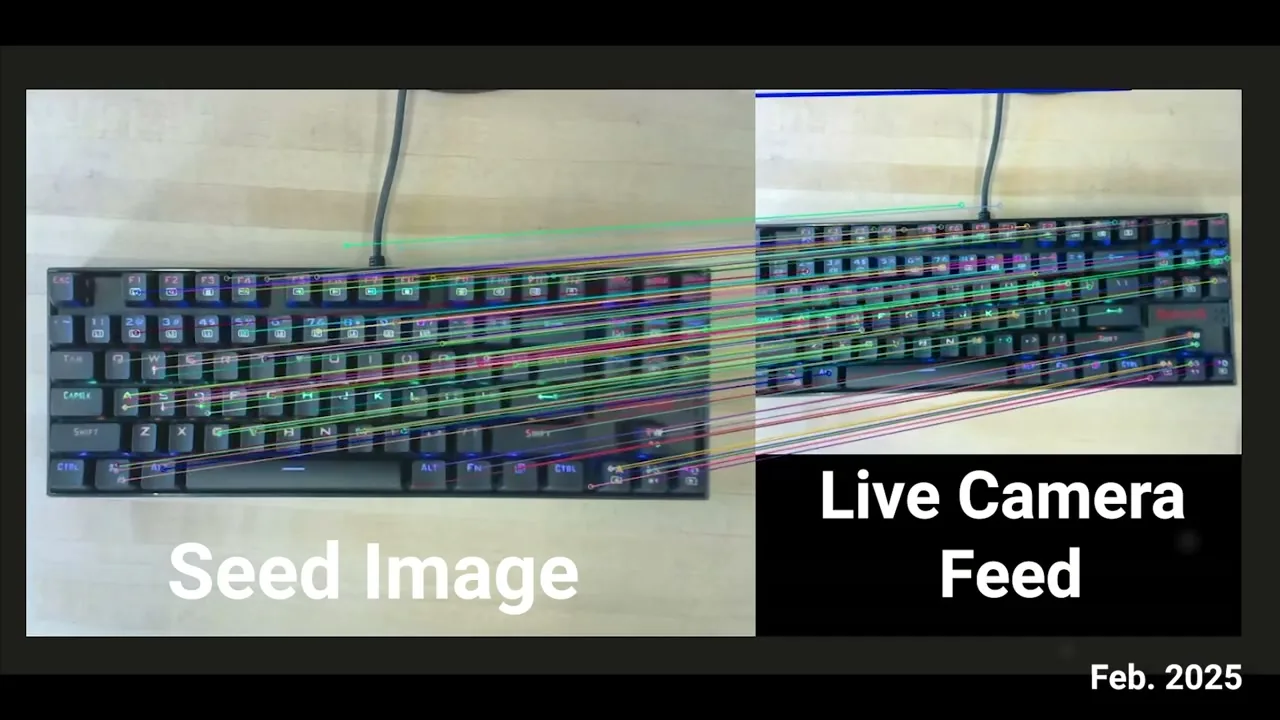
2025: comms, and the wheel fix. Two large dipoles unfolding to 2.5 m replace the circuit-board antennas, and a servo-driven Yagi sweeps and then tracks on measured signal strength. Onboard compute moves to a Jetson Orin, the ROS 1 and ROS 2 networks are bridged over the link with a discovery server, corrections arrive as RTCM3 over TCP, video is encoded in hardware, and the arm belt ratio changes from 1:3 to 1:1 with curved-tooth pulleys. Autonomous typing is demonstrated by mapping seed images to the live camera feed through a homography S-BYU-ITC25 S-BYU-SAR25. The wheel mounts are reinforced by lacing ties through the tread band and around the rim. Result: 4th, autonomy 86.
2026: laptop onboard, Nav2, visual servoing, and a regression. A laptop replaces the Orin, with the argument that it has more compute and a screen and keyboard for debugging in the field. A weight study found the centre of gravity over the arm, so the chassis and electrical box are rearranged to put the heaviest components at the back. A new printed wheel saves 2 kg, the ROS 2 migration finishes, Nav2 replaces a custom A* planner, a Gazebo simulation is added for hazard avoidance, and the object detector moves to a newer model. The arm gets redesigned jaw couplings, a depth camera on the end effector and a USB-C lead in the gripper, and typing moves to an open-source visual-servoing package S-BYU-SAR26. Result: 13th, autonomy 0, equipment 22.11, in the year BYU was one of eight teams asked to present its systems engineering, and after a missing brass arm gear twelve hours before the final task was replaced by a printed part in four hours S-BYU-USG26.
Subsystems
Mobility. Six driven wheels on a rocker-bogie with folding joints, skid steered, with no steering actuator. Speed is quoted at up to 4 km/h for 60 minutes on one pack S-BYU-SAR24. Wheels are air-filled with a moulded polyurethane tread band, laced with ties in 2025 and replaced by a fully printed design in 2026 S-BYU-SAR25 S-BYU-SAR26. The recurring cost is the wheel-to-hub load path: detachment in 2024, lacing in 2025 and a redesign in 2026 is a three-year arc on one joint.
Arm and end-effectors. Six degrees of freedom, counted as five serial joints plus a vertical elevator, in a SCARA layout chosen for horizontal manoeuvrability. The trade is stated by the team: the arm can only move horizontally and depends on the elevator for vertical travel S-BYU-CORDON S-BYU-SAR23. Vertical range is ground to 1.2 m, with a maximum gripper height of 1.531 m after the 2022 elevator redesign. The gripper opens to 15 cm and lifts 5 kg. Autonomous typing has a five-year history: kinematic calibration in 2020, homography matching of seed images to the live feed in 2025, and an open-source visual-servoing package in 2026.
Science. The payload has held two independent capabilities since 2022: a fluorescence assay and a chemical or biochemical test. The 2022 and 2023 versions paired a biuret assay read by a photoresistor with fluorescence microscopy; the 2024 module added moisture and temperature probes and read fluorescence through a transparent cache wall; 2025 added a spectrometer and an ultraviolet sensor; 2026 added a nutrient sensor on a linear-actuator probe S-BYU-ITC22 S-BYU-SAR24 S-BYU-SAR26. Scores run 91, 99.18, 100, 71 and 93, and the 2024 module was broken the night before its mission.
Communications. A Ubiquiti Rocket M9 at each node, running IEEE 802.11 in the 900 MHz band, with the base on an airMAX Yagi in horizontal and vertical polarisation and a servo azimuth mount driven from a display of signal strength, throughput and antenna direction S-BYU-ITC25. The only hard link numbers in the record are from 2018: 2.53 Mbit/s average at 1 km line of sight and 1.4 Mbit/s at 60° out of line of sight, from the radio’s own speed test S-BYU-ITC18. Video runs on a separate 5.8 GHz link with its own receiver. The 2025 paper’s real contribution is software: the rover’s ROS networks are extended over the radio so nodes keep running on local information, and a discovery server replaces multicast discovery to cut start-up latency S-BYU-ITC25. The team states plainly that it still struggled to hold a link when the rover moved beyond the base antenna’s line of sight.
Power and compute. A 48 V lithium-ion pack with a voltage regulator, good for 60 minutes at 4 km/h S-BYU-SAR23 S-BYU-SAR24. All components are controlled through a custom board in the chassis, with microcontrollers for lights, motor drivers, solenoids and sensors, and a kill switch on the exterior. Onboard compute went from a Jetson Xavier to a Jetson Orin to a full laptop in 2026 S-BYU-ITC25 S-BYU-SAR26. Sensors are a stereo camera, several wide-angle cameras, real-time kinematic GPS and an inertial unit, with no rover LiDAR in any year.
Mission performance
BYU’s science scores are the most stable result in its record: never below 71, with 99.18, 100 and 93 in three of the five seasons. The module is rebuilt every year and the score is not, which points at a process rather than at parts: sensor-based site selection, depth-proven sampling and a hand-over cache S-URC22-SCORES S-BYU-SAR24.
Delivery is the persistent weakness, at 15, 15, 45, 53 and 40, and the mission the drone work is aimed at. The drone itself changed direction: a custom quadcopter in 2024, then a commercial model in 2025 and 2026, which is a deliberate cut in integration risk S-BYU-SAR24 S-BYU-SAR26.
The 2026 result is the most instructive number in the dossier. A team that placed 3rd twice and 4th once fell to 13th with autonomy at zero and equipment at 22.11, in the year its review film describes the most sophisticated stack it has fielded. Either the rewrite finished too late or integration failed at the event, and no public source says which S-URC26-SCORES S-BYU-SAR26.
Lessons for a first build
- Instrument the subsystem most likely to end the run, and write down what it achieved. Three papers on one subject are worth more to a later team than a hundred pages of review prose S-BYU-ITC18 S-BYU-ITC25.
- A servo-tracked Yagi is a large win for one servo. Directional gain, one readout and a sweep-and-converge routine also meet the rule that antenna steering must be electronic rather than aimed by watching the rover S-BYU-ITC25.
- Rover antenna height is underrated. Going from flat antennas to 2.5 m dipoles was reported as the biggest range gain, because the base antenna is capped at 3 m, so height on the rover is the remaining lever S-BYU-ITC25.
- Visual-servoing manipulation is a five-year programme, not a feature. Calibration, then homography, then a library. Design the wrist, camera placement and cable routing for it early S-BYU-ZENODO20 S-BYU-SAR25.
- A SCARA arm on an elevator gives 1.2 to 1.5 m of vertical reach from a light arm, and puts the centre of gravity over the arm. BYU found that in 2026 and moved its mass rearward S-BYU-CORDON S-BYU-SAR26.
- Modular payloads are what the 50 kg and 70 kg rules reward. A 33.5 kg base plus two modules under 15 kg each, about 61 kg across all configurations, is the clearest worked example in the field S-BYU-SAR24 S-BYU-ITC25.
- Continuity has to be engineered. A capstone cohort that turns over every year produced 3rd, 3rd, 4th, 13th while describing better software each season S-BYU-ITC18 S-URC26-SCORES.
What remains uncertain
Mass per configuration is inferable but not weighed: 33.5 kg for the base rover, two modules under 15 kg each, and about 61 kg across all configurations S-BYU-SAR24 S-BYU-ITC25. Wheel dimensions, tread pressure, every drive motor and gearbox, and the team size after 2018 are unpublished; only the arm’s geared brushless motors are named.
No design report of any kind is public, so there is no mass budget, power budget or interface document to check the review films against S-BYU-SITE S-BYU-GH. Why autonomy went from 84 to 42 in 2024 and from 86 to zero in 2026, and why equipment fell from 95 to 22.11, is not explained in any source. The 900 MHz link’s channel width and sub-band use are never described, and a spoken claim of 20 MHz bandwidth in the 2025 film is inconsistent with the rule that caps each sub-band at 8 MHz.
Team sources
- marsrover.byu.edu, the team site, with the annual review films.
- Telemetry paper, 2018, the 900 MHz decision and the first measured link figures.
- Telemetry paper, 2022, the circuit-board antennas and the folding-wheel rebuild.
- Telemetry paper, 2025, the dipoles, the servo Yagi and the network architecture.
- Wheel-slip and arm-calibration paper, 2020, the earliest statement of the visual-servoing plan.
- Review film, 2025, the wheel fix and the typing method.
- Review film, 2026, the laptop, the centre-of-gravity fix and the visual-servoing package.
- University news, 2024, the failure list from the podium season.
Sources for this page
- S-BYU-ITC18Rozsa, Averett, Killpack, Rice, "BYU Mars Rover at the 2018 University Rover Challenge", ITC Proc. vol. 54Original
- S-BYU-ITC22Stone, Bronson, Wonnacott, Cordon, Holland, "The BYU Mars Rover and the 2022 University Rover Challenge", ITC Proc. vol. 57Original
- S-BYU-ITC25Durrant, Meyers, Spigarelli, "BYU Mars Rover Telemetry in the 2025 University Rover Challenge", ITC Proc. vol. 60Original
- S-BYU-NEWS24Williams, E., "BYU Mars Rover Team places 3rd at University Rover Challenge"Original
- S-URC26-SCORESURC2026 Official ScoresOriginal Archived copy
- S-URC22-SCORESURC2022 Official ScoresOriginal
- S-BYU-USG26Olson, K., "Brigham Young University Mars Rover Team Competes at 2026 University Rover Competition"Original
- S-BYU-ZENODO20Johnson, Liao, Vasquez, "Optimizing the Approach to the Extreme Retrieval Mission for BYU Mars Rover", J. Optimization Projects 1(1)Original
- S-BYU-CORDONCordon, D., "BYU Mars Rover" capstone portfolio page (2022 folding-wheel and elevator redesign)Original
- S-BYU-SAR23BYU Mars Rover, System Acceptance Review (SAR) URC 2023 (4:54)Original
- S-BYU-SAR24BYU Mars Rover, System Acceptance Review (SAR) URC 2024 (5:00)Original
- S-BYU-SAR25BYU Mars Rover, URC 2025 System Acceptance Review (video; Maxon sponsor credit)Original
- S-BYU-SAR26BYU Mars Rover, URC 2026 System Acceptance Review (video; ViSP typing, wrist depth camera)Original
- S-BYU-SITEBYU Mars Rover team site (SAR videos only; no payload description)Original
- S-BYU-GHGitHub account byu-mars-rover, 0 public source repositoriesOriginal