Start here
This book is a reference for a university team preparing a rover for the 2027 University Rover Challenge. It answers three questions in order: what the competition asks for, what the strongest teams built and what happened to them, and which design choices survive a first build. It does not design the rover, but every number it states has a source, a sample and a year.
Key takeaways
- The 2027 rules add two requirements that shape a first season: two life-detection capabilities, at least one of them a bioassay, and an Autonomy Mission that begins with a walking, suited astronaut S-URC27-RULES §1.b.v §1.e.
- The System Acceptance Review carries 100 of the 500 points and admits the top 36 teams to the field, so it is a qualification problem before it is a writing task S-URC27-RULES §3.a.iii.
- The limits did not move while the work grew: 50 kg in every deployed configuration, a 1.2 m cube at weigh-in, an average draw near 249 W and a peak near 3.7 kW S-URC27-RULES §2.a.ii.
- The first four things worth doing are measurements, not designs. Task forces, soil strength, step height and link range are not published, and each one frees several later decisions.
What the book answers
The competition is public and the rules are detailed. The difficult question is selection: of the hundreds of designs a team could build, which ones finish four very different missions inside the same 50 kg? The book answers that question from the public record rather than from opinion.
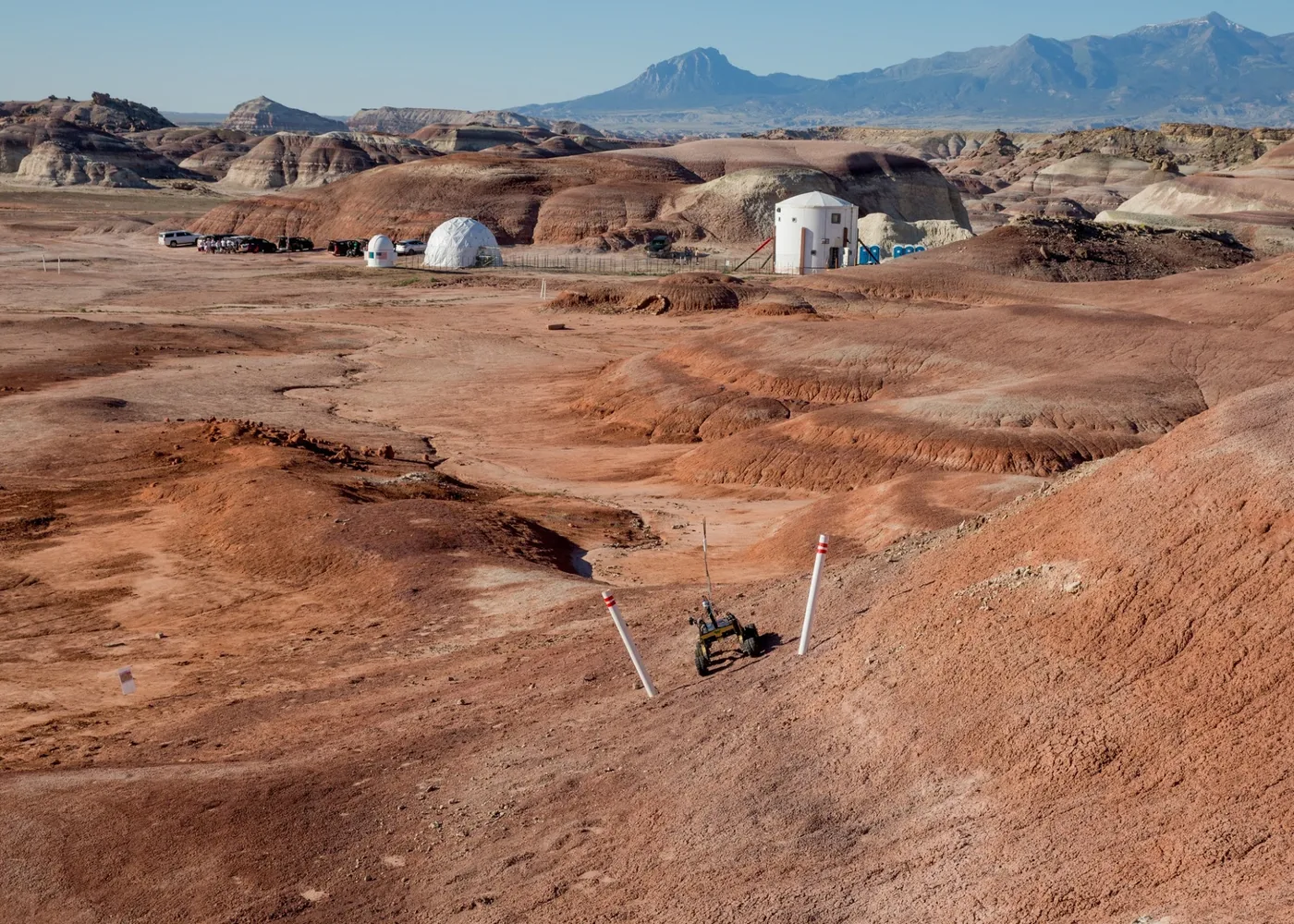
The four 2027 missions ask for incompatible things. Astrobiology wants instruments, wet chemistry and a contamination-controlled sample path. Delivery wants a strong arm, a rough-terrain drive and a staged clock. Equipment Servicing wants millimetre precision on a keyboard and a cam-lock hose. Autonomy wants a rover that can route-find alone and then follow a person in a suit. Every one of them is graded inside a time limit, at 1,309 m altitude, in dust and full sun.
How the book is organised
Eleven parts, read in any order after the executive summary. Each part stands alone, and each page ends with the sources it used.
| Part | What it gives | Start with |
|---|---|---|
| Front matter | The summary, the reading paths and the calendar | Executive summary |
| The competition | The four missions, 500 points, the hard limits, 155 requirements, the Q&A rulings | The 2027 competition |
| The field | 68 teams in the census, results from 2022 to 2026, 51 dossiers | The URC landscape |
| Subsystems | Twelve studies with comparison tables, failure modes and shortlists | Mobility |
| Cross-cutting analysis | Mass, power, 66 interfaces, failure record, what separates the top from the rest | Cross-cutting analysis |
| Mission backfit | Each mission and task against what the best teams did | Mission-by-mission backfit |
| The build plan | 110 problems in five waves, 70 risks, 77 open questions, the first 90 days | From analysis to build |
| Statistics | Every headline number with its sample, period and chart | Key numbers |
| Media | All 307 assets and the video library | Gallery |
| Sources and reference | 1,251 registered sources, the archived primary documents, the glossary | Bibliography |
| About | The evidence grades, the downloads and the reuse terms | About the evidence |
Where to begin
Four entry points cover most readers, and the reading paths by role page expands each into an ordered list.
- A new member starts with the executive summary, then reads the 2027 competition and missions and scoring. About six hours of reading gives the shape of the problem.
- A subsystem lead starts with the page for that subsystem, then checks the choice against interfaces and couplings and how rovers fail, then reads the dossiers of the teams that built each option.
- A systems lead starts with mass and power, then the problem register and the risk register. The cross-cutting analysis is the spine that holds the twelve subsystem pages together.
- A reviewer or guest starts with key numbers, then the bibliography and about the evidence to see how each value was derived and how strong the record is.
Reading conventions
Every non-trivial factual claim carries a source identifier such as S-URC27-RULES, which links to a row in the bibliography with a title, publisher, date and an original link. A rule reference such as <a class="clause" href="competition/rules.html#clause-2a">§2.a.ii</a> opens the matching clause on the rules page, and a Q&A identifier such as RQ11 opens the Q&A page.
Identifiers are stable across the book. Requirement identifiers look like <a class="ref" href="competition/requirements.html#req-req-mob-004">REQ-MOB-004</a>, engineering problems like <a class="ref" href="plan/problem-register.html#prob-w1-03">W1-03</a>, risks like <a class="ref" href="plan/risk-register.html#risk-r-t01">R-T01</a> and trade studies like <a class="ref" href="missions/coupling-and-trades.html#trade-t-06">T-06</a>; each links to the register that owns it. Years are explicit, samples are stated next to distributions, and a figure that is an estimate says “estimated” or “by inference” rather than borrowing authority it does not have.
Units follow one form throughout: 12 % with a space, × for dimensions, ≈ for approximations, ≥ and ≤ for bounds, and ranges written 2022-2026. Values are not rounded for neatness: a requirement of 7.72 N·m is not printed as 7.7 N·m.
The about the evidence page explains the four evidence grades, the citation form, and the places where the public record is thin.
What the book does not do
It does not design the rover, cost the build, or schedule the season for any particular team. Those are the team’s work, and the book stops at the requirements, the options, the numbers and the trades.
Three limits matter when reading:
- The 2027 task weights for Astrobiology, Delivery and Equipment Servicing are not published. Any statement that depends on them says so, and the Autonomy Mission is the only one with published sub-task point values S-URC27-RULES §1.e.iv.
- The 2027 SAR and Science Plan specifications were not published when this edition was prepared; the 2026 documents are used only where they are labelled as such S-URC27-SAR S-URC27-SCIENCEPLAN.
- Few teams publish a mass or a centre of gravity, so the mass model is a model of the field rather than a measurement of any one rover.
Where to go next
- Executive summary states the ten findings, the ten decisions and the eight main risks in about twenty minutes.
- Deadlines and milestones sets the calendar, from registration on 30 October 2026 to the finals in June 2027.
- Key numbers is the one-page sheet of every headline value.
- The first 90 days turns the findings into an ordered sequence of measurements.
Sources for this page
- S-URC27-RULESUniversity Rover Challenge 2027 – Requirements and GuidelinesOriginal Archived copy
- S-URC27-SARURC System Acceptance Review page, states "URC2027 SAR Requirements will be posted in early 2027!"Original
- S-URC27-SCIENCEPLANURC Science Plan page, states "URC2027 Details will be posted in early 2027!"Original