Competition structure
The 2027 competition awards 500 points: four missions at 100 each plus the System Acceptance Review at 100 S-URC27-RULES §1.a.i. Mission scores cannot fall below zero, and penalties multiply the points actually earned rather than the 100-point maximum. That single rule means the same penalty costs a strong team more than a weak one. This page states the structure, the points per minute of each mission clock and the dates that decide whether a team reaches the field at all.
Key takeaways
- The five components are equal in maximum points and unequal in effect. Each mission and the review are worth 100, yet Autonomy, Equipment Servicing and Delivery explain 83 % of the variance in finals totals and the review explains 2.8 % S-URC-RESULTS.
- A penalty scales with success. Being 2 kg heavy costs 10 % of the points scored, so it is cheapest on a mission that was going badly anyway S-URC27-RULES §2.a.iii.
- The review is the gate. About one registered team in three is invited, and a team outside the top 36 has no field score at all S-URC27-RULES §3.a.iii.
- Autonomy carries the largest capability cliff. A rover that never operates autonomously forfeits 95 of the 100 Autonomy points and has a hard ceiling of 405 of 500 S-URC27-RULES §1.e.
The five components
Mission scores are independent and cannot go below zero. Penalties are additive percentages applied to each mission’s earned points, so a 10 % and a 20 % penalty leave 70 % of what was earned. The expense-report penalty is a total-score administrative penalty rather than a mission penalty.
| Component | Clock | Points | What is scored |
|---|---|---|---|
| Astrobiology | 20–30 min, plus 5 min cache removal | 100 | Two sites, sampling, life-detection analysis and documentation S-URC27-RULES §1.b.ii |
| Delivery | 30–60 min total | 100 | Cargo handling, a marked path and precise positioning S-URC27-RULES §1.c.i |
| Equipment Servicing | 30 min, including up to 100 m of travel | 100 | Fifteen or more dexterous operations on a lander mock-up S-URC27-RULES §1.d.i |
| Autonomy | 40 min | 100 | Astronaut assistance at 50 and route finding at 50 S-URC27-RULES §1.e.i |
| System Acceptance Review | Desk review over the season | 100 | Video, report and judges’ assessment S-URC26-SAR |
The 2027 task weights for Astrobiology, Delivery and Equipment Servicing are not published, so the published per-task values exist only for the Autonomy mission. The 2027 review rubric is scheduled for early 2027 and was not available for this analysis S-URC27-SAR.
Points per minute of mission clock
Low point density is not the same as an easy mission: Autonomy’s points sit in a small number of hard targets. The density measures time pressure, not difficulty.
| Mission | Clock | Available points per minute | Reading |
|---|---|---|---|
| Astrobiology | 20–30 min | 3.33–5.00 | The most time-dense mission: design for the 20-minute case |
| Delivery | 30–60 min | 1.67–3.33 | 2026 ran 35 plus 20 minutes, a realised 1.82 points per minute |
| Equipment Servicing | 30 min | 3.33 | Many small tasks, each worth a fraction of the mission |
| Autonomy | 40 min | 2.50 | Two sub-missions of 50 that may be attempted in either order |
What a capability is worth
The Autonomy mission publishes its full point breakdown, which makes it the clearest statement of value in the rules.
| Task | Points | Condition |
|---|---|---|
| Suit camera and microphone at the command station | 5 | No autonomy required |
| Autonomous drive to the astronaut | 5 | Stop within 3 m |
| Follow | 15 | Gesture 15, audio 10, device or sign 5, as alternatives |
| Stay | 5 | Rover holds while the astronaut moves more than 20 m away |
| Fetch | 10 | Autonomous pick-up; teleoperation scores zero |
| Come | 5 | Autonomous return, stop within 3 m |
| Give | 5 | Autonomous placement of the implement |
| Route target 1 | 25 | Autonomous stop within 1 m |
| Route target 2 | 25 | Same, behind the hill and out of radio line of sight |
A teleoperation-only rover keeps the 5 suit points and forfeits 95. The arithmetic ceiling is 405 of 500 before any loss of Equipment Servicing typing points S-URC27-RULES §1.e.
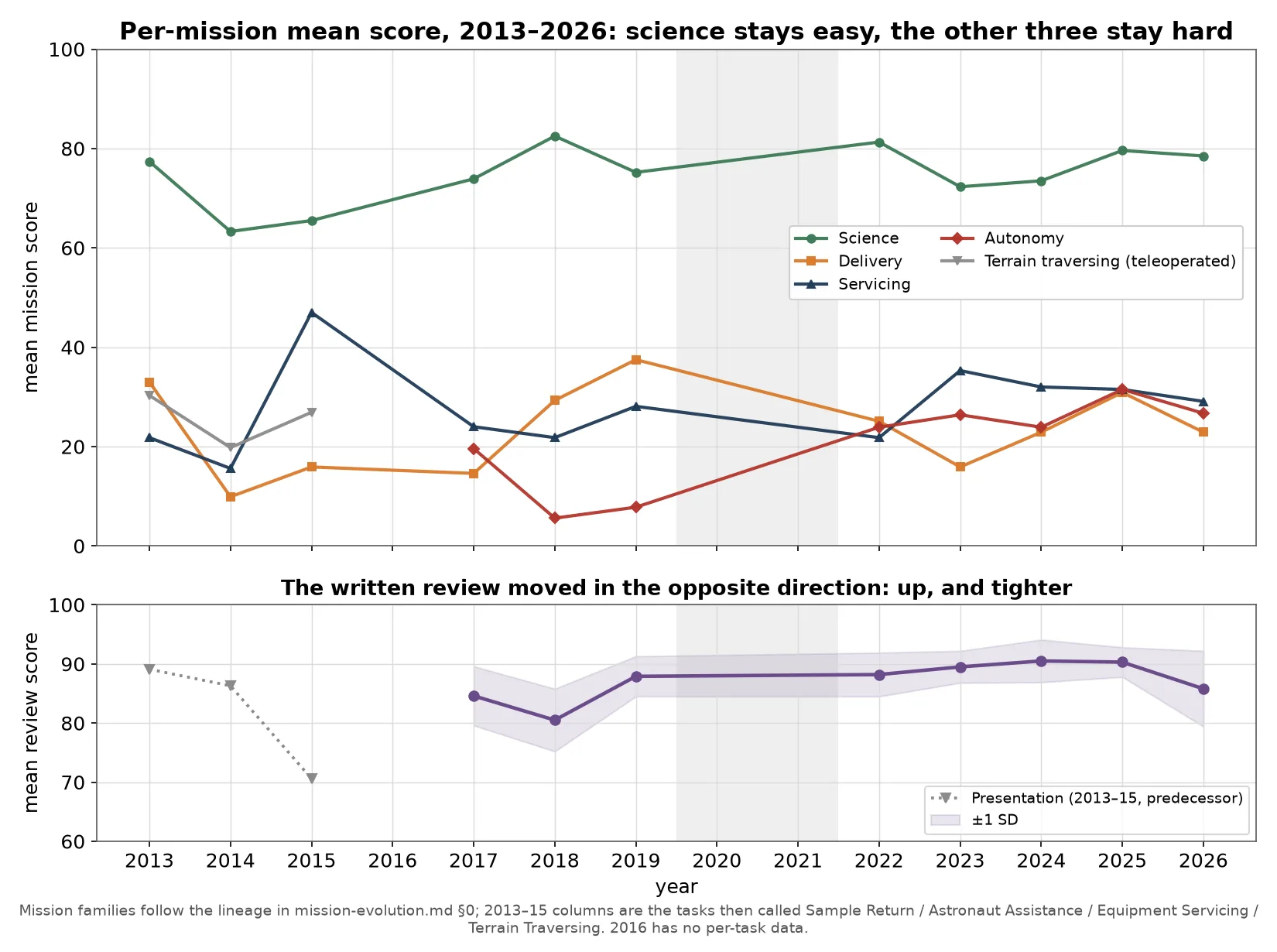
The interactive view uses the 2022–2026 score sheets only, where all four mission families carry the same names and the same 100-point maximum S-URC22-SCORES S-URC26-SCORES.
Penalties
The mass penalty is 5 % of the points scored in the event per whole kilogram over 50, with weight rounded down before the penalty is applied S-URC27-RULES §2.a.iii. The stowage penalty is larger: a configuration that does not fit the 1.2 m cube costs 40 % of that event S-URC27-RULES §2.a.ii, the equivalent of 8 kg of overweight at the same score.
| Overweight | Penalty | Loss at 100 points | Loss at 50 points |
|---|---|---|---|
| 1 kg | 5 % | 5.00 | 2.50 |
| 2 kg | 10 % | 10.00 | 5.00 |
| 3 kg | 15 % | 15.00 | 7.50 |
| 4 kg | 20 % | 20.00 | 10.00 |
Deadlines for 2027
| Date | Milestone | Clause |
|---|---|---|
| 2026-10-30 | Registration closes | §3.a.i |
| 2026-12-02 | Preliminary Design Review | §3.a.ii |
| 2027-03-05 | System Acceptance Review | §3.a.iii |
| 2027-04-30 | Communications documentation | §2.c.ii |
| 2027-05-21 | Science Plan | §1.b.i |
| 2027-05-26 | Rover Expense Report, with an update allowed to 2027-06-02 | §3.c.ii |
| 2027-06-02 to 2027-06-05 | Finals | §1.a.i, §3.a.iv |
The values on this page
| Statistic | Value | Definition | Period | Sample | Source | Chart and chapter |
|---|---|---|---|---|---|---|
| Total score | 500 | Four missions plus the review | 2027 | Rules | S-URC27-RULES §1.a.i | Missions and scoring |
| Mission floor | 0 | A mission score cannot be negative | 2027 | Rules | S-URC27-RULES §1.a.i | Missions and scoring |
| Invited field | 36 | Highest review scores invited | 2027 | About 116 registrations | S-URC27-RULES §3.a.iii | Review and judging |
| Mass penalty | 5 % per kg | Of points scored in the event | 2027 | Rules | S-URC27-RULES §2.a.iii | Rules, limits and the field |
| Stowage penalty | 40 % | For exceeding the 1.2 m cube | 2027 | Rules | S-URC27-RULES §2.a.ii | Rules, limits and the field |
| Review weights | 48 / 40 / 12 | Video, report, judges | 2026 | 2026 review | S-URC26-SAR | Review and judging |
Evidence note
The scoring structure is fixed by the 2027 rules, so there is no sample to state beyond the rulebook itself. The points-per-minute figures are arithmetic on the published mission clocks and are not a statement about difficulty. The three 2026 review weights are used because the 2027 rubric is not yet published.
Sources for this page
- S-URC27-RULESUniversity Rover Challenge 2027 – Requirements and GuidelinesOriginal Archived copy
- S-URC-RESULTSURC official scores 2022–2026, compiled CSVPrint copy
- S-URC26-SARURC2026 System Acceptance Review Requirements + SAR Q&AOriginal
- S-URC27-SARURC System Acceptance Review page, states "URC2027 SAR Requirements will be posted in early 2027!"Original
- S-URC22-SCORESURC2022 Official ScoresOriginal
- S-URC26-SCORESURC2026 Official ScoresOriginal Archived copy