title: Astronaut interaction and the EVA suit description: Fifty points built on a human: the Follow! ladder, the suit heat limit, and a safety case where contact costs nothing but an intervention ends the run. part: Subsystems chapter: "4.12" toc_depth: 3 tags: - astronaut - eva-suit - human-robot - autonomy
Astronaut interaction and the EVA suit
The Autonomy Mission asks a rover to find a suited person, obey them, follow them and hand them a pick, which makes a human both the commander and the target of the same system. This is new for 2027: nine years of earlier tasking cover finding a person and none of it covers obeying one. Three things decide the 50 points, and none of them is the rover’s hardware: the Follow! ladder, the heat inside the suit, and a safety case that inverts the usual incentive.
Key takeaways
- Follow! is priced by method, not by capability: 15 points for a gesture, 10 for a spoken word, 5 for a sign and 5 for a device, and the four do not stack S-URC27-RULES §1.e.vi. The entire modality choice is therefore a 10-point swing out of 50.
- A ladder, not a rung, is the design. Switching methods inside the mission is allowed and encouraged S-URC27-QA AUQ6, so a design that attempts gesture, falls back to audio and ends at a button adds probability at each step and can never subtract points.
- Contact carries no points penalty, and that is the trap. An unrequested intervention counts as an emergency stop and terminates the mission S-URC27-RULES §3.e.ii, so the real cost of driving too close is every remaining point in both sub-missions.
- The suit is an integration problem, not a costume. Heat is the failure mode, and a consumer digital video unit shuts itself down after five minutes at 35 °C S-DJI-O3, inside a suit during a 14-minute task.
What the subsystem must do
The sub-mission delivers 50 of the Autonomy Mission’s 100 points inside a shared 40-minute clock S-URC27-RULES §1.e.i. The rover drives to a suited team-mate, is commanded by them through five ordered commands, follows them, waits while they walk more than 20 m away, fetches a rock pick from the ground, returns and gives it back S-URC27-RULES S-URC27-RULES §1.e.iv §1.e.x. Four of the five commands are worth 5 points each and Follow! is where the margin sits.
| Element | Points | Earned by | Fails if |
|---|---|---|---|
| Suited astronaut with camera and microphone | 5 | A suited figure plus a live feed on a station display | The feed exists but is not monitored in the station |
| Drive to the astronaut | 5 | An autonomous stop within 3 m of the given point | Teleoperated, or a stop beyond 3 m |
| Follow! | 5–15 | The method used, then a stop within 3 m of the stopping astronaut | Command not recognised, target lost, final stand-off too large |
| Stay! | 5 | No motion while the astronaut walks more than 20 m away | Drift, creep, or a re-plan that moves the rover |
| Fetch! | 10 | An autonomous grasp and lift of the pick from the ground | A teleoperated grasp scores zero; a dropped pick fails |
| Come! | 5 | An autonomous drive to the astronaut, stopping within 3 m | Obstacles, overshoot, or a stop beyond 3 m |
| Give! | 5 | The pick placed on the ground or dropped | The pick is left in the gripper when time expires |
The command order is fixed S-URC27-QA AUQ13, and every command except the first drive originates from the astronaut S-URC27-QA AUQ7. The first drive is the only point in the mission where the station may choose a destination, and the walk route may never be known to it at all, because the judges show the approximate locations to the astronaut during setup S-URC27-QA AUQ14.
The numbers that size the design
The heat and wind rows come from an open weather archive. The ladder, stand-off and expectation rows are engineering estimates from stated parameters and are marked as such where they appear.
| Quantity | Value | Basis |
|---|---|---|
| Follow! ladder | gesture 15 · audio 10 · sign 5 · device 5, maximum 15 | The method sets the value and the methods do not stack S-URC27-RULES §1.e.vi |
| Expected value per person-week | sign 3.5 · device 3.2 · audio 2.0 · gesture 1.0 | Points multiplied by an assumed success probability, over an effort estimate |
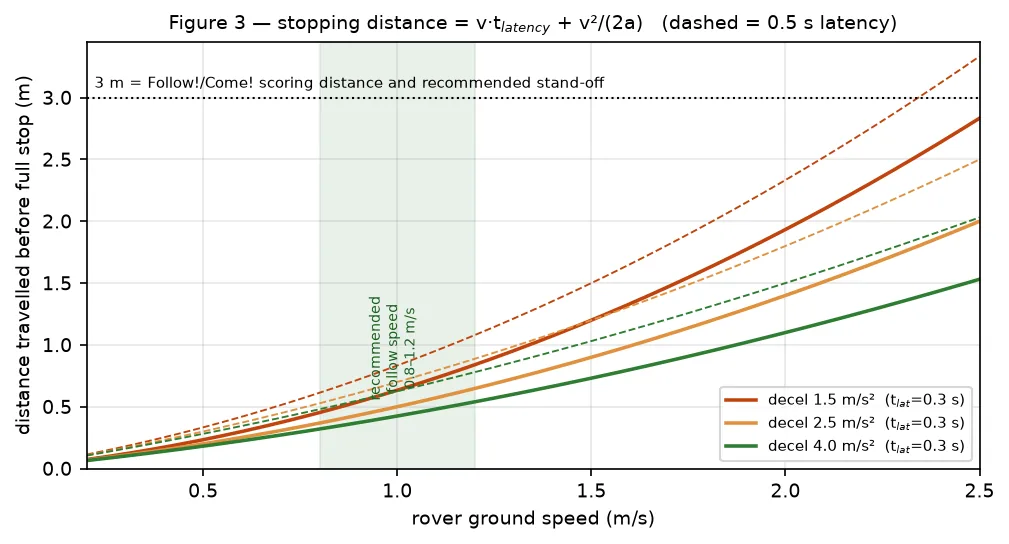
| Stand-off and stopping distance | 3.0 m target, never below 2.0 m; 0.50 m to stop at 1.0 m/s, 3.33 m at 2.5 m/s on loose sand | The margin disappears quickly with speed and latency |
| Heat at the site, June | mean daily maximum 33.3 °C, 95th percentile 38.9 °C, maximum 40.7 °C; 10 % of June days reach 37.8 °C | 2015–2025, 330 June days S-OPENMETEO-ARCHIVE |
| Wind | mean daily maximum 7.3 m/s, 95th percentile 12.3, gust maximum 25.6 | An exposed microphone at 7 m/s is a roar |
| Walking pace to design for | astronaut 0.6–1.0 m/s; rover follow at 1.2 m/s or less, and 1.0 m/s with a person in front | A suited student on sand, watching footing, by inference |
| Digital suit video | one consumer unit shuts down after 5 min at 35 °C standby | Disqualifying inside a suit S-DJI-O3 |
| Recommended suit video | about USD 163 for an analogue 5.8 GHz pod | Camera 36.99, transmitter 77.99, receiver 48.49 S-GETFPV-FOXEER S-GETFPV-RUSHTANK S-GETFPV-SKYDROID |
| Fetch! object | 920 g, 300 mm, alloy steel with a rubber grip, USD 14.99 | The pick the rules link §1.e.viii\: KEILEOHO 32 oz Rock Pick Hammer, alloy steel head and handle, 11.8 × 6.7 × 0.98 in, 920 g, anti-skid rubber grip, USD 14.99 (1-pack flat head) · Amazon / KEILEOHO · n.d.">S-AMAZON-ROCKPICK |
Design space, in one table
| Decision | Options | Recommended for a first build |
|---|---|---|
| Garment and heat | coverall · coverall plus an evaporative vest · a frozen pack vest · helmet or no helmet | A light compliant coverall, an evaporative cooling vest and a wide hat; skip the helmet or use a one-hand release, and test removal with gloves on |
| Suit camera and link | analogue 5.8 GHz · digital high definition · a small computer with an IP camera · a phone · an action camera | An analogue 5.8 GHz pod, because its failure modes are analogue and the station sees a plain video device |
| Command device | LoRa button · direct radio peer link · a phone application · tone decoding · a tether | A LoRa button independent of the video band, sized for a glove, decoded entirely by machine |
| Sign | an ArUco board · a printed word · a pictogram · an electronic display | A printed 20 cm 4x4_50 tag on rigid matte board, reusing the detector route finding already needs |
| Audio | rover microphone · suit microphone to the station · a wake word | Suit microphone into station recognition, so one microphone earns both the 5-point feed and the 10-point command |
| Gesture | pose landmarks plus a wrist rule · an arm fiducial · a trained sequence model · a sleeve inertial sensor | Pose at 6–8 m with an arm fiducial, promoted only after zero false positives on the real suit |
| Identity of the follow target | any person · a fiducial panel · colour · a beacon | A chest and back fiducial panel, because the field judge walks with the astronaut and “nearest person” is a defect |
The Follow! ladder is an expected-value argument
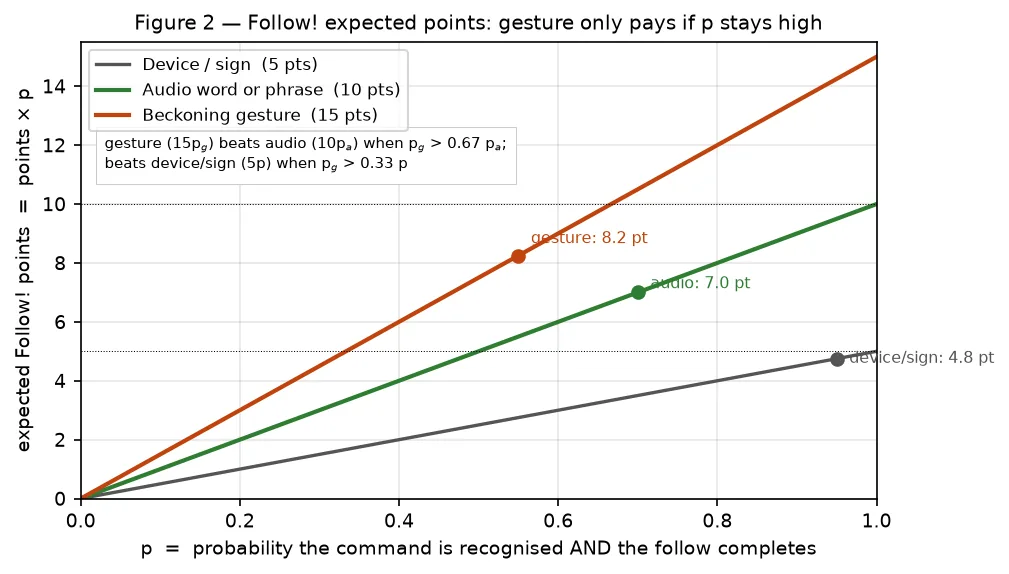
Follow! is worth 5, 5, 10 or 15 points by the method the astronaut uses, and the methods do not stack S-URC27-RULES §1.e.vi. Pricing each rung by the effort a first build needs, with deliberately generous success probabilities, gives an ordering that is not the obvious one.
| Method | Points | Success assumed | Expected points | Effort | Expected points per person-week |
|---|---|---|---|---|---|
| Device button | 5 | 0.95 | 4.75 | 1.5 weeks | 3.2 |
| Visual sign | 5 | 0.70 | 3.50 | 1.0 week | 3.5 |
| Spoken word | 10 | 0.70 | 7.00 | 3.5 weeks | 2.0 |
| Beckoning gesture | 15 | 0.55 | 8.25 | 8.0 weeks | 1.0 |
The conclusion is not to pick a rung but to build a ladder. The design attempts gesture, speaks a command if the gesture is not recognised inside a timeout, then presses the button. Because switching methods mid-mission is permitted S-URC27-QA AUQ6, each rung is strictly additive in probability and cannot subtract points; the worst case is the 5-point device.
There is a trap in the cheap end of the ladder. Every device channel must be decoded by machine, end to end. The moment a station operator hears a beep and presses a button, the command no longer originates from the astronaut, and the team is teleoperating while the rover drives autonomously, which the rules forbid S-URC27-RULES S-URC27-QA S-URC27-QA §1.e.iii AUQ2 AUQ21. A 5-point button is a one to two person-week firmware project, not a weekend. The gesture rung carries the opposite risk: it is the only rung that can drive the rover at a person on a false positive, so it stays conditional on a measured 90 % true-positive rate at 6–8 m on the real suit.
Safety: contact has no points penalty, and that is the trap
Three rules interact, and teams misread the middle one. Contact carries no points penalty; avoidance is highly recommended, and the competition organisers would sympathise with an astronaut who stops a rover that is getting too close S-URC27-QA AUQ1. The E-stop is on the rover, reachable from beside it, and it removes all battery power S-URC27-RULES §2.a.v. And an unrequested intervention counts as an emergency stop, terminating the mission with points preserved to that moment S-URC27-RULES §3.e.ii.
So the real cost of getting close is every remaining point in both sub-missions, and the arithmetic inverts the usual incentive. At 1.0 m/s with 2.5 m/s² of deceleration and 0.3 s of latency the rover stops in 0.50 m, leaving 2.5 m of margin inside a 3 m stand-off. At 2.5 m/s with 0.5 s of latency and 1.5 m/s² on loose sand it needs 3.33 m, which is more than the scoring distance. The operating envelope follows: follow at 1.2 m/s or less, stand off at 3.0 m, never close below 2.0 m, and treat “a person in front” as a hard limit of 1.0 m/s.
The safety protocol fits on a card that both the astronaut and the station carry. Walk the intended path together before the clock, agree which side the rover stays on, and agree an abort word. Voice is the first safety action: the astronaut says stop, the station gives the free autonomous stop, and the E-stop is reserved for imminent contact. The astronaut never walks toward the rover; if the rover is in the wrong place, the astronaut stops and gives the command again from a standstill. Bystanders are told that a red LED means autonomous and where the E-stop is, and the drone pilot is told not to fly low over the suit. Hydration, shade and a planned 12-minute exposure per attempt are part of the safety case, not part of comfort.
The suit is an integration problem, not a costume
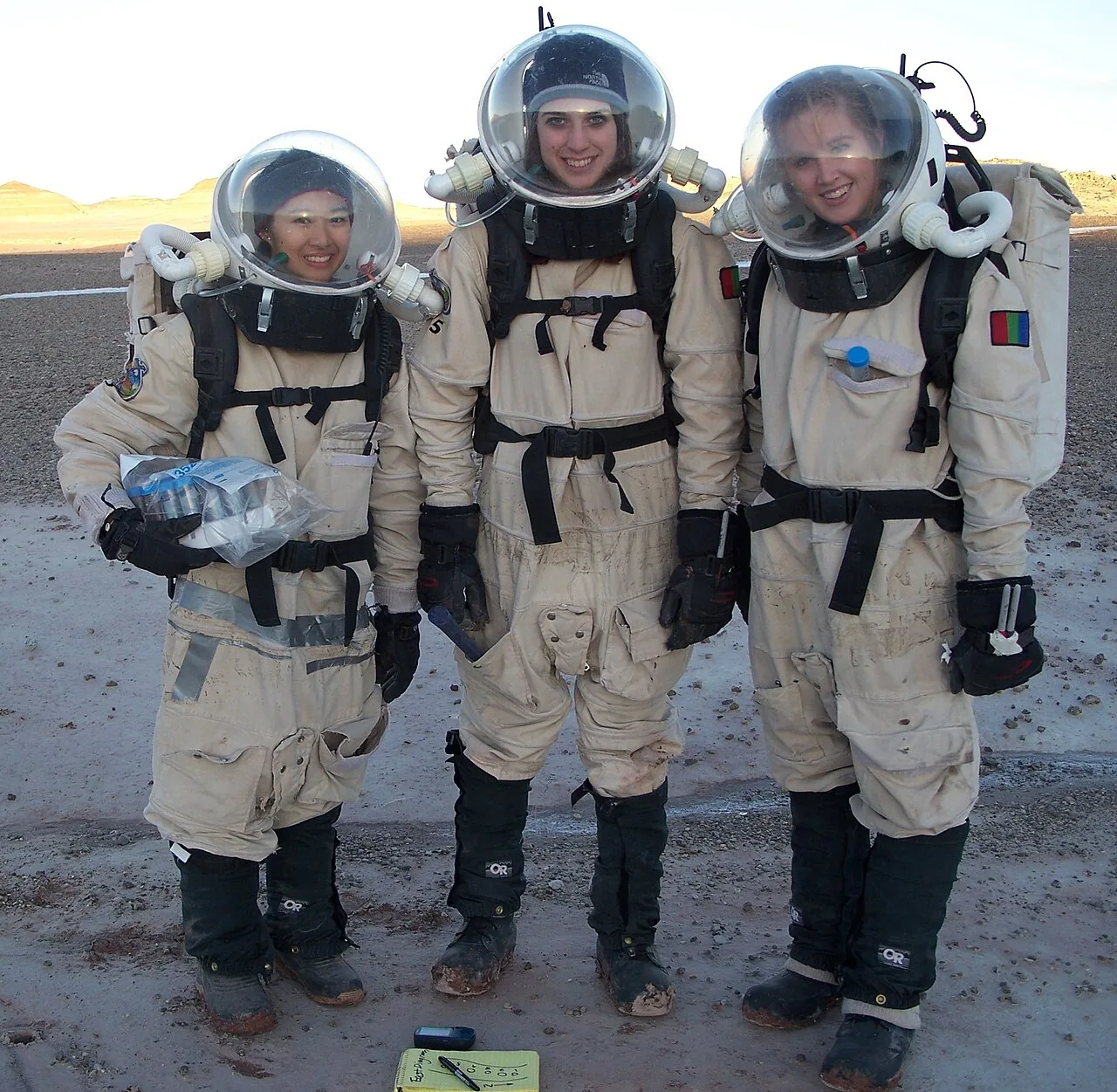
The rules make the suit easy and then hard. No pressurisation, no backpack and no oxygen are required, and colours and patterns are free, but it must cover the neck, wrists and ankles with closed-toe shoes S-URC27-QA AUQ12, carry a camera and microphone that are monitored in the station for 5 points S-URC27-RULES §1.e.iv, include a helmet only if the astronaut can remove it alone, and be practical at 37.8 °C S-URC27-RULES §3.d.iii.
Four consequences follow, and each one is a decision.
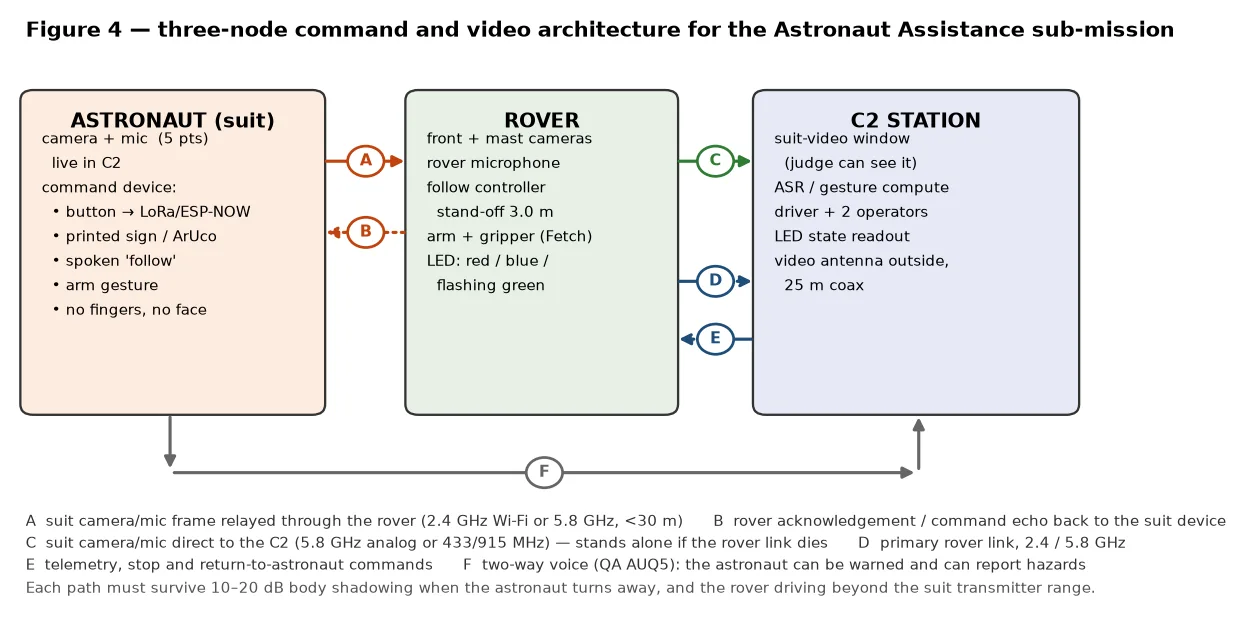
- The 5 points live on the path from the astronaut to the station, not on the camera. A recorded feed earns nothing; a feed that is always visible on a station display earns the points. The topology matters too: a direct suit-to-station link survives the rover driving away, while a relay through the rover dies exactly when the astronaut is more than 20 to 30 m off, which is the Stay! and Fetch! geometry by design.
- Heat is the failure mode, and digital video loses to it. A consumer digital unit shuts down after five minutes at 35 °C standby S-DJI-O3, and a phone sits at or beyond its own 0–35 °C operating range S-APPLE-TEMPERATURE. An analogue pod draws one or two watts, needs no operating system and degrades to a fuzzy picture, and the suit battery is sized for twice the planned exposure.
- Identity is a design problem. The field judge and spectators walk with the astronaut S-URC27-QA AUQ22, so person following has to be identity following. A chest and back fiducial gives identity, range and bearing, and the back panel is what the rover sees during the walk-away geometry. Any colour or pattern is legal S-URC27-QA AUQ12, so this costs a printout.
- The paperwork is part of the subsystem. The suit transmitter, the command device and any repeater are communications equipment and must be declared in the communications documentation by 2027-04-30 S-URC27-RULES §2.c.ii. The suit itself is excluded from rover mass S-URC27-QA AUQ12, while the rules list it inside the fielded-equipment accounting; itemising each suit line and marking its treatment is the defensible procedure.
Nine years of precedent cover finding, not obeying
The competition ran a task called Astronaut Assistance for six consecutive years, and the geometry it enforced is the geometry of the 2027 drive and return tasks. In 2011 to 2016 the position fix was good to only about 25 m, so a visual search was mandatory, and the astronaut was identified by a simulated space suit rather than by a coordinate. The delivery radius was 1 m, tighter than the 3 m the 2027 tasks allow S-URC11-RULES §3.d.
What transfers is precision at the end of a position-led approach, plus the habit of treating the suit as the visual marker. What does not transfer is any experience of a human giving commands: the sign channel has appeared before as an object identity held up in Delivery, but it has never been a command.
Two constraints on the practice regime follow. The station has no view of the course S-URC27-RULES §3.d.i, so every rehearsal runs blind, with operators in a closed room and the astronaut outdoors. And the published bar from a top team is 100 hours of operator practice S-WVU-SAR2026; a first build needs about 38 hours of dedicated sessions, from a bench session on the suit link through a command bench, open-ground following, a full blind run, fault injection and a dress rehearsal on unfamiliar ground.
Interfaces that bite
- Communications. The suit pod competes for the same 5.8 GHz band and the same station antennas as rover video, and its two to five megabits per second belong in the link budget.
- Arm. Give! must lower to 10 cm or less before release, with the astronaut at least 2 m away, because a dropped 0.92 kg steel pick near a person is a safety event rather than a lost point.
- Mobility. Following needs a controllable speed of 1.2 m/s or less and a measured deceleration of 2.5 m/s² on loose soil. Both are software limits, and neither may fight the Delivery mission’s 1.0–1.3 m/s average.
- Software and operations. A five-state machine with latched transitions, duplicate suppression, and a link-lost stop that needs no station action; plus one always-visible suit window and a transcript display.
- Environment. A dust-tolerant lens and a camera that does not thermally shut down. This is a thermal problem before it is a video problem.
Failure modes
| Failure | Mechanism | Prevention |
|---|---|---|
| The rover follows the wrong person | The field judge or a spectator walks near the astronaut | Require the suit fiducial before closing distance; ignore any person without it |
| The target is lost mid-walk | The astronaut turns away, is occluded, or a light suit blows out in sun | Predict from the last bearing, coast for a moment, then stop and wait rather than searching |
| A bystander’s arm is read as a command | Natural arm swing or waving triggers the gesture pipeline | Two-of-three confirmation, a rest pose before accepting a trigger, and the fiducial as a gate |
| The command is recognised twice | A repeated trigger re-arms the controller mid-task | Command identifiers with a latch, and duplicate suppression inside 2 s |
| Stay! creeps | A re-plan toward a stale goal, or obstacle recovery nudging the rover | An explicit hold state that disables the planner, verified on the wheel encoders |
| Fetch! closes on air | The grasp point is the image centroid of the mask, and the handle is under the head | Bias the grasp toward the head and confirm with depth before closing |
| The suit feed dies mid-task | Body shadowing, battery sag, or thermal shutdown | A shoulder-mounted antenna, an analogue link, and twice the battery capacity needed |
Shortlist for a first build
| Item | Choice | Why |
|---|---|---|
| Suit | Light compliant coverall, evaporative vest, wide hat, no helmet or a one-hand release | Meets coverage, survives heat, and leaves the removal rule trivially satisfied |
| Suit video | Analogue 5.8 GHz pod with the antenna on the shoulder | Analogue failure modes, a plain video device at the station, about USD 163 |
| Command ladder | Printed ArUco sign, LoRa button, then audio; gesture only after a measured test | The three cheapest rungs cover 10 points reliably |
| Identity | Chest and back fiducial panel | Removes the wrong-person failure for the cost of a printout |
| Follow behaviour | 1.2 m/s or less, 3.0 m stand-off, voice-first stop protocol | A 3 m stand-off is a real margin at the recommended speed |
| Practice | About 38 hours of dedicated sessions, blind station, with a fault-injection session | The station cannot see the field, so blind practice is the only rehearsal that counts |
Open problems
- Is a sleeve inertial gesture legal? The rule says visual recognition and the ruling names cameras S-URC27-QA AUQ24. Asking the organisers in writing settles it; until then the assumption is no.
- How far can a 20 cm tag be read in full sun? A range sweep at 5, 10, 15, 20 and 25 m at two sun angles gives a detect rate, which is what the sign rung depends on.
- Does pose-based beckoning work at 6–8 m on a light suit against desert? A hundred gestures at three distances with three subjects gives the true and false positive rates.
- What is the measured emergency deceleration on MDRS-like soil? Every number in the safety case depends on it. An instrumented stop test at four speeds on three surfaces closes it.
- How does speech recognition behave in 7 m/s wind with the motors running? Thirty utterances per condition give a false-accept rate, which is the gate on the audio rung.
- Does the astronaut’s body shadowing kill the suit link when they turn? A 360° walk at 10, 20 and 30 m with a signal-strength log settles the antenna placement.
- What happens if the astronaut presses the rover’s E-stop? The rules imply the mission is terminated and the rulings sympathise with the action. A written answer from the organisers, and a protocol that means it never happens, are both required.
Further reading
- WVU Team Mountaineers sets the published operator-practice bar and validates ArUco-based approach stopping in its 2026 review S-WVU-SAR2026.
- Missouri S&T trains a detector class for the rock pick and publishes its confidence thresholds S-MST-DOCS-CONSTANTS.
- Monash documents the wrong-place failure that this sub-mission punishes most: a failed detection in the field after a laboratory success.
- Autonomy: astronaut assistance maps every element of the task onto the rules.
- Software stack and autonomy owns the state machine this page assumes.
- Communications and networking owns the band plan the suit shares.
Sources for this page
- S-URC27-RULESUniversity Rover Challenge 2027 – Requirements and GuidelinesOriginal Archived copy
- S-URC27-QAURC2027 Questions & Answers (updated through 2026-10-11)Original Archived copy
- S-DJI-O3DJI O3 Air Unit, specs and FAQ: 1/1.7-inch CMOS 48 MP, 155° FOV, 12.7 mm equiv., 4K/1080p up to 120 fps, 8.3 g module; standby time 8 min at 25 °C and 5 min at 35 °C before the protection system shuts the unit down; designed to pair with DJI Goggles 3/Integra/2 or FPV Goggles V2Original
- S-OPENMETEO-ARCHIVEOpen-Meteo historical weather API (ERA5 reanalysis), query at 38.4062 N, 110.7912 W for June 2015–2025: daily temperature_2m_max (mean 33.3 °C, the analysis 38.9, max 40.7), wind_speed_10m_max (mean 7.28 m/s, the analysis 12.31, gust max 25.6), wind_gusts_10m_max, precipitation_sum; 330 June days; 10.3 % of days ≥ 37.8 °COriginal
- S-GETFPV-FOXEERGetFPV listing, Foxeer Predator 5 Micro 1000TVL 1.7 mm M12 FPV camera (Full Case), USD 36.99Original
- S-GETFPV-RUSHTANKGetFPV listing, RushFPV Rush Tank SOLO 1 W 5.8 GHz VTX, USD 77.99 (shown out of stock on access date)Original
- S-GETFPV-SKYDROIDGetFPV listing, Skydroid 5.8 GHz OTG dual-antenna FPV receiver for Android/smartphone, USD 48.49 (also: Foxeer Wildfire 72CH goggle module USD 89.99–194.99; SpeedyBee 5.8 GHz goggles receiver USD 120.99)Original
- S-AMAZON-ROCKPICKAmazon listing ASIN B08C5D2FHD, the "Amazon link" embedded in §1.e.viii: KEILEOHO 32 oz Rock Pick Hammer, alloy steel head and handle, 11.8 × 6.7 × 0.98 in, 920 g, anti-skid rubber grip, USD 14.99 (1-pack flat head)Original
- S-APPLE-TEMPERATUREApple Support 118431 "If your iPhone or iPad gets too hot or too cold", use and store within 0–35 °C ambient; "using an iOS or iPadOS device in very hot conditions can permanently shorten battery life"; built-in protections attempt to regulate temperatureOriginal
- S-URC11-RULESUniversity Rover Challenge 2011 – Requirements and GuidelinesOriginal
- S-WVU-SAR2026Team Mountaineers System Acceptance Review 2026 (rover "Deimos"): tri-modal 2.4 GHz + 5.8 GHz + 70 cm, gimbal camera on antenna mast, 750 m LOS / 164 m NLOS high-noise test, antenna + radio budget linesOriginal
- S-MST-DOCS-CONSTANTSBinder §05 "Autonomy Constants Reference & Tuning Guide", every tuned constant with typical value (drive PID, slope damping, waypoint radii, YOLO model paths/confidences, A*/Stanley parameters, GPS antenna offsets)Original