Q&A rulings
The 2027 Questions and Answers page is part of the rules, not commentary on them: the rulebook states that all matters addressed in the Q&A are applicable to the requirements and guidelines S-URC27-RULES. Its 65 answers settle questions the rulebook leaves open, and a dozen of them change a subsystem choice rather than a detail. This page organises every answer by mission, states the design consequence, and marks the places where the Q&A overrides the rulebook text.
Key takeaways
- Satellite internet is banned and a relay is encouraged. A local repeater or a drone relay is the endorsed answer to the obstructed links in Delivery and Autonomy, which makes a relay an architecture element rather than an optimisation S-URC27-QA RQ5.
- The team brings its own GNSS base station. There is no internet in the field and no correction service, so differential GNSS depends on base hardware the team owns, powers and erects inside the 15-minute setup S-URC27-QA RQ11.
- The bioassay definition is the payload gate. A molecule formed only by biology is required; an amino-acid assay alone does not qualify, and a chemical method alone does not count as the bioassay S-URC27-QA AQ9.
- The keyboard is not a teach-by-touch task. Touching any part of the keyboard in manual control is penalised, so alignment comes from the four corner tags and the arm servos on them S-URC27-QA EQ2.
How the Q&A binds a design
The page was first published on 2026-09-15 and revised on 2026-10-03 and 2026-10-11; it can change again before the System Acceptance Review, and it changed mid-cycle in earlier years S-URC27-QA. A team that treats it as a fixed document can be designing to an answer that no longer stands. The working rule is that the Q&A is the later ruling: where the two disagree, design to the answer and keep the clause as the trace.
Two structural facts follow. First, every ruling is binding, so a requirement that rests on an answer should cite the answer as its trace rather than a nearby clause. Second, an answer that grants an exception has to be requested early. The judges need lead time to test a Mars-feasibility argument, and the answer lands on the page for every team at once S-URC27-QA RQ12.
The twelve rulings that shape the vehicle
| # | Ruling | Reference | What it changes |
|---|---|---|---|
| 1 | Satellite internet is banned; local repeaters and a drone relay are explicitly encouraged | RQ5 | Removes the backhaul shortcut and makes a relay a required architectural option |
| 2 | No correction service and no internet: the team runs its own GNSS base station | RQ11 | Adds a receiver, antenna, mount, correction link and 120 V power to the setup |
| 3 | A magnetometer or digital compass is allowed | RQ3 | A legal heading source for dead reckoning and for the hill route |
| 4 | Microphones on the rover are allowed | RQ4 | A diagnostic audio channel during Equipment Servicing |
| 5 | An off-the-shelf drone is allowed; no drone in Astrobiology or Equipment Servicing | RQ9 | Scopes the airframe to two missions and moves effort to integration |
| 6 | 1 km applies to Delivery and Autonomy; the other two courses are much closer | RQ13 | Two link budgets, not one |
| 7 | Tank-fed pneumatics are legal; ambient-air systems need an exception | RQ12 | Bottled gas is available for sample handling, latches and deployment |
| 8 | A human drone battery swap is an intervention | RQ14 | A 20 % penalty on that mission unless the swap is robotic |
| 9 | A bioassay means a molecule formed only by biology | AQ9 | Two independent life detections, one meeting the strict test |
| 10 | The sample evaluated for life comes from at least 10 cm depth | AQ10 | A depth-indexed sampling record, not a scoop |
| 11 | 25 m of cable is required for the rover and for the drone; operators sit inside the command post with no view | DQ2 | Command-post layout, cable runs and pilot ergonomics |
| 12 | Touching the keyboard in manual mode is penalised; the display is a 4.3 in e-paper panel | EQ2 | Vision-servoed alignment and a compliant end effector |
Competition and conduct
CQ1 · The page is the record. Questions may be sent by email and answers are added to the page, so the page itself is the durable reference, and a question answered by email is worth requesting for the page S-URC27-QA CQ1.
CQ2 · No video of the 2027 tasks. The judges did not plan to publish video of the updated tasks or their infrastructure; earlier competition videos are described as a good source on earlier tasks S-URC27-QA CQ2. Task geometry therefore comes from the rulebook text plus older footage, and 2026 hardware cannot be assumed where the 2027 text differs.
CQ3 · Visa support. URC provides a letter of support on request, issued after the team is registered, and advises applying for as many members as possible S-URC27-QA CQ3. Registration gates the letters, and the registration deadline is 2026-10-30.
CQ4 · The schedule arrives about a week ahead, and the task order is drawn by lot. The order differs per team S-URC27-QA CQ4. That is a configuration requirement: the rover has to be mission-agnostic in its transport state, and any module swap has to be a rehearsed operation inside the 15-minute setup.
CQ5 · Regional pricing is ordinary pricing. The judges treat regional cost differences as normal pricing factors and report that across prior years the correlation between declared spend and score is extremely weak, with a wide spread S-URC27-QA CQ5. The cap is a documentation exercise rather than a performance lever.
CQ6 · Student discounts count. A student-only national discount may be used for valuation when any student of that country could obtain it, not only students of one university S-URC27-QA CQ6.
Rover and drone
RQ1 · The rover may change, but not mid-mission. Changes are allowed at any point, including during the field event, subject to the mass and cost limits. An intervention exists to repair a broken rover, not to swap a module S-URC27-QA RQ1. Modularity is legal between missions; a hot swap during one is not a free action.
RQ2 · The 70 kg limit is strict. Above it, parts are discarded or drilled until the rover complies; no percentage penalty schedule exists S-URC27-QA RQ2. The 50 kg figure per configuration keeps the 5 % of points per kilogram sliding penalty, so the aggregate limit is a gate and the configuration limit is a price.
RQ3 · A magnetometer is allowed. The judges said they could not verify that teams avoid a digital compass, and permitted it even though it is not Mars-analogous S-URC27-QA RQ3. It is the cheapest way to bound yaw drift when the differential fix is obstructed.
RQ4 · Microphones are permitted. Audio from the rover is a legitimate diagnostic channel for a stalling arm or a slipping wheel S-URC27-QA RQ4. The same answer states that spectators may not coach operators, which is a conduct rule rather than a hardware rule.
RQ5 · No satellite backhaul, but a relay is encouraged. A satellite relay is considered outside the spirit of the competition, while a rover-deployed repeater or a drone used as a relay is described as strongly encouraged S-URC27-QA RQ5. The relay carries mass and cost from the first design review, not from the week before the event.
RQ6 · Licensed high power on 2.4 GHz is permitted but discouraged. The judges would rather licensed teams use amateur bands away from the crowded 2.4 GHz and 900 MHz allocations S-URC27-QA RQ6.
RQ7 · Compliance is a deadline item. All applicable FCC regulations apply, particularly 47 CFR Part 15 Subpart C, and devices and operator licences go to the URC Director by 2027-04-30 S-URC27-QA RQ7. A change after that date has to be notified immediately.
RQ8 · A licence takes weeks, so it is a schedule item. The judges point at amateur licensing material and note that a licence is easy to obtain in a few weeks, and that foreign nationals may hold a US licence under reciprocal arrangements S-URC27-QA RQ8. The task needs an owner in September, not April.
RQ9 · The drone flies in two missions only. No drone may be used in Astrobiology or Equipment Servicing, and an off-the-shelf airframe is acceptable because nothing in the rules rewards self-build S-URC27-QA RQ9. The FAA requirements still apply in full.
RQ10 · Prior maps are sanctioned. Public LIDAR, photographs and maps may inform the algorithms, and URC intends to post at least one LIDAR dataset S-URC27-QA RQ10. Planning the hill route before the rover moves is legal, and it is the cheapest way to survive the route-finding sub-mission.
RQ11 · The team owns the GNSS base station. With no internet in the field and no correction service allowed, differential GNSS requires a base receiver, an antenna and a link to the rover S-URC27-QA RQ11. The base has to be standing and converged inside the 15-minute setup, and it draws on the 120 V supply at the command post.
RQ12 · Tank gas is legal, ambient air is not automatic. A system whose gas comes from a tank is acceptable, cooling fans need not be custom, and any other ambient-air system needs a case-by-case Mars-feasibility exception S-URC27-QA RQ12. A compressor or vacuum pump that moves ambient air sits squarely in the exception category, so the argument is made early.
RQ13 · 1 km is two missions, not four. Astrobiology and Equipment Servicing courses will be significantly closer, while Delivery and Autonomy may send the rover up to 1 km from the command post with the total traverse exceeding 1 km S-URC27-QA RQ13.
RQ14 · A human battery swap is an intervention. The rover may carry and deploy a spare battery, and anything carried counts in mass and cost, but the drone or the rover has to perform the swap S-URC27-QA RQ14. A hand swap costs 20 % of that mission’s points, and a battery left on the ground has to be recovered inside the 10-minute teardown.
RQ15 · The drone may deliver anything except a mini-rover. A drone-dropped repeater on a ridge is legal, at the cost of payload mass inside the 5 kg limit and a recovery inside the teardown S-URC27-QA RQ15. In the route-finding sub-mission a rover of any kind must start from the designated start location.
Astrobiology
AQ1 · Two science plans, and the May one is scored. The review version is about one page in the report with some time in the video; the May version is about five pages with background science and counts toward the mission score S-URC27-QA AQ1. The plan is a scoring artefact due 2027-05-21.
AQ2 · Life detection means bio-molecules. The capability has to search for biological components; it does not need to be expensive or sophisticated S-URC27-QA AQ2. Instrument selection is judged on the molecule it detects.
AQ3 · Any instrument class is acceptable. A purpose-built instrument from about one hundred US dollars to a few thousand is a legitimate route, and price is not the discriminator S-URC27-QA AQ3. The assay’s biological specificity is.
AQ4 · URC approves plans, not chemicals. Each chemical needs a safety plan covering transport, storage, use and disposal, anything above US DOT limits is not allowed, and anything below still needs permission from the science judges; most corrections concerned cradle-to-grave tracking rather than concentration S-URC27-QA AQ4. Chemistry selection happens before the review so the plan and the report agree.
AQ5 · The site is marked, the sample points are not. The team chooses where to sample, the soil is in situ and there are no trays, so site triage happens live from rover imagery S-URC27-QA AQ5. That needs a written stop-or-drive rule and the documentation package the mission requires.
AQ6 · Expect hard ground. Soil and sub-surface samples vary over short distances from reasonably easy to very hard, and there is no caliche surface at the science site S-URC27-QA AQ6. The sampling mechanism is designed for a worst-case penetration force and a jam recovery path.
AQ7 · Contamination control is argued, not maximised. The team has to justify its level of cleanliness rather than meet a stated standard S-URC27-QA AQ7. A cleanable scoop, a wipe-down procedure and sample-path segregation are the evidence.
AQ8 · Two people must stay clean. Only members who stayed inside the command post during the science mission and have not seen the site with their own eyes may take part in the science briefing S-URC27-QA AQ8. Anyone who walked the course as a runner or photographer is excluded.
AQ9 · The bioassay test. A bioassay must detect a molecule currently known to be formed only by biology or in the presence of biology: proteins, sugars, chlorophyll, nucleic acids, ATP or carotenoids. An assay for a molecule that could form abiotically, such as amino acids, is not sufficient on its own, and a chemical method alone does not satisfy the requirement S-URC27-QA AQ9. The payload needs two independent capabilities, at least one that passes this test, inside a 20–30 minute roving window.
AQ10 · Depth is provenance, not a lockout. Multiple depths may be compared, but the sample evaluated for life must come from at least 10 cm, it should be a specific sample rather than bulk soil, and the location including depth is part of the mission S-URC27-QA AQ10. An auger with depth control is acceptable; a record without depth is not.
Delivery
DQ1 · No drop, slope or step numbers. The course runs from flat ground to steep loose slopes and even vertical faces, with no values published S-URC27-QA DQ1. The obstacle envelope is a team decision that has to be defended with measurements on an analog site.
DQ2 · 25 m of cable, and the operators cannot see. Both the drone and the rover operators sit inside the command post with no view of the course, not next to the door or the window, and the controller and video wiring runs to antennas outside S-URC27-QA DQ2. Two independent cable runs are needed if the two systems use separate radios.
Equipment servicing
EQ1 · The design criterion is one gloved hand. The equipment details are intentionally withheld to reward flexible design, and every task should be reasonably doable by an astronaut using a single gloved hand S-URC27-QA EQ1. Design for a class of objects, not a fixed geometry list.
EQ2 · No teaching by touch. The tags exist to aid autonomous alignment; touching any part of the keyboard in manual control is penalised, the display must not be touched, and the surrounding metal of the lander may be touched S-URC27-QA EQ2. Visual servoing on the corner tags is the only legal alignment method.
EQ3 · E-paper, no key repeat, judge reset. The display remains a 4.3 in e-paper panel, keys do not auto-repeat while held, and a judge resets the display to restart an attempt S-URC27-QA EQ3. The read-back delay and the low contrast in sunlight belong in the typing loop, and an abort costs time rather than points.
EQ4 · The 10-minute transition may include a weigh-in. A new weigh-in and measurement is required unless the configuration is unchanged and previously compliant, or the team accepts the same penalty it already carries S-URC27-QA EQ4. Either freeze the configuration or rehearse the swap inside the window.
EQ5 · Confirmation may be requested, scoring may not. For tasks with poor visual feedback a team may ask for confirmation that a task was completed, not for a score, and URC decides which tasks allow it just before the competition S-URC27-QA EQ5. Design for camera-visible evidence of completion instead.
The published page numbers the last two Equipment answers without a matching answer number. The content is unambiguous, and the order here follows the page S-URC27-QA.
Autonomy
AUQ1 · Nothing is penalised for contact, but contact ends runs. Hitting the astronaut or a post carries no points penalty, yet a wheel caught on a post is common and an astronaut may stop a rover that comes too close S-URC27-QA AUQ1. Treat clearance as a functional requirement.
AUQ2 · Off-board compute is legal, human help is not. A base-station computer may do autonomy computation, but no person may assist while the rover drives autonomously, and one target is deliberately out of communications S-URC27-QA AUQ2. The far target has to be solvable onboard.
AUQ3 · No photometric specification for the LED. Teams verify daylight visibility themselves, a sunshade is suggested, and any light that clearly shows state is acceptable S-URC27-QA AUQ3. This is a cheap item that fails inspection if it is not tested at noon.
AUQ4 · A first abort returns to the command post. If the rover never reached the previous point and the attempt is aborted, it returns to the start area in front of the command post S-URC27-QA AUQ4. Return to start is a separate behaviour from return the way the rover came.
AUQ5 · The astronaut is a communications node. The suit microphone and camera may relay information to the rover, and the command post may talk to the astronaut if the link is two-way S-URC27-QA AUQ5. A body-worn relay is legal because nothing is deployed.
AUQ6 · Modes may be switched; only Follow! is graded on modality. The 5 / 5 / 10 / 15 split applies to Follow! alone, and every other command pays full points whatever method is used S-URC27-QA AUQ6. A simple reliable method is enough for the four binary commands.
AUQ7 · 20 m, in the field of view, from the astronaut. Fetch! and Come! place the astronaut at least 20 m away and directly visible, and all commands must originate from the astronaut S-URC27-QA AUQ7. That sets camera field of view, resolution and microphone signal-to-noise.
AUQ8 · The hammer is on the ground nearby. It lies in the immediate area, and the rover should not need to move to see it unless it parked on top of it or missed the 3 m stop S-URC27-QA AUQ8. The arm reaches it from the parked pose with a downward-looking camera.
AUQ9 · The LED reports mode, not completion. The field judge reads it to tell autonomous driving from teleoperation, flashing green is not required for Fetch!, Stay! or Give!, and the light should follow the rover’s actual state rather than the operator’s intent S-URC27-QA AUQ9.
AUQ10 · The astronaut sets the distance. The astronaut may walk up until the gesture fills the frame or move as far away as desired S-URC27-QA AUQ10. Detection has to work at both ends of that range.
AUQ11 · Gross-body gestures only. Finger and facial gestures are prohibited, justified by suit restriction; arm, leg and torso motion are allowed without further limit S-URC27-QA AUQ11. A thumbs-up or a point is non-compliant.
AUQ12 · The suit is not in the mass budget. Coverage is neck, wrists and ankles with closed-toe shoes, colours are free, and the suit itself is excluded while overalls and wearable electronics count S-URC27-QA AUQ12. The classification belongs in the expense report.
AUQ13 · The command order is fixed: Follow!, Stay!, Fetch!, Come!, Give! S-URC27-QA AUQ13. An operator interface that mirrors the five states reduces both error and time.
AUQ14 · The astronaut holds the geometry. Judges show the astronaut the approximate locations to move between, so the astronaut, not the operators, receives the route information S-URC27-QA AUQ14.
AUQ15 · Silence is required for a gesture Follow!, and nowhere else. Astronaut to command-post communication is encouraged at all other times S-URC27-QA AUQ15. The audio channel and the gesture channel impose opposite disciplines.
AUQ16 · The tag coordinates are exact. The tags help the judges and spectators as much as the rover reach the 1 m full-credit radius S-URC27-QA AUQ16. This is the strongest argument for a team-owned base station.
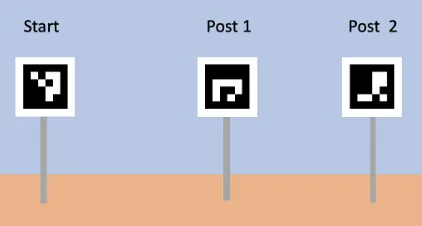
AUQ17 · The hill has several routes and no published inclination. The team chooses the route on natural terrain and no values are provided S-URC27-QA AUQ17. Route planning from elevation data and a traversability estimate is the intended solution; a fixed path cannot work.
AUQ18 · The LED is enough for the blind target. Arrival at the out-of-line-of-sight target needs no command-post indication, and for the visible target a display indication is recommended but not required S-URC27-QA AUQ18. A stored arrival event plus the LED is the minimum viable design.
AUQ19 · Repeaters count. They are allowed and encouraged in Autonomy and must be carried in both the mass and the cost budgets S-URC27-QA AUQ19. A repeater is fielded equipment, with a recovery inside the 10-minute teardown.
AUQ20 · The elevation model is a bonus. The format is likely GeoTIFF and release approval and timing are not guaranteed S-URC27-QA AUQ20. Public LIDAR and imagery stay on the critical path; a URC model does not.
AUQ21 · Hands off while the rover moves. Because the judges cannot tell which devices are connected, operators must not touch the controls while the rover drives autonomously, and programming while stopped is allowed S-URC27-QA AUQ21. The rule is enforced by observable behaviour, so the command post needs one visible interface and a rehearsed freeze.
AUQ22 · The spotter is a safety and legal role. The spotter keeps visual line of sight and may take control, and permission is requested before take-off and landing S-URC27-QA AUQ22. That is a second field member with no other mission role.
AUQ23 · A mini-rover may score in Autonomy. It is legal there and prohibited in Delivery, it needs its own emergency stop, and its mass counts inside the configuration S-URC27-QA AUQ23.
AUQ24 · Any camera may recognise the gesture. The suit camera is as acceptable as the rover’s own S-URC27-QA AUQ24. Pointing the sensor at the astronaut relaxes the rover’s own field-of-view requirement.
AUQ25 · The pilot flies from the command post. The astronaut may not fly the drone, and the pilot is the only person who may touch controls while the rover is autonomous S-URC27-QA AUQ25. Two physically separate control positions are needed.
AUQ26 · The astronaut wears but does not deploy. Nothing may be dropped in the field, while any electronics may be built into the suit S-URC27-QA AUQ26. Worn relay electronics are legal; a repeater placed on the ground by the astronaut is not.
AUQ27 · Voice commands may arrive either way. Spoken commands may be radioed to the rover or heard directly S-URC27-QA AUQ27. The choice has to be deliberate, because the two paths need different hardware.
Where the rulebook and the Q&A diverge
| Topic | Rulebook text | Q&A ruling | What to design to |
|---|---|---|---|
| Drone use | Advantageous for Delivery and Autonomy, not required | Banned in Astrobiology and Equipment Servicing | No drone in those two missions; a drone is a planned option for the other two |
| Field communications | No normal wireless internet; satellite internet not allowed | Local repeater or drone relay strongly encouraged | A relay is an architecture element |
| GNSS augmentation | Silent on corrections | No internet, so the team runs a base station | Base station is required hardware |
| Air systems | No air-breathing power or propulsion | Tank-fed gas and fans are fine; ambient-air systems need an exception | Bottled gas is legal; exceptions are filed early |
| 1 km range | Rovers not expected to travel as far as 1 km | Applies to Delivery and Autonomy; the other courses are closer; traverse may exceed 1 km | Two link budgets |
| Intervention | 20 % and 50 % penalty structure | The mechanism is for repair, not for swapping modules | No mid-mission module swaps |
| 70 kg limit | 70 kg total, 50 kg per configuration, 5 % per kilogram over 50 | 70 kg is strict; parts are discarded to comply | Mass control is a gate, not a penalty line |
| Weigh-in at each mission | Weighed and measured at every mission setup | Not repeated inside the 10-minute transition under two conditions | Freeze the configuration or rehearse the swap |
| Keyboard contact | Tags aid alignment | Touching the keyboard in manual mode is penalised | Vision-only alignment on the tags |
What the Q&A does not settle
Four questions remain open, and each is worth a written question rather than an assumption.
- The antenna limits and the GNSS base. The 3 m height and 5 m from the command post limits are written for the communications antenna; whether they apply to a separate base antenna is not addressed. Planning to 3 m is the safe reading.
- The repeater and the emergency-stop rule. A repeater cannot move on its own, so a fuse should suffice, but no answer says so. The reading comes from the wording of the stop rule, not from a ruling.
- The 2027 suit specification. The requirement is inherited from the rulebook plus one answer, and no separate 2027 suit document was found.
- The Science Plan and Chemical Safety Plan formats. The 2027 science plan page states that details will be posted in early 2027, so planning to the 2026 structure is the only available route.
Further reading
- Rules, limits and the field carries the clauses these answers interpret.
- Missions and scoring places each ruling inside its mission.
- 155 engineering requirements cites the Q&A ruling behind 51 of its rows.
- Deadlines turns the licensing, plan and documentation answers into dates.
- Open questions collects the questions still owed to URC.
Sources for this page
- S-URC27-RULESUniversity Rover Challenge 2027 – Requirements and GuidelinesOriginal Archived copy
- S-URC27-QAURC2027 Questions & Answers (updated through 2026-10-11)Original Archived copy