MIST Mongol Barota
The Military Institute of Science and Technology has the longest competition record of any Bangladeshi team, from 2014 to 2026. It also has the best single artefact in this collection: a complete 1 hour 20 minute judged session from the virtual 2021 competition, on the official channel, showing the weigh-in, the dimension check, an Equipment Servicing mission scored 100 and an autonomous navigation run that failed. Nothing else about the engineering is public. There is no design document, no CAD, no code and no post-event account for any year.
What this team shows
- A complete, judged session on film is worth more than any design document. It shows the weigh-in, the box check, six servicing tasks, the exact moment autonomy failed and the judges’ own explanation of why.
- The arrival indicator is a scored subsystem. This rover drove to the first gate and scored nothing because it could not convince the judge it had arrived.
- A 100 in Equipment Servicing is achievable with a five-axis arm, hobby servos and a parallel gripper, as long as the tasks are rehearsed. The same team scored 23.68 five years later when the task list hardened.
- No post-mortem exists for any season. A score with no cause cannot be learned from, and that is the largest loss in this dossier.
Identity and results
| Year | Rover | Total | Rank | SAR | Science | Delivery | Equipment | Autonomy |
|---|---|---|---|---|---|---|---|---|
| 2025 | Aurora X, Genesis 2.0 | 281.64 | 14 | 92.64 | 86 | 20 | 41 | 42 |
| 2026 | Celeste-1 | 259.16 | 11 | 76.48 | 95 | 20 | 23.68 | 44 |
Three seasons before that produced a review and no finals place, so each carries a single score:
| Year | Rover | Score | Outcome |
|---|---|---|---|
| 2022 | Phoenix | 92.85 | review scored, no finals place |
| 2023 | Aurora X | 92.56 | review scored, no finals place |
| 2024 | Aurora X | 90.15 | review scored, no finals place |
Earlier seasons exist only as team claims, because the official history index now starts at 2022 S-URC-HISTORY. The team records twelfth place in 2014, ninth and a best-Asian-team award in 2015, and 21st at the European event in 2016; none of these is contradicted and none can be checked against a primary result table S-MIST-SITE-ACHIEVEMENTS.
Three consecutive review-only seasons are the defining fact of the modern record. In 2022, 2023 and 2024 the team filed a review between 90 and 93 and recorded no mission scores S-URC22-SCORES S-URC23-SCORES S-URC24-SCORES. Its site claims a 2024 finals place that the official sheet does not support; the review figure is right and the finals claim is not S-MIST-SITE-COMPETITIONS.
The team’s headline claim of a 2021 world championship cannot be checked either. The 2021 competition ran virtually, this archive holds no official 2021 results sheet, and the web history index begins in 2022 S-URC-HISTORY. What the 2021 film does prove is one team’s run, not a ranking S-MIST-VURC2021.
Rover generations
The per-rover pages are four cards, each giving weight, battery, dimensions and arm degrees of freedom with almost no engineering narrative S-MIST-SITE-ROVERS. The lineage below combines those cards with the 2021 judged session and the 2025 and 2026 review films. Where a card and a scale disagree, the scale wins.
2014 and 2015: Mongol Barota. A card figure of 35 kg, 12 V lead-acid, 0.9 × 0.5 × 0.4 m and a three-axis arm S-MIST-SITE-ROVERS. A paper, “Mongol Barota: A next generation rover”, was presented at a 2014 conference and is the team’s one citation with a working identifier S-MIST-PAPER-SKIMA14.
2016: Explorer-0100. Card figures of 40 kg, 1.0 × 0.6 × 0.5 m and a four-axis arm S-MIST-SITE-ROVERS.
2021: Phoenix. The only rover in this dossier with judge-witnessed numbers: 42.1 kg on the scale at the weigh-in, and a dimension read as 1.047 m inside the 1.2 m check S-MIST-VURC2021. The team’s own card gives 45 kg, 24 V and a five-axis manipulator, so the card is 3 kg heavy S-MIST-SITE-ROVERS. The arm was removed for the autonomous navigation run at the judge’s suggestion, which means arm and autonomy were separate mission configurations five years before the rules formalised it.
2023 to 2025: Aurora X, and Genesis 2.0. A card figure of 50 kg, 24 V lithium-ion, 1.2 × 0.8 × 0.6 m and a six-axis arm S-MIST-SITE-ROVERS. The 2025 review film is titled for two rovers, Aurora X and Genesis 2.0, which suggests two configurations or a mid-season change S-MIST-SAR2025. In January 2025 the team announced a next-generation rover called Aurora X-II, and no page for it exists S-MIST-SITE-NEWS.
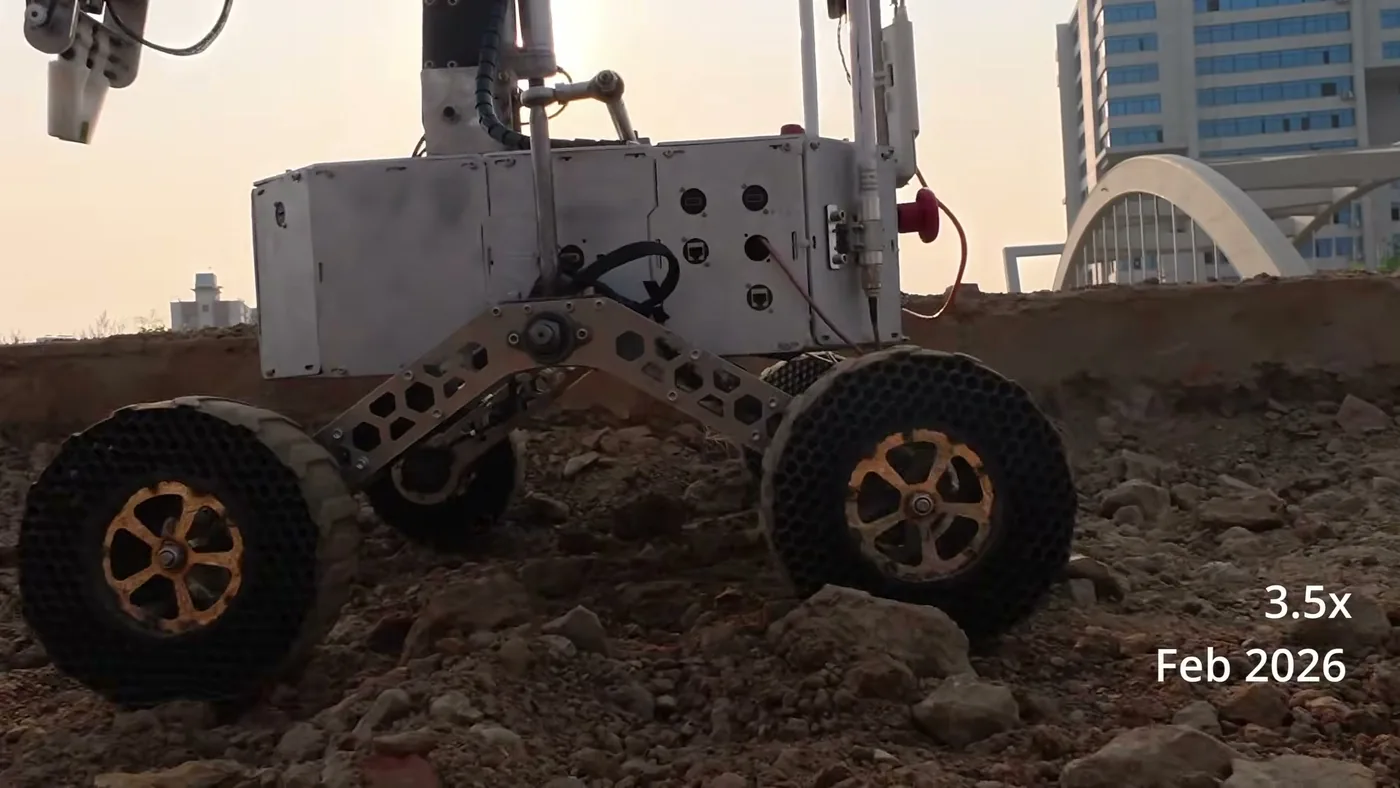
2026: Celeste-1. No specification page exists. The review film shows a four-wheel rover with black lattice tyres on gold multi-spoke hubs, a machined rocker link with lightening holes on each side, a white painted metal chassis with circular bulkhead connectors and a red emergency-stop mushroom on the flank, an antenna mast with paddle antennas, and a white multi-link arm with a parallel-jaw gripper S-MIST-SAR2026. Inside are a custom circuit board, a printed four-position carousel holding glass vials, a field scale for checking sample mass and an auger with a transparent sample tube.
Subsystems
Mobility. Four wheels, two per side, in every MIST rover for which an image exists. Each side carries a machined link pivoting on the chassis centre with a wheel at each end, so the layout is a rocker pair without an obvious spring or damper S-MIST-SAR2026. The team never uses the words rocker-bogie, and whether the two sides are cross-linked by a differential bar cannot be seen in the available frames. The 2026 news is the wheel: a printed lattice or honeycomb pattern on a multi-spoke hub, presented as a before-and-after against a conventional wheel S-MIST-SAR2026. A lattice printed in a compliant material gives a sprung, self-cleaning tread without a damper, and it needs no mould. No material, hardness, mass or print process is given.
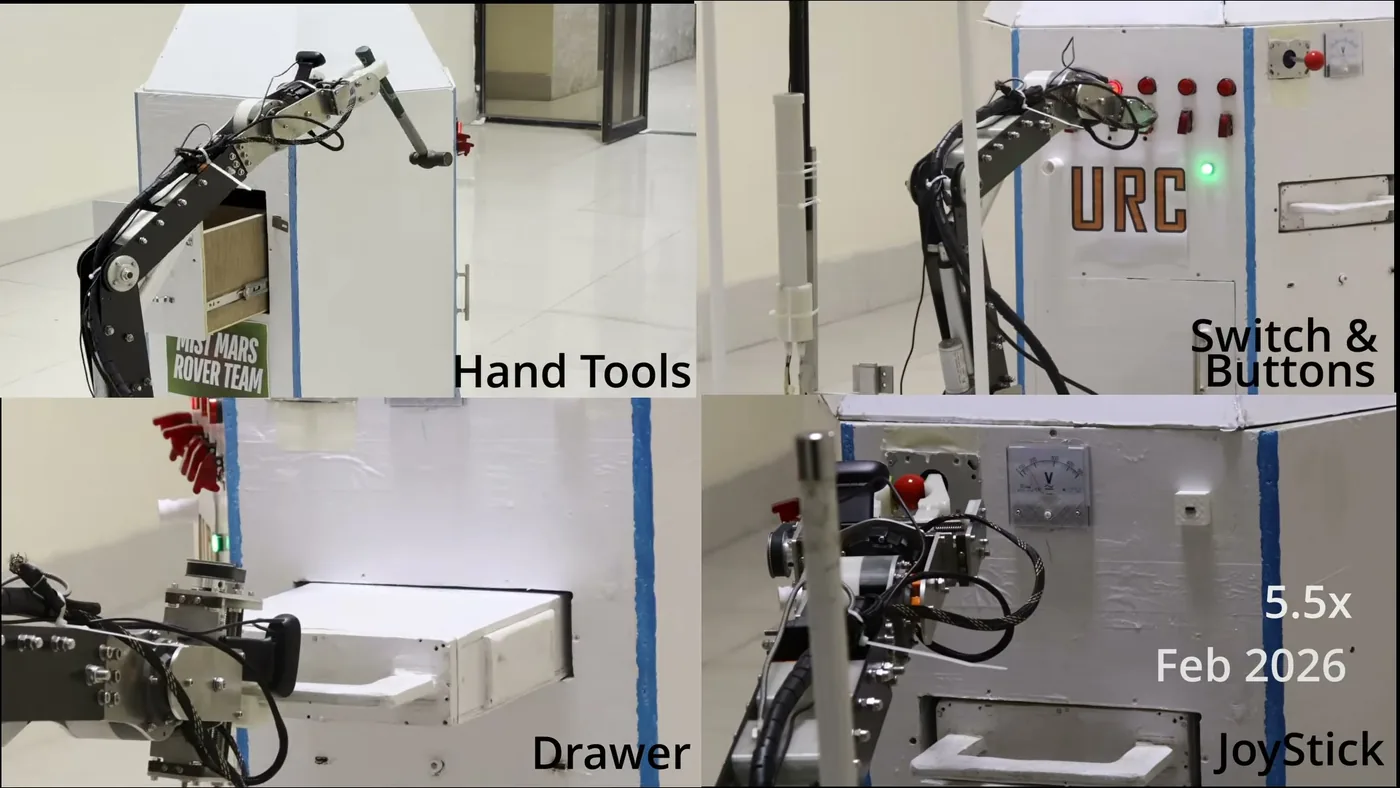
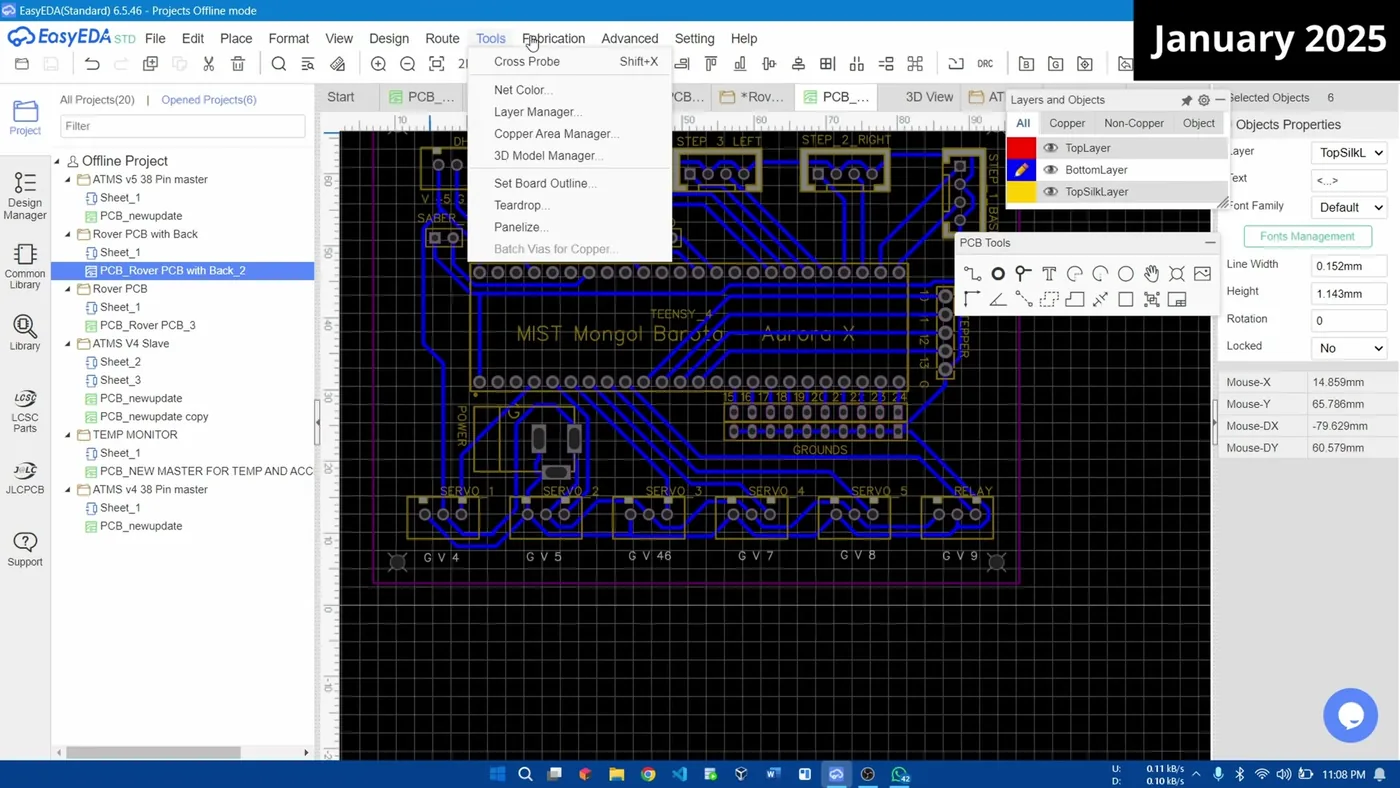
Arm and end effectors. Six axes per the Aurora X card, five per the Phoenix card, and no stated figure for 2026 S-MIST-SITE-ROVERS. The 2026 film shows a multi-link white arm with a parallel-jaw gripper handling the full servicing list: switches, buttons, a drawer, a joystick, a hose, test tubes, screwdrivers and a latched door S-MIST-SAR2026. The most specific evidence of the actuator architecture is a circuit board shown in the 2025 film, whose silkscreen reads servo channels one to five, two stepper channels, an encoder input and a relay, on a microcontroller carrier S-MIST-SAR2025.
Science. No instrument is named by the team in any source. There is no science page, no instrument list on the rover cards and no publication describing a payload. The 2026 film shows a printed four-position carousel holding glass vials, some holding a red liquid, an auger with a transparent sample tube driven into the ground by the arm, and a field scale used to weigh a bagged sample S-MIST-SAR2026. That combination implies a colorimetric workflow on a carousel with a mass check, and the analytes are unknown. The 2026 Science score of 95 is one of the highest in that year’s field, achieved with an undocumented payload.
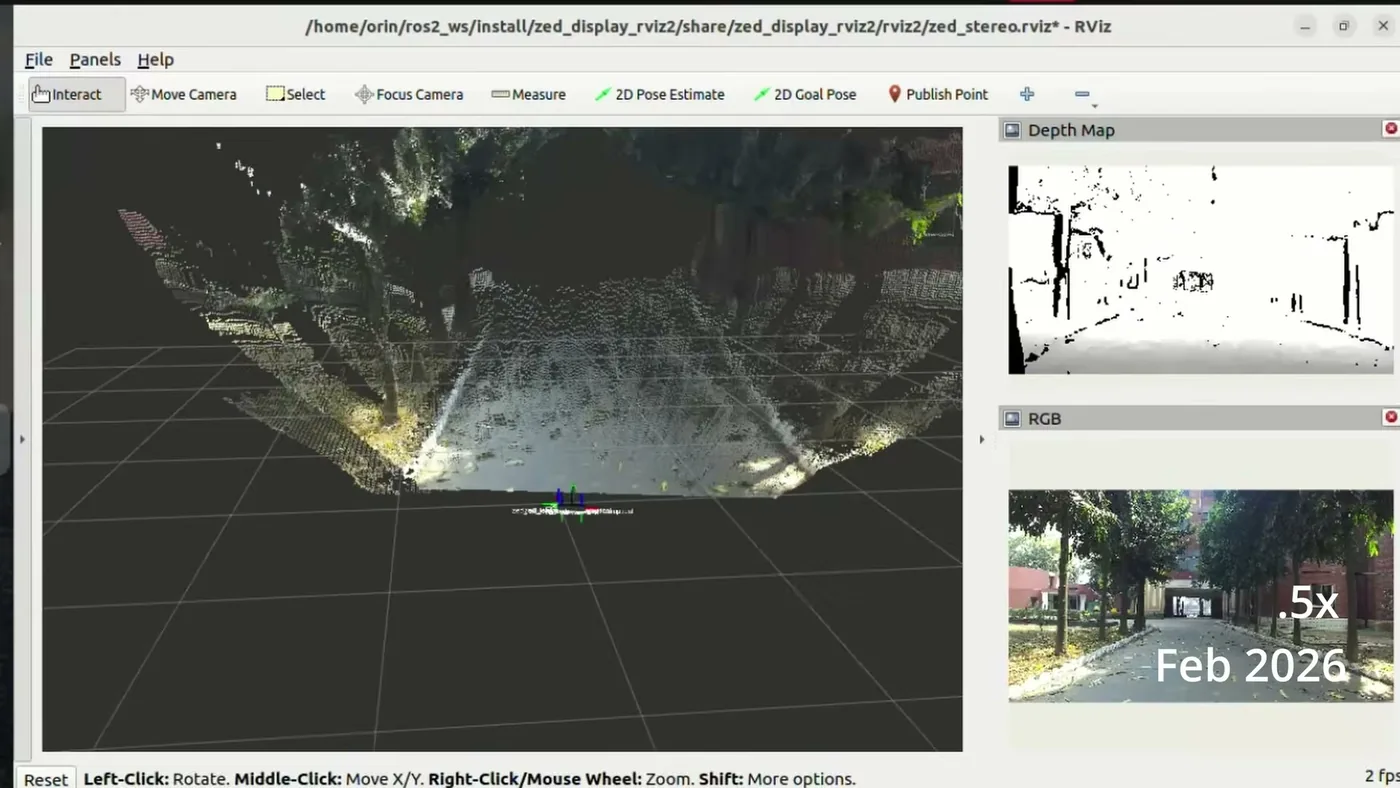
Compute, perception and software. The 2026 film shows an RViz session whose window title gives a ROS 2 workspace path under a user account called orin, running the stereo camera vendor’s display package with point cloud, depth map and colour panes side by side. The team’s own technology page names a Jetson Orin as the main computer, and the account name is consistent with it S-MIST-SAR2026 S-MIST-SITE-ROVERS. That is the strongest single piece of evidence about the 2026 stack. A second window shows an autonomy dashboard with a top-down cost map, a waypoint path and a log pane, on a field the team labels as its own campus course S-MIST-SAR2026. There is no public code and no code archive.
Power and safety. Twenty-four volt lithium-ion on the Phoenix and Aurora X cards, 12 V lead-acid on the 2014 rover, and the 2025 operator screen reading 23.94 V S-MIST-SITE-ROVERS S-MIST-SAR2025. Capacity, cell model, management, fusing and distribution are unpublished. A red mushroom emergency stop sits on the 2026 chassis flank, and whether it breaks pack power or signals a controller is unknown S-MIST-SAR2026.
Operations and people. Six sub-teams, one of them communications, with 40 or more active members drawn from eight engineering departments S-MIST-SITE-TEAM. The 2021 session shows at least four people on shift: an operator, a science operator, a camera operator and a lead answering the judge, with the lead rather than the operator handling technical questions. That is a judge-facing role split worth copying.
Mission performance
The 2021 session is the only mission-level narrative available for any MIST season, and it is complete.
Weigh-in and dimensions. 42.1 kg on the judge’s scale, and a dimension of 1.047 m inside the 1.2 m check, with the judge confirming that the arm did not protrude S-MIST-VURC2021. The judge asked for a second dimension to confirm the arm was spun inside the footprint, which is a detail worth copying into a weigh-in rehearsal.
Equipment Servicing: 100. Six sub-tasks demonstrated in sequence, including a 2.5 kg box lifted off a scale and placed in a drawer, and the judge declaring a perfect score with seconds to spare S-MIST-VURC2021. It is the highest servicing score in this dossier and it was achieved with a five-axis arm.
Autonomy: zero, and the reason matters. The rover moved to the first gate, failed to produce the required arrival indication, was still in search mode with eight minutes on the clock, and the team’s manual intervention forfeited the leg S-MIST-VURC2021. The rover drove; it could not communicate that it had arrived. A gate is not passed until the rover indicates that it believes it has reached the gate, and that indication is a design requirement, not a debug aid.
2022 to 2024: review-only seasons. Three reviews at 90 to 93 with no finals result S-URC22-SCORES S-URC23-SCORES S-URC24-SCORES. A review score in the nineties was comfortably inside the finals cut in all three years, so the binding constraint was travel or selection rather than engineering.
2025 and 2026: the split widens. Fourteenth in 2025, then eleventh in 2026 on a lower total, with Science rising from 86 to 95, Equipment falling from 41 to 23.68 and the review falling from 92.64 to 76.48 S-URC25-SCORES S-URC26-SCORES. The rank improvement is a field effect, not a team gain. The pattern is a team that improved its science story and lost its manipulation reliability and its documentation polish in the same season, which is the signature of a late platform change.
Lessons for a first build
- Film one judged-style run, with the questions audible. A 1 hour 20 minute video that shows the weigh-in, the box check, six servicing tasks and the failure mode is worth more than a design document to the next cohort S-MIST-VURC2021.
- Design the arrival indicator as a scored subsystem. This rover drove to the gate and scored nothing because the judge had no signal that it had arrived. A light array, a banner on the base station and an audible cue are cheap, and they convert a working traverse into points.
- A five-axis arm can score 100 in servicing. The task list hardened afterwards, but the existence proof matters: a first build does not need seven axes to start S-MIST-VURC2021.
- A printed lattice tyre is the cheapest compliant wheel to make. No mould, no beadlock ring, no cast urethane. The cost is durability and consistency, and the film shows wheels being handled off the rover between runs S-MIST-SAR2026.
- Split communications out of electrical. One of this team’s six sub-teams is communications. Communications is the subsystem that most often decides a mission, and giving it an owner is free.
- A campus gate course beats a simulator for training. A permanent set of posts and a crossbar, labelled as the team’s own field, is the cheapest preparation for the 2027 route-finding mission S-MIST-SAR2026.
What remains uncertain
Nothing about the 2026 rover is published by the team: no mass, dimensions, arm degrees of freedom, battery, radio or computer model. Everything in the subsystems section above is read from frames. The last trustworthy mass is 42.1 kg from 2021, and the 50 kg card figure has no method and no date.
The communications architecture is entirely unknown: no band, model, gain, power or range appears in any source, and the only documented link failure is the 2021 judge’s remark that the link was lagging. The science payload is unnamed, so a 95 in Science cannot be explained by any instrument. The sequence of rover names across 2025 and 2026, Aurora X, Genesis 2.0, Aurora X-II and Celeste-1, cannot be resolved into distinct vehicles from public sources.
Two published identifiers also need care. The 2014 conference paper resolves and is citable. The team’s 2022 conference paper carries an identifier that does not resolve at any of the registration services, so it cannot be cited until the team corrects it. And no post-competition account exists for any season, which means every failure cause in this dossier is unknown by definition.
Team sources
- mongol-barota.mist.ac.bd, the team site, with a rover card per generation up to Aurora X.
- Rovers, the four specification cards.
- 2021 judged session, the complete 1 hour 20 minute session on the official competition channel.
- 2026 System Acceptance Review, the primary film for Celeste-1.
- 2025 System Acceptance Review, the Aurora X and Genesis 2.0 season.
- 2014 conference paper, the team’s one citable publication.
Sources for this page
- S-URC-HISTORYURC History indexOriginal
- S-MIST-SITE-ACHIEVEMENTSCompetition record (URC 2021 champions; "highest scoring South Asian team").Original
- S-URC22-SCORESURC2022 Official ScoresOriginal
- S-URC23-SCORESURC2023 Official ScoresOriginal
- S-URC24-SCORESURC2024 Official ScoresOriginal
- S-MIST-SITE-COMPETITIONS"Competitions", URC mission blurbs, performance history (2025 14th; 2024 "Finals Qualified, 90.15 % SAR"; 2021 champions; 2015 9th; 2014 12th)Original
- S-MIST-VURC2021"Virtual URC 2021: MIST Mongol Barota, Session 1" on the official University Rover Challenge channel (1:20:42, uploaded 2021); full judged run: weigh-in 42.1 kg, box check 1.047 m, Equipment Servicing 100/100, Autonomous Navigation failure + manual intervention; auto-caption transcript retrieved with yt-dlp,write-auto-subOriginal
- S-MIST-SITE-ROVERSRover lineage pages.Original
- S-MIST-PAPER-SKIMA14"Mongol Barota: A next generation rover", SKIMA 2014 (8th Int. Conf. on Software, Knowledge, Information Management and Applications), DOI 10.1109/SKIMA.2014.7083564, verified via Crossref API; authors incl. Shafin, Kabir, RidwanOriginal
- S-MIST-SAR2025AURORA XPrint copy
- S-MIST-SITE-NEWSBuild updates.Original
- S-MIST-SAR2026MIST Mongol Barota URC SAR 2026Original
- S-MIST-SITE-TEAM"Our Team", 40+ active, 6 sub-teams (Mechanical, Electrical, Software, Science, Management, Communications), 8 departments; team leader + four faculty advisers namedOriginal
- S-URC25-SCORESURC2025 Official ScoresOriginal
- S-URC26-SCORESURC2026 Official ScoresOriginal Archived copy