70 risks
The register holds 70 scored rows in six categories. Each row carries a likelihood and an impact, and both come from the competition rather than from engineering intuition. Likelihood is anchored to a base rate in the public record wherever one exists, and is a stated judgement where none does. Impact is measured in the scoring architecture, so that a row either costs points inside a mission, zeroes one or more missions, or ends the field entry altogether.
Key takeaways
- Nine rows are high likelihood and high impact, and six of the nine are about process rather than hardware: how the review is assembled, when the build is aimed, whether integration time exists, how deep the team is, what the scope is, and whether mass is tracked.
- The top row is the review gate. Two of three registrants never reach a score sheet, and the published cut has sat at 84 to 87 points on recent rubrics.
- One safety rule changed in 2026, not 2027. A team copying a 2024 or 2025 kill path can be compliant with the rule it read and non-compliant with the rule it faces.
- A connector is the highest-ranked technical risk. The judges’ own advice names it, and the best-documented instance cost a top team about 45 points.
How likelihood and impact are set
| Band | Likelihood | Impact |
|---|---|---|
| High | A named base rate at 50 % or above | Removes the field entry, zeroes two or more missions, or puts a person at risk |
| Medium | 10 to 50 % | Zeroes one mission or a block of 20 points or more |
| Low | Below 10 % | Costs points inside a mission |
| No base rate | The band is a stated judgement | The impact definitions above still apply |
The bands are what make the register arguable. A base rate can be disputed, and that is the intended argument. The ranking rule is likelihood times impact first, then gate before score, then upstream before downstream, and it produces the order used below. The evidence behind each row is what to argue with, not the ordering.
The register in one matrix
| Impact high | Impact medium | Impact low | Total | |
|---|---|---|---|---|
| Likelihood high | 9 | 9 | 1 | 19 |
| Likelihood medium | 21 | 20 | 2 | 43 |
| Likelihood low | 6 | 2 | 0 | 8 |
| Total | 36 | 31 | 3 | 70 |
Six categories produce that matrix. Five categories would be the obvious division, but the five risks a first build must carry in 2027, which are a first-time programme, knowledge concentration, attrition, over-scope and an unowned calendar, fit none of technical, schedule, operational, safety or rules without distortion. They are therefore grouped as team, and they roll up into schedule in any strict five-category view.
| Category | Rows | What it covers |
|---|---|---|
| Rules and qualification | 14 | The review gate, the weigh-in, the cube, the communications filing, the chemical plan, the expense report |
| Technical | 22 | Margins that vanish under load, and behaviour that works on a bench and not in the field |
| Schedule | 9 | The calendar built as a sum of subsystem durations |
| Operational | 11 | The six-seat station, the two-configuration change, the drone crew |
| Safety | 9 | One element that has to work first time |
| Team | 5 | First-time programme, depth, attrition, scope, calendar ownership |
All 70 risks
The table is searchable and sortable, and it filters by category. Each row carries the mechanism that produces the risk and the change that removes it, rather than a way to hide the symptom.
The nine that carry the argument
| Row | In one line | |
|---|---|---|
| 1 | R-R01 | Miss the top-36 review cut, so there is no field entry at all |
| 2 | R-M04 | Attempt all four new 2027 capabilities and finish none of them |
| 3 | R-T02 | A connector fails on the transport leg and the rover is motionless at the start line |
| 4 | R-T01 | The link collapses behind terrain, by design, at the second route target |
| 5 | R-T22 | Mass and complexity grow during integration and eat the 50 kg, the power margin and the thermal margin |
| 6 | R-S01 | Build to June instead of building to March, when the review needs demonstration footage |
| 7 | R-T07 | Arm backlash is 4 to 5 mm at 1 m, which is wider than the keyway |
| 8 | R-M02 | One person holds each hard subsystem |
| 9 | R-S06 | Integration and test time is never reserved |
The shape of that list is not a coincidence. Six of the nine are process rows, and three are technical, of which one is a connector. That is the same shape the failure analysis found from the other direction: rovers fail where a single element is load-bearing and untested under field loads, and the field under-tests exactly those elements, because testing them is slow and happens in a car park.
The one pass-or-fail row
R-R07 is the row that can end a season on a technicality. The requirement is that one button ceases all power draw from any and all batteries, and that all systems on the rover have their power switched off by that single E-stop S-URC27-RULES §2.a.v. The second sentence entered the rulebook in 2026, not in 2027. A team copying a 2024 or 2025 design can therefore be compliant with the rule it read and non-compliant with the rule it faces, and the failure is silent until a judge asks for the current probe.
What removes it: a hardwired normally-closed loop to a direct-current-rated contactor with precharge, one connector at most in the safety path, and 50 presses under load with a voltmeter on every rail. What creates it: a software stop, a drive-bus-only kill path, or a design copied from a year whose wording was different.
The rows with the strongest evidence
R-R01, the review cut. The package is scored against more than a hundred others and lands outside the top 36, and there is no stand-by list. The published cut sits at 84 to 87 on the 2023 to 2025 rubrics, where the lowest admitted scores were 85.10, 84.04, 86.90 and 75.86. Two of three registrants never reach a score sheet, and the cut is not a quality filter: 25 team-years from 2022 to 2026 hold a review score with no finals result, including a 92.85 that would have been third best among that year’s finalists. Better prose does not help; December test evidence does.
R-T01, the link behind a hill. Range falls from hundreds of metres to 160 or 300 m when terrain intervenes: two teams measured 850 m falling to 300 m, and 750 m falling to 164 m. In 2027 the second route target is designed to be out of sight. Congestion from a full field is the same failure mode from the other side. What removes it: the radio at the mast rather than at the end of 25 m of cable, a 900 MHz recovery plane, and a rover that keeps planning when the link flag is false.
R-T02, the connector. The rover works in the car park and is motionless at the start line. This is the judges’ own headline S-URC-ADVICE, and the best-documented instance is a damaged cable that cost a strong team about 45 points S-WVU-NEWS2026. What removes it: latched connectors, service loops, one connector at most in any safety path, and a packaged shake test followed by a full power-on, which almost nobody in the record runs.
R-T22, mass growth. Every interface grows one part, and together they eat the 50 kg, the power margin and the thermal margin. Growth surfaces at the weigh-in, at the fielded total and at the stowage cube. The largest single-year score losses in the record follow whole-system changes, and the mass limit has not moved in twenty years while the payload requirement grew. What removes it: a weekly weigh-in from first assembly, a mass owner who can refuse a part, and a design target well below the cap.
R-S01 and R-S06, the calendar. The review is due 2027-03-05 and needs demonstration footage; on the only rubric available, the 2026 one used as a proxy, 48 of 100 points were in the video S-URC26-SAR. A rover that first runs in April cannot be filmed in March. The related row is that the plan is a list of subsystem durations added together, so integration receives nothing and every mission becomes a first attempt at the event. After the review there are 89 days, and they are a test window rather than a build window.
What would change this register
The register is written so that it can be falsified. These events should delete or re-score a row rather than be reinterpreted around it.
| Event | Rows it changes |
|---|---|
| A first-time-specific review failure rate is computed from the 25 review-only team-years | R-R01, R-S01 |
| URC publishes a non-finish or intervention log | R-T02, R-T05, R-X02, R-R07 |
| The 2027 review rubric is published | R-R01, R-R02, R-S09 |
| The 2027 Delivery sequence is published | R-O09, R-S06 |
| URC answers that one combined assay suffices | R-T09, R-T10, R-R08, and team decision D5 |
| URC answers that the antenna limits apply to all base antennas | R-T12, R-T13 |
| The first field day shows signal collapse between 300 and 700 m | R-T01, R-T03, R-T20 |
| The arm measurement shows 5 mm or worse repeatability | R-T07, R-T08, and decision D10 |
| The team signs a deferral list naming two or more capabilities | R-M04, R-R01, R-S06, R-T22 |
| Any 2027 team publishes measured link, thermal or bus data | R-T04, R-T06 |
Further reading
- 77 open questions carries the questions whose answers move these rows.
- 110 engineering problems is where each risk finds its row; a risk with no row is a missing row there.
- How rovers fail is the evidence base behind the technical rows.
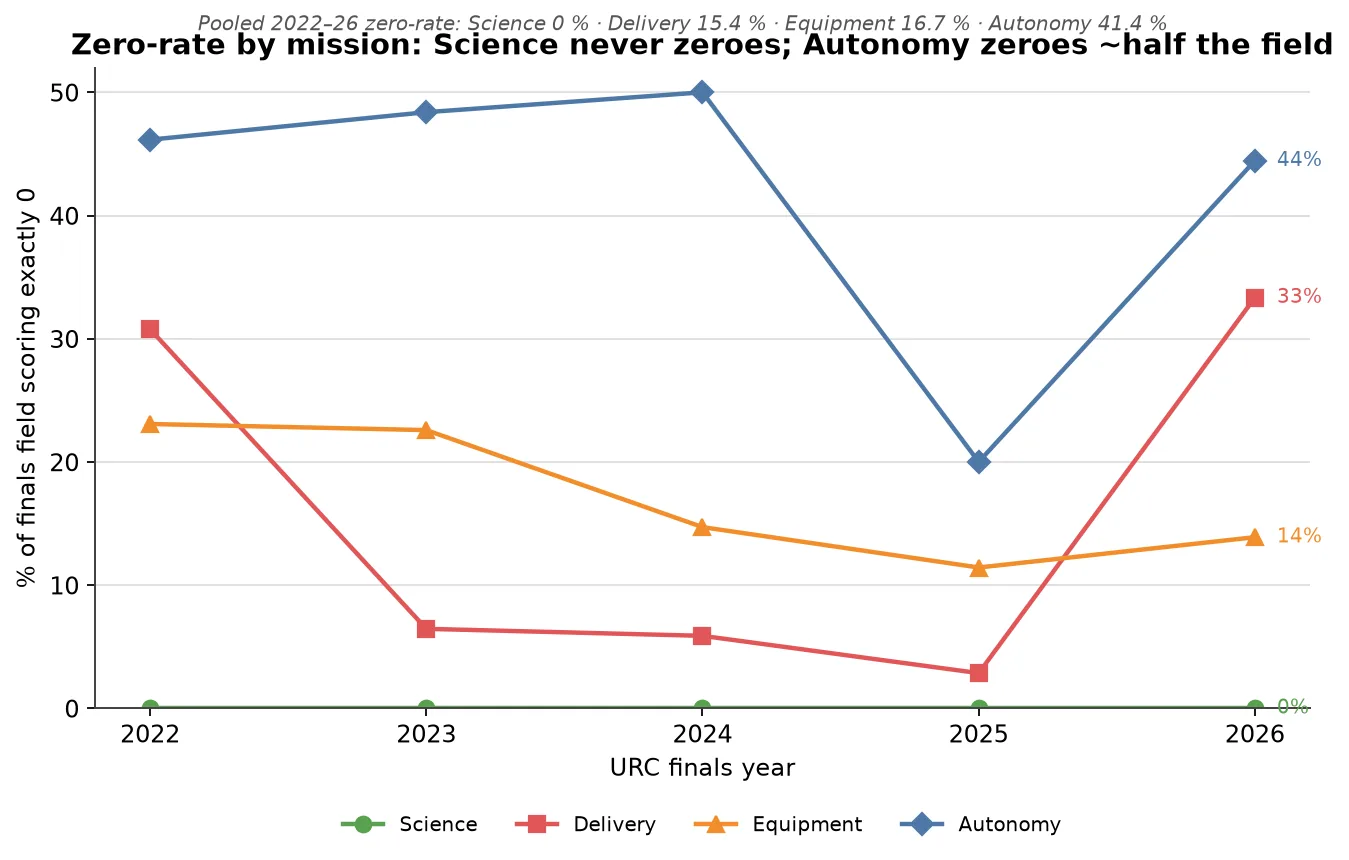
- What separates the top from the rest computes the zero rates and variance shares the likelihood bands rest on.
- The 13-week plan assigns the first thirteen weeks of these rows to dated weeks.
Sources for this page
- S-URC27-RULESUniversity Rover Challenge 2027 – Requirements and GuidelinesOriginal Archived copy
- S-URC-ADVICEURC Advice (judges' systems-engineering lessons)Original Archived copy
- S-WVU-NEWS2026WVU robotics team places fourth overall, earns top marks at international University Rover ChallengeOriginal
- S-URC26-SARURC2026 System Acceptance Review Requirements + SAR Q&AOriginal