Monash Nova Rover
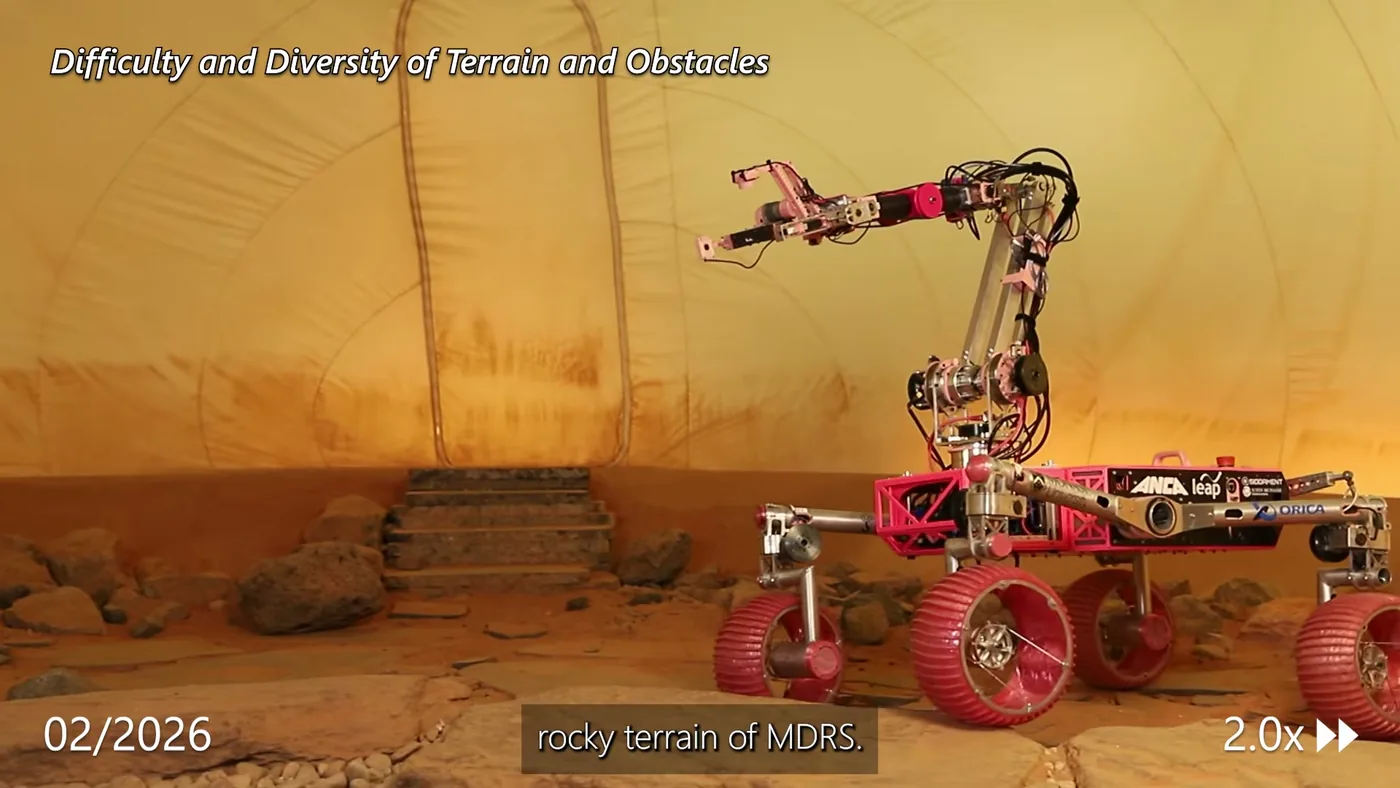
Monash has the highest mean total of any team in the 2022 to 2026 field and three podium finishes, and it reached its team record of 412.41 in 2026 by finishing two subsystems it had deferred and simplifying its autonomy stack. It also fell to 16th in 2024, in the middle of a platform change. The team designs nearly every high-value part itself: wheel gearboxes, steering drives, motor controllers, the computer carrier board and the chassis backplane.
What this team shows
- The platform cycle is two years, not one. Every second year of a platform is a large improvement and every first year is a regression: 2024 fell to 16th, 2026 rose to a record S-URC24-SCORES S-URC26-SCORES.
- The chassis is also the wiring harness. A single backplane board carries power and every bus, with daughter boards that slot in, so a failed board is a swap rather than a rewire S-MONASH-IEEE-RAM.
- Science is additive. The team keeps every instrument that has scored and adds to it, which produced a field maximum of 100 in 2026 from five independent measurement chains S-MONASH-SAR2026.
- Autonomy improved by removing sophistication. The 0, 14 and 86 scores of 2024 to 2026 track a move from a rebuilt Nav2 stack and a state-lattice planner back to a conservative planner S-URC24-SCORES S-URC26-SCORES.
Identity and results
| Year | Rover | Total | Rank | SAR | Science | Delivery | Equipment | Autonomy |
|---|---|---|---|---|---|---|---|---|
| 2018 | Sandstorm | 218.52 | 14 | 85.52 | 100 | 32 | 1 | 0 |
| 2019 | Huntsman | 276.45 | 9 | 89.45 | 85 | 70 | 22 | 10 |
| 2022 | Platypus | 380.55 | 2 | 94.55 | 93 | 70 | 53 | 70 |
| 2023 | Waratah | 354.83 | 2 | 91.26 | 96.57 | 15 | 82 | 70 |
| 2024 | Waratah, upgraded | 247.35 | 16 | 87.35 | 62 | 80 | 18 | 0 |
| 2025 | Banksia | 320.61 | 7 | 93.61 | 88 | 71 | 54 | 14 |
| 2026 | Banksia, upgraded | 412.41 | 2 | 91.46 | 100 | 76 | 58.95 | 86 |
The 2019 rank is derived from the total because that year’s sheet is printed alphabetically; every other rank is row order in the official sheets S-URC19-SCORES S-URC26-SCORES. The 2026 field was 36 teams that competed, from 116 registrations, and the team’s own “second of 116” counts registrations rather than finalists.
Monash does not build a new rover every year. Sandstorm in 2018, Huntsman in 2019, Wombat in 2021, Platypus in 2022, Waratah in 2023 and 2024, Banksia in 2025 and 2026: four-year platform lives with a mid-life overhaul, and the second year of each platform is where the score moves S-MONASH-ROVERS S-MONASH-NEWS2025.
Rover generations
2018 to 2022: six wheels and a growing science payload. Sandstorm entered the field in 2018 with a perfect science score but 1 in equipment and 0 in autonomy. Huntsman added the first in-situ life-detection payload in 2019. Wombat was built for the Australian Rover Challenge when URC was cancelled in 2020 and 2021. Platypus in 2022 was a six-wheel skid-steer rover on a passive parallel-linkage suspension, 1.2 by 0.9 by 0.8 m, with two 28 V lithium iron phosphate packs, a 5.8 GHz video link on a 3 m carbon-fibre pole, a Jetson TX2, an arm on brushed motors with custom controller boards, and a science platform with four scoops and a locking-lid cache S-MONASH-ROVERS S-MONASH-SAR2022. It finished 2nd.
2023: Waratah, and a wholesale drive redesign. From a second-place rover the team replaced the six-wheel skid-steer layout with four wheels on a rocker plus pivot steering at every wheel, switched brushed to brushless motors with in-house field-oriented controllers, and added a differential bar with 50 % more travel and a damper. The arm was rebuilt with six gearboxes using frameless brushless motors and a cycloidal stage, with through-hole cable routing and the controller inside the gearbox housing. Science moved to a pre-loaded carousel with three assays and an in-house Raman spectrometer. A deployable radio repeater with a self-righting base was carried S-MONASH-SAR2023 S-MONASH-IEEE-RAM. Result: 2nd, with 15 in Delivery after a surprise task and 82 in Equipment.
2024: the dip. The 2024 rover was an upgraded Waratah, not a new vehicle: 12:1 brushless planetary drives, cable-spoke wheels, machined pivot modules clamping slew drives rated above 70:1, new rocker geometry with 210 mm of travel per wheel, six redesigned arm gearboxes with the controllers bolted on as heat sinks, and a ground-up Nav2 autonomy rebuild S-MONASH-SAR2024. Autonomy scored zero and Equipment 18 while Delivery rose to 80 and Science fell to 62 S-URC24-SCORES. The team attributes no cause publicly; the pattern is consistent with a platform and stack refresh landing too late to be tested as a system.
2025: Banksia, year one. A clean-sheet rover: a redesigned core, a chassis backplane, a Jetson Orin Nano on a custom carrier board, a bespoke lithium-polymer pack with battery manager and E-stop, an in-house 15:1 cycloidal wheel gearbox at 32 N·m continuous, 70:1 worm-driven pivot drives giving zero-radius rotation and lateral strafing, and printed treads on bike-spoke wheels S-MONASH-SAR2025. The new arm did not arrive: gearbox lead times meant the old arm was retained to meet the competition, and autonomy fell to 14 S-URC25-SCORES.
2026: Banksia, year two. The deferred subsystems landed. A new six-degree-of-freedom arm with a differential roll-pitch-roll wrist replaced the heavier pitch-yaw-roll design, the science payload was rebuilt as five independent measurement chains with a depth-sensing auger, the battery became a bespoke lithium iron phosphate pack with a balancer and bidirectional power control, and a patch array was paired with the steerable base antenna S-MONASH-SAR2026 S-MONASH-BULL-JAN26. Result: 2nd with a team record, and a field maximum in science.
Subsystems
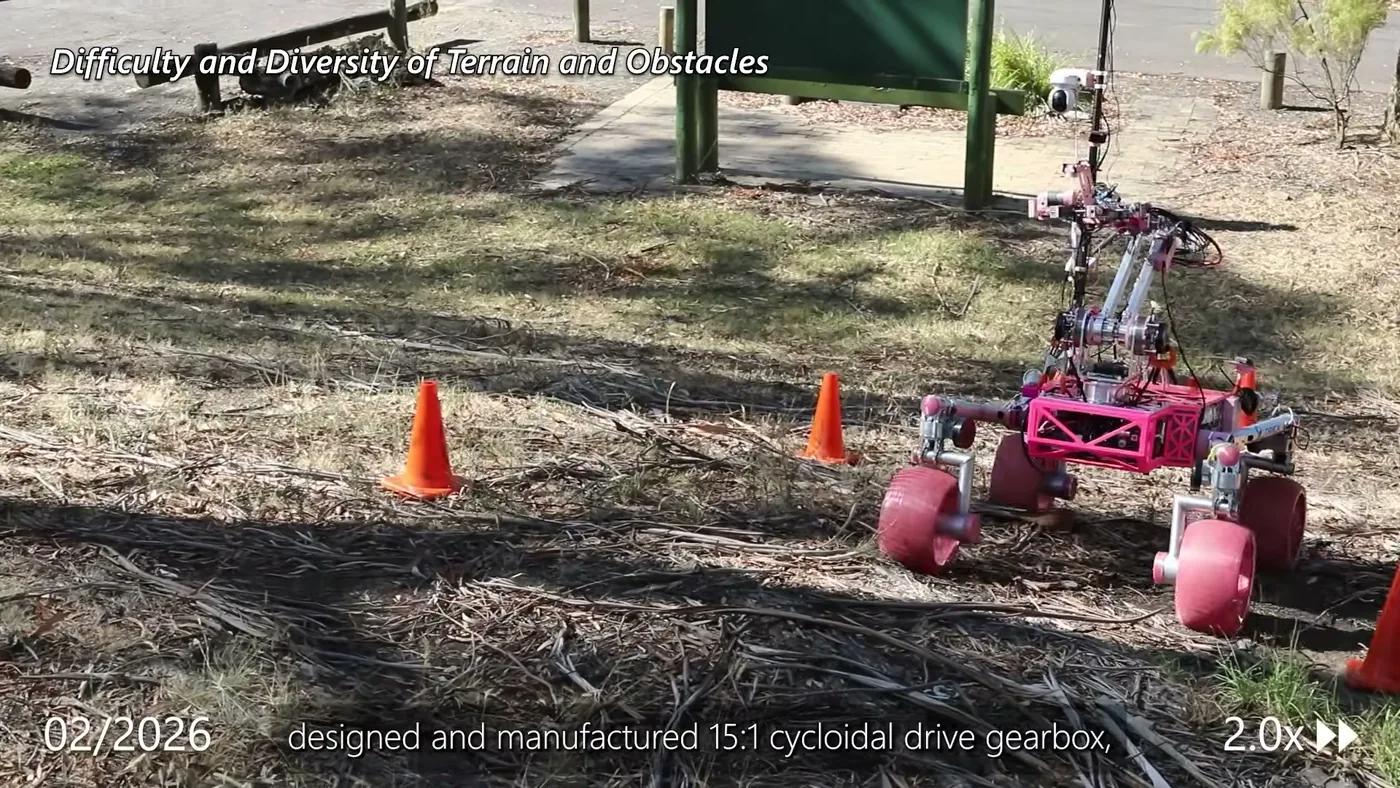
Mobility. Four wheels on a rocker with a rear-mounted differential bar. The rover model gives a wheel of 0.314 m diameter and 0.160 m width at 1.85 kg each, and a track of 0.646 m, while the steering configuration carries a track parameter of 0.816 m S-MONASH-GH-NOVA. Eight brushless motors: four through an in-house 15:1 cycloidal gearbox and four through 70:1 slew drives for pivot steering, all on four drive modes implemented as separate controllers S-MONASH-SAR2025 S-MONASH-SAR2026. Top speed is claimed at 3.6 m/s while the shipped controller caps pivot-drive at 2.5 m/s and strafe at 1.5 m/s, so the claim is a bench figure rather than an operating limit S-MONASH-GH-NOVA.
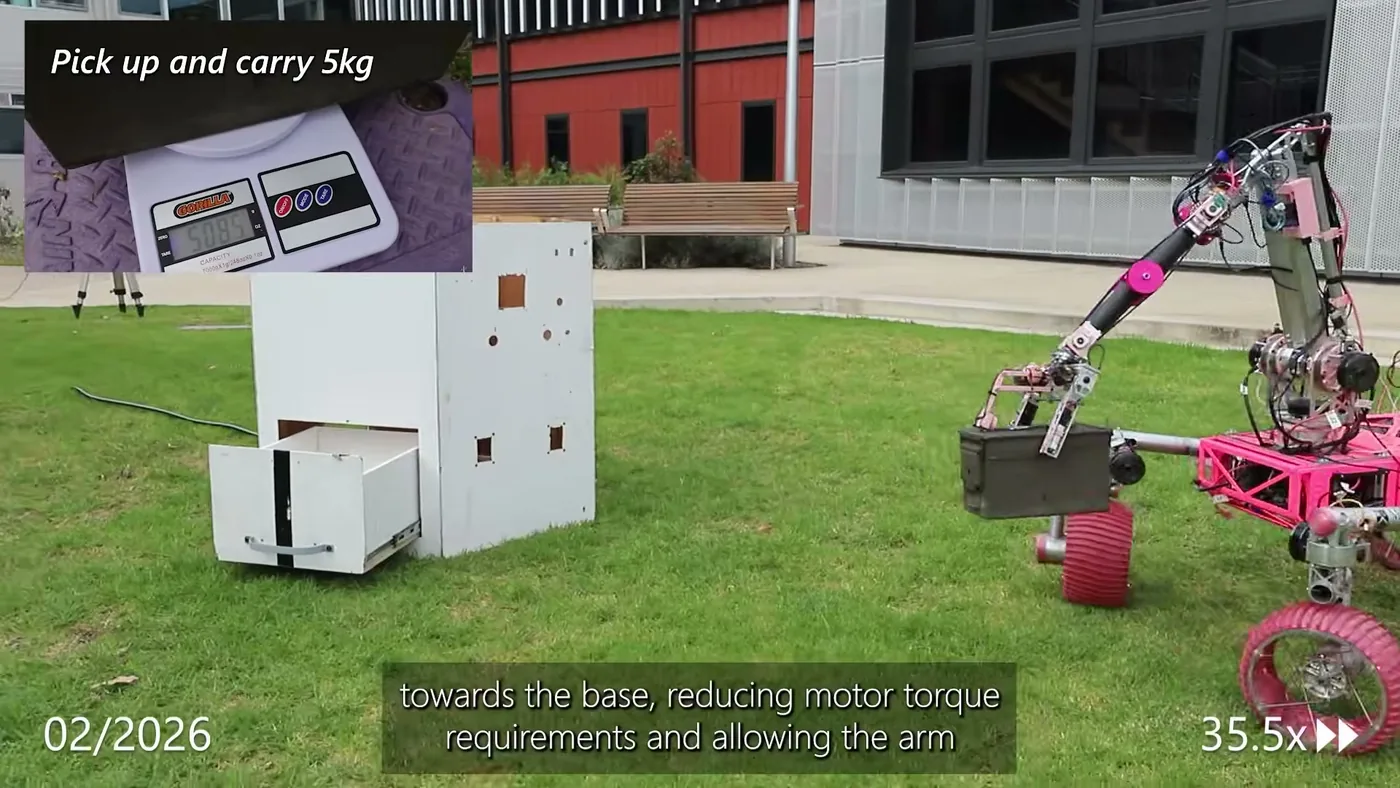
Arm and end-effectors. Six revolute joints plus a gripper, with a parallel-bar shoulder-elbow that keeps the forearm actuator near the base and shifts the centre of mass rearward S-MONASH-SAR2026. Link lengths from the model are 0.50 m for the upper arm and 0.45 m for the forearm, giving about 1.0 m of shoulder-to-fingertip reach, with the whole arm at 6.54 kg S-MONASH-GH-NOVA. The end effector is a two-finger parallel gripper on a lead screw with neoprene pads and an eye-in-hand camera. Payload is quoted as more than 5 kg, and the review film shows a bench scale reading 5.085 kg with the cache hanging from the arm S-MONASH-SAR2026.
Typing is vision-driven rather than taught: the arm locates the keyboard with a retro-reflective tag and edge detection of the required key, then plans and executes with its own kinematics package S-MONASH-SAR2026. The team’s benchmarks for that package and a feedback-collision check are in the public codebase S-MONASH-GH-NOVA.
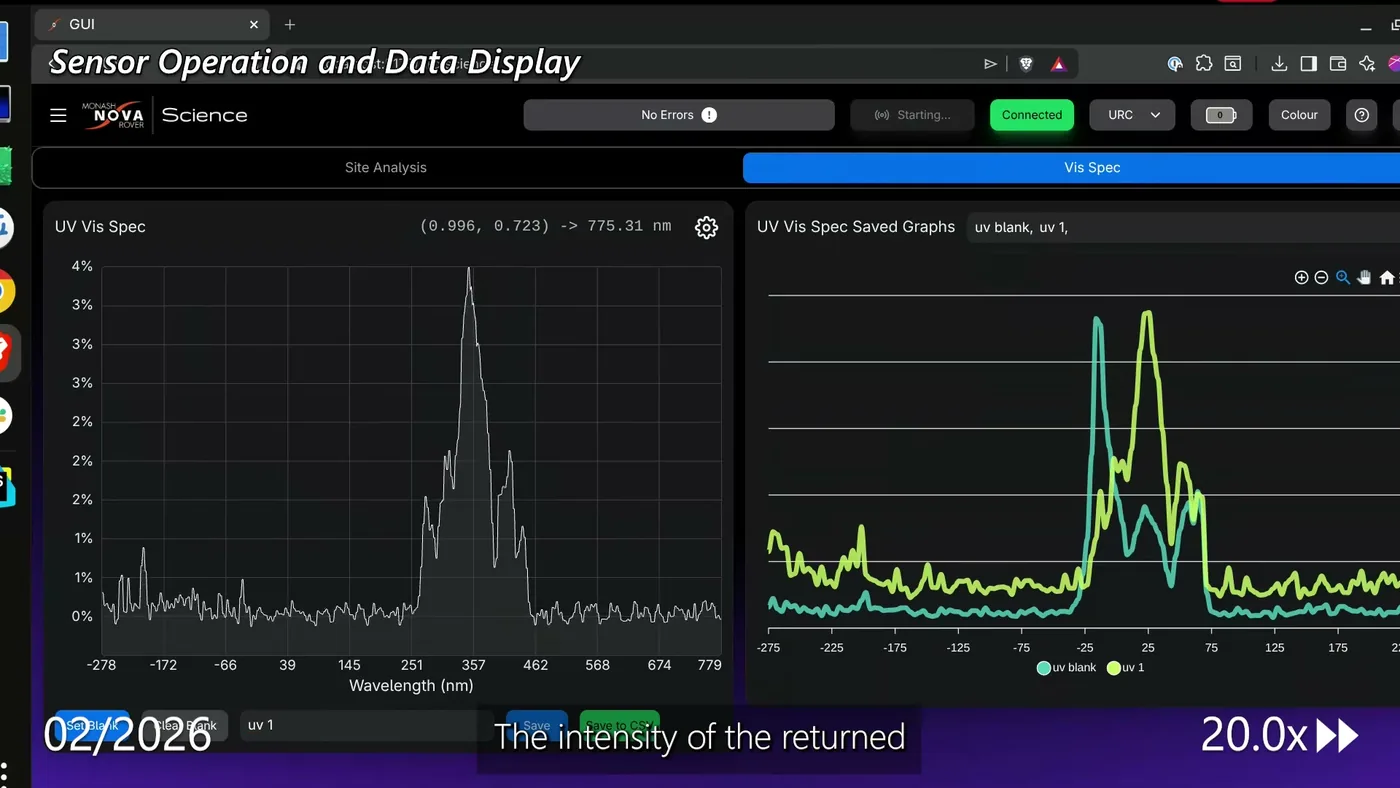
Science. The strongest subsystem and the one that produced the 2026 maximum. Sampling is an auger with Hall-effect depth sensing, which lets the team assert a sample from below 10 cm as evidence rather than as an operator judgement, and the sample goes into a sealed removable cache S-MONASH-SAR2026. The payload carries a near-infrared reflectometer and a heated ultraviolet-visible spectrometer with ninhydrin and malachite green, plus a pH and ammonia sensor array, moisture and temperature probes and a panorama camera. That is two independent life-detection capabilities, one of them a wet-chemistry bioassay, which is the shape the 2027 rules require S-URC27-RULES §1.b.v.
Communications. A dual-band radio that uses one band at a time, historically 900 MHz at URC and 5 GHz at the Australian event, plus a 900 MHz low-power module driven over AT commands S-MONASH-WS-RADIOS S-MONASH-RADIO900. The 2026 rover pairs a patch array with a steerable directional Yagi at the base and claims a minimum of 1 km S-MONASH-SAR2026. The team publishes its own link budget in a training workshop: 22 dBm output, about 1 dB per metre of cable loss, a 14 dBi antenna and a 36 dBm ceiling on radiated power, which caps antenna gain unless transmit power is reduced S-MONASH-WS-RADIOS. Base-station antenna steering must be electronic under the rules, and the team has a peer-reviewed paper on signal-strength-based tracking S-MONASH-IAC-RSSI.
Power, compute and software. Battery chemistry has reversed twice: lithium iron phosphate in 2021 and 2022, lithium polymer in 2023 to 2025, and back to a bespoke lithium iron phosphate pack with a balancer, bidirectional control and an integrated E-stop in 2026 S-MONASH-SAR2026. A Jetson Orin Nano on a team-designed carrier board runs the stack, with a fan card added in 2026 to cool the voltage-regulator boards inside a sealed chassis S-MONASH-SAR2025 S-MONASH-SAR2026. Perception is a Livox LiDAR and a stereo depth camera, with a 360° camera and a panorama camera for science S-MONASH-SAR2026.
The autonomy history is the most instructive sequence in the dossier.
| Year | Planner | Autonomy score |
|---|---|---|
| 2023 | in-house hybrid A* over a slope-thresholded occupancy grid | 70 |
| 2024 | ground-up Nav2 rebuild | 0 |
| 2025 | Nav2 with a state-lattice planner tuned against rotation in place | 14 |
| 2026 | Nav2 with a conservative global planner, voxel costmap and custom behaviour tree | 86 |
The two most ambitious stacks in the sequence scored 0 and 14, and the conservative 2026 configuration scored the field maximum S-URC24-SCORES S-URC26-SCORES. The 2026 stack fuses GPS, LiDAR, cameras, an inertial unit and wheel encoders in a filter, and takes obstacle data from the LiDAR into a voxel costmap S-MONASH-SAR2026. The operator station is a web application that talks to ROS over websockets, with a digital twin of the arm beside the camera feeds S-MONASH-GH-NOVA.
Mission performance
The score profile is stable where the team is mature and volatile where it is not. Across the five 2022 to 2026 finals, review scores run 87.35 to 94.55 with a mean of 91.6; science runs 62 to 100 with a mean of 87.9; delivery has one catastrophic year at 15 and otherwise sits between 70 and 80. Equipment and autonomy are where the finals are lost: equipment has never exceeded 82 in five finals, and autonomy is bimodal, either working or scoring almost nothing S-URC22-SCORES S-URC26-SCORES.
The 2023 Delivery score is the cleanest cautionary tale in the dossier. The mission added a surprise task announced after teams arrived, three teams found the object, and Monash scored 15 despite having the better chassis and new search features S-MONASH-IEEE-RAM. That is a search-and-recognition failure, not a mobility failure.
The 2026 podium came from finishing what was deferred, not from a new idea. The arm and the science payload both landed a year late, and the autonomy stack was made less ambitious. Science reached 100 and autonomy 86 while equipment stayed at 58.95, still the weakest of the 2026 missions and the one the next arm iteration has to fix S-URC26-SCORES.
Lessons for a first build
- Plan for a two-year platform. A first build should expect its second season, not its first, to convert the work, and should avoid changing the arm and the autonomy stack in the same year S-URC24-SCORES S-MONASH-SAR2025.
- The backplane is the highest-leverage idea here. One board carrying power and every bus, with slot-in daughter boards, turns a failed board into a field swap S-MONASH-IEEE-RAM.
- Build the rover model from the CAD and use it everywhere. Onshape to robot model to simulation, collision checking and the operator’s digital twin is one pipeline that costs a week and pays all season S-MONASH-GH-NOVA.
- Put the science verdict in the operator station. Per-site tabs, saved spectra and automatic sample labels mean the debrief is written while the rover works S-MONASH-SAR2026.
- Do not attempt in-house actuators in year one. The motor-controller and gearbox programme is a five-year accumulation, and the team’s own paper names the cost as extra engineering and extra validation S-MONASH-IEEE-RAM.
- Depth-verified sampling turns a claim into evidence. A Hall-effect sensor on the auger is what lets the team state a sample came from below 10 cm S-MONASH-SAR2026.
- A deployable repeater is allowed and has been demonstrated. Monash built one with a self-righting base in 2023, and the 2027 rules permit rover- or drone-deployed repeaters S-MONASH-IEEE-RAM S-URC27-RULES §2.c.iv.
What remains uncertain
No mass budget is published, and the only public mass statement is a “28 to 60 kg” range on the team site that cannot be reconciled with the 50 kg limit S-URC27-RULES §2.a.ii. The rover model gives 24.4 kg for the rolling chassis and 6.54 kg for the arm, before battery, science and electronics, but several link masses are dummy values S-MONASH-GH-NOVA. Battery capacity, mast height, drone mass and the 900 MHz module vendor are unpublished, and the datasheet the code cites is dead.
The public record contradicts itself in four places: the 2026 arm is “Titan” in the review film and “Taipan” in the bulletins and code; the object detector is one version on the site and another in the film; track width differs between the model and the controller; and top speed differs between the claim and the shipped configuration S-MONASH-SAR2026 S-MONASH-GH-NOVA. The cause of the 2024 collapse is not stated by the team, and no public evidence exists of a key-in-lock mechanism, which the 2027 servicing mission adds S-URC27-RULES §1.d.ii.
Team sources
- novarover.space, the team site.
- Rover specifications, a specification sheet per rover.
- MonashNovaRover/nova, the Apache-2.0 codebase with the rover model, arm model and operator station.
- A Tale of Two Rovers, the joint paper with West Virginia University on the two design philosophies.
- Review film, 2026, the record season described subsystem by subsystem.
- Review film, 2023, the year of the drive redesign.
- Field test bulletin, November 2025, the beach test and the science field trial.
Sources for this page
- S-URC24-SCORESURC2024 Official ScoresOriginal
- S-URC26-SCORESURC2026 Official ScoresOriginal Archived copy
- S-MONASH-IEEE-RAMA Tale of Two Rovers: How Different Philosophies Foster Innovation in the 2023 University Rover ChallengeOriginal
- S-MONASH-SAR2026Monash Nova Rover, URC SAR 2026 (video, 5:09)Original
- S-URC19-SCORESURC2019 Scores (SAR + 4 missions, alphabetical)Original
- S-MONASH-ROVERSOur Rovers, per-rover specification sheets (2017–2025)Original
- S-MONASH-NEWS2025Monash Nova Rover Shines at 2025 University Rover ChallengeOriginal
- S-MONASH-SAR2022Monash Nova Rover Team, 2022 URC SAR (video, 5:23)Original
- S-MONASH-SAR2023Monash Nova Rover Team, 2023 URC SAR (video, 4:59)Original
- S-MONASH-SAR2024Monash Nova Rover, URC SAR 2024 (video, 5:07)Original
- S-MONASH-SAR2025Monash Nova Rover, URC SAR 2025 (video, 5:00)Original
- S-URC25-SCORESURC2025 Official ScoresOriginal
- S-MONASH-BULL-JAN26The Monash Nova Rover Bulletin, January 2026Original
- S-MONASH-GH-NOVAMonashNovaRover/nova, "The Monash Nova Rover mono-repo" (Apache-2.0; default branch main; 2,389 files; last push 2026-10-23)Original
- S-URC27-RULESUniversity Rover Challenge 2027 – Requirements and GuidelinesOriginal Archived copy
- S-MONASH-WS-RADIOS"Radios Workshop, Monash Nova Rover" (video, 1:54:59)Original
- S-MONASH-RADIO900nova/src/other/radio_900/README.md, "900 MHz radios related code", AT-command terminal, references an antenna-tracking FYP and an "AH module AT command development guide" datasheetOriginal
- S-MONASH-IAC-RSSIReal-Time RSSI-Based Antenna Tracking: Leveraging Machine Learning for Lunar and Martian Rover CommunicationOriginal
- S-URC22-SCORESURC2022 Official ScoresOriginal