title: "Site, travel and field constraints" description: The desert site as an engineering constraint: the command post, the clock, the spectrum, the road and the heat. part: The competition chapter: "2.8" toc_depth: 3 tags: - logistics - operations - field
Site, travel and field constraints
At URC the logistics are engineering constraints. The command post is a metal box with no view, so every antenna is outside and every display is read blind. The setup window is fifteen minutes, so the ground station is a deployable system rather than a packing problem. The radio spectrum is monitored and split into three sub-bands that can be assigned per mission. The site is at 1,309 m, reaches 37.8 °C, has no cell service and permits no testing at the competition location. Each of these becomes a mass item, a time budget or a test-plan constraint.
Key takeaways
- Six students, one box, no view. The command post holds at most six students, excludes advisors, blocks the course from sight and blocks radio through its walls S-URC-LOGISTICS S-URC27-RULES §3.d.i.
- Fifteen minutes in and ten minutes out is the whole ground-station design budget, and a drone link on its own antenna adds a second 25 m run S-URC27-RULES S-URC27-QA §1.a.ii DQ2.
- The spectrum is a referee. The 900 MHz link must work in each of three 8 MHz sub-bands, and from 2027 the rule covers the drone and the astronaut link as well as the rover S-URC27-RULES §2.c.v.
- There is no testing at the site and no parts nearby. The nearest electronics source is a six-hour round trip and the nearest trauma hospital is at least two hours away S-URC-ADVICE S-URC-DESERT-SAFETY.
Who may be on site
| Constraint | Value |
|---|---|
| Registered students | 24 |
| Registered advisors | 2 |
| Individuals on site per competition day | 14 |
| Students inside the command post during a mission | 6 or fewer |
| Advisors inside the command post | Not permitted |
| Minimum age | 18 on the first competition day, unless the Director grants prior approval |
| Team size during the year | Unlimited, with students enrolled at least half-time |
The 2027 rulebook defers the attendance figures to the URC website, so the published numbers above are the working assumption S-URC27-RULES S-URC-LOGISTICS §3.b.iii.
The six-person limit is a console count, not a suggestion. Driver, science operator, arm operator, drone pilot, autonomy operator and mission commander fill it, and there is no seventh seat and no advisor to take one S-URC-LOGISTICS S-URC27-RULES §3.b.ii. Two further roster rules follow from it. A team member who leaves the command post to act as a runner cannot return to operate or analyse data for that mission, so the field crew of spotter, runners and astronaut has to be rostered separately. And the Astrobiology briefing is open only to members who stayed inside and never saw the site, so two people have to stay clean all week S-URC27-QA AQ8.
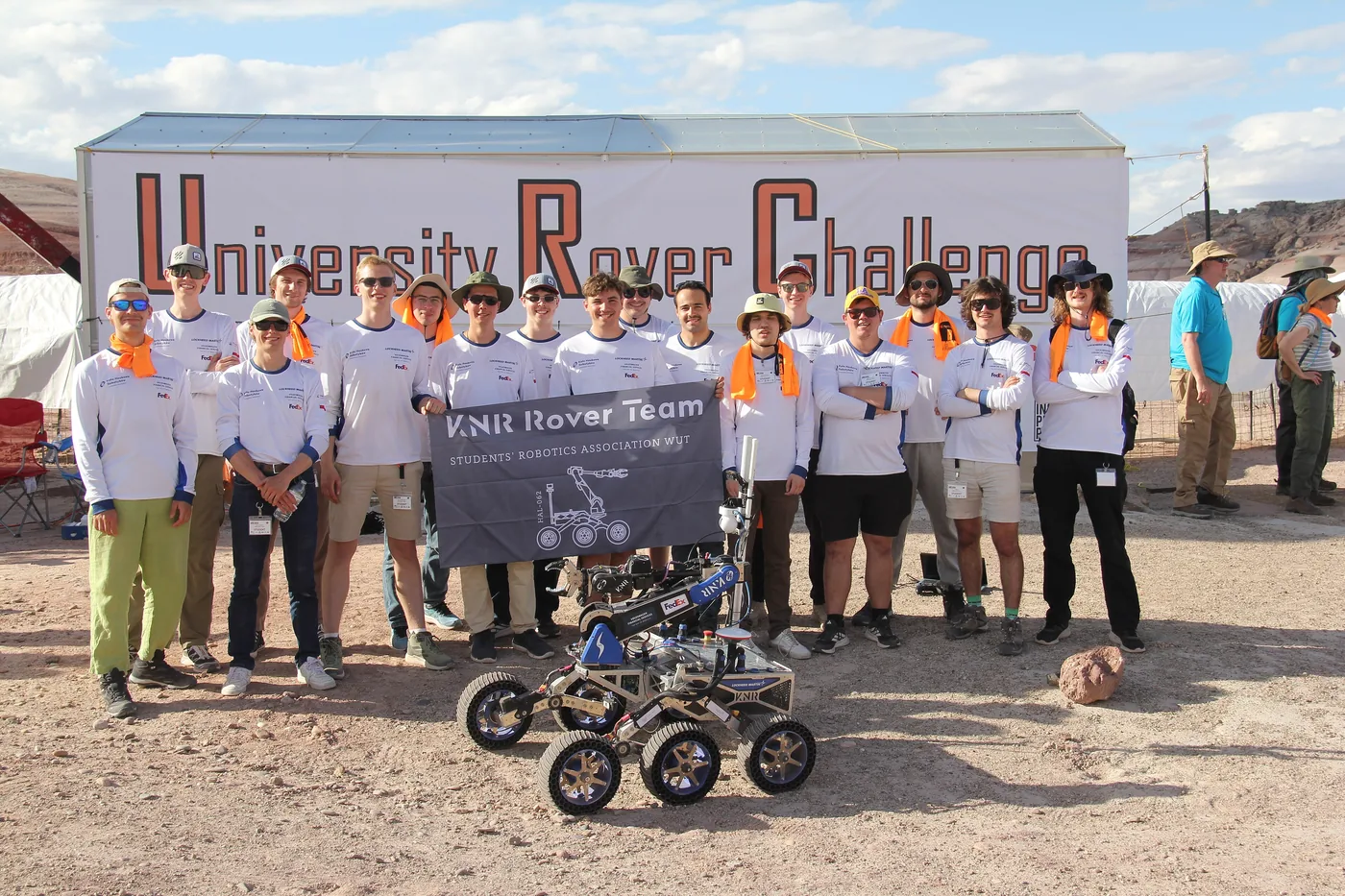
The command post
These stations will be metal trailer units (such as the back of a small moving truck provided by URC) or structures at the Mars Desert Research Station. Visibility of the course to the operators in the C2 station will be blocked. Basic power (120 V, 60 Hz), tables and chairs will be provided. S-URC27-RULES §3.d.i
The judges’ advice page is blunter about the station at the research station: “This is a metal structure and radio signals, including WiFi, will NOT go through the walls” S-URC-ADVICE. Both statements point the same way. The antenna is outside, the cable is long, and the operator sees only what the rover sends back.
| Provided | Not provided |
|---|---|
| 120 V, 60 Hz power | A stated current limit or a guarantee of an uninterruptible supply |
| Tables and chairs | Network, internet or cell service |
| A structure with a blocked view | Any allowance for a slow setup |
That turns the ground station into a deployable system with a stopwatch on it: base station, GNSS base, antenna mast, two radio links, six operator positions, a drone control position and a power distribution board, carried in cases, erected by hand in the sun, and reversed in ten minutes S-URC27-RULES §1.a.ii.
Setup, teardown and the mission clock
| Constraint | Value |
|---|---|
| Setup from command-post access to ready, including all communications | 15 minutes or less |
| Teardown and removal of all equipment, then radios off | 10 minutes or less |
| Recovery of equipment left in the field | Inside the same 10 minutes, after mission time ends |
| Autonomy to Equipment Servicing turnaround | As little as 10 minutes, same command post, adjacent course |
| Mission order | Drawn by lot, with the schedule known about a week ahead |
The schedule arriving about a week before the field event and the order being drawn by lot are configuration requirements rather than inconveniences. A rover has to be mission-agnostic in its transport state, and any module swap has to finish inside the setup window S-URC27-QA CQ4.
Cable, mast and antenna
| Constraint | Value |
|---|---|
| Communications cable the team brings | At least 25 m |
| Cable for drone operations | A second 25 m run when the drone link has its own antenna |
| Base-station antenna height | 3 m or less |
| Antenna base position | Within 5 m of the command post |
| Guy anchors | Within 10 m of the command post |
| Judge-designated positions at site structures | Up to 20 m, to avoid buried pipes and blocking structures |
| Steered antennas | Allowed, with no camera on the antenna and no reliance on watching the rover |
A 25 m run costs real decibels at 2.4 GHz and at 5 GHz, so the cable loss budget belongs in the link budget rather than after it. The 20 m exception exists to keep the team away from buried services at the structures, and it changes the cable length and the guy geometry rather than the mast S-URC27-RULES §2.c.iii.
The field environment
| Constraint | Value | Design consequence |
|---|---|---|
| Air temperature | Up to 37.8 °C | Surface temperatures in sun are higher, so the enclosure heat load is set by sunlight |
| Wind and dust | Dust raised frequently; rover must withstand it | Sealed connectors, filtered intakes, a cleaning routine |
| Rain | Light rain must be tolerated; heavy rain and thunderstorms are not expected | Splash protection rather than a waterproof claim |
| Light | All events in full daylight | Displays need a hood or high brightness; the LED needs a daytime check |
| Altitude | 1,309 m | Thinner air reduces air-cooled heat-exchanger performance |
| Terrain | Soft sand, gravel, rough stone, boulder fields, vertical drops, steep loose slopes | The mobility envelope in one line |
| Transit | A washboard dirt road from the highway to the site | Connectors and harnesses have to survive vibration |
Drone wind is separate and advisory: the rules strongly suggest operating in 48 km/h wind with a top speed of at least 64 km/h, and the dummy mass requirement is never waived S-URC27-RULES §2.b.vi.
Spectrum: the invisible referee
| Constraint | Value |
|---|---|
| 900 MHz bandwidth | 8 MHz maximum per use |
| 900 MHz sub-bands | 902–910, 911–919 and 920–928 MHz, usable exclusively |
| Sub-band choice | Assigned per mission by the competition schedule, so the radio must shift |
| Scope | All links between command post, rover, drone and astronaut, including any local network between devices |
| Monitoring | On site, to keep teams inside their assigned channels |
| 2.4 GHz | No URC restriction, but FCC rules apply |
| Other bands | Amateur bands are encouraged for licensed teams |
| Documentation | Devices and licences to the URC Director by 2027-04-30 |
| Non-competing time | Radios powered down at the event site |
The scope line is the 2027 change that catches designs: a link that was a rover link in 2026 is a rover, drone and astronaut link now, and an internal network that happens to run in the 900 MHz band is inside the same limit S-URC27-RULES §2.c.v. A team on the site is also within signal range of other teams on other sub-bands, so interference is expected rather than exceptional.
Where testing is allowed and what is not
- No testing at the site. The rules prohibit it before, during and after the competition S-URC27-RULES §3.d.iv.
- Permitted areas only. Testing is limited to places where off-road vehicles are permitted, such as the Factory Butte open area, or to town land. Undesignated public land is not allowed.
- No cell service. There is no telephone and no cell coverage at the site, so documentation, licence copies, spares lists and vendor contacts have to be carried offline S-URC-ADVICE S-URC-DESERT-SAFETY.
- No parts nearby. The nearest electronics source is a six-hour round trip, which makes a declared spares kit a requirement rather than a preference.
- Drone airspace. The site is Class G, below 120 m above ground, about five miles from an uncontrolled airport, and drones may not enter the national park S-URC27-RULES §2.b.xi.
- Drone paperwork. Remote ID, registration above 250 g, a TRUST certificate carried by every pilot and a spotter with continuous visual line of sight.
Travel, vehicles and lodging
| Constraint | Value |
|---|---|
| Public transport to the site | None; the team must have its own vehicle |
| Permitted vehicles | Pickups, cargo vans, minivans, sport utility vehicles and 15-passenger vans |
| Not permitted | Box trucks of 14 ft or more, and any stakebed truck |
| Airports | Grand Junction 159 mi, about 2.5 h; Salt Lake City 236 mi, about 4 h; Las Vegas 405 mi, about 6.5 h |
| Fuel spacing | Over 100 mi between stations is common, so do not pass a station with under 150 mi of range |
| Hanksville to the site | 20–25 min over dirt road |
| Lodging | Hanksville, with overflow in Caineville, Torrey and Green River |
| Lodging rules | No rover work or hand-tool use indoors |
| Fees | $197 application, $397 event registration after review selection |
Two details cost teams time at the wrong moment. Lodging blocks are released after the review results, so a cancellable fallback is worth holding. And components, including lithium batteries, have been seized in customs, so a US purchase backup belongs in the travel plan for any international team S-URC-LOGISTICS.
Health and safety
| Constraint | Value |
|---|---|
| Nearest trauma hospital | At least 2 h by road, or 90 min by air ambulance |
| Nearest medical clinic | At least 1 h by road |
| Emergency communications | No telephone and no cell service at the site |
| Footwear | Fully enclosing footwear is required at all events |
| Water | Drinking-water re-supply is provided at the mission sites |
| Hazards | Venomous snakes, wasps and hornets, scorpions, spiders and cougars |
| Chemical response | No chemical safety response equipment on site |
A written medical plan, a designated first-aid lead, an evacuation route and medication for the whole trip plus a margin are all part of the field kit. The absence of chemical response also sets the science posture: containment and a no-spill regime, because there is nothing to clean a spill with S-URC-DESERT-SAFETY S-URC26-SCIPLAN.
The season to the clock
| When | What | What it gates |
|---|---|---|
| 2026-10-30 | Registration closes | Support letters, and the competition itself |
| 2026-12-02 | Preliminary Design Review | A five-page report in the 2026 format |
| 2027-03-05 | System Acceptance Review | A seven-page report and a 5:00 video; the top 36 go to the field |
| 2027-04-30 | Communications devices and licences | The radio hardware freeze for every link |
| 2027-05-21 | Science plan | About five pages, scored in Astrobiology |
| 2027-05-26 | Rover Expense Report | A work-breakdown level accounting, with a deadline-day penalty |
| One week before finals | Mission schedule and 900 MHz sub-band per mission | Radio agility and mission-order rehearsal |
| 2027-06-02 to 2027-06-05 | Finals | Everything above, in order |
What the site does not publish
- Command-post current capacity. The rules give 120 V at 60 Hz and no current limit, no circuit count and no guaranteed backup. A design load of about 10 A continuous with a battery buffer is a defensive reading, not a published figure.
- Whether the antenna limits cover the GNSS base. The 3 m and 5 m figures are written for the communications antenna. Planning to 3 m is the safe interpretation.
- The 2027 command-post details. Whether the station is a trailer or the station structure, and the power arrangement at each site, are not published for 2027; the 2026 text is the available description.
- The vehicle list revision date. The permitted-vehicle document is linked from the logistics page and carries no revision date.
- Lodging block timing. The release of room blocks after review results is 2026 practice, not a stated 2027 rule.
- Spectrum enforcement detail. The rules state that monitoring exists and do not say what follows a breach.
- Medical support at the site. Distance to care is published; whether a medic is present during missions is not.
Further reading
- Rules, limits and the field carries the clauses quoted here.
- Q&A rulings holds the antenna, cable and command-post answers in full.
- Deadlines turns the season table into dated milestones.
- Operator station and operations designs the ground station against these limits.
- Environment, dust, thermal and repair turns the desert into a test plan.
Sources for this page
- S-URC-LOGISTICSURC LogisticsOriginal Archived copy
- S-URC27-RULESUniversity Rover Challenge 2027 – Requirements and GuidelinesOriginal Archived copy
- S-URC27-QAURC2027 Questions & Answers (updated through 2026-10-11)Original Archived copy
- S-URC-ADVICEURC Advice (judges' systems-engineering lessons)Original Archived copy
- S-URC-DESERT-SAFETYURC Desert Safety GuideOriginal
- S-URC26-SCIPLANURC2026 Science Plan + Chemical Safety Plan RequirementsOriginal