Legendary Rover (Rzeszów University of Technology)
Rzeszów won the University Rover Challenge in 2015 with 460 points and in 2016 with 452.3, the fastest ascent to a title in the record: eighth in 2013, third in 2014, first in 2015. In the modern era it is a five-competition team that treats Utah as one event among several. It finished fifth in 2025 with every mission scoring, then tenth in 2026 in a season where it also placed second in Australia and third in Turkey, with Delivery down to 20 and Autonomy back to zero.
What this team shows
- A generation can be cancelled. The fifth rover was abandoned unfinished and the fourth was upgraded instead, then won a different competition that season. Very few teams record a decision like that.
- The 2019 failure account is the most useful page this team has published: a short circuit destroyed every electronic board five hours before the competition, and the rover still placed 13th with the fourth-best Delivery score in the field.
- Racing five events a season buys field time and costs depth. At URC the depth shows up in the autonomy column, which has produced 22.4 then zero in the two most recent seasons.
- The modern rovers use an open lattice wheel rather than a solid tyre, a compliance-based approach with no published test data behind it.
Identity and results
| Year | Rover | Total | Rank | SAR | Science | Delivery | Equipment | Autonomy |
|---|---|---|---|---|---|---|---|---|
| 2018 | unnamed | 205.04 | 19 | 76 | 93.04 | 0 | 36 | 0 |
| 2019 | LRT VII Twardowsky | 259.41 | 13 | 89.81 | 65.6 | 72 | 22 | 10 |
| 2025 | LRT VII Twardowsky | 351.25 | 5 | 88.85 | 95 | 71 | 74 | 22.4 |
| 2026 | LRT VII Twardowsky | 261.39 | 10 | 90.28 | 99 | 20 | 52.11 | 0 |
The title years used a different task set and are tabulated apart:
| Year | Rover | Total | Place | Field | Note |
|---|---|---|---|---|---|
| 2013 | LRT I | 157.25 | 8 | 10 | Sample Return 65 and presentation were the only scoring tasks |
| 2014 | LRT II Wolverine | 338 | 3 | 23 | Science 100, Delivery 55, Equipment 51, Autonomy 40 |
| 2015 | LRT III | 460 | 1 | 23 | Science 100, Delivery 80, Equipment 99, Autonomy 90 |
| 2016 | LRT IV | 452.3 | 1 | 28 | Winner of the Ares bracket in a two-bracket year |
No total before 2018 is comparable with the modern four missions, because the mission set and the scoring changed S-URC-HISTRESULTS. The 2016 event ran in two brackets, so its place is within the Ares bracket.
Between 2020 and 2024 the team appears in no URC result row: the 2020 and 2021 competitions ran without a finals field, 2022 and 2023 carry registrations and no results, and 2024 is a non-entry S-URC-HISTORY S-URC22-TEAMS S-URC23-TEAMS S-URC24-TEAMS S-URC22-SCORES S-URC23-SCORES.
The team’s own achievement page covers those same seasons with other events: sixth at the Indian Rover Design Challenge in 2022, fourth at the Anatolian Rover Challenge in 2024 with a best-manipulator award, and first at the Anatolian event in 2025 S-PRZ-ACH. The 2026 season reads as four podiums elsewhere and tenth at URC: fourth at the Canadian event, third at the Anatolian event, second at the Australian event, and fourth at the Tottori challenge.
Rover generations
The lineage is unusually well recorded for a team with no technical publishing: five generations named on the team’s site, with a gap in the numbering.
LRT I, 2013. Eighth at its debut. The entry was printed under the university’s earlier team name, and the team’s own account gives the same year, rank and university, which resolves the earlier name to this programme S-PRZ-SITE S-URC-HISTRESULTS.
LRT II Wolverine, 2014. Third place with 100 in Science, the first podium S-URC-HISTRESULTS.
LRT III, 2015. The title: 100 in Science, 99 in Equipment Servicing, 90 in Autonomy and 80 in Delivery, for 460 points. No team in the 2022–2026 field has scored a comparable total, because the mission set and the scoring have changed since; the two eras cannot be compared S-URC-HISTRESULTS.
LRT IV, 2016. A second title, 452.3, as the winner of the Ares bracket in the two-bracket year.
LRT V, 2017, cancelled. The fifth rover was never finished, the fourth was upgraded instead, and and the season went to a different event. Teams rarely publish a decision to stop building, and this one did S-PRZ-SITE.
LRT VII Twardowsky, 2019 to 2026. The current platform, named for a figure from Polish legend, spanning a six-season gap in appearances and therefore a large but unquantified amount of component change S-PRZ-SITE.
Subsystems
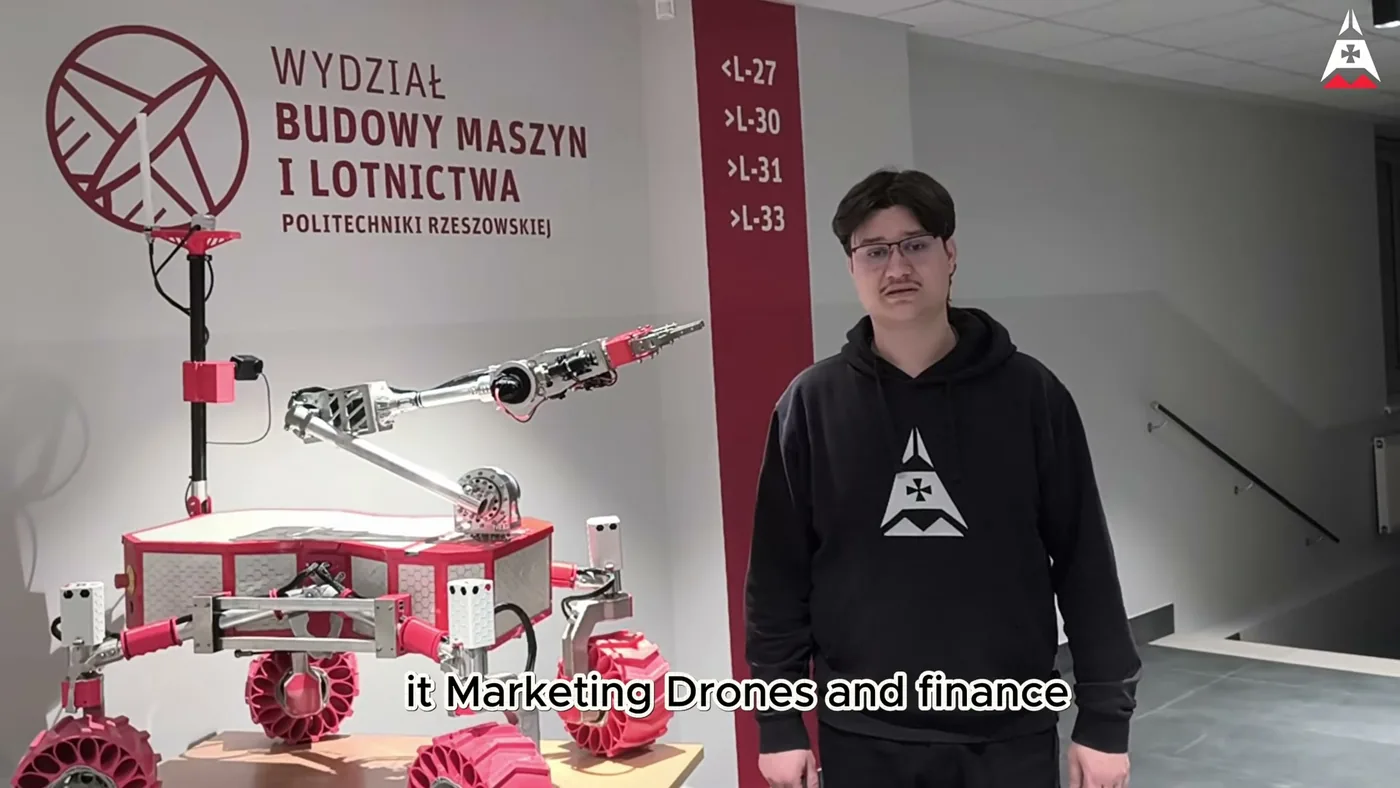
Mobility. Four driven wheels, each an open red lattice rather than a solid tyre, on machined aluminium links with a coil-over spring-damper at every corner S-PRZ-SAR2026. The lattice wheel is a compliance approach: the structure flexes where a solid tyre would transmit load into the chassis, and it can be printed or moulded without a tyre mould. Wheel diameter, motor and gearbox model, and mass are unpublished, and whether the lattice is additive or moulded cannot be settled from the film.
Manipulation. A long slender multi-link arm on a rotating turret, with a machined yoke at the shoulder, a tube upper link, an elbow joint and a lattice-truss forearm ending in a red and black end effector S-PRZ-SAR2026. Degrees of freedom, reach and actuator family are unpublished.
Mast and communications. A vertical black mast forward of the arm carries a camera and beacon assembly and what appear to be antenna leads S-PRZ-SAR2026. The radio model is unpublished.
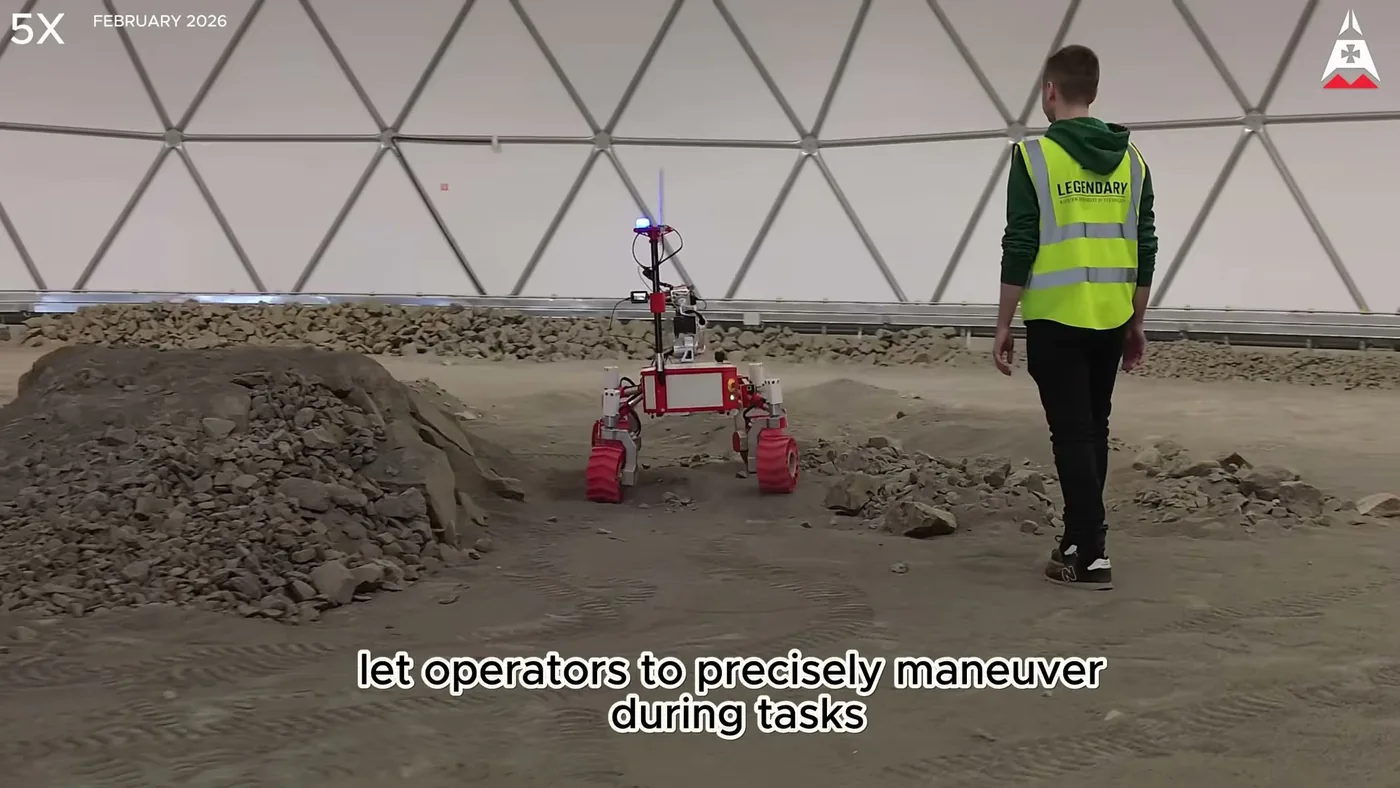
Operator station. The review film describes a framework that provides real-time communication and lets operators maneuver precisely during tasks; the visible hardware is a gamepad and a laptop showing a live camera feed S-PRZ-SAR2026.
Science. The most striking gap in the dossier. Science scored 95 in 2025 and 99 in 2026, among the best in the field in both years, and no instrument is named in text or visible in the frames covered here S-URC25-SCORES S-URC26-SCORES.
The drone. The 2026 review credits a drone sub-team alongside marketing and finance, and no aircraft appears in the frames captured S-PRZ-SAR2026. No drone appears in any URC mission score.
Mission performance
2015 and 2016: built on servicing. Two titles with near-perfect Equipment Servicing, 99 in 2015, plus Autonomy at 90, which was competitive then and would be exceptional now S-URC-HISTRESULTS. The mission mix and the scoring have changed enough that the totals are historical facts rather than benchmarks.
2018: a champion two years later, 19th. Delivery 0 and Autonomy 0 with Science at 93.04 and a review score of 76 S-URC-HISTRESULTS. This is the clearest single-year demonstration in the archive that a strong written review does not protect a team.
2019: the short circuit. Electronics destroyed five hours before the competition, the rover restored only partly, and still 13th of 36 with the fourth-best Delivery score in the field at 72 and eight of nine servicing tasks completed S-PRZ-SITE. Their own account says 13th of 34 teams, and the archived table has 36 rows; the rank agrees even where the field size does not.
2025: the complete season. 95, 71, 74 and 22.4 across the four missions, all scoring, fifth overall S-URC25-SCORES. The best URC result since 2016.
2026: two missions lost. Review 90.28, the team’s best, and Science 99, among the best in the field, with Delivery down from 71 to 20 and Autonomy from 22.4 to zero S-URC26-SCORES. Six places lost on two missions, in a season that produced four podiums at other events. Why the same rover that placed second in Australia could not deliver in Utah is unpublished, and there is no post-event account.
Lessons for a first build
- Stopping a build is a legitimate decision. LRT V was cancelled, the previous rover was upgraded, and the season was spent elsewhere. A first team that runs out of time in month eight should consider the same move rather than shipping an unfinished chassis.
- Publish the failure, not only the result. The 2019 line about a short circuit destroying every board five hours before the competition is the most useful sentence this team has written, because another team can design against it. A post-event account is worth more than a specification table.
- Test in a controlled space. A dome arena gives a repeatable surface and a fixed light level. It is cheaper than a simulator and closer to the field.
- A five-competition season is a strategy with a cost. It buys field time and it dilutes preparation. On this record the cost appears in the autonomy column at URC, which produced 22.4 and then zero while other events went well S-URC26-SCORES S-PRZ-ACH.
- An open wheel is a compliance decision. A lattice wheel replaces a solid tyre with structure. It is easy to make and hard to make consistent, so it needs test data that this team has not published.
What remains uncertain
Mass, wheel diameter, actuator models, arm degrees of freedom and radio are unpublished. The science payload is the largest gap: a 99 in Science with no named instrument leaves the score unexplained, and the review film’s spoken commentary is the cheapest remaining source.
Why Autonomy scored zero at URC 2026 after 22.4 in 2025 has no published answer. Why the 2022 and 2023 seasons ended at or before the review, and whether the team withdrew after qualifying, is also unstated. Whether the lattice wheels are printed or moulded, and what compliance they were designed for, cannot be settled from video. And whether the LRT VII that raced in 2026 is the same vehicle as the LRT VII of 2019 is unknowable from the record, given a six-season gap and no published component history.
Team sources
- legendary.prz.edu.pl, the team site, with the rover lineage and partners.
- Achievements, the full multi-competition record from 2014 to 2026.
- YouTube channel, review films from 2018 to 2026.
- 2026 System Acceptance Review, the primary film for LRT VII.
- 2025 System Acceptance Review, the best modern URC season.
- LegendaryRover on GitHub, an account with no public archives.
Sources for this page
- S-URC-HISTRESULTSURC results database: derived 2022–2026 statistics (§4–§5) and archived official results 2013–2019 (§7)Print copy
- S-URC-HISTORYURC History indexOriginal
- S-URC22-TEAMSURC2022 Team List ("URC2022 Featured 99 Teams, 15 Countries")Original
- S-URC23-TEAMSURC2023 Team ListOriginal
- S-URC24-TEAMSURC2024 Team ListOriginal
- S-URC22-SCORESURC2022 Official ScoresOriginal
- S-URC23-SCORESURC2023 Official ScoresOriginal
- S-PRZ-ACH"Osiągnięcia" (achievements), full multi-competition record 2014–2026: URC 3rd 2014, 1st 2015, 1st 2016, 5th 2025, 10th 2026; ARC 1st 2025 / 3rd 2026; AuRC 2nd 2026; CIRC 4th 2026; Tottori 4th 2026; IPAS 1st 2021; IRDC 2nd 2021 / 6th 2022Original
- S-PRZ-SITE"Łaziki" (rovers) page, LRT I→IV, "LRT V never completed for lack of funds", LRT VII "Twardowsky"; URC 2019 account: short circuit destroyed all electronic boards 5 h before the competition, rover restored "partly", 13th of 34 with 259 pts, Delivery 4th in the field, 8 of 9 tasksOriginal
- S-PRZ-SAR2026"Legendary Rover URC SAR 2026", video, 5:00, uploaded 2026-02-28; frames show LRT VII: red lattice-structure wheels, machined suspension with red coil-overs, multi-link arm on a rotating turret, camera mast; captions describe a real-time comms framework and gamepad teleopOriginal
- S-URC25-SCORESURC2025 Official ScoresOriginal
- S-URC26-SCORESURC2026 Official ScoresOriginal Archived copy