Astrobiology mission
Astrobiology is the only mission where the science is the deliverable and the rover is the instrument platform. The physical envelope is modest: a sample from at least 10 cm below the surface, of at least 5 g. The evidence envelope is not. Two documented sites, two life-detection capabilities, one of them a bioassay, and an honest debrief have to fit inside a 20-minute worst case.
Key takeaways
- Mass is easy; the evidence is the mission. 5 g of soil is about 3–4 cm³ at a bulk density of 1.3–1.6 g/cm³, roughly a fifth of a 16 mm auger filled to 10 cm. Proving depth, avoiding contamination and running two assays inside the clock is the hard part.
- The clock decides the architecture. A planning model built from the rule’s own sequence leaves about 2.5 minutes of slack in the 20-minute case. Assays must therefore run while the rover drives, which makes the payload body-mounted and self-sequencing.
- A 94-point 2026 payload would fail the 2027 clause without a hardware change, because amino-acid chemistry alone does not meet the bioassay definition S-URC27-QA S-WVU-2026-SCIPLAN AQ9. The payload that scored 96 in 2022 was closer to the 2027 rule than the spectrometer that replaced it at Missouri S&T.
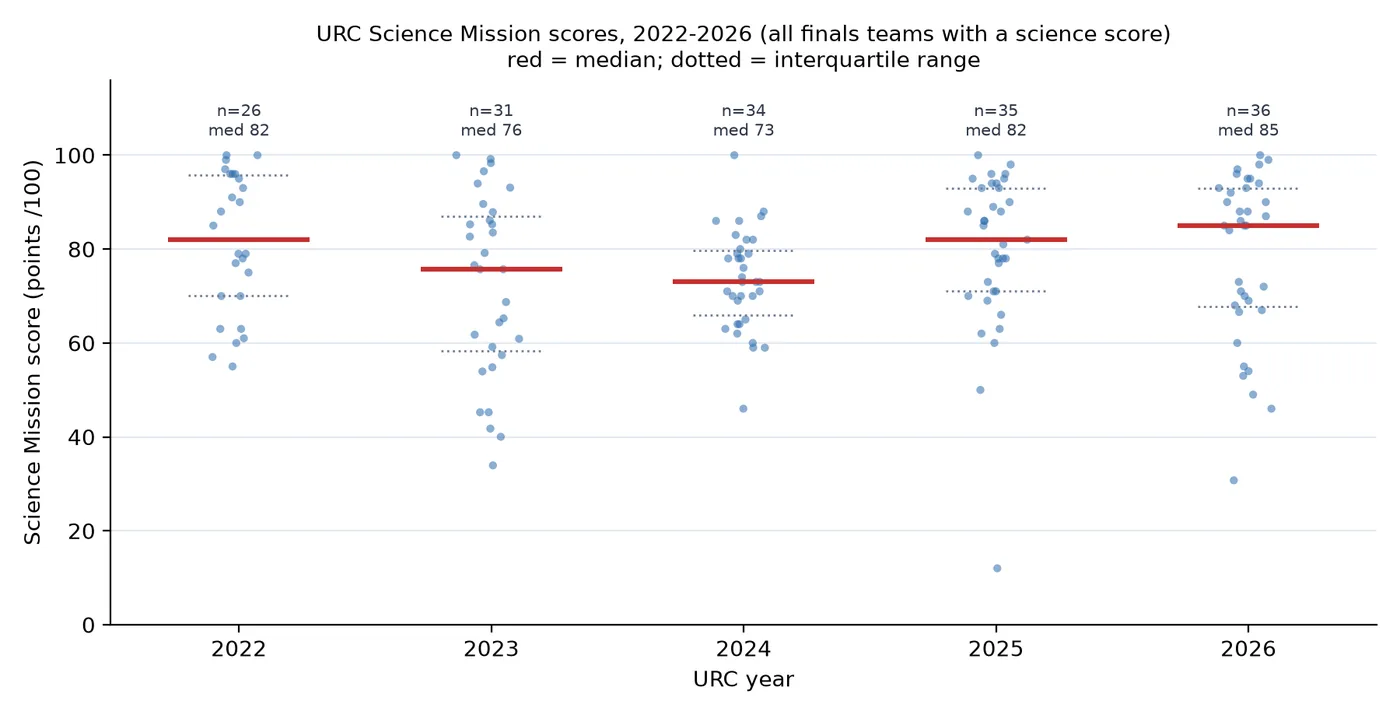
- This is the field’s strongest mission. The median has stayed between 73 and 85 every year, a 100 has been achievable every year, and no team in 162 team-years has scored zero.
What the mission physically demands
| Demand | Number | Basis |
|---|---|---|
| Depth | At least 10 cm below the surface, from a single sample; the portion below 10 cm sets the mass | S-URC27-RULES §1.b.vi |
| Mass | At least 5 g from below 10 cm | S-URC27-RULES §1.b.vi |
| Volume implied | About 3–4 cm³ of soil at 1.3–1.6 g/cm³ | Arithmetic, by inference |
| Soil resistance | From reasonably easy to very hard, with no caliche; no force value is published | S-URC27-QA AQ6 |
| Downforce implied | About 30–80 N of downforce and 1–3 N·m of torque for a 16–20 mm auger in medium clay | Standard soil mechanics, by inference; the chassis carries the reaction, not a compliant wrist |
| Sample point | Sites are not marked beyond the overall site, and the soil is in situ with no trays | S-URC27-QA AQ5 |
| Life detection | Two capabilities, at least one a bioassay that detects a molecule formed only by biology or in its presence | S-URC27-RULES S-URC27-QA §1.b.v AQ9 |
| Documentation | Panorama with cardinal directions and scale, close-up at high resolution with scale, GNSS with elevation and an accuracy range | S-URC27-RULES §1.b.iii |
| Time and radius | 20–30 minutes inside a 0.5 km radius, plus 5 minutes for cache removal | S-URC27-RULES §1.b.ii §1.b.vii |
| Containment | All chemicals, water and reaction products contained; hazardous chemicals pre-approved with a transport, use, disposal and accident plan | S-URC27-RULES S-URC27-QA §1.b.ix AQ4 |
| Perception | Site selection from rover data only; the operators cannot see the site | S-URC27-RULES §2.c.i §3.d.i |
The 20-minute case
The planning model below is constructed from the rule’s sequence. It is a planning aid, not a rule.
| Step | Site 1 | Site 2 | Note |
|---|---|---|---|
| Drive and select | 3 min | 3 min | 100–200 m between sites inside a 0.5 km radius |
| Document | 2 min | 2 min | Automate the overlay and the metadata capture |
| Acquire a sample below 10 cm | 3 min | none, the cache comes from one site | A 3-minute allowance is optimistic in very hard soil |
| Load and start assay 1 | 1.5 min | none | The slowest assay starts first and runs during the traverse |
| Load and start assay 2 | 1 min | 1 min | Both results must be read before the clock ends |
| Stow and seal the cache | 1 min | none | The 5-minute removal is after the clock |
| Sub-total | 11.5 min | 6 min | 17.5 of 20 minutes, leaving 2.5 minutes |
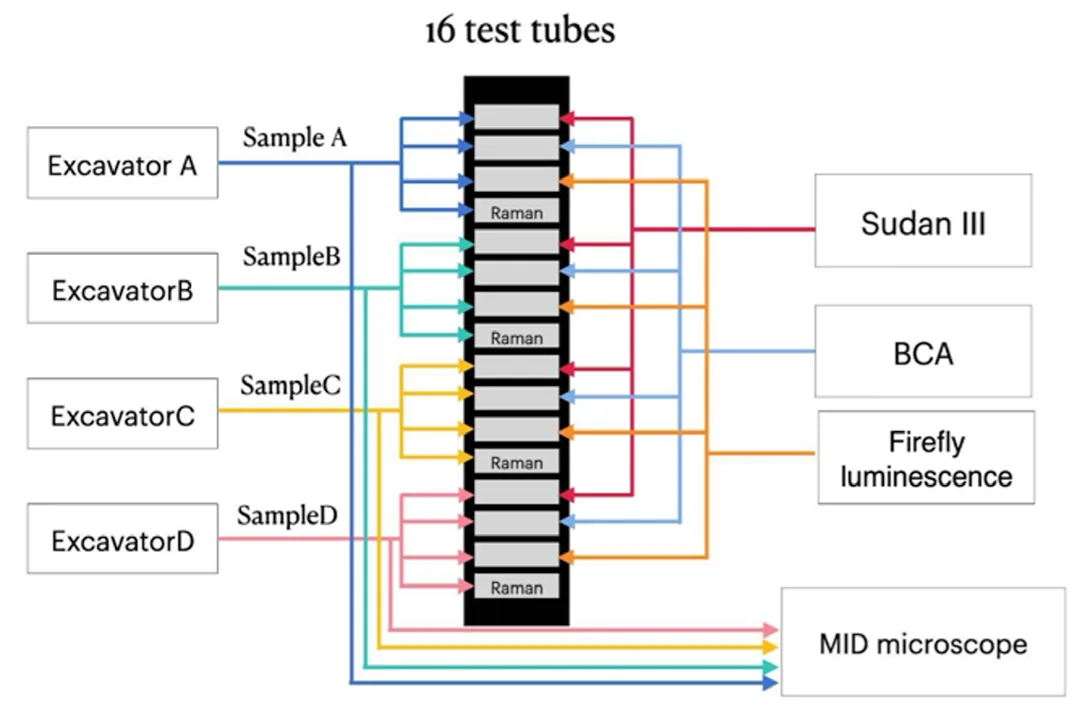
A design in which the arm must hold a cuvette in front of a camera for three minutes has already lost the mission. The payload must be a body-mounted fluidic system that a pump or carousel can drive without the arm, with a readout the C2 can interpret while the rover moves.
What the best teams did, and what 2027 does to it
Astrobiology is the field’s strongest mission: a 100 has been achieved every year, and the top ten sit 9–23 points above the rest of the field.
| Year | Teams | Median | Teams ≥90 | Maximum | Top-10 mean | Rest mean |
|---|---|---|---|---|---|---|
| 2022 | 26 | 82.0 | 11 | 100 | 95.4 | 72.4 |
| 2023 | 31 | 75.7 | 6 | 100 | 83.2 | 67.1 |
| 2024 | 34 | 73.0 | 1 | 100 | 80.1 | 70.7 |
| 2025 | 35 | 82.0 | 11 | 100 | 92.1 | 74.6 |
| 2026 | 36 | 85.0 | 13 | 100 | 94.0 | 72.5 |
Derived from the five official result sheets S-URC22-SCORES S-URC23-SCORES S-URC24-SCORES S-URC25-SCORES S-URC26-SCORES. The 100s went to AGH and Yonder Dynamics in 2022, West Virginia in 2023, BYU in 2024, UIU in 2025 and Monash in 2026.
The payload record is the more useful table, because it converts a rule change into a list of approaches that survive it.
| Team, year | Documented payload | Score | Under the 2027 clause |
|---|---|---|---|
| Missouri S&T 2022 | DPA for DNA, propidium iodide for nucleic acids, biuret for protein | 96 | Compliant, and the most 2027-ready payload in the window |
| West Virginia 2023 | An STS spectrometer covering the visible range, plus a TMB peroxidase assay; chlorophyll, carbonate and a “no life” result | 100 | Compliant, and a negative result still scored 100 |
| KARURA 2024 | ATP by luciferase, BCA protein, lipid, Raman and a microscope | 74 | Compliant, and the best public contamination design |
| Missouri S&T 2024 | A Raman spectrometer replacing all chemical tests | 82 | Not compliant as the sole method |
| UIU 2025 | Deep auger, spectrophotometric tests and a Bradford protein assay | 100 | Compliant, and the best-documented template |
| Monash 2026 | Near-infrared and wet-chemistry UV-Vis, including BCA protein | 100 | Compliant if the protein channel is kept |
| West Virginia 2026 | Ninhydrin as the primary life detection, with resazurin and methylene blue | 94 | Not compliant: AQ9 excludes amino acids alone |
The decisive finding. A payload that scored 94/100 in 2026 would fail the 2027 clause without any hardware change, because amino-acid chemistry alone does not meet the bioassay definition S-URC27-QA S-WVU-2026-SCIPLAN AQ9. Conversely, the payload that scored 96 in 2022 was closer to the 2027 rule than the Raman instrument that replaced it. Science scores from 2022 to 2026 therefore transfer as evidence of documentation, sampling and debrief skill, and not as evidence of payload compliance.
What 2027 removes is the stratigraphic profile, from both documentation and debrief S-URC26-RULES S-URC27-RULES §1.b.iii §1.b.iii. That frees one to three minutes of site time and one debrief bullet. It does not devalue the rest of the documentation, and it raises the bar on the biology, because there is less geology to hide behind.
Which subsystem options serve it
| Decision | Option A applies when | Option B applies when |
|---|---|---|
| Payload | Two wet biomolecule assays sharing one detector: ATP and BCA protein on one photodiode or spectrometer, about 3.5–4.5 kg by inference | One wet and one optical assay (ATP with autofluorescence), only with a written answer from the judges on the second method’s status |
| Sampler | A body-mounted auger on a 200 mm linear stage, the West Virginia and UIU approach | An arm-held scoop, as the backup sample path only |
| Assay timing | Room-temperature rapid chemistry, such as the 5-minute BCA variant | A 37 °C incubation only if a heater is already aboard, because pre-heating is what KARURA had to do |
| Depth proof | A graduated clear liner with a measured stroke | A depth camera, if it can resolve the soil column through dust |
| Heading | Dual-antenna GNSS for exact cardinal annotation | A calibrated magnetometer, allowed, for ±2–3° |
| Operations | Two staff: a C2-only science operator and a debrief speaker | One person, only if that person never leaves C2 (AQ8) |
Minimum viable versus stretch
- The minimum that scores: reach a site, relay a panorama and a close-up with a scale, record GNSS with elevation and accuracy, and debrief honestly. The historical cluster for this behaviour is a 40–55 band, by inference.
- The minimum that is also compliant: two life-detection capabilities, one of them a bioassay. That is a mandatory requirement rather than a scoring option, so a rover with no bioassay is non-compliant however well it documents.
- The stretch: two sites analysed, two biomolecule results each, depth-resolved provenance, a written contamination justification, and a quantitative Mars-applicability argument in the debrief.
Risks to retire early
| Risk | Why it is real | The test that retires it | Lead time |
|---|---|---|---|
| The assay chemistry does not survive the desert | LAMP master mix ships at −20 °C and a rover has no freezer S-NEB-LAMP | Five days at 38 °C, then run the assay; signal at 80 % of day 0 or better | 3 months |
| The assay cannot finish in 20 minutes | KARURA’s BCA needed 30 minutes at 37 °C and had to pre-heat S-KARURA-2024-PAPER | A timed dry run of the full sequence; both results logged by T+17:00 | 6 months |
| False positives | Extracellular ATP, humic interference with BCA, acidic soil turning a dye yellow S-NEB-LAMP | Sterile-soil blank, a method blank and standard-addition recovery | 3 months |
| Sample too shallow or too light | The 10 cm depth and 5 g mass limits are single-point failures, and hard soil is confirmed S-URC27-QA AQ6 | Drill three analog soils and photograph the liner; 5 g below 10 cm in under 4 minutes | 4 months |
| One rock ends the sample | KARURA 2024 lost its sampling mechanism to a rock S-KARURA-2024-PAPER | A slip clutch, a scoop fallback and rock rejection from imagery | 4 months |
| The cache spills or jams | No documented URC incident, but the rule is explicit S-URC27-RULES §1.b.vii | Twenty inversions over a weighed pad, then a timed gloved removal | 4 months |
| Cardinal direction or scale missing | Both are required S-URC27-RULES §1.b.iii | Automate the north arrow and scale bar, then check a blind sample of 20 images | 2 months |
| The debrief speaker is ineligible | AQ8 limits the debrief to members who stayed in C2 | Name the speaker in the operations plan and keep that person in C2 | 1 month |
One risk sits above the table: the payload definition itself. It is the only item in the mission with a hard pre-SAR deadline, and every other risk in the list is cheaper to retire once it is fixed.
What is not published
- The 2027 weights of the four Astrobiology components, so no statement of the form “life detection is worth X points” is possible.
- Whether one combined assay can satisfy both life-detection capabilities; AQ9 is silent on double counting.
- The Science Plan format, which is promised for early 2027.
- Whether the Equipment Servicing cache is the team’s own cache or a judge-supplied one, so the arm interface must work for both.
Further reading
- Science and astrobiology payload works the payload options and the fluidic architecture with numbers.
- UIU, West Virginia, Monash, Missouri S&T and KARURA carry the payload evidence.
- Mass and power places a 3.5–4.5 kg payload inside the 50 kg limit.
- What 2027 invalidates sets this mission’s payload change beside the other two genuinely new requirements.
Sources for this page
- S-URC27-QAURC2027 Questions & Answers (updated through 2026-10-11)Original Archived copy
- S-WVU-2026-SCIPLANTeam Mountaineers URC 2026 Science Plan, BiRD digger, dual topsoil/subsoil cache, per-site fluid path, ninhydrin/resazurin/methylene blue, Ocean Optics UV-VisOriginal
- S-URC27-RULESUniversity Rover Challenge 2027 – Requirements and GuidelinesOriginal Archived copy
- S-URC22-SCORESURC2022 Official ScoresOriginal
- S-URC23-SCORESURC2023 Official ScoresOriginal
- S-URC24-SCORESURC2024 Official ScoresOriginal
- S-URC25-SCORESURC2025 Official ScoresOriginal
- S-URC26-SCORESURC2026 Official ScoresOriginal Archived copy
- S-KARURA-2024-PAPER「学生による火星探査車の国際開発と生命探査」 (International development of a student Mars rover and life detection), *Planetary Science Society of Japan* journal 33(3), 342–349Original
- S-URC26-RULESUniversity Rover Challenge 2026 – Requirements and GuidelinesOriginal Archived copy
- S-NEB-LAMPSARS-CoV-2 Rapid Colorimetric LAMP Assay Kit manual (WarmStart Colorimetric LAMP), 65 °C/30 min, −20 °C storage, acidic-sample interferenceOriginal