Arm and end-effectors
The arm is the only subsystem that touches the lander. In 2027 it must perform nine physically different actions, from pressing a 19.05 mm key to lifting a 5 kg cache and picking a 0.91 kg hammer off the ground, between 1.5 m height and the ground. It must do that while the whole rover folds inside a 1.2 m cube. Two numbers decide the architecture more than any other: 78.3 N·m at the shoulder, and 4.4–5.2 mm of backlash at the tip.
Key takeaways
- Nine actions, one arm S-URC27-RULES §1.d.ii. The 2027 task set added the key and lock transfer and deleted the 2026 USB-C insertion, so a design frozen to 2026 tasking is already wrong.
- Size the shoulder for 78.3 N·m static, 117 N·m dynamic and 176 N·m with shock. No integrated actuator reaches that at one metre, which is why every high-scoring arm has a high-ratio reducer, a brake or a counterbalance at the shoulder.
- Backlash, not encoder resolution, decides typing. A 14-bit encoder is worth 0.38 mm per metre. A 15–18 arcmin planetary joint loses 4.4–5.2 mm per metre, the whole typing tolerance, before any vision error S-CUBEMARS-AK.
- The camera belongs on the wrist. A 720p sensor with a 70° lens resolves the 2 cm keyboard tags at 0.91 m and the 1 cm key tags only at 0.46 m.
What the subsystem must do
In 2027 the arm covers nine physically different actions: press a 19.05 mm key, turn a key in a tubular lock, pull a drawer, undo a latch, push a 1.5-inch cam-lock hose on, turn a quarter-turn valve, work buttons, switches and knobs, lift a cache under 5 kg by a handle of at least 10 cm, and, in Autonomy, pick a 0.91 kg rock-pick hammer off the ground S-URC27-RULES §1.d.ii §1.e.viii–x. The workspace runs from 1.5 m to the ground S-URC27-RULES §1.d.i, while the whole rover must still fold inside the 1.2 m cube S-URC27-RULES §2.a.ii.
Those two facts conflict. An arm with 1.5 m of reach cannot stow straight out, and the ground reach has to clear the rover’s own bumper, so the shoulder sits near the front face of the chassis, on a turret that swings outboard, or on a deck high enough to point down over the nose. The three traced requirements behind that geometry are REQ-ARM-001 for the reach envelope, REQ-ARM-011 for autonomous typing and REQ-ARM-018 for the stow box. The tolerances below are inferences from the hardware geometry except where a source is given; they matter because the field failure is a one to five millimetre alignment error, not a lack of strength.
| Task | What the arm must physically do | Tolerance or force |
|---|---|---|
| Sample tube into cache, close the lid, turn the lock | Pinch, axial insert, two-finger twist | ±3–5 mm, insertion under 5 N |
| Lift the cache | Power grasp on a handle of at least 10 cm | ±20 mm, load under 5 kg |
| Drawer | Hook or pinch pull, place, push closed | ±10 mm; pull force not published |
| Latch and hinged panel | Lever the latch, then a broad push on the panel | ±5 mm |
| Autonomous typing | Single-point press, retreat, repeat | ±3 mm design, 0.45–5 N S-URC27-TASKHW |
| Key in a tubular lock | Pinch the bow, extract, align the keyway, insert, turn | ±1–2 mm at the keyway |
| Cam-lock hose | Power grasp on the fitting, axial push of 15–25 mm | ±5 mm; push force not published |
| Quarter-turn valve, buttons, switches, knobs | Grasp and rotate 90°, or push and toggle | ±5 mm, 1–10 N |
| Rock-pick hammer | Ground pick of a 0.91 kg, ≈300 × 170 × 25 mm steel hammer, retained while driving | ±20 mm |
The numbers that size the design
The torque, backlash and camera figures are worked estimates from the stated parameters. The task geometry and the mass range rest on the rulebook, the vendor datasheets and the two published arm masses.
| Quantity | Value | Basis |
|---|---|---|
| Reach | ground to at least 1.5 m, at a 0.5–0.8 m standoff | Panel height is in the rules; the standoff is a practical estimate |
| Cache load | under 5 kg, by a handle of at least 10 cm and no more than 5 cm diameter | S-URC27-RULES §1.d.ii |
| Shoulder torque, static | 78.3 N·m | 5 kg at 1.05 m plus 6.5 kg at 0.42 m |
| Shoulder with factors | 117 N·m dynamic, 176 N·m shock | ×1.5 twice |
| Typing geometry | 19.05 mm pitch, about 0.45 N actuation, about 4 mm travel | Redragon K552, ANSI standard S-URC27-TASKHW |
| Typing tolerance | ±3 mm design, ±5 mm geometric limit | 13–14 mm cap top with a 3 mm tip |
| Joint backlash | 15–18 arcmin = 0.25–0.30° = 4.4–5.2 mm per metre | CubeMars AK and Robotis XM540 quotations S-CUBEMARS-AK S-ROBOTIS-XM540 |
| Camera standoff | 2 cm tag at 0.91 m, 1 cm tag at 0.46 m, 0.30 m at 30 px | Pinhole model at 720p and 70°, by inference |
| Arm mass | 4–14 kg, or 8–28 % of the 50 kg limit | RSX 4.42 kg to ARES 14 kg S-RSX-ARM-URDF S-ARES-PAPER-2025 |
The inversion that matters is the same one that governs the drivetrain. An AK80-9 turns at 570 rpm and supplies 22 N·m at peak S-CUBEMARS-AK, far more joint speed than any of the nine tasks needs. What the arm lacks is torque margin at the shoulder and lost motion at the wrist.
Design space, in one table
| Decision | Options | Recommended for a first build |
|---|---|---|
| Kinematics | 6R spherical wrist · 5R plus prismatic X · 5R · 4R · dual arm · arm on a lift | 6R of 0.9–1.1 m with a wrist that faces the panel, or 5R plus one stiff prismatic axis parallel to the lander |
| Prismatic axis | none · 400 mm ball-screw stage | Worth adding when typing and key insertion are the priority: the best documented Equipment Servicing run used this layout |
| Joint actuation | integrated BLDC · harmonic or cycloid · custom BLDC · brushed with high ratio | Integrated actuators at elbow and wrist, with a harmonic, cycloid or 2:1 stage at the shoulder; a planetary reduction at the wrist blows the typing budget |
| Gravity holding | brake · spring counterbalance · gravity-compensating current | A fail-safe brake or a counterbalance at the shoulder; current-only holding heats the joint |
| End effector | two-finger parallel · dual head · swappable heads · adaptive or suction | Two-finger parallel, 100–110 mm opening, one motor, current-limited, with swappable tips |
| Sensing | incremental plus limit switches · absolute magnetic · multi-turn absolute · force and torque | An absolute encoder on every joint, current-based torque limits, and a wrist camera with ArUco detection |
Backlash decides whether typing works
The encoder is fine. At 14 bits, one count is 0.022°, which is 0.38 mm per metre at the tip. The gearbox is not. A 15–18 arcmin planetary joint loses 4.4–5.2 mm per metre, which is the entire ±5 mm typing limit consumed by lost motion before any vision error S-CUBEMARS-AK S-ROBOTIS-XM540. A harmonic or cycloid reducer is roughly an order of magnitude better and costs three to ten times the mass and price per joint.
That is why the two teams that publish a typing method both close the loop with a camera rather than trusting joint counts. ARES uses a keyboard detector plus a single-point tip and the instruction “extend the tip and press the key”; BYU uses ViSP visual servoing S-ARES-SAR26 S-BYU-SAR26. ARES placed 8th overall at URC 2026 with 324.59 points and 5th in Equipment Servicing with 62.11 S-URC26-RESULTS. The practical recipe is a two-stage loop: inverse kinematics to a pose 20–30 mm in front of the key, visual servoing over the last 30 mm from the 2 cm corner tags, then a short compliant press.
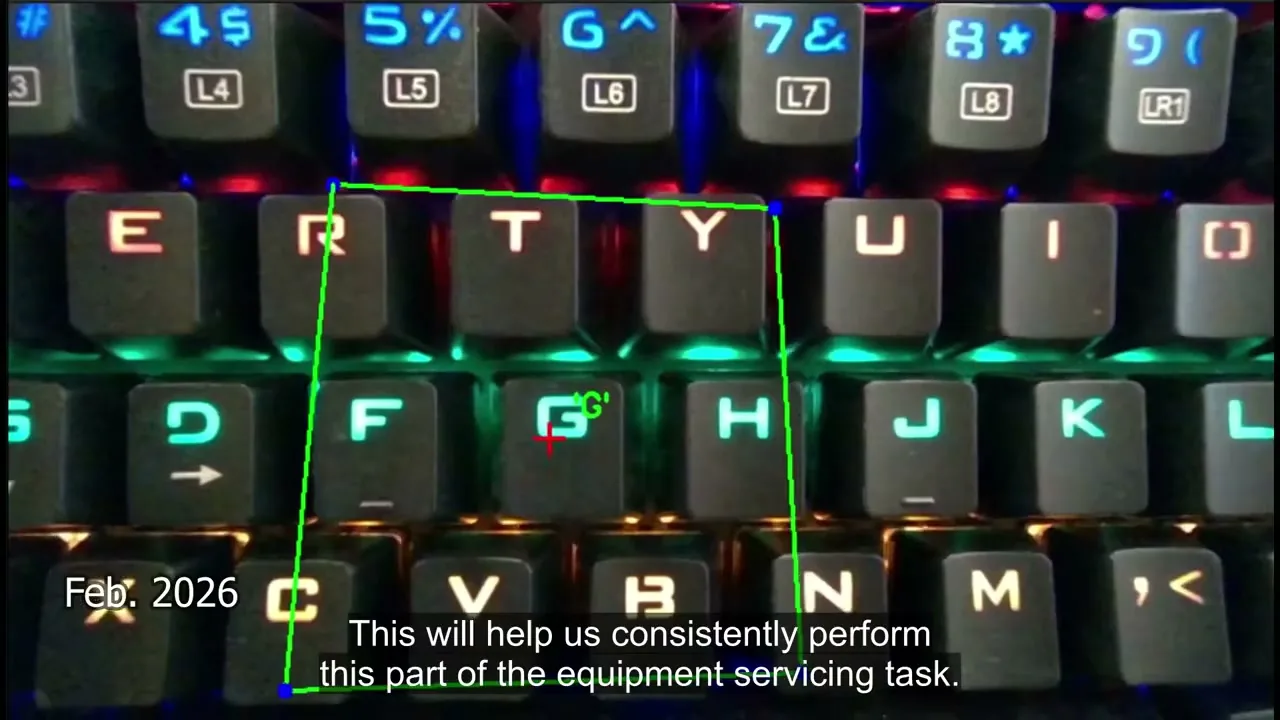
A 720p camera with a 70° lens resolves the 2 cm keyboard tags at 20 px from 0.91 m, and the 1 cm key and keyhole tags only from 0.46 m, or 0.30 m for a comfortable 30 px. The key task therefore forces the camera within about 0.3–0.4 m of the keyway, which rules out a mast or chassis camera and means the wrist must come that close without the end effector occluding the tag. A 4K sensor buys a factor of about three in standoff and costs field of view, so the usual answer is a wide camera for the approach and a narrow one for the fine task.
The shoulder is a reducer problem
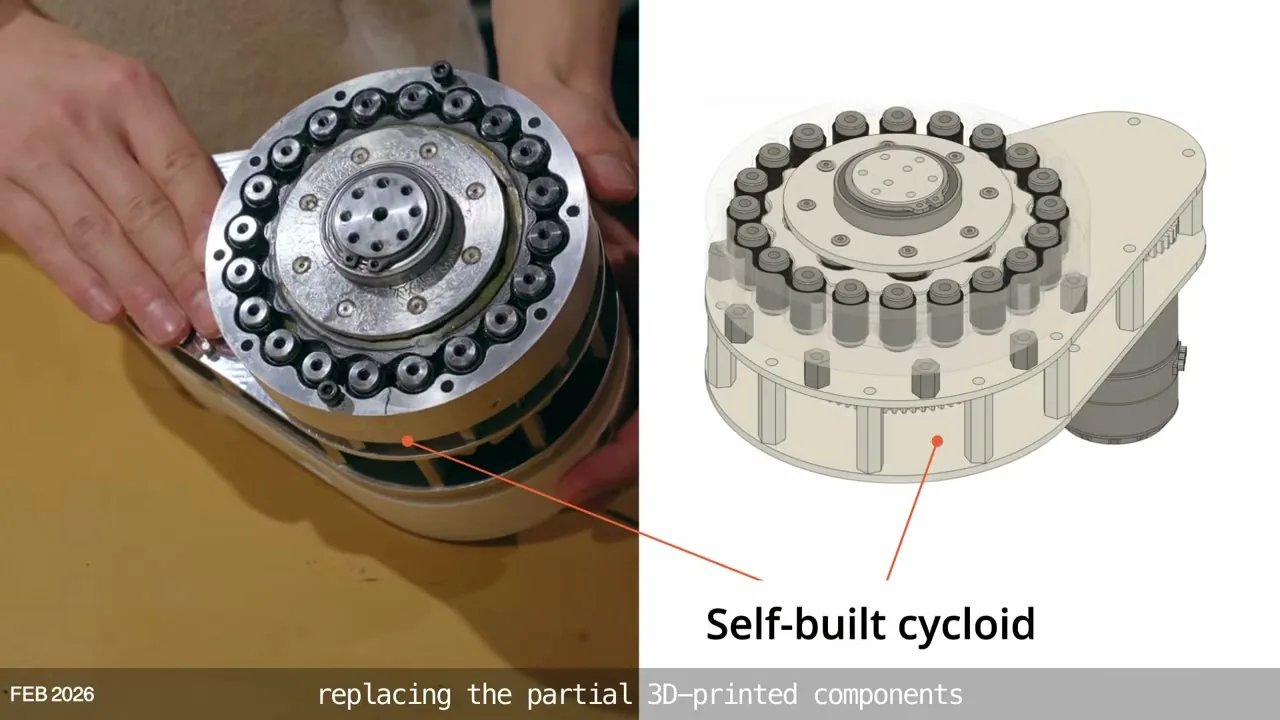
At the 5 kg cache limit and 1.05 m of reach the shoulder needs 78.3 N·m static, and the dynamic and shock factors take it to 117 N·m and 176 N·m. No single integrated actuator in the comparison class reaches that: the AK10-9 peaks at 53 N·m and needs a 2.2:1 stage, the AK70-9 at 29.2 N·m needs 4.0:1, and the AK80-9 at 22 N·m needs 5.3:1. ARES solves it with a self-built 1:38 cycloid rated 98 N·m in a 14 kg arm; a 100:1 harmonic is the bought alternative S-ARES-PAPER-2025 S-CUBEMARS-AK.
Holding is the second half of the problem. A non-counterbalanced arm holds about 78 N·m continuously for tens of seconds during the drawer and cache tasks. An AK10-9 rated at 18 N·m cannot do that without a 4.3:1 reduction, and the joint will heat. The options are a high-ratio reducer, a normally engaged brake, or a spring counterbalance, and it is the brake or the counterbalance that removes the heat rather than the torque mode. The cache is held at only 0.4–0.6 m when the arm is folded, where 20–29 N·m is manageable.
The two architectures that win
Six-revolute arms dominate the record, and the arithmetic is why: a shoulder, an elbow and a three-axis wrist can point a tip normal to any panel face and still fold the elbow inside the box. RSX publishes a 6-revolute chain with a 384 mm upper arm, a 305 mm forearm and 4.42 kg of total arm mass including the gripper and camera S-RSX-ARM-URDF. Monash’s 0.50 m and 0.45 m links with a 0.10 m wrist come to 6.54 kg S-NOVA-BULLETIN-2025.
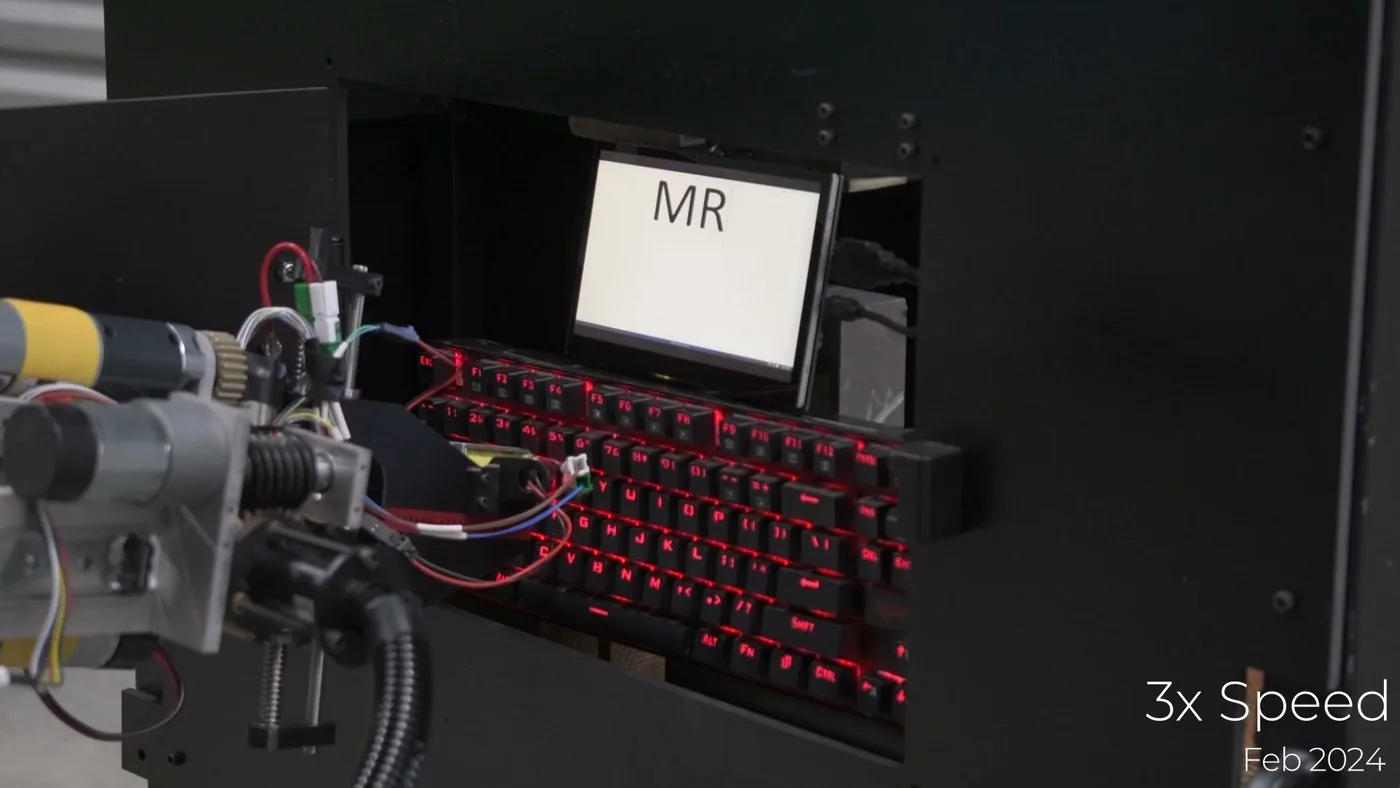
The competing layout keeps the rotary joints and adds one prismatic axis parallel to the lander face. Missouri S&T (MRDT) has run a hybrid Cartesian and rotary arm since 2024, with the linear axis taking the fine motion across the panel, and scored 94, 93 and 100 in Equipment Servicing across 2024–2026 S-MRDT-SAR26. ARES independently built a 400 mm ball-screw stage for the same reason, describing it as designed for tasks such as keyboard input, in a 1170 mm arm of 14 kg S-ARES-PAPER-2025.
The mechanisms differ and the capability does not: both buy backlash-free fine motion in the plane where typing, key insertion and drawer pulls happen. The strongest architectural signal in the record is convergence on that capability, not on a joint count.
What the field scores
Equipment Servicing is the arm’s report card, and it is the weakest mission in the field. The mean has stayed between 21.8 and 35.3 for five years while single teams reach the high nineties, which says the difficulty is the manipulation itself rather than the task list.
| Year | Teams scored | Mean | Median | Exact zero | Best |
|---|---|---|---|---|---|
| 2022 | 26 | 21.8 | 19.5 | 6 | 58 |
| 2023 | 31 | 35.3 | 35.0 | 7 | 93 |
| 2024 | 34 | 32.0 | 26.3 | 5 | 95 |
| 2025 | 35 | 31.5 | 27.0 | 4 | 93 |
| 2026 | 36 | 29.1 | 25.0 | 5 | 100 |
An arm team should expect a median near 25 and a realistic ceiling of 60 to 100 with a long tail of zeros S-URC22-RESULTS S-URC23-RESULTS S-URC24-RESULTS S-URC25-RESULTS S-URC26-RESULTS. The mission is scored task by task, and one early failure consumes the thirty minutes.
The team record supports an arm reconstruction for only six of the roughly 36 teams that scored in 2026, which is itself a finding: this is the least documented subsystem in the public record S-CENSUS.
Interfaces that bite
- Mobility. Reaction torque at the shoulder reaches 176 N·m, so the arm mounts on a structural node, not a suspension link. Its 4–14 kg at 0.4–0.6 m raises the centre of gravity and unloads the front wheels on a slope.
- Power. Peak current is 28 A per AK10-9 joint and 10–12 A per AK70-class joint. A stalled arm during a task is a brownout risk, so it needs its own fused rail with soft start and current telemetry.
- Timing and compute. Fine alignment wants under 150 ms of latency, and visual servoing over a 300 ms link is unstable, so the control loop belongs on the rover. The hands-off rule forbids human input, not offboard computation S-URC27-QA AUQ2.
- Science. A compliant wrist makes a 30 cm drill wander, so the drill mounts on the body rather than the wrist.
- Safety. A 5 kg cache held by a current-limited gripper falls when the E-stop removes all power. That has to be an accepted decision before the mission, not a surprise beside a judge.
Failure modes
Most of the failure record is mechanical rather than computational. A prismatic or vertical axis designed for static load fails under driving shock, a high-ratio reducer breaks after a collision with the lander, and a lost encoder zero ends the mission because re-homing is impossible hands-off.
| Mechanism | Observed failure | Design change that prevents it |
|---|---|---|
| Prismatic axis and structure | Missouri S&T’s 2024 Delivery run lost the vertical axes of the arm under driving loads | Design the vertical axis for shock, add tensioning and travel limits, and test the arm while driving |
| Alignment and compliance | Monash’s 2022 panel slipped and closed twice, costing about nine minutes | A hook-shaped latch tip, passive compliance, and an approach along the panel edge rather than the face |
| Gravity and heat | A shoulder holding 78 N·m continuously heats and sags | A high-ratio reducer, a brake or a counterbalance, plus temperature monitoring |
| Lost zero | Incremental encoders with limit switches lose position at power-off | An absolute encoder on every joint, or a battery-backed multi-turn counter |
| Gripper slip | A friction grasp drops the cache, the hose or the hammer | A closed jaw with a mechanical stop, grip-force monitoring, and a secondary retention for the cache |
Shortlist for a first build
| Item | Choice | Why |
|---|---|---|
| Architecture | 6R serial, 0.9–1.1 m links, wrist that faces the panel | The field default, with closed-form inverse kinematics and the largest evidence base |
| Alternative | 5 rotary joints plus a stiff prismatic axis parallel to the lander | The layout that produced 94, 93 and 100 in Equipment Servicing; rail backlash must stay under 0.5 mm |
| Shoulder | Integrated actuator with a harmonic, cycloid or 2:1 stage, or a brake | 78 N·m static and 176 N·m shock are past any single integrated unit |
| Elbow and wrist | Integrated BLDC of the AK70 or AK80 class at the wrist, with a 2:1 stage or an AK10-9 at the elbow | The elbow needs 35.6 N·m static and 53 N·m with the dynamic factor; the wrist needs 7.4 N·m and 11 N·m |
| End effector and tips | Two-finger parallel, 100–110 mm opening, one motor, current-limited, plus a compliant typing tip, a chamfered key funnel and a hook | Covers the cache handle, the hammer shaft, the valve lever and the hose fitting; a hook cannot slip off a latch like a friction grasp |
| Sensing and mass | Absolute encoder on every joint, wrist camera, 6–8 kg for the arm and tips | Re-homing is impossible hands-off, and the mass leaves room inside 50 kg |
Open problems
- What force does the cam-lock hose need? The 2027 gasket is cut to half thickness and no figure is published. A mock with the exact fitting and a load cell settles it.
- What does the K552 need in force, travel and repeatability? The 0.45 N figure is a standard switch number, not a measurement on the task keyboard, and a hundred automated presses at ±3 mm gives the real distribution. The chosen joint also has to be measured under load and at 38 °C, because a datasheet figure taken cold and unloaded is not the number that decides typing.
- What is the arm’s real mass and centre of gravity on the rover? No 2026 team publishes both, and the slope analysis needs them.
- What happens after one joint fails? No team in the 2022–2026 record documents a mid-mission recovery, and injected encoder, limit-switch and CAN faults on the bench give the answer.
Further reading
- Missouri S&T, Monash, BYU, ARES, RSX and ROBOCOL carry the reconstructed arms.
- Equipment servicing sets the task sequence the arm has to survive.
- Mass and power places the arm in the full 50 kg budget.
- Interfaces and couplings works the arm-mass and backlash chains with numbers.
Sources for this page
- S-URC27-RULESUniversity Rover Challenge 2027 – Requirements and GuidelinesOriginal Archived copy
- S-CUBEMARS-AKCubeMars AK series product/specification pages: AK60-6, AK70-9, AK70-10, AK80-9, AK10-9 (prices, torque, mass, backlash, encoder)Original
- S-URC27-TASKHW2027 task hardware resolved from the rulebook's own hyperlinks (keyboard, display, hammer, hose)Print copy
- S-ROBOTIS-XM540Robotis DYNAMIXEL XM540-W270-R product page (stall torque derivation, 15 arcmin backlash, USD 494.39)Original
- S-RSX-ARM-URDFRSX 2025 arm URDF + meshes (6 revolute joints, link masses)Original
- S-ARES-PAPER-2025"Development of a Multifunctional Rover System for Mars Exploration and Operations in the University Rover Challenge" (RSJ 2024, 2K2-07)Original
- S-ARES-SAR26ARES Project, URC 2026 System Acceptance Review (video)Original
- S-BYU-SAR26BYU Mars Rover, URC 2026 System Acceptance Review (video; ViSP typing, wrist depth camera)Original
- S-URC26-RESULTSOfficial URC 2026 scoresPrint copy
- S-NOVA-BULLETIN-2025Nova Rover Bulletin Nov–Dec 2025, "Taipan" arm, redesigned wrist, joint-space/task-space handoverOriginal
- S-MRDT-SAR26Missouri S&T Mars Rover Design Team, 2026 URC System Acceptance Review (video)Original
- S-URC22-RESULTSOfficial URC 2022 scoresPrint copy
- S-URC23-RESULTSOfficial URC 2023 scoresPrint copy
- S-URC24-RESULTSOfficial URC 2024 scoresPrint copy
- S-URC25-RESULTSOfficial URC 2025 scoresPrint copy
- S-CENSUSURC team census, master index (68 teams, 187 team-year rows, tiers, documentation test)Print copy
- S-URC27-QAURC2027 Questions & Answers (updated through 2026-10-11)Original Archived copy