Robocol (Universidad de los Andes, Colombia)
Robocol is a science-only competitor. In its two finals, Science scored 77 and 76 while the other three missions produced 0, 0 and 0 in 2022 and 4.25, 5 and 0 in 2024. Its autonomy has never scored a point. It has also been displaced at its own university: Ceres, a Universidad de los Andes team, took the 2025 slot while Robocol did not enter. The profile is the cleanest single-cause failure in the record, with one mission family working and three not, and it is a guide for a team deciding how much of the mission set to attempt.
What this team shows
- A science-only rover is a stable, low-ceiling strategy. Keep the review high, keep science working, accept about 165 to 175 points and a finish in the twenties.
- Science scored 77 and 76 two years apart with a review score of 87.75 and 86.21. The capability is real and repeatable; only one subsystem has ever been finished.
- The 2024 manipulation hardware moved and produced token points, 4.25 in Delivery and 5 in Equipment Servicing, which is the signature of an arm that runs but does not complete a task.
- Printed flexible-spoke wheels with no separate tyre are a cheap, replaceable concept that a first-time team could prototype in a week.
Identity and results
Robocol is the rover programme of Universidad de los Andes in Bogotá, one of the longest-running Latin American rover teams, with a European Rover Challenge history that reaches back to at least 2015 S-RBC-GH S-RBC-SITE. It reached the URC finals in 2022 and 2024 and was registered in 2023 without recording a finals score S-URC22-SCORES S-URC24-SCORES S-URC23-TEAMS. It did not register for 2025 or 2026, and the Universidad de los Andes entry in both seasons is Ceres S-URC25-TEAMS S-URC26-TEAMS. Tier C is the census label for that record; the tier rule is defined on the census page.
The 2018 rover is named Ucumarí. No name is published for the 2022 or 2024 machines.
| Year | Rover | Total | Rank | Field | SAR | Science | Delivery | Equipment | Autonomy |
|---|---|---|---|---|---|---|---|---|---|
| 2022 | not published | 164.75 | 22 | 26 | 87.75 | 77 | 0 | 0 | 0 |
| 2024 | not published | 171.46 | 30 | 34 | 86.21 | 76 | 4.25 | 5 | 0 |
Both totals are the exact sum of their components. The two seasons are near-identical in shape, which is the point: two campaigns two years apart produced the same mission profile.
Robocol and Ceres are both Universidad de los Andes teams, and the census deliberately does not merge them. Whether Ceres is a rename, a split or a rival group inside the same university is unresolved, and it matters for any longitudinal claim about Colombian URC capability. Robocol was still listed separately in the 2024 team list S-URC24-TEAMS.
The rover
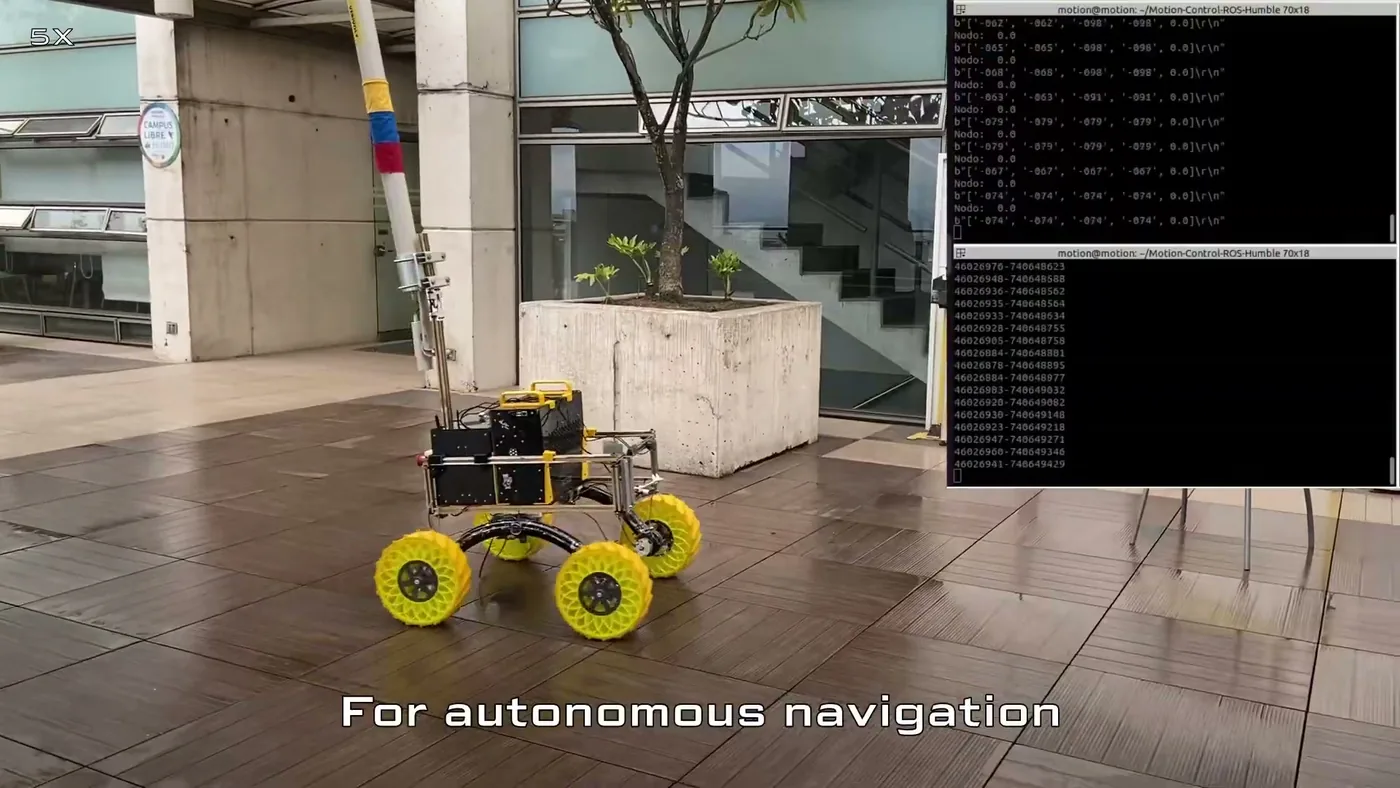
The team site lists three projects, a rover, a submarine and a drone, so the group is a multi-robot club rather than a single-purpose team S-RBC-SITE. The rover itself is a small four-wheeled platform on a tubular frame, visibly smaller than the six-wheel field standard, with bright-yellow 3D-printed flexible-spoke wheels that work without a separate tyre, and a vertical mast carrying colour-banded antennas S-RBC-SAR2024.
The software shown in the 2024 film is ROS 2 Humble: a terminal titled as a motion-control workspace streams per-node values, and autonomous navigation appears as a demonstration rather than a scored result S-RBC-SAR2024. Mass, dimensions, wheel diameter, drive motors, arm, battery, radios, on-board computer and science instruments are all unpublished.
The organisation’s code is an archive of older seasons rather than an active codebase for the current rover. The rover-related projects are RobocolURC2018 in C, last updated 2018-07, and RobocolERC2015 in C++, last updated 2015-09, alongside a home-robot web interface and an inventory project S-RBC-GH. Nothing from 2022 or 2024 is public, so the ROS 2 stack in the film exists but is not published.
Mission performance
2022, 22nd of 26. Science 77 with Delivery, Equipment Servicing and Autonomy all at zero S-URC22-SCORES. Only the mission that needs neither an arm nor an autonomy stack scored.
2023, registered but unscored. A review film was published and the team was registered, but the score sheet has no row S-RBC-SAR2023 S-URC23-SCORES. The season ended at the review.
2024, 30th of 34. Delivery 4.25 and Equipment Servicing 5, with Autonomy at zero again S-URC24-SCORES. The manipulation hardware produced token points, which means the arm moved but the task sequence was not completed.
2025 and 2026, absent. No registration, and the university’s entry is Ceres in both years S-URC25-TEAMS S-URC26-TEAMS.
Lessons for a first build
- A single working mission caps the programme. With three of four mission families unavailable, the best possible outcome was always around 165 to 175 points. The rover could not reach the mid-field on science alone, however good the science was.
- A token score is a diagnosis. 4.25 and 5 are not partial capability; they are a sequence that started and did not finish. The fix is rehearsal on a clock, not a new arm.
- Printed flexible-spoke wheels are a week of prototyping. No separate tyre, no spare part to ship, and a wheel that can be printed again after damage. It is the cheapest idea on this rover to copy.
- Publish the stack that exists. The ROS 2 motion-control work in the 2024 film is invisible to anyone outside the team because no code from those seasons is public, which makes the programme harder to continue across a change of cohort.
- A stable low ceiling is still a ceiling. This profile is the most efficient way to attend a URC final and the least effective way to place at one.
What remains uncertain
The relationship between Robocol and Ceres is unresolved in every source reached. Whether Robocol still exists as an active club is unknown: the site is live, its news stops in 2021, and its code stops in 2018. Mass, dimensions, wheels, arm, battery, radios, on-board computer and science instruments are unpublished. Why autonomy never scored despite a demonstrated ROS 2 motion-control stack is not documented. Why 2023 has a review film and no finals row is also unexplained. The 2013 to 2019 record was not found in the archived tables consulted, so the team’s first URC finals may predate 2022.
Team sources
- robocol.uniandes.edu.co, the team site, listing the rover, submarine and drone projects.
- robocol on GitHub, seven code projects, with rover work only from 2015 to 2018.
- Robocol on YouTube, the review films from 2018 to 2024.
- 2024 review film, the rover, the wheels and the motion-control terminal.
- University Rover Challenge, the competition whose official score sheets carry the results above.
Sources for this page
- S-RBC-GHrobocol GitHub organisation, 7 repositories; rover code only RobocolURC2018 (last push 2018-07) and RobocolERC2015 (2015-09), plus domoboticsWEB, inventario. Nothing public for the 2022 or 2024 URC roversOriginal
- S-RBC-SITERobocol official site (ES), Universidad de los Andes, Proyectos (Rover, Submarino, Dron) / Historia / Equipo / Noticias; news items 2018–2021 plus a "Robocol participa en URC 2024" bannerOriginal
- S-URC22-SCORESURC2022 Official ScoresOriginal
- S-URC24-SCORESURC2024 Official ScoresOriginal
- S-URC23-TEAMSURC2023 Team ListOriginal
- S-URC25-TEAMSURC2025 Team ListOriginal
- S-URC26-TEAMSURC2026 Team ListOriginal Archived copy
- S-URC24-TEAMSURC2024 Team ListOriginal
- S-RBC-SAR2024Robocol Rover TeamPrint copy
- S-RBC-SAR2023"URC SAR 2023 - ROBOCOL COLOMBIA", video, 5:09, uploaded 2023-03-04; the SAR behind the 2023 season that has no finals rowOriginal
- S-URC23-SCORESURC2023 Official ScoresOriginal