Missions and scoring
Every point in the 2027 competition sits in one of five places: four field missions at 100 points each and a System Acceptance Review at 100. The missions are deliberately different in shape. Astrobiology presses the clock hardest, Delivery gates itself behind a first stage, Equipment Servicing is a dense run of small manipulation tasks, and Autonomy is the only mission with published task values and the highest risk per point. This page gives the point values, the constraints that produce them, and the two arithmetic rules that decide what a score actually is.
Key takeaways
- The total is fixed at 500, and penalties are additive fractions of the points earned. A 10 % penalty and a 20 % penalty together leave 70 % of a mission score, not 72 %.
- Autonomy is 20 % of the total on paper, but 95 of its 100 points require genuine autonomous operation. A teleoperation-only rover is capped at 405 of 500 before it loses a single Equipment Servicing or review point.
- Three of the four missions publish no task weights, so 300 of the 400 field points cannot be priced at task level. Autonomy is the exception and its values are exact.
- The four missions separate the field by different margins. Across 2022–2026, mission scores explain variance in the order Autonomy 30.6 %, Equipment 27.7 %, Delivery 24.3 %, Science 14.4 %, with the review at 2.8 %.
The 500-point split
Each mission is scored independently and cannot go below zero S-URC27-RULES §1.a.i. The clock below is the on-course time, excluding setup, teardown and retrieval.
| Mission | Clock | Points | Points per minute available | Autonomy required | Drone |
|---|---|---|---|---|---|
| Astrobiology | 20–30 min, plus 5 min cache removal | 100 | 3.33–5.00 | No | Not allowed |
| Delivery | 30–60 min, two stages | 100 | 1.67–3.33 | No | Allowed, optional |
| Equipment Servicing | 30 min, including up to 100 m of travel | 100 | 3.33 | Autonomous typing only | Not allowed |
| Autonomy | 40 min, two sub-missions | 100 | 2.50 | 95 of the 100 points | Reconnaissance only, and it must land before route finding |
| System Acceptance Review | Desk submission | 100 | Not meaningful per minute | No | No |
Point density measures time pressure, not difficulty. Autonomy has the lowest density and the worst risk per point, because its points are concentrated in two 25-point targets and a 15-point gesture command. Astrobiology has the highest density and a broader spread of partial credit.
Astrobiology: 100 points in 20–30 minutes
The rover selects sites itself, analyses samples on board and caches one sample for the judges S-URC27-RULES. The mission is the scientific core of the competition and the place where the 2027 payload requirement changed most.
| Constraint | 2027 value | Note |
|---|---|---|
| Site radius | 0.5 km from C2 | Straight-line radius; path length is not specified (§1.b.ii) |
| Roving time | 20–30 min | Design to the 20-minute end (§1.b.ii) |
| Sites | At least 2 investigated, 1 sampled | Only the overall site is marked; sample points are not S-URC27-QA AQ5 |
| Sample | At least 5 g from at least 10 cm depth | The portion below 10 cm sets the mass (§1.b.vi) |
| Life detection | Two capabilities, at least one a bioassay | The bioassay must detect a biomolecule S-URC27-QA AQ9 |
| Cache | Sealed against inversion, removable in 5 min | Must be openable by the judges (§1.b.vii) |
| Documentation | Panorama with cardinal directions and scale, close-up with scale, GNSS with elevation and accuracy | Every site investigated (§1.b.iii) |
| Chemicals | No spill; hazardous chemicals pre-approved | The judges approve a safety plan, not a chemical S-URC27-QA AQ4 |
| Science Plan | 2027-05-21 | Expands the review version and counts toward the score (§1.b.i) |
The scoring rubric names four components: thoroughness of the site investigation, quality and applicability of the on-board analysis, quality of the returned sample, and scientific knowledge at the debrief (§1.b.xi). No weights are published for any of them, and the Science Plan is scored separately.
What the 2027 rule changed is the analysis payload. Two life-detection capabilities with at least one bioassay means assay chemistry, fluid handling, containment and a time-to-result that fits inside a 20-minute roving window. The sample requirement did not move: 5 g from below 10 cm, with a documented depth. The cheapest points in the mission are the ones a working camera and GNSS buy: two documented sites and a coherent account of what the data means. The expensive points are the bioassay and a clean, sealed, uncontaminated sample.
Delivery: 100 points across two stages
Delivery is the longest mission and the only one with an explicit stage gate. The rover moves objects for astronauts across terrain built to get harder with distance.
| Constraint | 2027 value | Note |
|---|---|---|
| Structure | Two stages, with a minimum Stage-1 score to proceed | Remaining Stage-1 time is added to Stage 2 (§1.c.i) |
| Total time | 30–60 min on course | Stage times are not published (§1.c.i) |
| Objects | Up to 5 kg, smaller than 40 × 40 × 40 cm | Grasp feature of 7.5 cm or less (§1.c.iii) |
| Course | Up to 1 km from the start gate | Soft sand, gravel, stony ground, boulder fields, drops and loose slopes (§1.c.ii) |
| Line of sight | Not guaranteed for more than 50 % of the course | Later tasks are deliberately out of sight (§3.d.ii) |
| Navigation | Working GNSS essential | Pickup and delivery coordinates are approximate (§1.c.iv) |
| Mobile deployables | Mini-rover prohibited | A drone may assist (§1.c.i) |
The stage gate is what makes Delivery strategically different. Failing the Stage-1 minimum ends the mission there, so the first stage’s points are worth more than their face value: they also unlock the second stage. The 2027 gate score, the stage durations and the task weights are all unpublished.
The most recent complete published course is the 2026 one, and it is a reference point rather than a 2027 rule: 35 minutes for Stage 1 and 20 for Stage 2, a gate at 40 points, a 20 cm placement tolerance and a 100-point task split S-URC26-DM. Those numbers describe 2026 and must not be imported into a 2027 plan, but they show the shape a published Delivery rubric takes.
Equipment Servicing: 100 points in 30 minutes
The mission is a dense series of manipulation tasks on a mock lander, reached by up to 100 m of relatively flat driving (§1.d.i). Every task completed earns points, the tasks may be attempted in any order, and no per-task value is published (§1.d.ii).
| Task family | What it demands |
|---|---|
| Sample tube into cache | Fine grasp, insertion, lid closure and a lock turn |
| Cache to lander | A carry of a sub-5 kg container by a handle at least 10 cm long |
| Drawer | Insertion into a tight space and closure |
| Latch and panel | A pull against a latch, then a hinged swing |
| Autonomous typing | A 3–6 letter key on a vertical keyboard, hands-off, with 2 × 2 cm markers at the corners |
| Key transfer | Extract a key, carry it, align to a second lock and turn it against pin resistance |
| Hose | Push on a 1.5 inch cam-lock fitting whose gasket is cut to half thickness |
| Valve | A quarter turn of a lever handle |
| Controls | Buttons, switches and knobs |
Two features dominate the design. The first is the vertical keyboard: the rover has to locate a small board, find 2 cm markers in full sun, and strike keys with about 2 mm of travel and roughly 0.45 N of actuation force without knocking the board. The second is the key transfer, which adds a grasp-and-rotate task on an object small enough that the 1 cm markers exist because the key cannot be tracked otherwise.
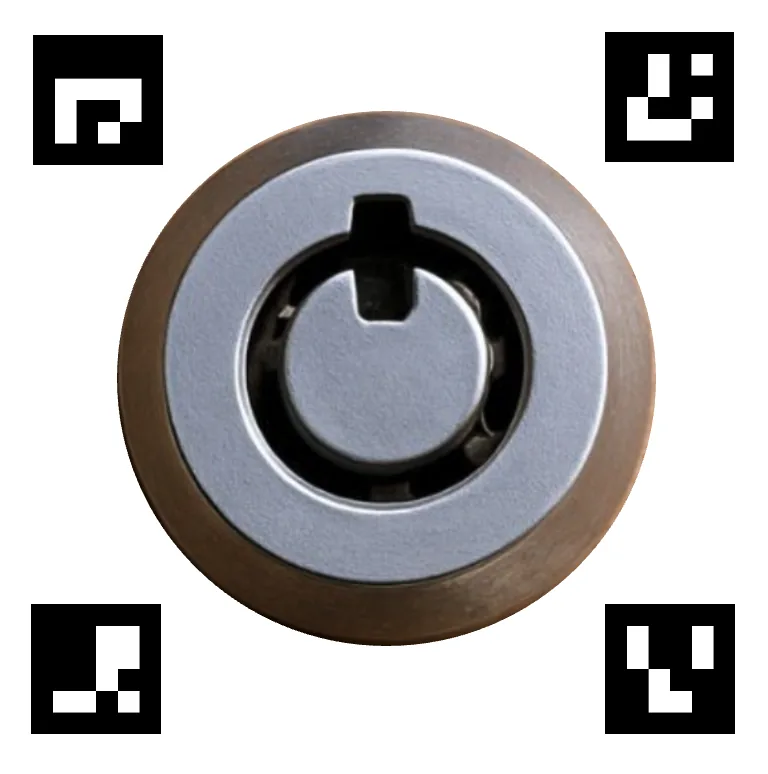
The schedule couples this mission to Autonomy. Equipment Servicing may begin 10 minutes after the Autonomy Mission from the same C2 station, and a fresh weigh-in and measurement may have to happen inside that window S-URC27-QA EQ4.
Autonomy: 100 points in 40 minutes
Autonomy holds two 50-point sub-missions that may be attempted in any order (§1.e.i) S-URC27-RULES. Unlike the other three missions, every value below is exact.
Astronaut assistance, 50 points
| Task | Points | Requirement |
|---|---|---|
| EVA suit with camera and microphone | 5 | Team-provided suit, monitored from C2 (§1.e.iv) |
| Drive to the astronaut | 5 | Autonomous stop within 3 m of the given location (§1.e.v) |
| Follow | 15 | Autonomous following, stopping within 3 m when the astronaut stops (§1.e.vi) |
| Stay | 5 | No movement while the astronaut moves more than 20 m away (§1.e.vii) |
| Fetch | 10 | Autonomous pickup of a rock pick from the ground (§1.e.viii) |
| Come | 5 | Autonomous drive to the astronaut, stop within 3 m (§1.e.ix) |
| Give | 5 | Place or drop the hammer on command (§1.e.x) |
Follow is graded by command modality, and the values are alternatives rather than additions: a device carried by the astronaut is worth 5 points, a visual sign 5, a spoken word or phrase 10, and a beckoning gesture the full 15 (§1.e.vi). The gesture route is worth 10 points more than the device route, which makes gesture recognition the single largest optional capability in the mission. Gestures may use arms, legs or torso only, with no fingers and no facial movement S-URC27-QA AUQ11. The command order is fixed: Follow, Stay, Fetch, Come, Give S-URC27-QA AUQ13.
Route finding, 50 points
| Element | Value |
|---|---|
| Targets | 2, worth 25 points each, in any order (§1.e.xii) |
| Stop tolerance | 1 m, with the arrival indicated (§1.e.xvii) |
| Markers | Three-sided posts, 20 × 20 cm ArUco 4x4_50 faces, 2.5 cm cells, 0.5–1.5 m above ground (§1.e.xii) |
| Terrain | One target on a hill where not all approaches are navigable (§1.e.xv) |
| Link | The second target is behind the hill, out of radio line of sight (§1.e.xvi) |
| Start | Flat, easy ground, reachable by teleoperation (§1.e.xii) |
| Abort | 20 % for an operator stop or return; 50 % to teleoperate back; capped at 50 % (§1.e.xviii) |
The route sub-mission is where the 2027 rule is sharpest. Two 25-point targets, a 1 m tolerance and a link that fails behind a hill mean a single communications decision can cost a quarter of the mission. The Q&A makes the arrival indication easier, since the rear LED is sufficient and a C2 indication is not required for 2027 S-URC27-QA AUQ18.
The System Acceptance Review: 100 points and the gate
The review is a written and video package judged against other teams, and the 36 highest scores are invited to the field S-URC27-RULES §3.a.iii. It is 20 % of the maximum score and the only route to the other 80 %. The 2026 rubric split its 100 points as 48 for the video, 40 for the written report and 12 for the judges’ assessment S-URC26-SAR; the 2027 rubric is not yet published. The mechanics and the 2027 document status are on Review, judging and awards.
The penalty arithmetic
Penalties are fractions of the points earned, added together, with a floor at zero (§1.a.i). The rule is easy to misread, because it makes a penalty cheap on a bad mission and expensive on a good one.
| Penalty | Trigger | Rate |
|---|---|---|
| Overweight | Above 50 kg in a mission configuration | 5 % of points earned per kilogram over, per mission (§2.a.iii) |
| Oversize | Outside the 1.2 m cube at weigh-in | 40 % (§2.a.ii) |
| Intervention | Any direct team touch of the rover or a deployable | 20 % each, additive, clock running (§3.e.viii) |
| Autonomy operator stop | C2 stops the rover or returns it to the astronaut | 20 % on that task (§1.e.xi) |
| Autonomy teleoperation | Driving back to a visited location | 50 % on that task, capped at 50 % (§1.e.xviii) |
| Late expense report | Report after 2027-05-26 | 10 % of total points per day (§3.c.ii) |
The weight table shows why a mass margin is worth more than it looks. At 100 points earned, one kilogram over costs 5 points; five kilograms over costs 25.
| Overweight | Penalty | Loss at 100 earned | At 75 | At 50 | At 25 |
|---|---|---|---|---|---|
| 1 kg | 5 % | 5.00 | 3.75 | 2.50 | 1.25 |
| 2 kg | 10 % | 10.00 | 7.50 | 5.00 | 2.50 |
| 3 kg | 15 % | 15.00 | 11.25 | 7.50 | 3.75 |
| 4 kg | 20 % | 20.00 | 15.00 | 10.00 | 5.00 |
| 5 kg | 25 % | 25.00 | 18.75 | 12.50 | 6.25 |
Because the fractions add, combinations reach the floor quickly: 5 kg over plus two interventions plus an oversize is 105 %, and the mission scores zero whatever it earned. A single 2 kg overage and one intervention leave 70 % of the points earned, not 72 %.
What a teleoperation-only rover can score
The question that shapes a first season is how much the rover has to do on its own. The table answers it exactly, assuming every other mission and the review score full marks, which isolates the value of autonomy.
| Capability set | Autonomy points | Ceiling out of 500 | Forfeited |
|---|---|---|---|
| Teleoperation only | 5 | 405 | 95 |
| Astronaut assistance only | 50 | 450 | 50 |
| Route finding only, plus a suited astronaut | 55 | 455 | 45 |
| Full autonomy, Follow by device or sign | 90 | 490 | 10 |
| Full autonomy, Follow by audio | 95 | 495 | 5 |
| Full autonomy | 100 | 500 | 0 |
A drone adds no guaranteed points: full marks are possible without one (§2.b.i). It buys time and reduces risk in Delivery and Autonomy, and in Autonomy it must land before route finding starts (§1.e.xiv).
Where the points are at risk
Point values say what a task is worth; the score record says how often teams fail to collect. Across 162 finals team-years from 2022 to 2026, mission scores account for variance in the order Autonomy 30.6 %, Equipment Servicing 27.7 %, Delivery 24.3 % and Science 14.4 %, with the review at 2.8 % S-URC22-SCORES S-URC23-SCORES S-URC24-SCORES S-URC25-SCORES S-URC26-SCORES. The Autonomy Mission produced a zero score in 41 % of team-years, 67 of 162, more than any other mission.
Those are historical figures from the 2022–2026 rules, not a forecast for 2027, and the mission definitions changed. They do show where a first build is most likely to lose points through a single failure rather than through a slow accumulation of small ones. A rover that scores nothing in Autonomy loses the mission; a rover that loses a small task in Equipment Servicing loses a fraction of one.
What changed from 2026
| Dimension | 2026 | 2027 |
|---|---|---|
| Astrobiology life detection | One life detection plus a second capability of choice | Two life detections, at least one a bioassay |
| Astrobiology documentation | Stratigraphic profile required | Removed from documentation and debrief |
| Delivery tasks | Marked-path task among the options | Not listed for 2027 |
| Delivery scoring | Full rubric published for the course | Stage times, gate and weights unpublished |
| Equipment Servicing | USB-C cable task | USB task removed, key transfer added |
| Equipment Servicing hose | Gasket removed | Gasket cut to half thickness |
| Equipment Servicing hardware | Keyboard linked only | Keyboard and e-paper display both linked |
| Autonomy | 30 min, two GNSS points, two posts, three objects | 40 min, astronaut assistance plus two 25-point targets at 1 m |
| Autonomy penalties | 20 % for teleoperation, free autonomous return | 20 % for a stop or return, 50 % for teleoperation, capped at 50 % |
| Drone scope | Delivery only | Delivery and Autonomy, with a designated landing pad |
| Mass and size | 50 kg, 70 kg, 1.2 m cube | Same values, with measurement explicit at every weigh-in |
What the 2027 numbers do not yet say
- No task weights for Astrobiology, Delivery or Equipment Servicing. Only Autonomy publishes exact values.
- No Delivery stage durations and no Stage-1 minimum. The 2027 course description is promised before the competition.
- No partial-credit rates for route finding or for Delivery tasks.
- No cumulative-distance cap in the Autonomy Mission, unlike the 2 km cap in 2026.
- No published rubric for the 2027 System Acceptance Review, and no Science Plan specification beyond the Q&A guidance S-URC27-SAR-PAGE S-URC27-SCIPLAN-PAGE.
- No published dimension, mass or force for any task object, from the sample tube to the hammer.
Where a 2026 number is used on this page, it is labelled as 2026 and treated as a reference point. The 2027 rulebook and the Q&A current to 2026-10-11 are the only authorities for a 2027 value S-URC27-RULES S-URC27-QA.
Further reading
- Rules, limits and the field states the clauses these points come from.
- Review, judging and awards covers the 100-point review in full.
- The 2027 competition places the season around the five scored components.
- Autonomy: astronaut assistance and Autonomy: route finding work each sub-mission in detail.
- Astrobiology and Equipment servicing carry the mission-level engineering choices.
- What separates the top from the rest explains the variance figures behind the risk section.
Sources for this page
- S-URC27-RULESUniversity Rover Challenge 2027 – Requirements and GuidelinesOriginal Archived copy
- S-URC27-QAURC2027 Questions & Answers (updated through 2026-10-11)Original Archived copy
- S-URC26-DMURC2026 Delivery Mission Course rules (used only as a 2026 proxy; not a 2027 rule)Original
- S-URC26-SARURC2026 System Acceptance Review Requirements + SAR Q&AOriginal
- S-URC22-SCORESURC2022 Official ScoresOriginal
- S-URC23-SCORESURC2023 Official ScoresOriginal
- S-URC24-SCORESURC2024 Official ScoresOriginal
- S-URC25-SCORESURC2025 Official ScoresOriginal
- S-URC26-SCORESURC2026 Official ScoresOriginal Archived copy
- S-URC27-SAR-PAGEURC2027 System Acceptance Review (page stub)Original
- S-URC27-SCIPLAN-PAGEURC2027 Science Plan (page stub)Original