AGH Space Systems (AGH University of Krakow)
AGH Space Systems won the 2024 University Rover Challenge with 392.76 points and a four-wheel holonomic platform that no other Tier A team in this field uses. It scored 88.61 on the 2025 review, then did not appear in the 2025 or 2026 finalist field, while continuing to compete in Europe and Australia with the same rover. The programme is the clearest case in the field of one platform, continuously rebuilt, with the design effort spent on interfaces rather than on new vehicles.
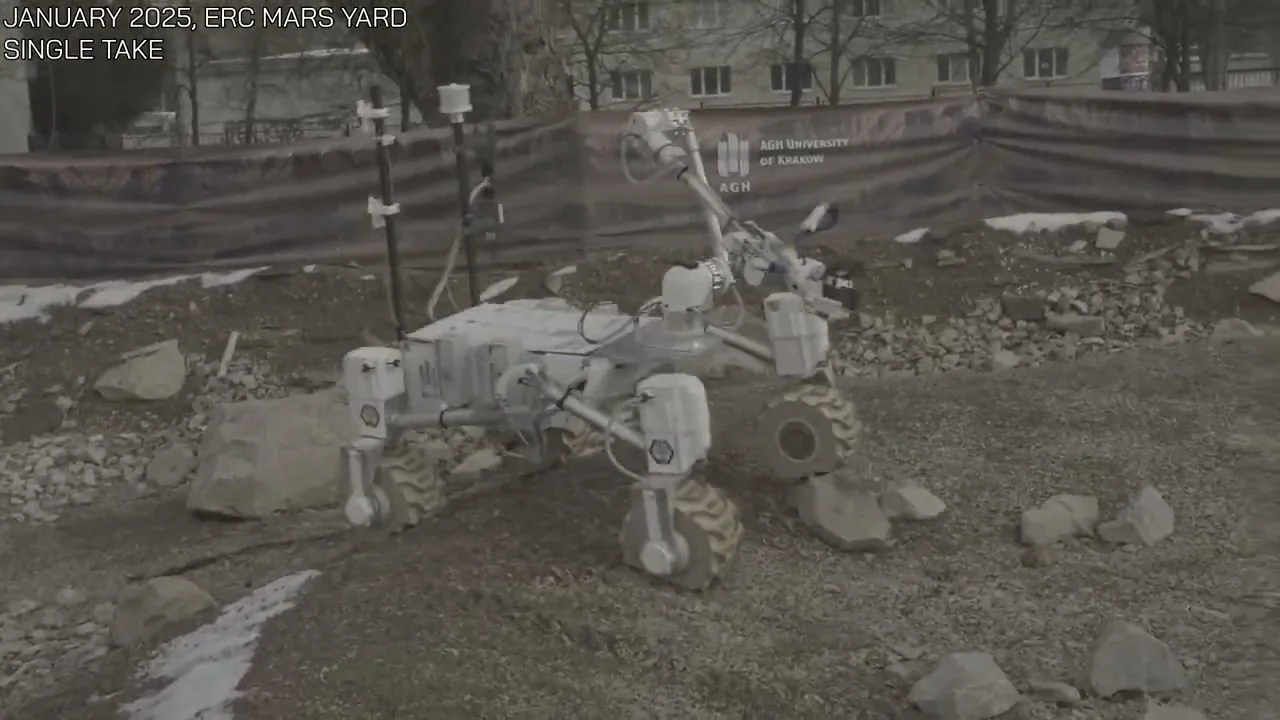
What this team shows
- Kalman has been rebuilt continuously since 2017, with entire subsystems replaced while the rover stayed operable and the suspension family and operator interface persisted S-AGH-SAR25 S-AGH-ERC26.
- The 2024 title came from autonomy, not from science or manipulation: the autonomy score went from 0 in 2023 to 72 in 2024, the best in the field, on a software rewrite with no hardware change S-URC23-SCORES S-URC24-SCORES.
- Holonomic drive costs four steering actuators and a richer kinematic model, and buys lander-panel re-positioning without a multi-point turn and a panorama taken by spinning in place S-AGH-SAR22 S-AGH-SAR23.
- No weighed competition mass is public. The team asserts the 50 kg and 70 kg limits and never publishes a scale reading S-AGH-SAR23 S-AGH-SAR24.
Identity and results
| Year | Rover | Total | Rank | SAR | Science | Delivery | Equipment | Autonomy |
|---|---|---|---|---|---|---|---|---|
| 2022 | Kalman | 341.10 | 4 | 91.10 | 100 | 50 | 16 | 84 |
| 2023 | Kalman | 274.17 | 8 | 90.48 | 75.69 | 15 | 93 | 0 |
| 2024 | Kalman | 392.76 | 1 | 96.76 | 82 | 68 | 74 | 72 |
| 2025 | Kalman | 88.61 | not in the field | 88.61 | not scored | not scored | not scored | not scored |
| 2026 | Kalman | no entry | no entry | no entry | no entry | no entry | no entry | no entry |
The shape is 4th, 8th, 1st, then out of the field. In 2024 AGH beat West Virginia University by 0.96 points with science and equipment mid-pack and autonomy in first place, 5 of 7 locations reached S-URC24-SCORES S-AGH-ACH. In 2023 the same rover scored 93 in Equipment Servicing and zero in autonomy, which is the most useful pair of numbers in its record S-URC23-SCORES.
The rover is called Kalman and the team describes it as one platform maintained for over nine years, with entire subsystems replaced without suspending operability S-AGH-SAR25 S-AGH-ERC26. Phobos, the first rover, ran at the European Rover Challenge in 2016; Kalman started at the European event in 2018 and at URC in 2019 S-AGH-PHOBOS S-AGH-KALMAN. Outside URC the team won the European Rover Challenge in 2022 and 2023, the International Rover Challenge in 2020 and 2023, the Canadian International Rover Challenge in 2023, and the Australian Rover Challenge in 2025 with 421.6 points of 500 S-AGH-ACH.
Rover generations
2019 to 2021: the platform settles. Kalman appears in the URC record from 2019. The team’s own history treats the seasons up to 2021 as the point where the architecture was fixed: by 2022 the rover has four wheels, four steering columns, a rocker per side and no bogie link between wheels on the same side S-AGH-KALMAN S-AGH-SAR22.
2022: the new arm and a browser ground station. The one large hardware change is a six-degree-of-freedom manipulator with harmonic gears, brushless motors, decentralised controllers and inverse kinematics, with the older five-degree-of-freedom arm kept as a running spare. Wheels are printed in TPU with a honeycomb interior, the ground station becomes a web application, and Gazebo plus a build pipeline catch most faults before a field test S-AGH-SAR22. Result: 4th, with Science 100 and Equipment 16.
2023: lighter and better sensed. A new, lighter suspension and more powerful propulsion modules sit on the frame that was 40 % lighter and more spacious the year before; a new printed wheel iteration saves 3 kg. The arm gains a modular gripper housing three perpendicular cameras. Comms is stated for the first time as 433 MHz for commands and a 5.8 GHz video link, tested to about 1 km S-AGH-SAR23. Result: 8th, with autonomy at zero.
2024: the championship year. The platform is carried over and the changes are software and science. Autonomy is refactored to ROS 2: an unscented Kalman filter fed by four depth cameras, an inertial unit and GPS to about 5 cm, a slope-sensitive costmap, ArUco localisation and a custom object detector trained on the delivery objects. Science gains a mobile laboratory, a reflectance probe and a drilling module still in development S-AGH-SAR24. Result: 1st, with the best autonomy score in the field.
2025: standardisation and a drone. Integration rather than architecture: a uniform circuit-board outline with a single backplane cage, a claimed reconfiguration between maintenance and autonomous modes in under 10 minutes, a 6S lithium-polymer pack hot-swapped from external mounts, dual extended Kalman filters for localisation, and Nav2 with a custom holonomic path follower. A quadcopter with 14-inch props and a 650 mm frame is added S-AGH-SAR25. Result: review-only, 88.61.
2026: six sub-teams and a differential bar. The European Rover Challenge film is the most detailed current account: six sub-teams, an aluminium rocker with a rear differential bar justified by stability during arm operations, finite-element analysis on the frame, four steering modules with toothed belts acting as safety clutches, printed wheels with elastic nylon rims, up to six lithium-ion packs with a custom battery manager, and arm joints moved to permanent-magnet motors with magnetic encoders on CAN FD S-AGH-ERC26. Result: second at the European Rover Challenge, no URC entry.
Subsystems
Mobility. Four wheels, a rocker per side, and a steering actuator at every wheel. The rover model in the public code gives a wheelbase of 0.792 m, a track of 0.666 m and a wheel collision cylinder of 0.24 m diameter by 0.15 m width S-AGH-GH-URDF. Wheels are airless and fully printed: TPU with a honeycomb interior, then a gyroid infill, then gyroid plus nylon rims S-AGH-SAR22 S-AGH-SAR25 S-AGH-ERC26. The suspension is passive and the model treats the rocker as a fixed joint, which is consistent with a structure that is not actuated S-AGH-GH-URDF. Top speed is not published; the Nav2 velocity smoother caps commands at 2.0 m/s per axis, which is a limit, not a measurement S-AGH-GH-KALMAN.
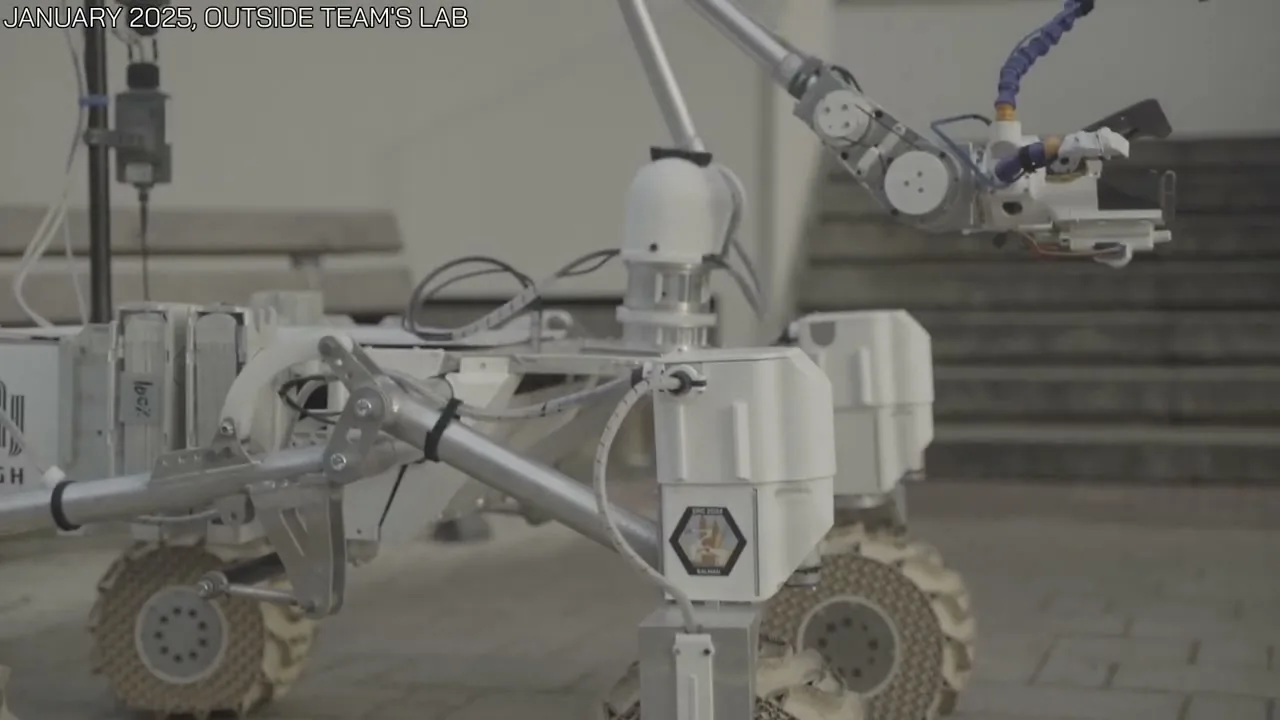
Arm and end-effectors. Six revolute joints plus a jaw, with the chain summing to about 1.24 m to the jaw pivot and 1.34 m to the end of a mounted end effector from the arm base, by arithmetic on the published joint offsets S-AGH-GH-ARMURDF. The end effector is a modular gripper with task-specific claws; the 2023 version housed three perpendicular cameras and the 2024 version added a high-resolution camera module S-AGH-SAR23 S-AGH-SAR24. Control is by inverse kinematics from a 3D space mouse, with predefined poses and recordable trajectories. The code also documents an action that maps a rectified panel image to panel metres, so an operator can click a button on screen and have the arm go there S-AGH-GH-ARM2.
Science. The 2024 payload was a mobile laboratory: an ultrasonic soil-extraction chamber, a biomarker spectrophotometer and a fluorescence analyser, reporting on DNA, amino acids, carbohydrates and chlorophyll, plus a reflectance probe and a time-of-flight sensor for panorama scale S-AGH-SAR24. By 2026 the payload is simpler: a reflectance spectrometer and an arm-mounted pH probe with 0.1 resolution over the 0 to 14 range S-AGH-ERC26. Sampling moved from a scoop and sealed containers to a drilling module aimed at 30 cm depth, still described as in development in 2026.
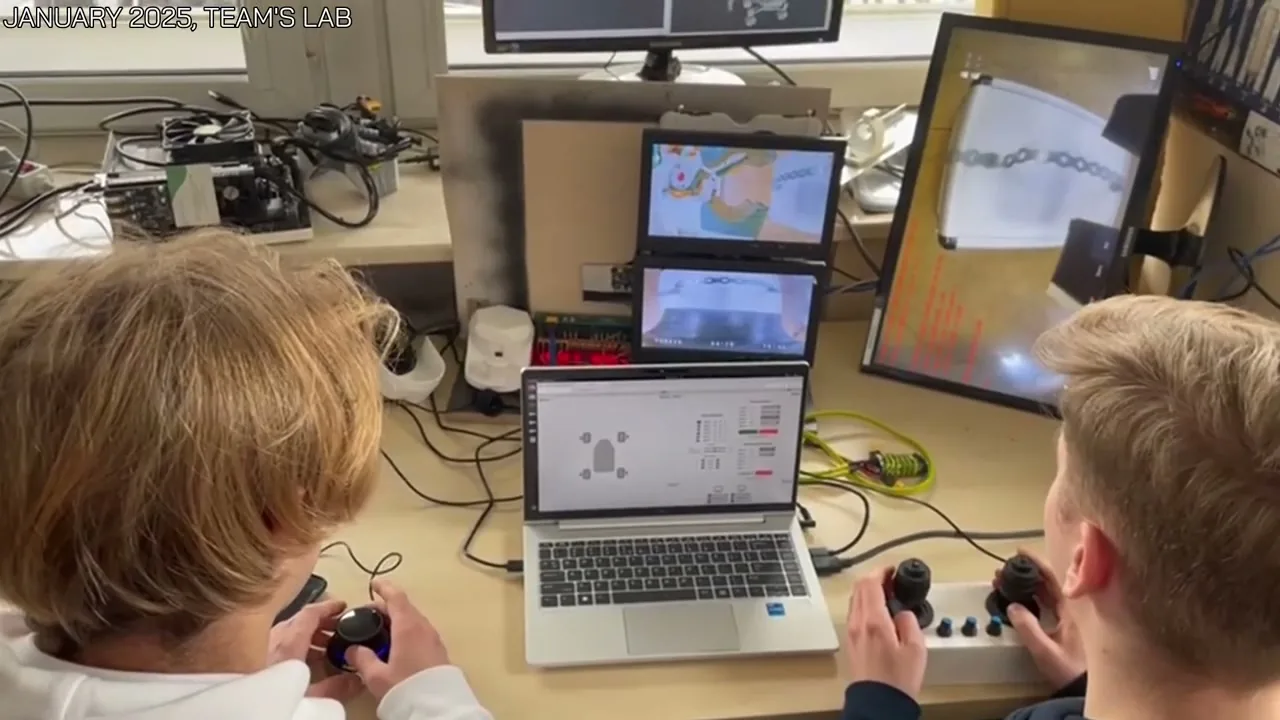
Communications. A 433 MHz command link and a 5.8 GHz analogue video link, with range claims of about 1 km line of sight in 2023 to 2025 and 300 m without line of sight in 2026 S-AGH-SAR23 S-AGH-ERC26. The distinctive part is not the radio but the tunnel: a ROS 2 node carries selected topics, services and actions over the link in a custom frame format, packing each field to a fixed width. Orientation components get one byte each, latitude and longitude four bytes, and updates are capped at 5 Hz for the inertial unit and 2 Hz for position S-AGH-GH-ROSLINK. Autonomy missions therefore arrive as goals rather than as a stream of setpoints, and paths are deliberately not sent.
Power, compute and operations. Packs are hot-swapped from outside the frame: a 6S lithium-polymer in 2025, and up to six lithium-ion packs with a custom battery manager in 2026, one pack good for about 20 minutes S-AGH-SAR25 S-AGH-ERC26. The E-stop is a series interrupt in the battery lead that physically breaks the connection, unchanged from 2022 to 2026 S-AGH-SAR22 S-AGH-ERC26. Perception runs on four depth cameras, one per side, with a LiDAR and inertial odometry fork in integration in 2026 S-AGH-GH-HWCFG S-AGH-GH-ORG. The main computer model is not stated for 2022 to 2025; the arm got its own compute module in 2026.
Mission performance
The 2024 win is the result to study. AGH scored 96.76 on the review, 82 in science, 68 in delivery, 74 in equipment and 72 in autonomy, and won by less than one point S-URC24-SCORES. The autonomy improvement from zero to 72 in one year, without a hardware change, is the largest single-year autonomy jump in the 2022 to 2026 record.
The 2023 season shows the other side. The same team advertised a tested autonomy stack in its review film, then scored zero on the mission, and no primary account of the cause exists S-URC23-SCORES S-AGH-SAR23. The Delivery score of 15 that year is consistent with a run that ended early. A tested stack and a run plan are different deliverables.
The absence from 2025 and 2026 is the most interesting cell in the row. A 2024 champion submitted a review at 88.61, did not appear among the 35 teams that competed in 2025, and is absent from the 2026 sheet, while placing third and second at the European Rover Challenge in those years and winning the Australian Rover Challenge in 2025 S-URC25-SCORES S-URC26-SCORES S-AGH-ACH. The public record gives no reason, and the Australian tasks are visible in the same code, which suggests a deliberate change of competition focus rather than a loss of capability.
Lessons for a first build
- Spend the effort on interfaces, not on new vehicles. The arm comes off with four screws and two cables, every board slides into one cage, and packs slide in from outside the frame. A team that can only build once should copy that and not the annual redesign S-AGH-SAR23 S-AGH-SAR25.
- Holonomic drive is a real option, priced honestly. It buys lateral approach to a lander and rotation in place for panoramas, and it costs four steering actuators, four encoders and a kinematic model the autonomy stack must carry S-AGH-SAR22 S-AGH-SAR25.
- Design the telemetry format for the link. Packing each field to a fixed width, sending goals rather than paths, and giving video its own band is the cheapest answer to a 900 MHz, non-line-of-sight problem S-AGH-GH-ROSLINK.
- An E-stop that interrupts the battery lead has no firmware in the path. AGH kept the same series interrupt for four seasons S-AGH-SAR22 S-AGH-ERC26.
- Plan the autonomy run as its own deliverable. Start position, LED signalling, abort rules and an operator procedure are separate from the software, and the 2023 zero is what happens when only the software is planned S-URC23-SCORES.
- Expect manipulation scores to move for task reasons. Equipment Servicing fell from 93 to 74 on the same arm architecture, and no source explains it S-URC23-SCORES S-URC24-SCORES.
What remains uncertain
No weighed competition mass is public, although the team states that it meets the 50 kg and 70 kg limits S-AGH-SAR23 S-AGH-SAR24. Motor and gearbox part numbers, the main computer model, the radio model, the precision-positioning receiver and the arm payload rating are all unpublished. The arm reach above is arithmetic on model offsets, not a datasheet figure, and the effort limits in that model are dummy values.
Two published claims conflict. The 433 MHz link is described as full duplex in 2023 and 2024 and as half duplex in 2025, which matters because it decides whether uplink and downlink share a channel. Battery chemistry is described as a 6S lithium-polymer in 2025 and as lithium-ion with a custom manager in 2026. Neither the cause of the 2023 autonomy zero nor the reason for the 2025 and 2026 absence appears in the public record.
Team sources
- spacesystems.agh.edu.pl, the team site.
- Kalman, the current rover page.
- AGH Space Systems rover code, the ROS 2 codebase, rover model and arm model.
- Review film, 2025, the best single tour of the rover.
- Review film, 2024, the championship season.
- European Rover Challenge film, 2026, the most recent account of the architecture.
- University news, 2024, the win release.
Sources for this page
- S-AGH-SAR25AGH Space Systems, SAR URC 2025 Video (4:53, auto-captions)Original
- S-AGH-ERC26AGH Space Systems, ERC 2026 Video (8:20, auto-captions); most detailed 2026 subsystem walkthroughOriginal
- S-URC23-SCORESURC2023 Official ScoresOriginal
- S-URC24-SCORESURC2024 Official ScoresOriginal
- S-AGH-SAR22AGH Space Systems, SAR URC 2022 Video (5:00, auto-captions)Original
- S-AGH-SAR23AGH Space Systems, SAR URC 2023 Video (4:58, auto-captions)Original
- S-AGH-SAR24AGH Space Systems, SAR URC 2024 Video (5:00, auto-captions)Original
- S-AGH-ACHOur achievements, dated competition record with per-event notesOriginal
- S-AGH-PHOBOSPhobos, first rover project page (EN), 2016 ERC, subsystem detail and failure listOriginal
- S-AGH-KALMANKalman, project page (EN), incl. technical-solutions list and team historyOriginal
- S-AGH-GH-URDFkalman_description/urdf/visual_model.urdf.xacro, rover kinematics, wheel geometry, joint layoutOriginal
- S-AGH-GH-KALMANkalman_robot, rover ROS 2 monorepo (MIT), package map and launch hierarchyOriginal
- S-AGH-GH-ARMURDFkalman_description/urdf/arm.urdf.xacro, 6-joint arm chain, link offsets, joint limitsOriginal
- S-AGH-GH-ARM2kalman_arm2/README.md, 2026 arm autonomy: gamepad scheme, homography pixel→panel mapping, MoveToPanelPoseOriginal
- S-AGH-GH-ROSLINKkalman_master/config/pc_ros_link.yaml, ROS-over-RF link: forwarded topics and per-field bit widthsOriginal
- S-AGH-GH-HWCFGkalman_hardware/config/, RealSense D455 streams, NMEA GNSS driver, Phidgets Spatial IMUOriginal
- S-AGH-GH-ORGGitHub org agh-space-systems-rover, 20 public repos, last push 2026-10-22Original
- S-URC25-SCORESURC2025 Official ScoresOriginal
- S-URC26-SCORESURC2026 Official ScoresOriginal Archived copy