IITB Mars Rover Team (IIT Bombay)
The IIT Bombay team publishes the most complete autonomy architecture of any team in this band: eleven ROS 2 packages, three-dimensional mapping, a fifteen-state estimator, two simulators and a strategy layer above the navigator. It also scored zero in autonomous navigation in 2018, in 2023 and in 2024. The distance between the published architecture and the field result is the most useful thing in this dossier, and the team is candid enough in public for that distance to be measurable.
What this team shows
- A code archive is not a capability. The autonomy code is more thorough than most teams publish, and it produced three zeros in the finals.
- Science is genuinely strong: 93.09 in 2023 is one of the highest science scores in the modern field, and the review has held between 89 and 91 for four years.
- The ten-year record contains the field’s canonical worst result, a total of zero, which is what happens when one dead subsystem takes every mission with it.
- Two of the last four seasons produced a review and no finals appearance, which is an attendance signal rather than an engineering one.
Identity and results
| Year | Rover | Total | Rank | SAR | Science | Delivery | Equipment | Autonomy |
|---|---|---|---|---|---|---|---|---|
| 2015 | unnamed | 0.0 | 23 | 0 | 0 | 0 | 0 | 0 |
| 2018 | unnamed | 173.39 | 31 | 79.82 | 69.57 | 16 | 8 | 0 |
| 2023 | unnamed | 229.40 | 19 | 89.31 | 93.09 | 12 | 35 | 0 |
| 2024 | unnamed | 205.99 | 22 | 90.99 | 80 | 16 | 19 | 0 |
Four other seasons produced a review without a finals place, so they carry a single score each:
| Year | Score | Outcome |
|---|---|---|
| 2019 | 87.5 | review scored, no finals place |
| 2022 | none | registered, no result row |
| 2025 | 90.28 | review scored, no finals place |
| 2026 | none published | review submitted, no result row |
The 2019 and 2025 rows are review-only seasons S-URC-HISTRESULTS S-URC25-SCORES. In 2026 the team is on the registration list and published a review film, and appears in no result row at all S-URC26-TEAMS S-URC26-SCORES. The team also registered in 2022 and is absent from that year’s sheet.
The team uses no rover names. Its site and its code refer to “the rover” or to the team’s own abbreviation, which makes cross-year comparison depend on the score sheet.
Rover generations
There is no named lineage, so the record has to be read as four periods.
2015: the zero. Zero in every mission, 23rd of 23 S-URC-HISTRESULTS. This is the reference case for the field-wide finding that one dead subsystem can zero every mission, because the totals are additive across the four missions and the review.
2018 and 2019: the shape settles. A review score of 79.82 with Science 69.57 in 2018, Delivery 16 and Equipment 8, and autonomy already at zero. 2019 is a review-only year at 87.5 S-URC-HISTRESULTS.
2023 and 2024: strong science, no autonomy. A review above 89 in both years, Science 93.09 then 80, and autonomy at zero twice S-URC23-SCORES S-URC24-SCORES. Equipment Servicing halved from 35 to 19 in the second year, and the rank fell three places.
2025 and 2026: documentation without a finals place. A review submitted in both seasons and no result in either S-URC25-SCORES S-URC26-SCORES.
Subsystems
Autonomy architecture. The published workspace is the most detailed artefact this team produces. It splits into interfaces, perception, navigation, mapping, strategy, drivers, estimation, two simulators, launch configuration and low-level control, eleven packages in all S-IITB-GH-AUTO. Two design choices stand out. Mapping uses three-dimensional simultaneous localisation and mapping with loop closure, then projects the result down to a two-dimensional grid. Estimation is a fifteen-state filter that fuses four explicit measurements, four drive measurements, an inertial unit and visual odometry. A separate strategy package handles exploration, task allocation and recovery, so the rover has a layer above the path follower.
Navigation and perception. Navigation is built on the standard ROS 2 navigator, with local tuning and three-dimensional path planning. Perception covers detection, classification and fiducial tag recognition. Sensors include a stereo depth camera, a four-dimensional lidar, a two-dimensional lidar and an inertial system S-IITB-GH-AUTO.
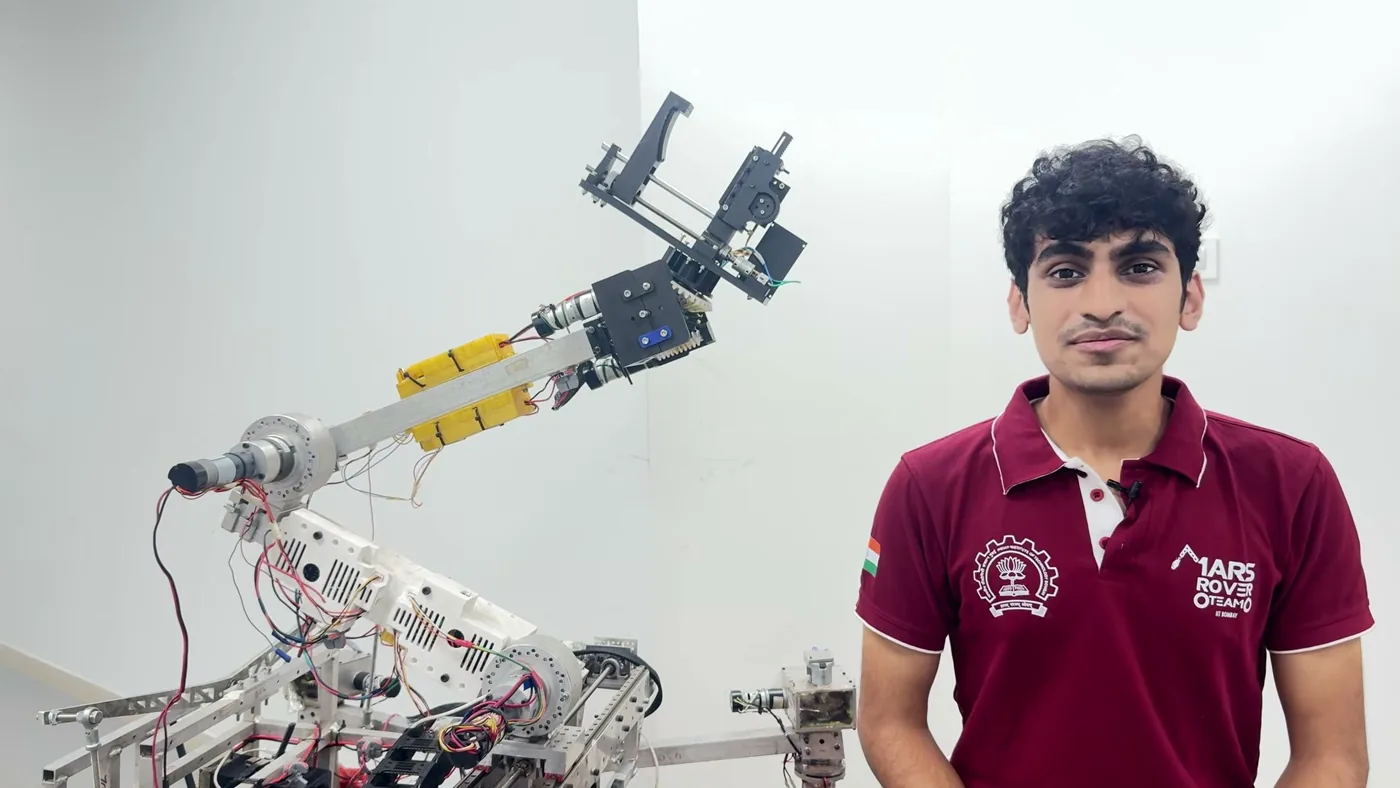
Manipulation. A wrist-mounted head with a drill and a gripper covers both the sampling and the servicing tasks with one arm S-IITB-SAR2026. The structure is aluminium extrusion and machined plate. Degrees of freedom, reach, payload and actuator family are unpublished.
Embedded and electrical. A microcontroller codebase for the 2026–27 rover, a separate ROS 2 workspace maintained by the electrical group, and a control interface for the subsystems S-IITB-GH. Battery packs appear as taped assemblies mounted on the arm boom rather than in a compartment, which is a maintenance decision as much as a packaging one.
The drone. A drone demonstration was published in 2022 S-IITB-YT. Nothing since then describes an aircraft, and the 2027 delivery mission rewards one.
Staffing. The team site lists four projects with named effort: autonomous navigation with six members, a communications hub with four, an environmental analysis module with five and power management with three, so 18 people across the four S-IITB-SITE. Whether that is the whole team is unpublished.
Mission performance
The autonomy paradox. Autonomy scored zero in 2018, zero in 2023 and zero in 2024 S-URC-HISTRESULTS S-URC23-SCORES S-URC24-SCORES. That is 100 points left on the table in each of the three seasons the team reached the finals. A stack with three-dimensional mapping, a fifteen-state estimator and a strategy layer is more autonomy engineering than most teams in the field publish, and it did not complete a course.
The gap is not in the code. It is in integration, field validation and operator procedure: whether the stack ran on the actual rover, over the actual ground, with the arrival indication that the rules require, is a different question from whether the packages exist.
Science and the review carried the team. 93.09 in Science in 2023 is one of the highest science scores in the modern field, and the review never fell below 79.82 across five submissions S-URC23-SCORES S-URC24-SCORES. The two seasons that produced a review without a finals place show that a strong written submission is necessary and not sufficient.
2015 as the anchor. A total of zero is the clearest illustration in the field of additive scoring: one subsystem that stops the rover moving or stops the judges scoring takes the other three missions with it.
Lessons for a first build
- Treat autonomy field trials as a scored deliverable. A published architecture with no end-to-end run on the rover scores zero, and this team has done it three times. Put a full autonomous course run in the schedule from the first semester and make it a gate for the rest of the work S-IITB-GH-AUTO S-URC24-SCORES.
- Copy the package split. Separating interfaces, perception, navigation, mapping, drivers and start-up configuration is free to adopt and makes a stack debuggable when something fails in the field.
- Watch where estimation risk concentrates. A fifteen-state filter fusing eight measurements is more estimation engineering than most student teams attempt, and it is also the part most likely to fail silently if one sensor is miscalibrated.
- Use one wrist head for two jobs. A drill and a gripper on the same wrist covers sampling and servicing without a second arm or a changer S-IITB-SAR2026.
- Keep the review team funded through a hardware change. The review has been the team’s most consistent asset across four seasons, and it is the cheapest score to defend.
What remains uncertain
Why autonomy scored zero in 2023 and 2024 is the central question and the public record does not answer it. The review films for both years contain autonomy sections, and reading those sections against the code would settle it.
Why 2025 and 2026 produced a review and no finals result is also unexplained, and it matters because two of the last four seasons ended before the score sheet. Every physical specification is missing: mass, wheels, suspension, drive motors, battery capacity, radio and computer board. Team size is unknown beyond the 18 people named against four projects. Whether the European and Indian competition codebases share hardware with the URC rover is also unpublished.
Team sources
- iitbmartian.github.io, the team site with project cards and staffing.
- iitbmartian on GitHub, 17 archives, active through October 2026.
- Autonomy workspace, the ROS 2 packages used for the 2026–27 rover.
- YouTube channel, reviews from 2018 to 2026 plus a 2022 drone demonstration.
- 2026 System Acceptance Review, the primary film for the 2026 rover.
- 2024 System Acceptance Review, a season with a working science payload and zero autonomy.
Sources for this page
- S-URC-HISTRESULTSURC results database: derived 2022–2026 statistics (§4–§5) and archived official results 2013–2019 (§7)Print copy
- S-URC25-SCORESURC2025 Official ScoresOriginal
- S-URC26-TEAMSURC2026 Team ListOriginal Archived copy
- S-URC26-SCORESURC2026 Official ScoresOriginal Archived copy
- S-URC23-SCORESURC2023 Official ScoresOriginal
- S-URC24-SCORESURC2024 Official ScoresOriginal
- S-IITB-GH-AUTOiitbmartian/ROS2_Autonomous_2026_27, colcon workspace; packages rover_perception (object detection/classification, AR tag detection), rover_nav2 (path planning, control, 3D navigation), rover_slam (3D SLAM, RTAB-Map, loop closures), rover_strategy (exploration, task allocation, recovery), rover_drivers (ZED 2i, 4D LiDAR, 2D LiDAR, SBG), rover_ekf (4 explicit + 4 drive → KF; KF + SBG + VO + IMU → EKF), rover_gazebo, rover_unity, rover_bringup, rover_controls, rover_interfacesOriginal
- S-IITB-SAR2026URC 2026Print copy
- S-IITB-GHiitbmartian GitHub organisation, 17 source repositories incl. ROS2_Autonomous_2026_27, MRT_STM32_26_27, rover_elec_ros2_2027, Autonomous_Navigation_2D, irc_26_stm, erc_ws, erc_unity_project, erc_image_processing, language-model descriptor, GUI, Gazebo_simulationOriginal
- S-IITB-YT"Mars Rover Team IIT Bombay" YouTube channel, SAR 2018, 2019, 2022, 2023, 2024, 2025, 2026; CDR 2017; "URC SAR 2022 Drone Demo"Original
- S-IITB-SITEIITB Mars Rover Team site (GitHub Pages), founded 2012; URC/IRC/ERC as targets; four project cards with staffing (autonomy 6, comms 4, environmental analysis 5, power 3)Original