Michigan Mars Rover Team (MRover)
Michigan won the 2022 competition with 388.97 points, then dropped to 4th, 9th and 11th before recovering to 5th in 2026, the year it received the first INCOSE Foundation award for systems engineering. The team publishes its software, its board designs and a 166-page engineering wiki, and publishes no design report at all. That asymmetry is the most useful thing about it: the engineering is readable down to controller registers, and the mass and power budgets are not public.
What this team shows
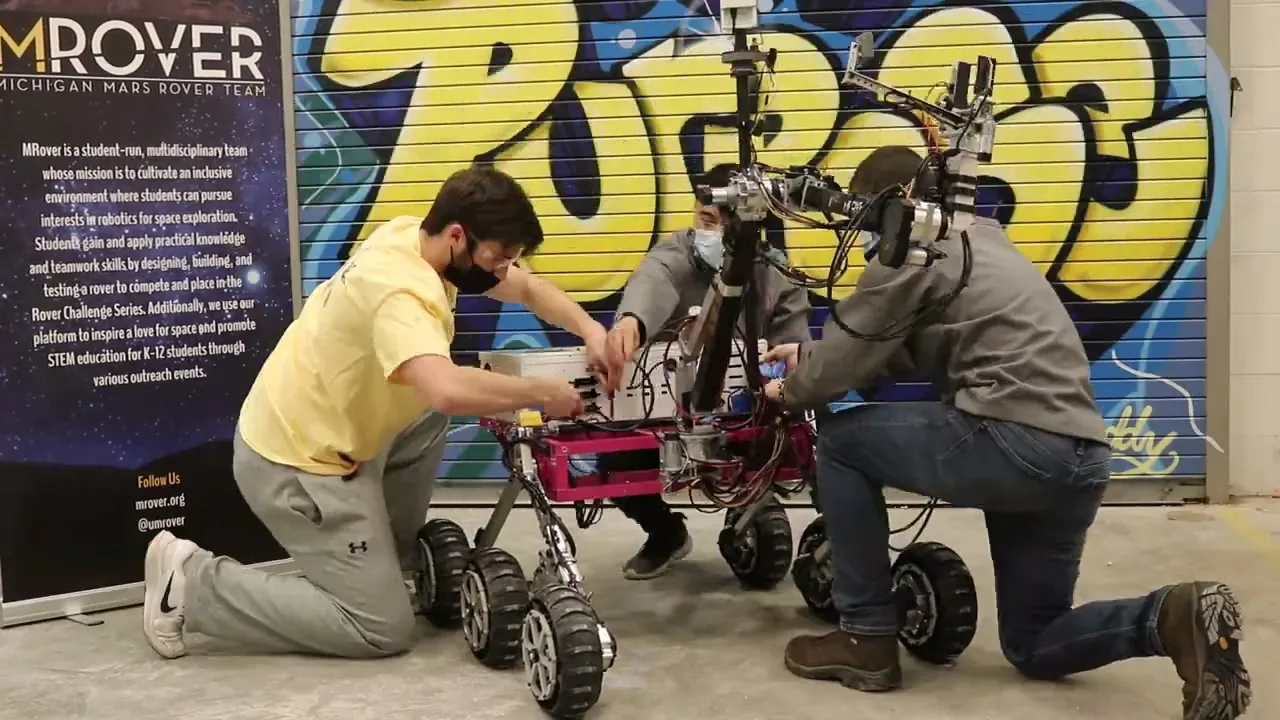
- A champion can be built on process. The 2022 rover was the 2021 architecture industrialised, with a servicing lander, a navigation test cart, development boards and a stated priority on mock missions and operator practice S-MICH-SAR2022.
- One mission’s rule change moved the champion to mid-field. Delivery fell from 80 to 15 in 2023, the year the mission format changed, while autonomy rose to 96 S-URC23-SCORES.
- Its release practice is a system-engineering artefact in itself: 49 public code projects, continuous integration for every board, and a three-reviewer protocol with a mandatory statement of what was tested S-MICH-GH-ORG S-MICH-GH-WSWIKI.
- The weak mission is manipulation, not mobility. Equipment Servicing scored 53, 52, 36, 23 and 55.26 across five seasons and never reached the field leaders S-URC26-SCORES.
Identity and results
| Year | Rover | Total | Rank | SAR | Science | Delivery | Equipment | Autonomy |
|---|---|---|---|---|---|---|---|---|
| 2022 | Rosie | 388.97 | 1 | 90.97 | 95.0 | 80.0 | 53.0 | 70.0 |
| 2023 | Dahlia | 343.08 | 4 | 92.21 | 87.87 | 15.0 | 52.0 | 96.0 |
| 2024 | Perry | 274.41 | 9 | 89.41 | 78.0 | 15.0 | 36.0 | 56.0 |
| 2025 | Kiwi | 299.62 | 11 | 91.62 | 85.0 | 30.0 | 23.0 | 70.0 |
| 2026 | Phil | 375.89 | 5 | 94.63 | 96.0 | 44.0 | 55.26 | 86.0 |
The team has competed since 2010 and its best results before 2022 were 7th in 2019 and 9th in 2018, so the 2022 title was a first win after a decade of mid-field finishes S-MICH-ROVERS. The 2022 margin was 8.4 points over Monash, and it came entirely from Science and Delivery: autonomy at 70 and equipment at 53 were mid-field S-MICH-MARS2022 S-URC22-SCORES.
The 2026 systems-engineering award is scored separately and does not change placement, and the rubric is published. It is a two-stage, 200-point evaluation: a 100-point pre-screen across eight categories applied to all 38 finalists’ reviews, then a 100-point finals stage with a structured interview and in-field observation, with a combined score of at least 75 required S-URC-INCOSE. Thirteen of the 38 finalists cleared the 80-point pre-screen. MRover’s own score is not published.
Rover generations
2000 to 2021: two reversals. The team built its first URC rover in 2010 with a steel frame, two motors, a chain drive and no suspension. Six wheels arrived in 2011, four with independent shocks in 2012, six again in 2013, and a six-wheel rocker-bogie with a rectangular chassis from 2015 to 2017, with the frame moving from aluminium to carbon fibre in 2017. In 2018 the team abandoned the six-wheel rocker-bogie for four independent shocks and a differential bar to go faster, and dropped ROS for hand-written code. In 2019 it rebuilt the arm for inverse kinematics over seven degrees of freedom and added an in-house Raman spectrometer, scoring a perfect science result and finishing 7th. In 2020 it ran a carbon-fibre chassis, a custom cycloidal arm transmission, a custom 10S pack and a deployable radio repeater, and was the top qualifier when the event was cancelled. In 2021 it went back to six wheels and a welded aluminium chassis, with printed compliant wheels on hub motors taken from consumer hoverboards, a 36 V pack built in house, and a 3-DoF Cartesian sampler S-MICH-ROVERS S-MICH-TALK2021.
2022: Rosie. A new rover on the 2021 architecture but industrialised: welded aluminium chassis, rocker-bogie suspension, brushless motors in custom gearboxes, printed wheels, a six-degree-of-freedom arm with in-house cycloidal gearboxes rated to 10 kg, a lead-screw gripper opening to 13 cm, closed-loop inverse kinematics, a second arm configuration for science, a wet-chemistry carousel with ultraviolet sterilisation of the scoop, eight life-detection tests, a 36 V pack for two hours, 900 MHz radios to 2 km and a stereo camera on a gimbal S-MICH-SAR2022. The team spent the year on integration and test rather than on new mechanisms, and the rover won.
2023: Dahlia. Welded aluminium chassis with lighter drive gearboxes, the six-degree-of-freedom arm upgraded to brushless motors, a wrist slip ring for continuous end-effector rotation, a separate three-degree-of-freedom science arm, two soil deposit points, a 36 V pack for more than 2.5 hours, 900 MHz and 2.4 GHz links, a ROS microservice architecture with regression testing in simulation, and a localisation split between a global filter and a locally accurate visual-odometry frame S-MICH-SAR2023. The Delivery score collapsed to 15.
2024: Perry. A simplification year: five degrees of freedom on the arm, a 2.4 GHz link at up to 60 Mbps, real-time kinematic GPS, and a display that combines camera views with a three-dimensional model S-MICH-ROVERS. Autonomy halved and the total fell to 274.41, the lowest of the five seasons.
2025: Kiwi. The package redesign: a torsion-box chassis, a double-lambda rocker-bogie, upgraded printed wheels with custom gearboxes, a five-degree-of-freedom arm with two new end effectors, power and control centralised on custom boards, a Jetson AGX Orin, a sheathed auger and dual life-detection assays S-MICH-ROVERS. It was the most mechanical change of the five years and the worst placement of them.
2026: Phil. A fully sheet-metal chassis with a rear-mounted differential bar, a redesigned science payload, a new shoulder joint for arm speed and range, a power distribution system built as a motherboard with daughter cards, brushed motor controllers supporting 12 V and 24 V, and optimised path generation and object detection S-MICH-ROVERS. Science reached 96, autonomy 86 and equipment 55.26, the best all-round rover since the championship.
Subsystems
Mobility. Six wheels, a double-lambda rocker-bogie and a rear differential bar. The rover model resolves what the name means: each side has a rocker, the front wheel hangs directly from it, and a pair of cranks on a common axis drives a lower link that splits into front and rear lambda links carrying the centre and rear wheels. The differential bar is a chassis pivot at the rear whose ends attach to each side through a two-axis connector, so the bar pitches with average rocker motion while each side still rolls independently S-MICH-GH-URDF. Drive is six identical velocity-controlled wheels with no steering actuator, each on a moteus controller, with six channels plus a staged backup: 46 V, 15 A and one channel capped at 450 W S-MICH-GH-MOB S-MICH-DOCS-ESW-DEV.
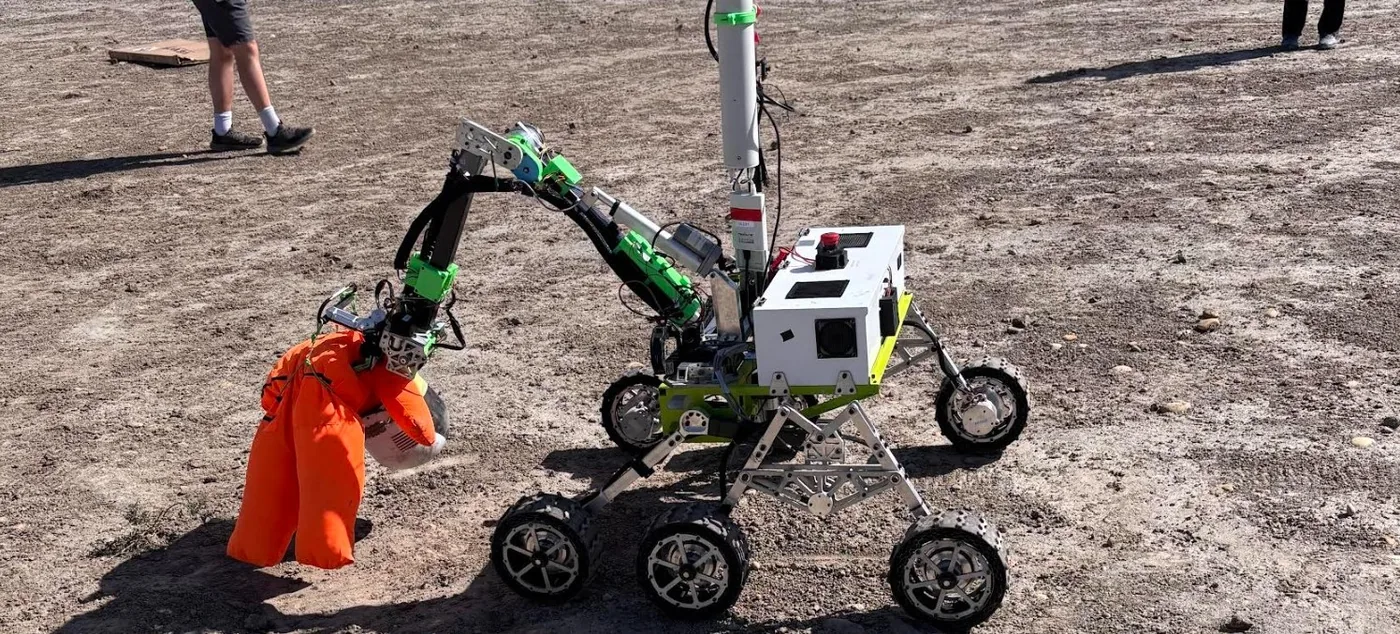
Arm and end-effectors. The count has moved: seven degrees of freedom in 2019, six in 2021 to 2023, five from 2024. The 2026 arm is a prismatic shoulder slide with 0.40 m of travel, two links of 0.58 m and 0.35 m, two more joints and a roll of ±135°, plus a linear actuator and a gripper with a short pusher stroke S-MICH-GH-URDF. Reach is about 1.2 m from the shoulder plus the slide. Actuation is deliberately mixed by load case: brushless motors on the drive and on the shoulder, elbow and wrist pair, brushed motors on the second joint and the gripper, all through in-house cycloidal gearboxes, with a slip ring giving continuous wrist rotation since 2023 S-MICH-DOCS-ESW-BL S-MICH-DOCS-BRUSHED. Two crossing lasers on the end effector mark the keyboard standoff distance, a cheap depth cue that predates the visual work.
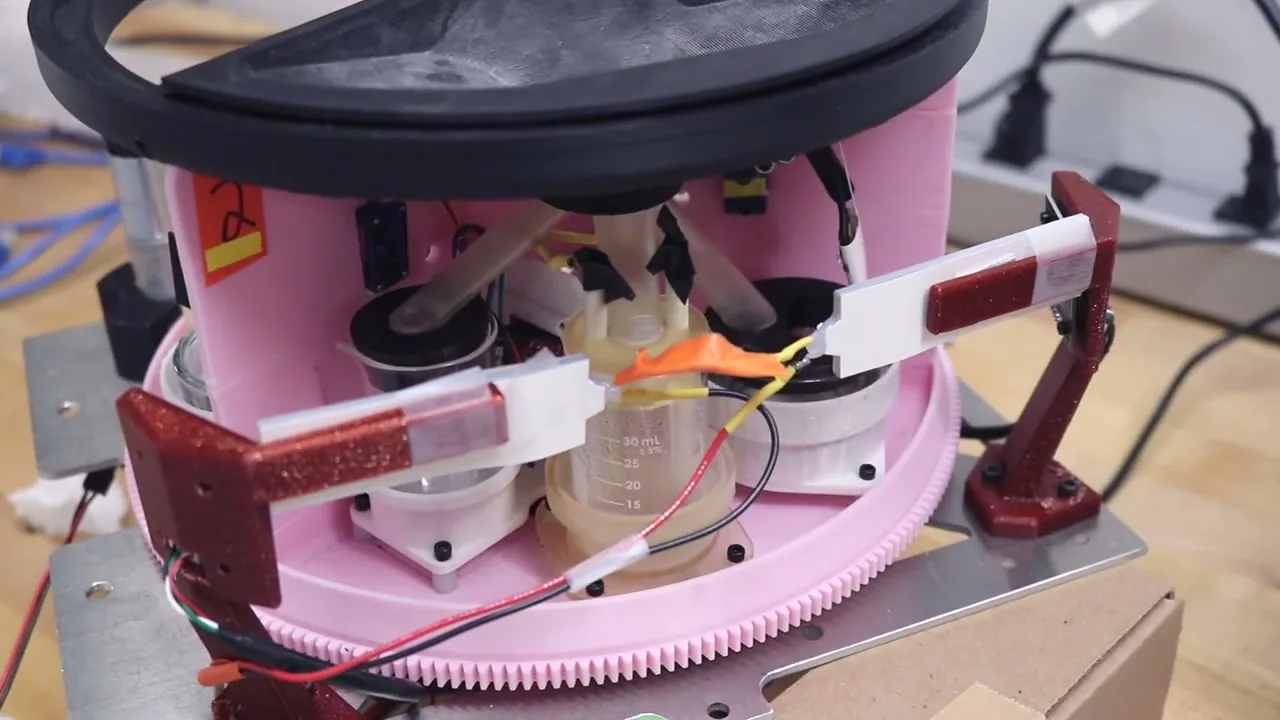
Science. The strongest subsystem: an in-house Raman spectrometer, an actuated microscope with its own camera stream, a spectrophotometer and a carousel of single-use wet-chemistry assays, with ultraviolet sterilisation of the scoop between sites and a cache that closes with a gear mechanism. Capacity is three soil samples and nine rocks per mission S-MICH-SAR2022 S-MICH-SAR2023. Sampling moved from a dedicated science arm to a sheathed auger with a linear actuator of 0.30 m stroke S-MICH-GH-AUGER S-MICH-GH-LA.
Communications. The band history is a trade between range and throughput: 900 MHz with a linear amplifier and a deployable repeater in 2021, 900 MHz to 2 km in 2022, 900 MHz and 2.4 GHz together in 2023, and a 2.4 GHz link at up to 60 Mbps in 2024 S-MICH-TALK2021 S-MICH-SAR2022 S-MICH-ROVERS. In 2025 the team replaced the commercial radios with its own: two radio boards, one for 900 MHz and one for 2.4 to 5 GHz, firmware with two link types, and an HTTP interface that reports link quality as data, including round-trip time, heartbeats acknowledged, transmit failures and queue drops S-MICH-GH-MRADIO S-MICH-GH-RADIOAPI. Every camera stream is capped at 1 Mbit/s of H.265 at 640 by 480 and 15 frames per second so that fifteen streams fit the link S-MICH-DOCS-CAM.
Power, compute and operations. A 36 V pack built in house, a 10S5P in 2021, with a power distribution board iterated every year and its rail map published in the board schematics S-MICH-TALK2021 S-MICH-GH-ELEC. One board per function on CAN FD, with a composed arbitration identifier; the brushed controller is the only board with a control loop, and a 10 Hz watchdog faults it if commands stop, so a lost link stops the motor instead of leaving it running S-MICH-DOCS-ESW-BMC. The E-stop is described only as an accessible push button. Compute is a Jetson AGX Orin; localisation uses a dual-antenna receiver with two antennas 1.0 m apart for heading and a base station running survey-in, with corrections carried over ROS S-MICH-DOCS-LOC. There is no LiDAR: depth comes from a stereo pair.
Mission performance
The 2022 title came from readiness. Science at 95 and Delivery at 80 carried it, the team’s own account is about mock missions and operator practice, and its president said almost nobody on the leadership team had been to a competition before S-MICH-MARS2022 S-MICH-EECS2022 S-MICH-ME2022.
The 2023 drop is the clearest natural experiment in the field. The Delivery mission format changed, MRover scored 15 in exactly that column, and the champion fell to 4th while its autonomy rose to 96, the best in its own history at that point. Delivery and Equipment together fell from 133 points in 2022 to 67 in 2023, which is a 66-point loss in the two missions an arm has to win S-URC22-SCORES S-URC23-SCORES. No public post-mortem exists; the likely mechanisms are object classes hard-coded as trained detector models, and an arm envelope that did not match the new task.
The 2026 recovery targeted exactly that. A new shoulder joint for speed and range, brushed controllers for both 12 V and 24 V loads, a motherboard-and-daughter-card power architecture, and optimised path execution produced 55.26 in equipment and 44 in delivery, with science at a personal best S-MICH-ROVERS S-URC26-SCORES.
Lessons for a first build
- The review protocol is the cheapest system-engineering lever available. Three reviewers with defined and non-overlapping jobs, a pull request template that asks how the change was tested in simulation and on the rover, and a commit message that must state the testing performed S-MICH-GH-WSWIKI S-MICH-GH-PRTEMPLATE.
- Publish the code and the wiki, not the reports. A public stack is why this dossier can describe the rover at register level; an unpublished review is why its mass is unknown S-MICH-GH-ORG.
- Dual-antenna real-time kinematic GPS is the highest-value autonomy purchase. True heading at standstill removes the failure that ends gate traversals, and the team documents the symptom of swapped antennas as a 180° heading error S-MICH-DOCS-LOC.
- Many cheap cameras, one stereo pair, one long-range camera, and a fixed bandwidth budget per stream. Naming cameras by port rather than enumeration order is a small trick that pays in the field S-MICH-DOCS-CAM.
- An N+1 drive channel turns a failed controller into a configuration change rather than a field reflash S-MICH-DOCS-ESW-DEV.
- Do not let the arm’s degree-of-freedom count drift, and do not hard-code the object classes. Each change re-tunes inverse kinematics, limits, gearboxes and operator memory, and the next season’s objects need a new model S-MICH-ROVERS S-MICH-GH-OBDET.
- Instrument the power path in the first revision. The team’s own project list records that current and temperature sensing on an earlier distribution board did not work, which left it without electrical telemetry for a season S-MICH-ESW26.
What remains uncertain
Mass in competition configuration is not published anywhere reachable, including the team site, the 166-page wiki, 49 public code projects, both review films and the university coverage. The numbers in the rover model are simulator values that sum well over 50 kg and cannot be a real budget S-MICH-GH-URDF. Power budget, battery capacity, measured top speed, wheel diameter and width, arm reach and radio power are equally unpublished; the values given above are inferences from controller limits and link lengths.
The E-stop architecture is unknown: the films say an accessible push button and no schematic is public. Whether the documented drone stack, complete with a flight checklist and a 900 MHz telemetry modem, has ever flown at a URC event is not confirmed by any source. A frequently repeated claim that the rover was designed for a 30° slope appears in no primary source and is contradicted by the team’s own statement of 45° in 2022 and 2023 S-MICH-SAR2022 S-MICH-SAR2023.
Team sources
- mrover.org, the team site, with a design-change paragraph for every rover since 2000.
- docs.mrover.org, the engineering wiki, including localisation, navigation and the motor-controller split.
- umrover on GitHub, the rover stack, embedded code, board designs and drone stack.
- Review film, 2022, the championship rover described component by component.
- Review film, 2023, the brushless arm, slip ring and dual-band links.
- Space Symposium talk, 2021, the clearest account of how the team operates.
- INCOSE Foundation award page, the published rubric behind the 2026 award.
Sources for this page
- S-MICH-SAR2022"Michigan Mars Rover Team SAR 2022" (video, 4:54; frame source for all 2022 assets)Original
- S-URC23-SCORESURC2023 Official ScoresOriginal
- S-MICH-GH-ORGumrover GitHub organisation, 49 public repositories, languages, licences, 22 archived, last push 2026-10-25Original
- S-MICH-GH-WSWIKIMRover Workflow Wiki, issue-per-PR, 3 mandatory reviewers with defined roles, required commit-message anatomy ending in "description of the testing that occurred", SAM/technical-advisor roleOriginal
- S-URC26-SCORESURC2026 Official ScoresOriginal Archived copy
- S-MICH-ROVERSOur Rovers, per-rover design history, 2000–2026 (Astro page; full text in data-desc attributes)Original
- S-MICH-MARS2022"U of Michigan Wins URC Competition!" (388.97; Monash 380.55; Missouri S&T 370.71; 36 teams)Original
- S-URC22-SCORESURC2022 Official ScoresOriginal
- S-URC-INCOSEINCOSE Foundation, Excellence in Systems Engineering Award (URC)Original
- S-MICH-TALK2021"MRover, Building Astronaut-Assisting Rovers for Mars Exploration", U-M Space Symposium 2021 (video, 23:55; speakers David Baek, Rachel Li)Original
- S-MICH-SAR2023"Michigan Mars Rover Team SAR 2023" (video, 5:01)Original
- S-MICH-GH-URDFRover URDF/xacro, chassis 0.598×0.478×0.183 m, wheel r 0.12 / w 0.09, double-lambda links + cranks ±1.2 rad, rear diff bar at x −0.376 with 2-DoF end joints, arm A slide 0–0.40 m / B 0.58 m / C 0.35 m / E ±135°, 3 GNSS frames (1.0 m centre), IMU, ZED, long-range + finger camerasOriginal
- S-MICH-GH-MOBrover/mob/*.cfg, six drive moteus configs + backup; servo.max_voltage 46, max_current_A 15, max_velocity 2.0, default_velocity_limit 1.7, fault_temperature 75, middle_left max_power_W 450, timeout_max_torque_Nm 5Original
- S-MICH-DOCS-ESW-DEVDevice Values, rover/ layout ("six drive controllers plus a backup", arm/science/chassis groups), YAML vs moteus.cfg, "missing keys silently default to 0"Original
- S-MICH-DOCS-ESW-BLBrushless DC Motors, moteus r4.11 for drive, moteus n1 for arm joints, which joints are brushlessOriginal
- S-MICH-DOCS-BRUSHEDBrushed DC Motors, "24 V brushed motor for joint B and a 12 V brushed motor for the gripper"Original
- S-MICH-GH-AUGERrover/sp/auger.yaml, BMC, CAN 65, no encoder, stall detect, 0.30 m commanded travelOriginal
- S-MICH-GH-LArover/sp/linear_actuator.yaml, Firgelli Automation "Super Duty" actuator (product URL in comment), 1644 pulses/cm, 0.30 m strokeOriginal
- S-MICH-GH-MRADIOmradio, in-house radio: STM32H755 dual-core (CM4/CM7), LwIP/Ethernet, PCB sheets 900_mhz + 2.4-5_ghz, firmware link abstractionOriginal
- S-MICH-GH-RADIOAPImradio HTTP API, /api/status, /api/config, links halow/wifi, RSSI/MCS, rtt, heartbeats, txq drops, per-core idle, reset reasonOriginal
- S-MICH-DOCS-CAMCameras, 15 concurrent streams, Startech 4-port PCIe USB 3.2, ZED 2i, ZED Mini on mast, USB-2 bandwidth rulesOriginal
- S-MICH-GH-ELECmrover-electrical, Altium electrical subteam folder: boards/year-24-25/{pdb-25,bdcmc_25,mother-daughter-25,science-board-25,encoder-25}, boards/x-previous-years/{year-23-24,legacy} (incl. pdb-mk4-22, motherboard-23), power/, notes/Original
- S-MICH-DOCS-ESW-BMCBrushed Motor Controller (BMC), H-bridge, quadrature encoder, AD8418A current sense, FDCAN, 25 Hz loop, 10 Hz CAN watchdog, fault codesOriginal
- S-MICH-DOCS-LOCLocalization, GNSS/RTK, IMU, REP-105 frames, EKF (dual-antenna UM982 on rover, F9P base, survey-in)Original
- S-MICH-EECS2022"MRover crowned champions of the University Rover Challenge" (Rosie; 388.97/500; first win, previous best 7th in 2019; mission list; Science highest + tied-highest ERD; Rachel Li quote)Original
- S-MICH-ME2022"What makes a champion?" (annual build cycle: design in summer, manufacturing in autumn, built and integrated by March; operator-practice vs debugging trade-off; team rosters)Original
- S-MICH-GH-PRTEMPLATEmrover-ros2 pull-request template, documentation?, how tested, tested in sim?, tested on rover?, unit tests?Original
- S-MICH-GH-OBDETconfig/object_detector.yaml + data/*.onnx, stereo + image detectors, bottle/mallet/pick models, hit-count fusion, 15 m threshold, long-range fov 10.0Original
- S-MICH-ESW26"ESW 2026-2027 Projects", living project list (Google Doc, exported to txt): SCB/BLC boards, moteus reliability, stall detection, formalising testing/V&V, RTOS, CANalyzer CI, camera bandwidth/GMSL2/FPGA, PDB sensing "did not work", THP sensor "overheated at URC", DYNAMIXEL XL330-M288-T on the science payloadOriginal