title: The 2027 competition description: What the 2027 University Rover Challenge asks for: four field missions, a 100-point acceptance review and the hard limits behind them. part: The competition chapter: "2" toc_depth: 3 tags: - urc-2027 - missions - calendar
The 2027 competition
The University Rover Challenge is a student rover competition with a published rulebook, a field in the Utah desert and a single set of hard limits that every design must fit. In 2027 it scores 500 points: four field missions at 100 points each and a 100-point System Acceptance Review (SAR) that also decides which teams reach the field at all. This page sets the shape of the season: the calendar, the five scored components, the limits, and the changes that make 2027 harder than 2026. The three pages that follow take each part apart, from the rulebook clauses to the review that gates entry.
Key takeaways
- The 2027 mission set changed shape for the first time in five years. Science became Astrobiology, with two life-detection capabilities and at least one bioassay. Autonomous Navigation became an Autonomy Mission that opens with a suited astronaut.
- The System Acceptance Review is 20 % of the score and the only route to the other 80 %. It is judged against other teams, and only the 36 highest scores are invited to the field.
- Mass and size did not move: 50 kg per deployed configuration, 70 kg fielded in total, a 1.2 m cube at every weigh-in. The science payload grew inside an unchanged budget, which is the central trade of the cycle.
- A teleoperation-only rover can score at most 405 of 500, because 95 of the 100 Autonomy points require genuine autonomous operation.
What the competition is
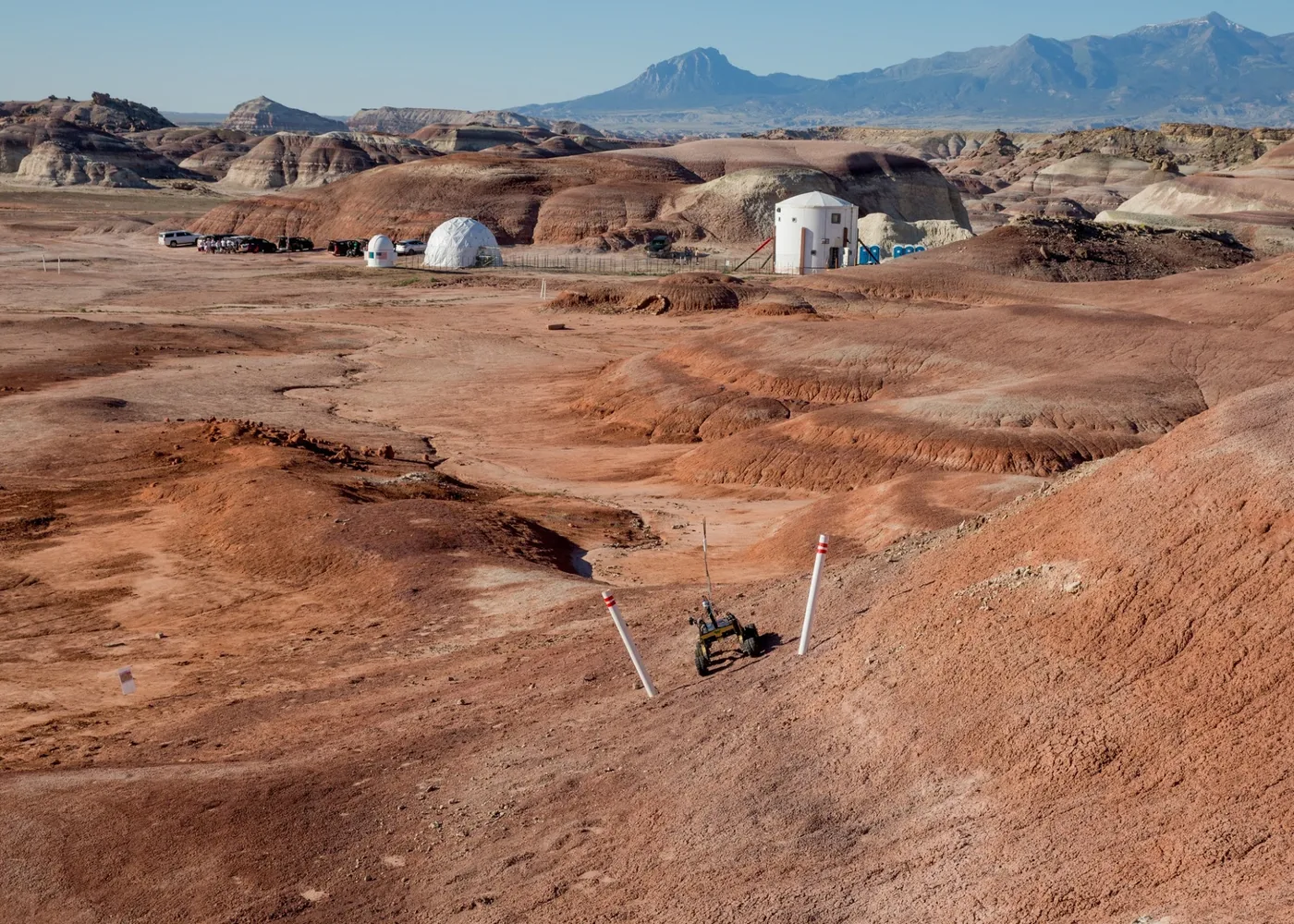
The University Rover Challenge is run by The Mars Society at the Mars Desert Research Station (MDRS), a simulated Mars habitat on Utah state land near Hanksville. Student teams design and build a rover, then operate it from a command and control (C2) station with no view of the course S-URC27-RULES §3.d.i. Everything the operators know about the site arrives through the rover: cameras, telemetry and a wireless link that is not guaranteed line of sight S-URC27-RULES §2.c.i.
The station sits at 1,309 m (4,295 ft) in high desert, with full daylight, frequent dust and summer heat up to 37.8 °C S-URC27-RULES S-URC-LOGISTICS §3.d.iii. None of it can be rehearsed on site: URC prohibits testing at MDRS before, during or after the event S-URC27-RULES §3.d.iv. Terrain and reliability therefore have to be proven at home, against an obstacle set the rules do not fully specify.
The season at a glance
Every date below is fixed in the 2027 rulebook S-URC27-RULES. The milestone that decides the season is the System Acceptance Review on 2027-03-05: it is scored and it controls entry.
| Milestone | Date | What it is | What it controls |
|---|---|---|---|
| Registration closes | 2026-10-30 | Declaring intent and team details | Eligibility (§3.a.i) |
| Preliminary Design Review (PDR) | 2026-12-02 | Project and design readiness, five pages | Readiness assessment, not scored (§3.a.ii) |
| System Acceptance Review | 2027-03-05 | Written and video package | 100 points, top 36 invited (§3.a.iii) |
| Communications documentation | 2027-04-30 | Devices, bands and operator licences | Compliance (§2.c.ii) |
| Science Plan | 2027-05-21 | Written plan for the Astrobiology Mission | Feeds the Astrobiology score (§1.b.i) |
| Rover Expense Report | 2027-05-26 | Expenses in work-breakdown format; update allowed 2027-06-02 | 10 % of total points per day late (§3.c.ii) |
| Finals | 2027-06-02 to 2027-06-05 | Four missions at MDRS | 4 × 100 points (§3.a.iv) |
The field schedule itself arrives about a week before the first field day, and the order of tasks is drawn per team, so two teams at the same event do not run the missions in the same order S-URC27-QA CQ4. Setup from C2 access is capped at 15 minutes and teardown at 10, and weighing and measuring happen inside the setup window S-URC27-RULES §1.a.ii §2.a.ii.
The four missions and the review
Each mission is worth 100 points and is scored on its own. The clock and the autonomy requirement differ sharply, which is what makes the four missions different engineering problems rather than one problem four times.
| Component | Clock | Points | Autonomy required | Drone |
|---|---|---|---|---|
| Astrobiology | 20–30 min plus 5 min cache removal | 100 | No | Not allowed |
| Delivery | 30–60 min, two stages | 100 | No | Allowed, optional |
| Equipment Servicing | 30 min | 100 | Autonomous typing only | Not allowed |
| Autonomy | 40 min, two sub-missions | 100 | 95 of the 100 points | Reconnaissance only, and it must land before route finding |
| System Acceptance Review | Desk submission due 2027-03-05 | 100 | No | No |
Mission scores are independent and cannot fall below zero, and penalties are additive fractions of the points earned rather than of the 100 available S-URC27-RULES §1.a.i. The formula, the worked penalty cases and the exact point value of each autonomy behaviour are on Missions and scoring.
The hard limits
These are the constraints that decide whether a rover competes at all. Each one is stated in the rulebook, and most carry a specific penalty S-URC27-RULES.
| Limit | 2027 value | Consequence |
|---|---|---|
| Mass per deployed configuration | 50 kg | 5 % of points earned per kilogram over, in each mission (§2.a.iii) |
| Mass of all fielded parts | 70 kg | Strict; parts are removed until the total is under (§2.a.iii) |
| Stowed size | 1.2 × 1.2 × 1.2 m, no disassembly | 40 % penalty at weigh-in (§2.a.ii) |
| Fielded equipment | $26,000 cap | Covers rover, modules, drone, EVA suit, base station and C2 (§3.c.iii) |
| E-stop | One red push button | Must stop movement and remove all battery power (§2.a.v) |
| Drone | 5 kg including dummy mass | Above it the drone cannot be used (§2.b.vii) |
| 900 MHz links | 8 MHz within three sub-bands | Applies to C2, rover, drone and astronaut links (§2.c.v) |
| Interventions | 20 % each | Additive, and the mission clock keeps running (§3.e.viii) |
| Setup and teardown | 15 min and 10 min | Weigh-in and measurement happen inside setup (§1.a.ii; §2.a.ii) |
The mass limit is measured, not declared
The rover is weighed and measured before every mission, and it may fold or articulate to fit but may not be disassembled S-URC27-RULES §2.a.ii. Weight is rounded down to the whole kilogram, so 50.9 kg records as 50 kg, but designing to that edge leaves no margin for a bracket or a cable added after the last weigh-in.
What changed for 2027
The comparison below is the working list for anyone converting 2026 knowledge into 2027 requirements. The 2026 column is reference only; the 2027 column is the rule S-URC27-RULES S-URC26-RULES.
| Change | 2026 | 2027 | Engineering consequence |
|---|---|---|---|
| Science becomes Astrobiology | One life detection plus a second capability of choice | Two life detections, at least one a bioassay | Payload mass, power, fluids and time-to-result all rise |
| Stratigraphic profile | Required photograph and discussion | Removed | Less camera reach and geology, more life detection |
| Autonomy | Seven static targets, 30 min | Astronaut assistance plus route finding, 40 min | Human detection and following, gesture recognition, rough-terrain route planning |
| Object recognition | Mallet, hammer and bottle detection | Deleted | Perception effort shifts from object detection to pose and gesture |
| Equipment Servicing | USB-C cable task | USB task removed, key-in-lock added | Finer manipulation, rotational compliance |
| Hose connector | Gasket removed | Gasket cut to half thickness | Push-on force is higher |
| Drone launch | From the rover or the start area | Designated field landing pad | The rover no longer carries the drone |
| Drone dummy mass | Waived above 24 km/h | Never waived | The 5 kg limit holds in all conditions |
| Mission adjacency | Equipment Servicing, then Autonomy | Autonomy, then Equipment Servicing, 10 minutes apart | Two configurations are weighed back to back |
| Fielded equipment cap | $24,000 | $26,000 | The EVA suit sits explicitly inside the cap |
| Rule numbering | Competition in §2, rover in §3 | Equipment in §2, competition in §3 | Every clause citation moves |
Two consequences are structural rather than incremental. The Autonomy Mission now rewards commanded human-robot interaction, and the command set (Follow, Stay, Fetch, Come, Give) with gesture recognition has no precedent in earlier URC rulebooks S-URC27-RULES S-URC27-QA AUQ11. At the same time the science payload doubled while the 50 kg limit and the 1.2 m cube stayed put, so the extra instrument mass has to come out of mobility, structure or modularity.
From clauses to requirements
The rulebook is written as competition clauses, not as specifications. The requirement set on this site translates those clauses into 155 testable statements, each traced to a rule clause or a Q&A ruling, and marks each one mandatory, scoring-driven or advisory S-URC27-RULES S-URC27-QA.
| Domain | Rows | What it covers |
|---|---|---|
| SYS | 14 | Mass, size, integration and configuration |
| MOB | 11 | Terrain, climb, stopping accuracy and payload |
| ARM | 21 | Reach, grasp, typing, key transfer and hose connection |
| SCI | 20 | Sample acquisition, life detection, cache and documentation |
| PWR | 9 | Endurance, E-stop behaviour and thermal limits |
| COM | 15 | Range, obstruction, spectrum and antenna geometry |
| CMP | 15 | Marker detection, astronaut detection and gesture |
| SFT | 19 | Localisation, route planning, following and abort behaviour |
| OPS | 12 | C2 station, setup time, roles and schedules |
| SAF | 8 | E-stop architecture and deployable safety |
| DRN | 11 | Drone mass, flight rules and airspace |
Mandatory clauses are the gates: mass, size, E-stop, spectrum, communications documentation and the review milestones. Most mission clauses are scoring-driven, where partial credit exists and the strategic question is where to spend effort. The full set, with trace and test method per row, is on 155 engineering requirements.
How to read this part
- Rules, limits and the field works the cross-mission envelope clause by clause, with the mass, size, spectrum, terrain and penalty rules in one place.
- Missions and scoring takes the four missions and the review apart, with the exact autonomy points and the penalty arithmetic.
- Review, judging and awards covers the PDR, the SAR rubric, the science and chemical safety plans, the expense report and the awards.
- The requirements, the Q&A record, the rule history, how the missions evolved and site and field constraints sit alongside those three.
How the 2027 material is dated
The rulebook was published in September 2026 and the Q&A used throughout this site is current to 2026-10-11. The 2027 PDR, SAR and Science Plan pages are not yet published, and each one says its requirements will follow. Where a 2026 value is used for scale, it is labelled as 2026 and never presented as a 2027 rule S-URC27-QA S-URC27-SAR-PAGE S-URC27-PDR-PAGE.
Sources for this page
- S-URC27-RULESUniversity Rover Challenge 2027 – Requirements and GuidelinesOriginal Archived copy
- S-URC-LOGISTICSURC LogisticsOriginal Archived copy
- S-URC27-QAURC2027 Questions & Answers (updated through 2026-10-11)Original Archived copy
- S-URC26-RULESUniversity Rover Challenge 2026 – Requirements and GuidelinesOriginal Archived copy
- S-URC27-SAR-PAGEURC2027 System Acceptance Review (page stub)Original
- S-URC27-PDR-PAGEURC2027 Preliminary Design Review (page stub)Original