Wisconsin Robotics
Wisconsin Robotics is the field’s clearest case of management discipline without engineering-rigour discipline. It publishes one repository per subsystem, a pinned container environment, an operator interface with full source and a working computer-aided-design to simulation pipeline. It has also finished 12th in both 2024 and 2026, across two near-total redesigns, and it failed to qualify in 2025. The public code contains no functional tests and almost no continuous integration, which is the other half of the explanation: good process buys a stable ceiling, and it does not buy mission points on its own.
What this team shows
- Process consistency produces a ceiling. Two complete redesigns, two 12th places, and the shape of the score changed completely underneath S-URC24-SCORES S-URC26-SCORES.
- The 2026 arm traded rotary joints for lead screws, a linear actuator and a gantry. Delivery rose from 10 to 40 and Equipment Servicing fell from 53 to 26.32, so the rank did not move.
- Offline terrain priors are an underrated autonomy strategy. A* over public LiDAR of the actual field earns points without a live mapping stack S-WISC-GITHUB-PATH-PLANNING.
- The 2025 absence was a qualification miss, not a decision to skip the season S-WISC-NEWS-2026.
Identity and results
| Year | Rover | Total | Rank | SAR | Science | Delivery | Equipment | Autonomy |
|---|---|---|---|---|---|---|---|---|
| 2022 | Daybreak | 80.17 | Not ranked | 80.17 | Not scored | Not scored | Not scored | Not scored |
| 2023 | Eclipse | 202.11 | 21 | 89.42 | 75.69 | 10 | 27 | 0 |
| 2024 | Nebula | 260.46 | 12 | 92.46 | 63.00 | 10 | 53 | 42 |
| 2025 | No entry | Not scored | Not ranked | Not scored | Not scored | Not scored | Not scored | Not scored |
| 2026 | Forward | 252.86 | 12 | 86.54 | 70.00 | 40 | 26.32 | 30 |
The 2022 entry was scored on the review alone and did not reach the field. The 2025 season ended at qualification, which the university’s own account describes as narrowly missing the cut. The 2026 result was 12th of 38 finalists, drawn from about 116 registered teams S-URC22-SCORES S-WISC-NEWS-2026 S-URC26-SCORES. No award is recorded in the window.
Rover generations
2016 to 2019: Insomnia, Ascent, Ascent MkII, Horizon. The named lineage runs from 2016. Little is published about these rovers beyond their names and years S-WISC-SITE-ROBOTS-LINEAGE.
2022: Daybreak. A six-wheel rocker-bogie with a vertical differential bar, chosen so the suspension could take heavy impacts without springs and dampers. Wheels were Kevlar and epoxy shells on aluminium spokes with rubber grousers, each driven by a geared brushed motor. The arm had six kinematically redundant joints with a 1.5 m reach and encoders at every joint, and the payload used a scoop, a funnel and LiDAR with a forward cliff sensor S-WISC-YOUTUBE-SAR-2022.
2023: Eclipse. The wheels became aluminium spokes with a Kevlar shell and integrated grousers on brushless drive with planetary gearboxes. The arm kept six degrees of freedom at 1.5 m and 5 kg. The science payload added five colorimetric tests, a modular turntable, a Raman spectrometer, a microscope and a moisture sensor on a linear actuator. A drone with an autopilot and a small companion computer added ArUco template matching, optical flow and simulation. The rover finished 21st with autonomy at zero S-WISC-YOUTUBE-SAR-2023 S-URC23-SCORES.
2024: Nebula. The best result in the record, 12th with Equipment Servicing at 53 and Autonomy at 42. No review film was located for this season, so the design is known only through scores and later references. The 2026 film describes the split wheel design and the modular power distribution as carried over rather than new S-URC24-SCORES S-WISC-YOUTUBE-SAR-2026.
2026: Forward. A near-total redesign: a new arm, a new rocker and a new drive, an electrical overhaul with modular boards and an interface, and a methane sensor fabricated in house and added to the fluorometry system S-WISC-NEWS-2026.
Subsystems
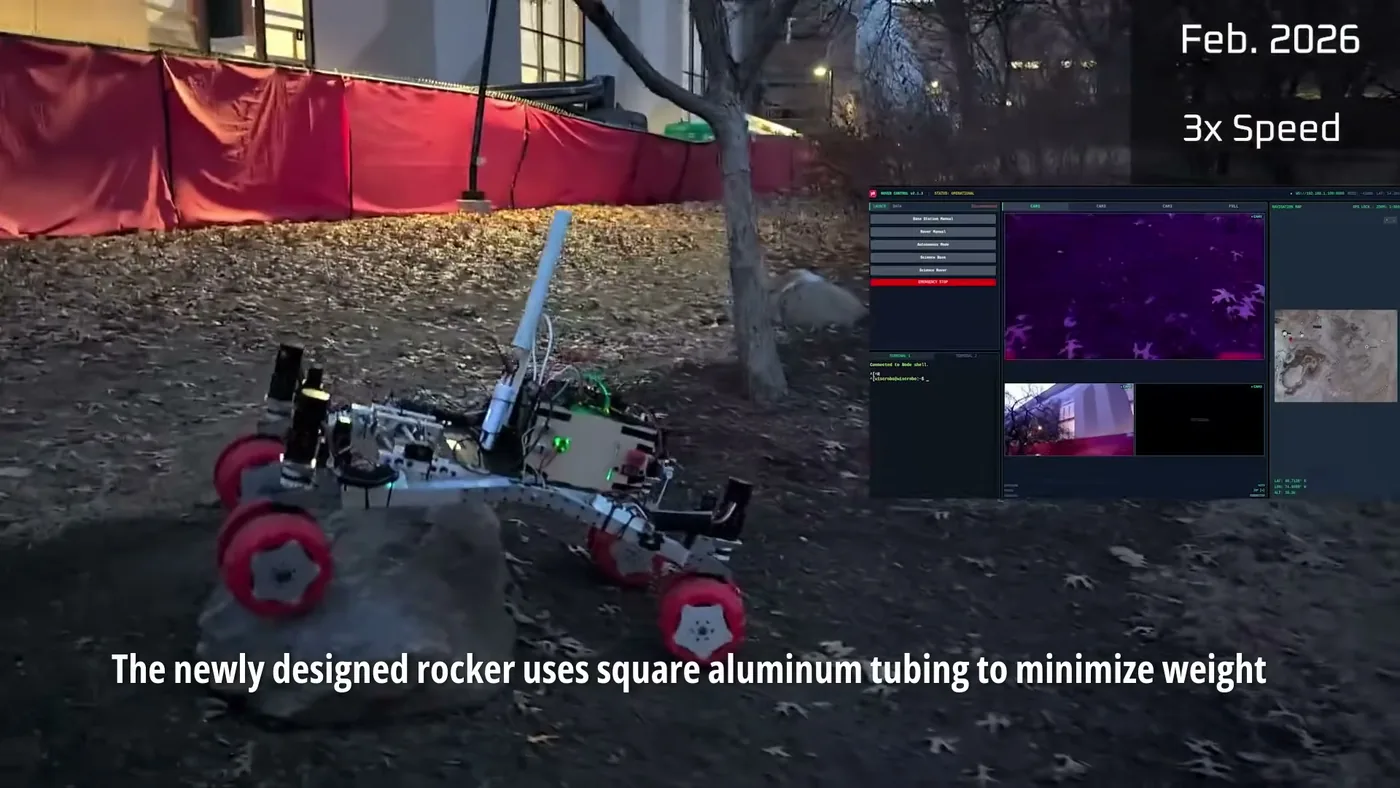
Mobility. A six-wheel rocker-bogie with a vertical differential bar, rebuilt in 2026 from square aluminium tubing with an angled profile to raise ground clearance while cutting stress concentrations. The 2026 drive moves each drive motor alongside a swerve motor, which reduces weight, stack-up and wiring. Whether every wheel steers, and how a rocker-bogie coexists with swerve modules, is the single most important unpublished fact about this rover S-WISC-YOUTUBE-SAR-2026.
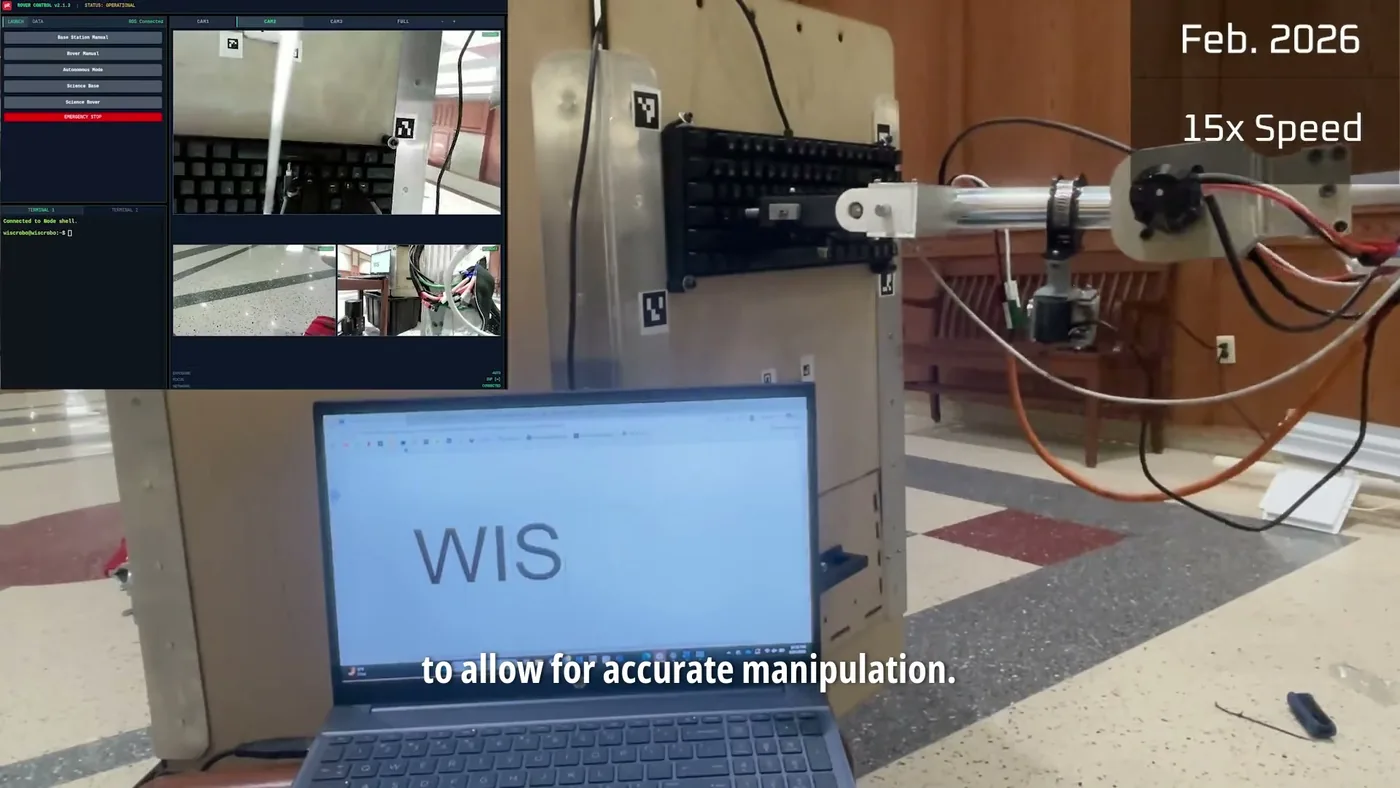
Arm and end-effector. The 2022 and 2023 arms were six-degree-of-freedom, kinematically redundant, 1.5 m long and rated to 5 kg, with encoders and current limits at every joint. The 2026 arm is a different machine: lead screws and a linear actuator for position control, a vertical axis on a gantry cart driven by a gear plate, a differential gearbox and a lead-screw claw, plus soft grippers for large irregular objects. The team’s stated reason is reliability for two-dimensional tasks such as the keyboard and the universal port S-WISC-YOUTUBE-SAR-2022 S-WISC-YOUTUBE-SAR-2026.
Science. The 2026 payload uses a sheath auger drill with tubing that carries soil into a cache pre-loaded with assay solution, so a sample can be tested without rotating the carousel. The carousel holds up to six samples, two shielded for fluid containment and one with a magnetically sealing lid, with peristaltic pumps moving fluid through the fluorometer. The fluorometer reads 598 nm emission for proteins and 523 nm for DNA fragments, and a semiconductor methane sensor fabricated from scratch sits above it on a heating unit. The 2023 Raman spectrometer, microscope and five-test colorimetric suite do not appear in the 2026 narration S-WISC-YOUTUBE-SAR-2026.
Communications. The 2026 rover runs two radios, 5 GHz and 900 MHz, with the network divided into essential and non-essential systems so that motor control and the central camera survive a degraded video link. That is the cleanest graceful-degradation design in this tier. The radio models, power, gain and range are not published, and the visible antenna marking is not enough to identify the unit S-WISC-YOUTUBE-SAR-2026.
Power and electrical. The team retained a modular power distribution system and redesigned every board for consolidation and protection. Named features include reverse-polarity protection, transient-voltage suppression, a reservoir capacitor bank and an active inrush-current limiter on a timer for a controlled power-up. The headline change is a move from off-the-shelf modules to a fully custom buck converter. An emergency stop cuts power to the drive system, and the interface carries a software emergency stop as well S-WISC-YOUTUBE-SAR-2026.
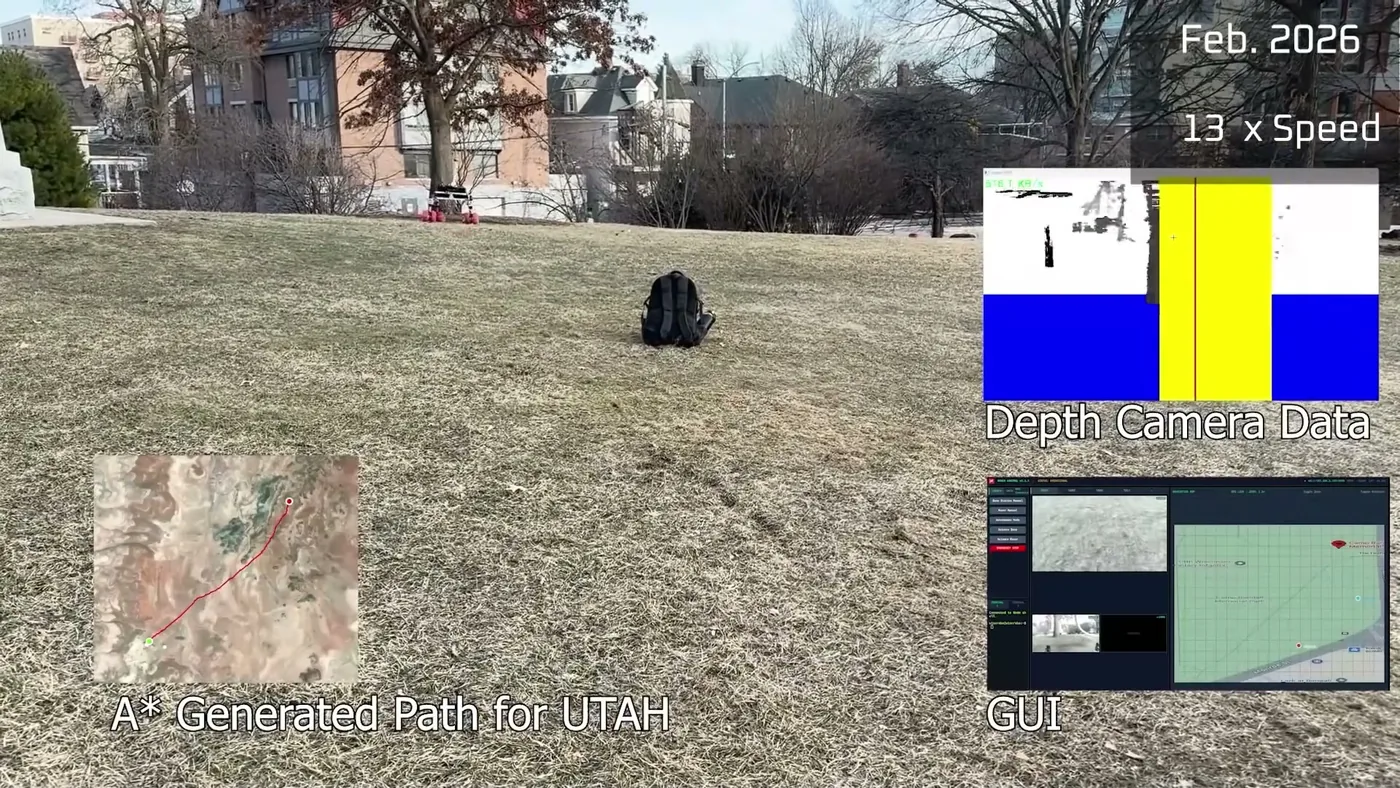
Software and autonomy. ROS 2 Humble in a pinned multi-service container environment, with Windows and WSL2 instructions, a workspace import file and pre-commit checks. The path-planning server builds a traversability graph from public point-cloud data of the Utah field, runs A* with geodesy, and can merge several tiles offline. In the field the rover plans a route and the interface shows the current position and computed path on a map. ArUco search follows an Archimedean spiral with 4 m between turns, 0.5 m waypoints and a 20 m radius, then decelerates continuously and stops within 1 m with an LED signal S-WISC-GITHUB-PATH-PLANNING S-WISC-YOUTUBE-SAR-2026.
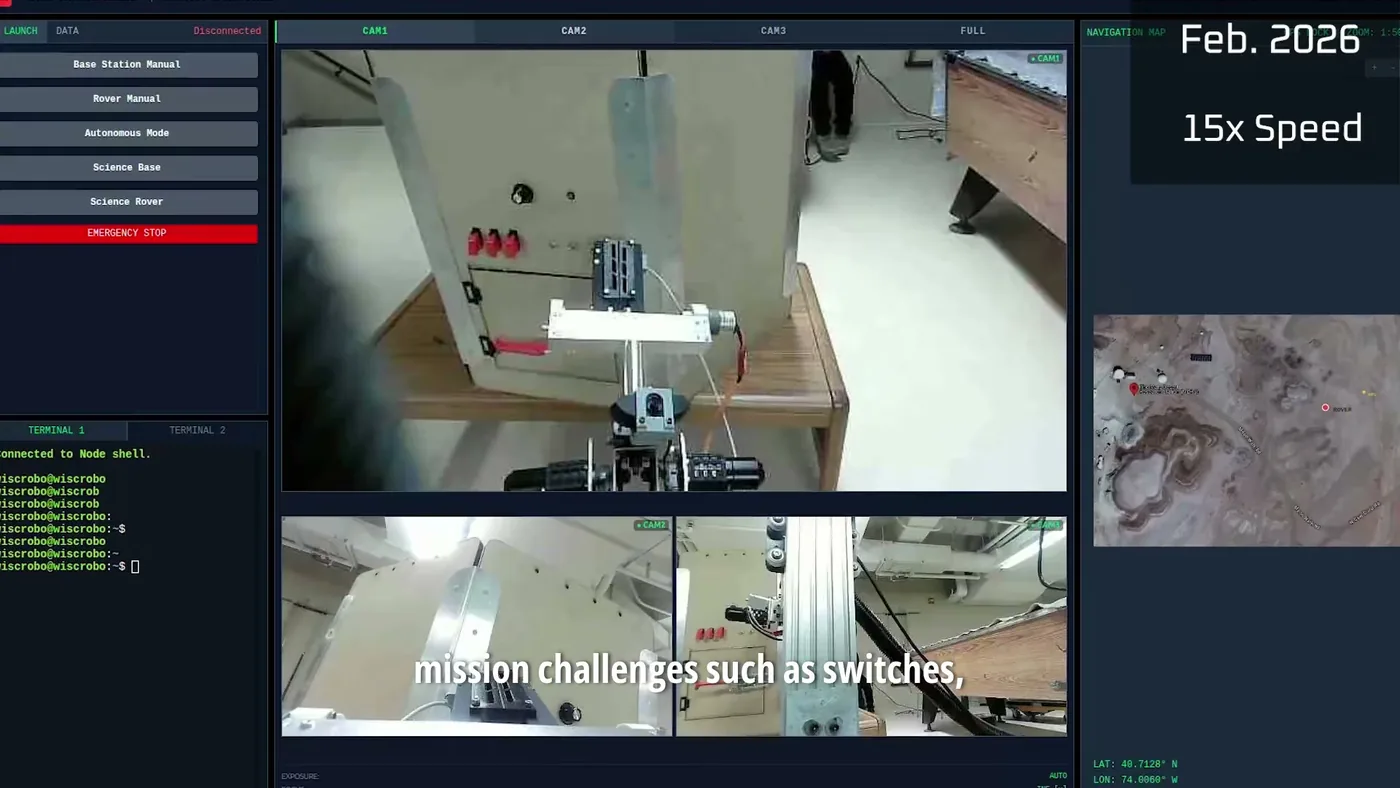
Operations. The operator interface is a four-panel resizable application with launch and data tabs, five mission-mode buttons, camera tiles, two terminal panes and a navigation map built from pre-downloaded map chunks rather than a live service. That offline choice is deliberate and it matters at a remote site S-WISC-GITHUB-GUI S-WISC-YOUTUBE-SAR-2026.
Mission performance
The 2022 season is a review-only entry, and the 2023 season is the first contested one: 21st with autonomy at zero and Delivery at 10. The 2024 season is the breakthrough, with Equipment Servicing at 53 and Autonomy at 42 for the first time S-URC22-SCORES S-URC23-SCORES S-URC24-SCORES.
The 2026 season is the most instructive. Delivery rose from 10 to 40 and Science from 63 to 70, while Equipment Servicing fell from 53 to 26.32 and Autonomy from 42 to 30. The total fell by 7.6 points and the rank stayed at 12th. In the same season fifth place was 375.89, so the missing points sit 123 points above the team and concentrate in the two manipulation missions S-URC24-SCORES S-URC26-SCORES.
The qualification miss in 2025 is the other fact that matters. A missed cut costs a whole season of a short record and forces the next rover to be a redesign rather than an iteration, which is exactly what 2026 became S-WISC-NEWS-2026.
Lessons for a first build
- Reproducible environment beats test quantity, but neither is sufficient. A pinned container environment and pre-commit checks coexist with zero functional tests and almost no continuous integration, and the results plateau.
- Make the network degrade gracefully. Splitting essential from non-essential traffic across two radios keeps motor control alive when video falls over.
- Plan from public terrain data. A* over public point clouds of the venue is testable before the rover moves and earns autonomy points without a live mapping stack.
- Monthly mock competitions are cheap. A self-built lander with switches, ports and a keyboard, plus a 5 kg test mass, is a reproducible rehearsal any first-year team can copy.
- Publish what is reusable. The operator interface with full source is the most valuable artefact this team releases. The empty successor repository and the zero-issue backlog are what happens when review happens outside the public record.
- Qualification is a design requirement. A missed cut costs a season and converts the next build from an iteration into a redesign.
What remains uncertain
Mass, wheel diameter and width, wheelbase, track, the 2026 arm’s reach, battery and power budget are not published. How many wheels steer, and how swerve coexists with a rocker-bogie, is unresolved. Radio models and range are not identifiable from the frames. No 2024 review film was located, so the best result is known only from scores and later references. No evidence exists for the 2025 season at all. The 2026 arm’s lead-screw axes make its reach and payload hard to compare with the 1.5 m and 5 kg of the rotary arms.
Team sources
- wisconsinrobotics.org, the team site with the rover lineage and sub-team pages.
- wisconsinrobotics on GitHub, the season, subsystem and interface repositories.
- Current season repository, the rover software tree.
- Operator interface, the published ground station.
- 2026 review film, the source of every frame on this page.
- University report, 2026, the qualification miss and the redesign list.
Sources for this page
- S-URC24-SCORESURC2024 Official ScoresOriginal
- S-URC26-SCORESURC2026 Official ScoresOriginal Archived copy
- S-WISC-GITHUB-PATH-PLANNINGWRoverSoftware_25-26, wr_path_planning: ROS 2 path-planning server, A* over LAZ point clouds, EPSG geodesy, laz_merge.pyOriginal
- S-WISC-NEWS-2026Wisconsin Robotics Moves Forward in University Rover Challenge (12th of 38 finalists of 116; 2025 qualification miss; 2026 redesign list; lead names)Original
- S-URC22-SCORESURC2022 Official ScoresOriginal
- S-WISC-SITE-ROBOTS-LINEAGEForward (URC 2026, current), Nebula (2024), Eclipse (2023), Horizon (2019), Ascent MkII (2018), with "URC since 2016". Each has a "Watch SAR" …Original
- S-WISC-YOUTUBE-SAR-20222022 SAR, 5:03.Original
- S-WISC-YOUTUBE-SAR-20232023 SAR, 4:47.Original
- S-URC23-SCORESURC2023 Official ScoresOriginal
- S-WISC-YOUTUBE-SAR-2026"SAR 2026 URC (with captions), Wisconsin Robotics", 4:50.Original
- S-WISC-GITHUB-GUI"The graphical user interface for controlling the Rover. Contains video stream, map an[d]…", the operator interface, which most teams never pu…Original