Delivery mission
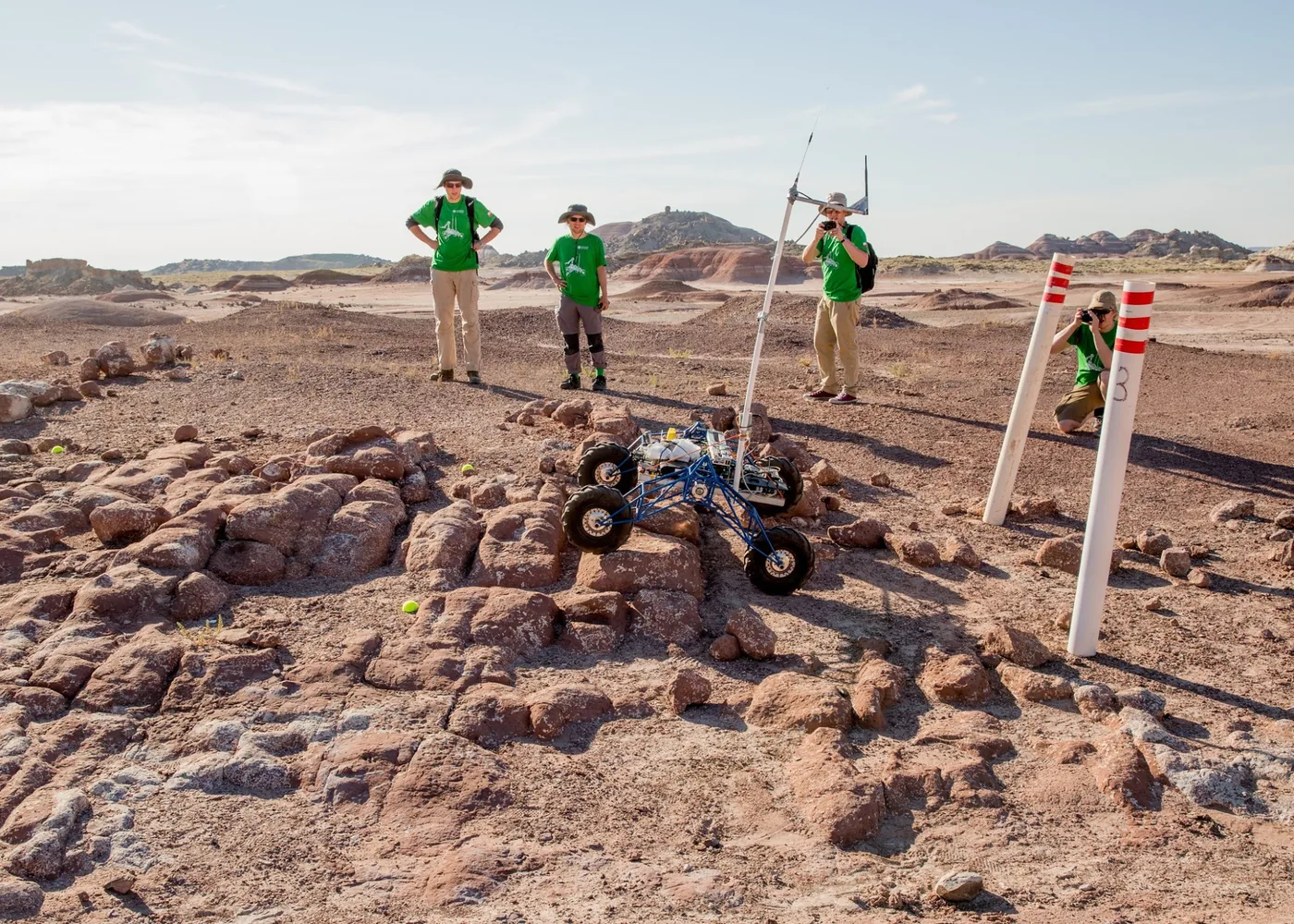
Delivery is the mission where time, terrain and a gate interact. A 5 kg object, smaller than 40 cm on each side, travels up to a kilometre over sand, gravel, boulder fields, vertical drops and steep loose slopes, with line of sight lost for more than half of the course. The gate, not the terrain, is what breaks seasons.
Key takeaways
- The gate is the physics. A fixed Stage-1 clock plus a minimum Stage-1 score means the rate at which the first tasks are banked matters more than total capability. In 2023, 14 of 31 teams scored exactly 15 S-URC23-SCORES.
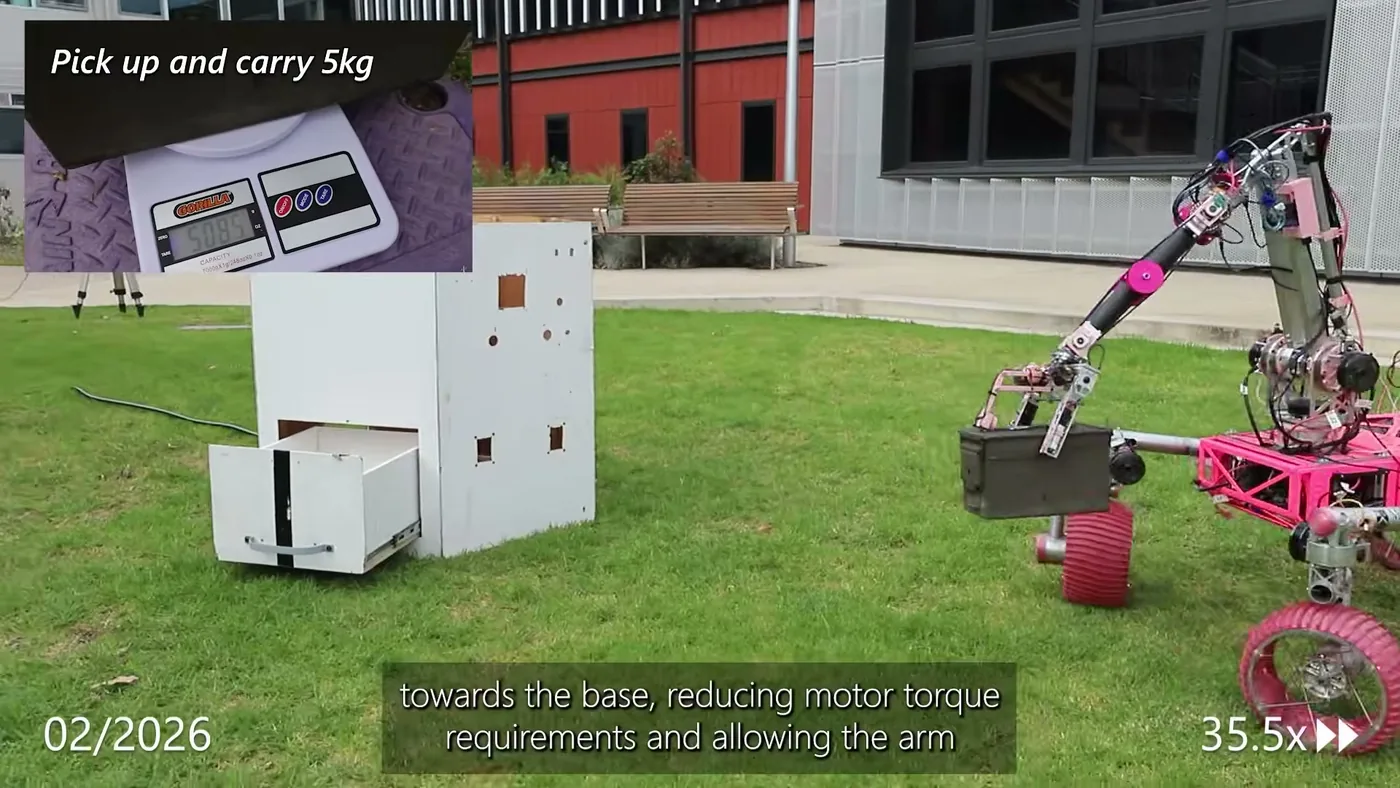
- The lift is cheap; the retention is not. A 5 kg object at 0.5 m needs about 25 N·m at the shoulder, by inference. What fails is the grip over rough ground, not the motor.
- Speed is a mission requirement. Two kilometres of driving at 1 m/s is 33 minutes of a 30–60 minute mission, and at 0.5 m/s the drive alone is longer than the mission. The practical target is 1.0–1.5 m/s on flat gravel and 0.4–0.6 m/s on a 25–30° slope.
- 2027 leaves most of this valid. The marked-path task is removed, while the object envelope, the 5 kg mass, the 1 km course, the out-of-sight requirement and the drone option are unchanged. What is missing is the task list and the Stage-1 minimum.
What the mission physically demands
| Demand | Number | Basis |
|---|---|---|
| Object mass | 5 kg or less per object | S-URC27-RULES §1.c.iii |
| Object envelope | Smaller than 40 × 40 × 40 cm | S-URC27-RULES §1.c.iii |
| Grasp feature | 7.5 cm diameter or less, as a handle or a natural feature such as a rock edge or a shaft | S-URC27-RULES §1.c.iii |
| Lift moment implied | About 25 N·m static at the shoulder for 5 kg at 0.5 m | Arithmetic, by inference |
| Course range | Up to 1 km from the start gate; the total path may exceed 1 km | S-URC27-RULES S-URC27-QA §1.c.ii RQ13 |
| Line of sight | Not guaranteed for more than half the course, and later tasks are deliberately out of sight | S-URC27-RULES §1.c.ii §3.d.ii |
| Terrain | Soft sand, gravel, rough stony areas, rock and boulder fields, vertical drops and steep loose slopes; the Q&A adds vertical faces | S-URC27-RULES S-URC27-QA §1.c.ii DQ1 |
| Terrain limits | No numeric slope or step limit is published | S-URC27-QA AUQ17 |
| Speed implied | 2 km at 1 m/s is 33 minutes; 0.5 m/s makes the drive alone longer than the mission | Arithmetic, by inference |
| Placement tolerance | Not published for 2027; the 2026 rule required the object to rest within 20 cm with no rover part touching | S-URC26-DM as a 2026 reference |
| Stage structure | A fixed time per stage, a specified Stage-1 minimum that gates Stage 2, and leftover Stage-1 time transferred forward | S-URC27-RULES §1.c.i |
| Autonomy | Not required; teleoperation is legal for the whole mission | S-URC27-RULES §1.c |
| Drone | Allowed and pad-launched, at 5 kg or less including a dummy mass; full points are possible without one | S-URC27-RULES §2.b.i §2.b.iv–vii |
| Mini-rover | Prohibited | S-URC27-RULES §1.c.i |
What the best teams did
Delivery is the most volatile mission in the record: mean 23.6, median 15.0, 15 % zeros and only 4 % of scores at 80 or above. The distribution is bimodal rather than graded, because a slow start produces 0–20 and a competent run produces 50–80.
| Year | Teams | Mean | Median | Exact 0 | Exact 15 | Scores ≥80 | Maximum | Top-10 mean |
|---|---|---|---|---|---|---|---|---|
| 2022 | 26 | 25.1 | 22.5 | 8 | 2 | 2 | 80 | 43.0 |
| 2023 | 31 | 15.9 | 15.0 | 2 | 14 | 1 | 90 | 28.0 |
| 2024 | 34 | 22.9 | 15.0 | 2 | 5 | 1 | 80 | 37.9 |
| 2025 | 35 | 30.9 | 30.0 | 1 | 1 | 1 | 80 | 56.5 |
| 2026 | 36 | 22.9 | 18.0 | 12 | 0 | 1 | 100 | 56.2 |
Derived from the official mission column in the five result sheets S-URC22-SCORES S-URC23-SCORES S-URC24-SCORES S-URC25-SCORES S-URC26-SCORES. The 2023 cluster at exactly 15 is the Stage-1 gate: one or two cheap tasks banked, then a time-out.
| Team | 2022 | 2023 | 2024 | 2025 | 2026 | The lesson |
|---|---|---|---|---|---|---|
| Missouri S&T | 80 | 15 | 15 | 70 | 100 | Three seasons to close one gap: object search and grasp inside the clock |
| Monash | 70 | 15 | 80 | 71 | 76 | 2023 was a pure search-and-recognition failure |
| West Virginia | 42.5 | 90 | 52 | 80 | 61 | 90 was double the next-best, built on an 8 kg lift and a large workspace |
| UIU | 18.75 | 45 | 30 | 35 | 62 | The 2026 jump follows a mobility and arm rebuild |
| Michigan | 80 | 15 | 15 | 30 | 44 | Champion in 2022, then two 15s, with no public explanation |
| BRACU | did not enter | 15 | 15 | 22 | 61 | 15 to 61 in four seasons, through a communications rebuild |
Official Delivery column, from the five result sheets S-URC22-SCORES S-URC23-SCORES S-URC24-SCORES S-URC25-SCORES S-URC26-SCORES; BRACU’s first recorded Delivery entry is 2023.
The clearest transferable lesson from the best Delivery runs is time management. West Virginia’s 2023 search discipline, which covered the search area from an overhead map and kept a detection window open to the last 90 seconds, and Missouri S&T’s 2026 run both came from a reliable wrist camera and a rehearsed order of tasks, not from unusual hardware S-WVU-SAR2023 S-MST-SITE-ATHENA.
Does 2027 invalidate it
Mostly no, with one planning caveat.
- Removed: the marked-path task, “follow a marked path that requires precise maneuvering over a designated terrain feature”, is absent in 2027 S-URC26-RULES S-URC27-RULES §1.c.iii §1.c.iii. That removes one path-following family. It does not reduce the terrain requirement, because reaching the objects still means crossing the same terrain list.
- Unchanged: the object envelope, the 5 kg mass, the 1 km range, the out-of-sight requirement, the approximate GNSS locations, scoring on the correct object at the correct location with partial credit, the drone option and the mini-rover prohibition S-URC27-RULES §1.c.
- Not yet published: the stage durations, the Stage-1 minimum and the task list, all of which the rulebook defers to a document published before the competition S-URC27-RULES §1.c.i. A team training to the 2026 timing of 35 minutes and 20 minutes with a 40-point gate may be training to the wrong clock S-URC26-DM as a 2026 reference. The capability transfers; the rehearsal timings must be set when the task list lands.
Verdict: the approach carries forward with a raised planning risk. The design implication is not a different rover but a rehearsed gate, run as a sequence of bankable tasks with an abandon rule, and re-timed once the 2027 task list is published.
Which subsystem options serve it
| Decision | Option A applies when | Option B applies when |
|---|---|---|
| Mobility | Six-wheel passive rocker, printed wheels and skid steer: the field default and the safest first build | Four wheels when mass binds and the terrain is mostly gravel and sand |
| Arm | A two-finger 100–110 mm jaw, current-limited, with swappable tips, plus a hook or pin | A dedicated cargo hook when the object’s centre of gravity is unpredictable |
| Communications | 2.4 GHz primary and 900 MHz recovery, the only combination that survives intentional loss of sight | A 5.8 GHz third band for video when most of the course is in sight |
| Search | A wrist or mast camera with a YOLO-class detector | A drone when the search area dominates the clock and a pilot and spotter pair exists |
| Drone | Flown only after 20 sorties with the dummy mass in wind | Left at home: full points are possible without one, and Missouri S&T’s 2024 drone never flew |
| Load handling | The object stowed for the traverse, keeping the centre of gravity low | Carried in the gripper only for short moves, with a carry-pose lock |
Minimum viable versus stretch
- The minimum that scores: reach the course and complete one Stage-1 task, such as reading a sign, opening a lid, pushing a button or moving a small object. Teleoperation is legal.
- The minimum that passes a gate: two or three of those banked in the first third of Stage 1, which needs a known task order. The mitigation is to rehearse a generic fast opening, then resequence when the 2027 list publishes.
- The stretch: every task, with the correct object at the correct location, including a 5 kg load over rock, a large-area search and a later task beyond radio line of sight. On the 2026 task set that was worth 100 to one team.
Risks to retire early
| Risk | Why it is real | The test that retires it | Lead time |
|---|---|---|---|
| Stage-1 time-out | 14 of 31 teams at exactly 15 in 2023; Missouri S&T ran out of time in Stage 1 S-URC23-SCORES S-MST-NEWS2023 | A timed mock Stage 1 with an abandon rule; three bankable tasks inside one third of the clock, five runs in a row | 4 months |
| Object not found | Missouri S&T could not locate a specific rock through its cameras in 2023; Monash scored 15 on the same task S-MST-NEWS2023 S-MONASH-IEEE-RAM | Detection-range test with judge-like objects at 5, 10 and 20 m in sun; a sweep that covers the area inside one third of the clock | 3 months |
| Dropped or misplaced 5 kg object | ARES demonstrated a 10.4 kg lift, so the risk is retention rather than strength S-ARES-SAR26 | Twenty-metre carry over rock with a 5 kg mass; no slip and a stable jaw current in 20 of 20 runs | 3 months |
| Link loss out of sight | West Virginia measured 750 m in sight against 164 m out of sight in 2026 S-WVU-SAR2026 | A deliberate drive behind a hill on the 900 MHz band alone, with a recovery switch under 10 seconds | 4 months |
| Stuck or rolled rover | Judges describe rovers driven into gulleys and flipped over S-URC-ADVICE | Twenty traverses of a local rock field with no stuck event longer than 60 seconds | 5 months |
| Arm fails under driving loads | Missouri S&T lost a vertical axis under driving in 2024; West Virginia had an over-torque cascade in 2023 S-MST-NEWS2024 S-WVU-YT-DOORFAIL | Two hours of rough driving with the arm installed, logging strain and current | 4 months |
| Drone not flyable on the day | Missouri S&T’s 2024 drone was kept on the ground by complications S-MST-SITE-HYPERION | Twenty sorties with the dummy mass in wind, plus a pad-launch rehearsal | 3 months |
| Placement outside tolerance | The 2026 rule was 20 cm with no rover part touching S-URC26-DM | Place-and-withdraw against a 5 cm ring, 18 of 20 runs inside the tighter of the 2026 and 2027 tolerances | 3 months |
What is not published
- The 2027 stage durations and the Stage-1 minimum, so a gate rehearsal cannot yet be timed.
- The 2027 task list, so the points per minute of each task cannot be ranked.
- The 2027 placement tolerance.
- Any numeric slope or step limit for the course, which means the obstacle set has to be chosen and measured locally.
Further reading
- Mobility sizes the speed and the terrain capability this mission needs.
- Arm and end-effectors covers the jaw, the retention problem and the lift.
- Delivery, payload handling and drones is the synthesis for the drone option, which has no dedicated study behind it.
- Missouri S&T, Monash, West Virginia and BRACU carry the Delivery evidence.
- What 2027 invalidates places the removed marked-path task beside the other changes.
Sources for this page
- S-URC23-SCORESURC2023 Official ScoresOriginal
- S-URC27-RULESUniversity Rover Challenge 2027 – Requirements and GuidelinesOriginal Archived copy
- S-URC27-QAURC2027 Questions & Answers (updated through 2026-10-11)Original Archived copy
- S-URC26-DMURC2026 Delivery Mission Course rules (used only as a 2026 proxy; not a 2027 rule)Original
- S-MONASH-SAR2026Monash Nova Rover, URC SAR 2026 (video, 5:09)Original
- S-URC22-SCORESURC2022 Official ScoresOriginal
- S-URC24-SCORESURC2024 Official ScoresOriginal
- S-URC25-SCORESURC2025 Official ScoresOriginal
- S-URC26-SCORESURC2026 Official ScoresOriginal Archived copy
- S-WVU-SAR2023Team Mountaineers System Acceptance Review 2023 (rover "Wanderer"): Cambium PTP 450 900 MHz link, 850 m LOS / 300 m NLOS, 2 m telescoping mast, drone 900 MHz + 2.4 GHzOriginal
- S-MST-SITE-ATHENAAthena (2026) rover page, compact suspension, 3D-printed wheels, hub motors, STM32/CAN controllers, simulator arm, LiDAROriginal
- S-URC26-RULESUniversity Rover Challenge 2026 – Requirements and GuidelinesOriginal Archived copy
- S-MST-NEWS2023MRDT Winter 2023 Newsletter (PDF, 4.2 MB), URC 2023 review (belt break, Stage-1 delivery failure, rain delay) and 2024 design intentOriginal
- S-MONASH-IEEE-RAMA Tale of Two Rovers: How Different Philosophies Foster Innovation in the 2023 University Rover ChallengeOriginal
- S-ARES-SAR26ARES Project, URC 2026 System Acceptance Review (video)Original
- S-WVU-SAR2026Team Mountaineers System Acceptance Review 2026 (rover "Deimos"): tri-modal 2.4 GHz + 5.8 GHz + 70 cm, gimbal camera on antenna mast, 750 m LOS / 164 m NLOS high-noise test, antenna + radio budget linesOriginal
- S-URC-ADVICEURC Advice (judges' systems-engineering lessons)Original Archived copy
- S-MST-NEWS2024MRDT Newsletter Winter 2024–25 (PDF, 7.5 MB), URC 2024 review with failure forensics, 2025 design update, 88 active membersOriginal
- S-WVU-YT-DOORFAILFailure: Wanderer Struggled to Close a Door with a Broke Arm and Under Strong Wind During URC 2023Original
- S-MST-SITE-HYPERIONHyperion (2024) rover page, Cartesian arm, all-spectroscopy science, first drone Zephyr, C++ autonomy, managed switchOriginal