KNR Rover Team (Warsaw University of Technology)
KNR builds the best-written rover in the field, and one of the least dexterous. Its review score was third of 35 teams in 2025 and second of 36 in 2026, at 96.63, beaten only by West Virginia’s 96.75. Its Equipment Servicing score across four finals is 8, 22, 10 and 10.53. The 2026 season is the year both facts landed at once: ninth place overall, the team’s best URC finish, on the back of an autonomy score of 44 where the previous season had zero.
What this team shows
- The written review gates a team; it does not rank it. A 96.63 review and a 10.53 servicing score can coexist in the same rover S-URC26-SCORES.
- Interchangeable mission modules, a manipulator, a drilling station and a science station, let one chassis serve four missions and let sub-teams work in parallel.
- Autonomy went from zero to 44 in one season on the same rover generation, which is evidence that the score tracks team composition more than hardware.
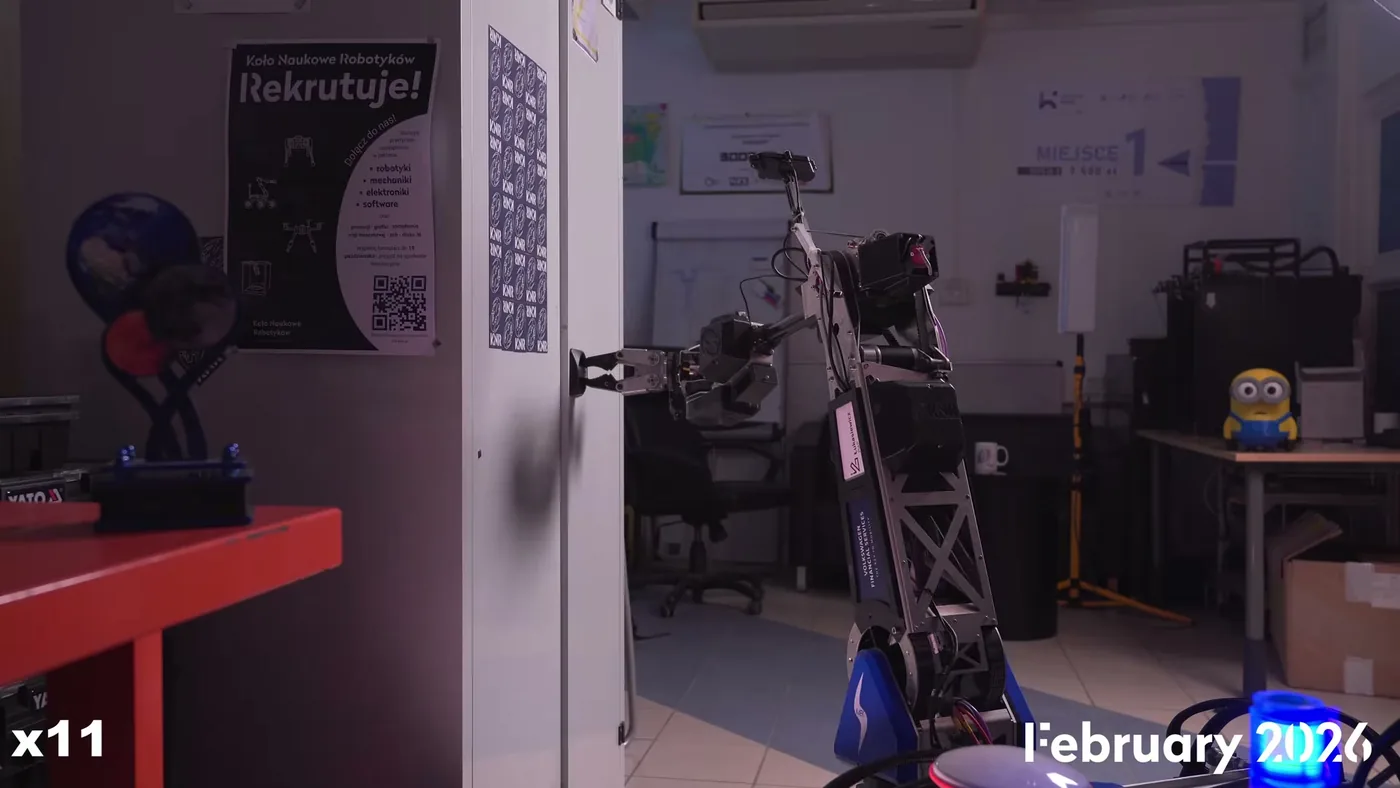
- The unbroken weakness is manipulation. Equipment Servicing has never exceeded 22 in four finals, while the same arm is demonstrated on a door handle in the team’s own film.
Identity and results
| Year | Rover | Total | Rank | SAR | Science | Delivery | Equipment | Autonomy |
|---|---|---|---|---|---|---|---|---|
| 2018 | HAL-062, first generation | 172.49 | 32 | 78.58 | 73.91 | 12 | 8 | 0 |
| 2019 | HAL-062 | 214.35 | 21 | 85.35 | 87 | 20 | 22 | 0 |
| 2025 | HAL-062, fourth iteration | 208.78 | 28 | 93.78 | 90 | 15 | 10 | 0 |
| 2026 | HAL-062 | 274.91 | 9 | 96.63 | 90 | 33.75 | 10.53 | 44 |
The 2020 and 2021 competitions ran without a finals field, and the team’s own record describes an entry in each S-KNR-HAL S-URC-HISTORY. It registered for 2022 and 2023 without a result row, and did not register in 2024 S-URC22-TEAMS S-URC23-TEAMS S-URC24-TEAMS S-URC22-SCORES S-URC23-SCORES.
The written review is the strongest column by a wide margin: 78.58, 85.35, 93.78 and 96.63, a monotonic climb across four appearances. Science is nearly as stable at 73.91, 87, 90 and 90. Everything mechanical is a floor: Delivery 12, 20, 15 and 33.75; Equipment 8, 22, 10 and 10.53 S-URC25-SCORES S-URC26-SCORES.
Rover generations
HAL-062. One name across the whole record, in its fourth iteration by 2024 and still the current platform in 2026 S-KNR-HAL. The team publishes no generation history beyond the iteration count, so the design lineage is inferred from the score sheet and the review films.
2018 and 2019. A young team with a working chassis and little else. Delivery and Equipment both in single digits or low twenties, autonomy zero, and the review already the strong half S-URC-HISTRESULTS.
2025. Re-entry after a five-season gap: 28th, with Science 90 and a third-best review in the field, but Delivery 15, Equipment 10 and Autonomy 0 S-URC25-SCORES. Against the 2025 field medians of about 30 in Delivery, 27 in Equipment and 28 in Autonomy, the team was at roughly half the field median in every mechanical mission.
2026. Autonomy 0 to 44 and Delivery 15 to 33.75, above the 2026 field median of about 18 S-URC26-SCORES. Equipment stayed at 10.53. Two missions working instead of one moved the team 19 places.
Subsystems
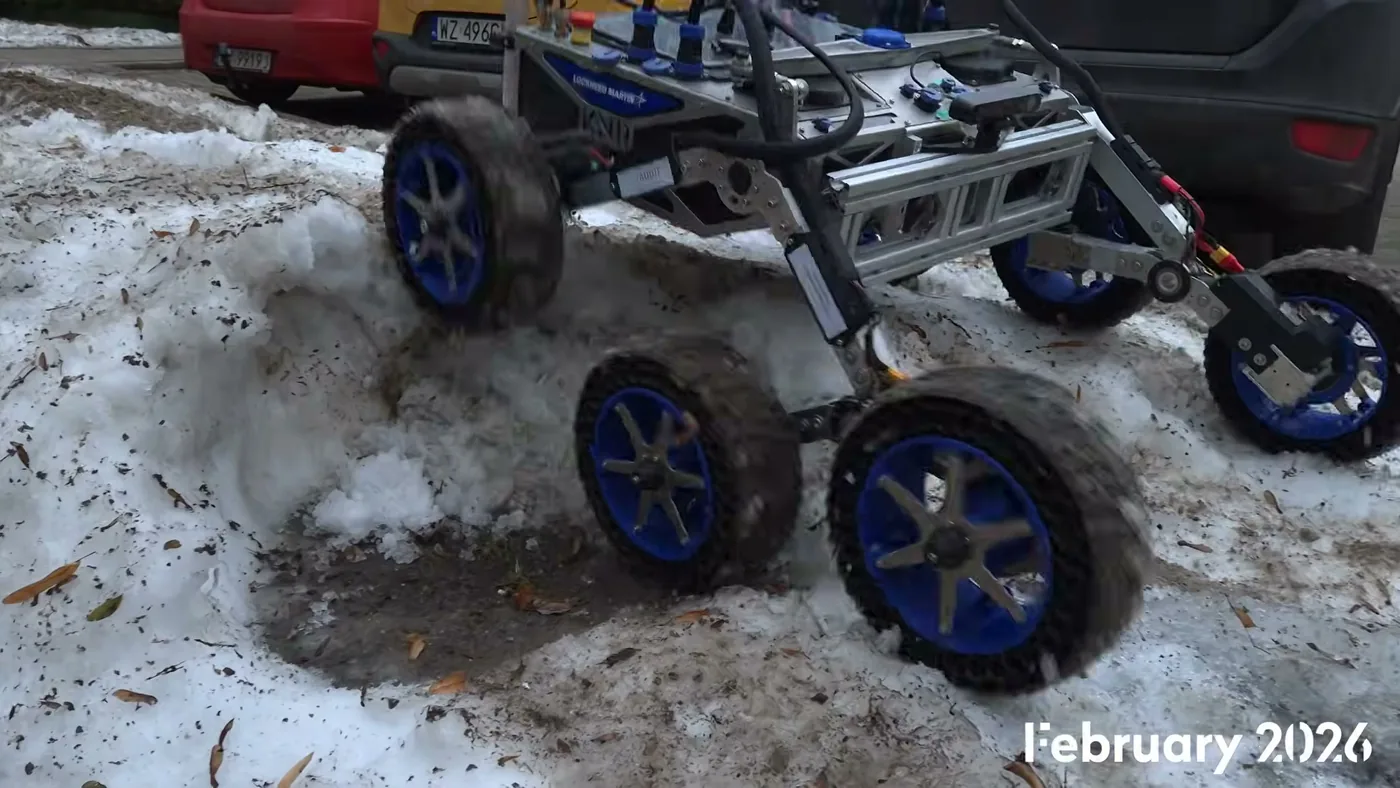
Mobility. In the team’s own words: solid aluminium construction, rocker-bogie suspension and differential drive S-KNR-HAL. The 2026 film adds detail: a ladder frame in bolted aluminium T-slot extrusion with laser-cut plate gussets, six wheels on blue spoked hubs with wide knobbly pneumatic tyres, and a machined rocker-bogie link per side carrying a top-mounted electronics plate. Skid steering, with no steering actuator described anywhere. Wheel diameter, motor model and gearbox ratio are unpublished.
Manipulation. A six-axis manipulator with a parallel two-finger gripper, and a set of interchangeable operational modules: the manipulator itself, a drilling station and a science station, with a drone landing station under development in 2025 S-KNR-HAL. The 2026 film shows a tall two-link arm with a box-truss upper link, a wrist camera above the end effector, and a grasp demonstrated on a door handle in a workshop rehearsal.
Science. A dedicated science department and a science module are named, with Science scoring 90 in both 2025 and 2026 S-KNR-HAL S-URC26-SCORES. The instruments themselves are unpublished.
Communications. A long-range analogue camera system lets the team drive the rover without keeping it in sight, which the team states as a design requirement rather than a feature S-KNR-HAL. That is the unmanned-operation requirement that many teams discover only at the field. Radio model, band and power are unpublished.
Autonomy. Decisions are made dynamically through a depth-camera vision system, with an inertial unit and satellite positioning described as optional add-ons S-KNR-HAL. That account matches the score history: zero in 2018, 2019 and 2025, then 44 in 2026.
Power and compute. Nothing published: no battery chemistry, capacity, distribution or computer board appears on the site or in the film chapters covered here.
Mission performance
The servicing floor. Equipment Servicing has produced 8, 22, 10 and 10.53 across four finals S-URC-HISTRESULTS S-URC25-SCORES S-URC26-SCORES. The mechanism of the failure is not published anywhere, and no post-event account exists. What is verifiable is that the arm exists, has six axes, and grasps a door handle on camera. On the evidence available, the hardware is not obviously the missing part.
The 2026 breakthrough is one mission wide. Ninth place rests on the autonomy jump to 44 and a Delivery improvement to 33.75. One subsystem’s first successful season is a single data point, and the 2027 rules raise the autonomy demand again by putting a second target beyond radio line of sight.
The review does not protect the rank. In 2026 the team had the second-best review in the field and finished ninth; in 2025 it had the third-best and finished 28th. A first-time team reading this record should take the review seriously as a threshold and not as a score.
Lessons for a first build
- Split the rover into mission modules. A manipulator, a drilling station and a science station that swap onto one chassis let sub-teams work in parallel and let one vehicle serve four missions S-KNR-HAL. It is the most directly copyable organisational idea in this dossier.
- Design for driving out of sight. A long-range video link was a stated requirement here before it was a scoring problem. Unmanned operation changes what the operator station and the antenna have to do.
- Treat the review as a gate that has to be cleared early. Four seasons of high review scores prove it can be done repeatably. They also prove it does not rescue a mechanical mission.
- Rehearse the servicing tasks on the real arm. The gap between a demonstrated grasp and a scored servicing run is where this team loses its points, and it is a scheduling problem rather than a hardware one.
- Look for the autonomy change, not the autonomy hardware. The same rover went from zero to 44 in one season. What changed was almost certainly the people and the practice, which is the part a new team can plan for.
What remains uncertain
The servicing failure has no published cause, and it is the single highest-value unknown about this team. What changed in autonomy between 2025 and 2026 is the second: a one-page account from the team would be worth more than any other document it could publish.
Mass, wheel diameter, drive motors, battery, radio and arm actuators are all unpublished, and the review film’s communication and future-upgrade chapters are the cheapest place to look for them. Why the 2022 and 2023 registrations produced no result, and whether URC was deprioritised in favour of the European event in 2024, is also unstated. The organisation also links a second code organisation that holds more than the one public archive seen here, and its contents are unknown.
Team sources
- knr.edu.pl, the parent society’s site.
- HAL project page, the best single document on this team: architecture, modules and the 35-member structure.
- YouTube channel, review films from 2018 to 2026.
- 2026 System Acceptance Review, seven chapters from mobile platform to future upgrades.
- 2025 System Acceptance Review, the season before the autonomy jump.
- knr-rover-team on GitHub, one public archive, last updated in 2022.
Sources for this page
- S-URC26-SCORESURC2026 Official ScoresOriginal Archived copy
- S-KNR-HAL"KNR Rover Team" project page, HAL-062: aluminium structure, rocker-bogie suspension, differential drive, 6-DOF manipulator, long-range analogue camera system for driving without line of sight, depth-camera autonomy with optional IMU/GNSS; interchangeable modules (manipulator, drilling station, science station) plus a drone landing station in development (2025); 35 members, 5 departments; 4th rover iteration (2024); achievement list incl. ERC 2025 finals and a win in the ERC "Probing" taskOriginal
- S-URC-HISTORYURC History indexOriginal
- S-URC22-TEAMSURC2022 Team List ("URC2022 Featured 99 Teams, 15 Countries")Original
- S-URC23-TEAMSURC2023 Team ListOriginal
- S-URC24-TEAMSURC2024 Team ListOriginal
- S-URC22-SCORESURC2022 Official ScoresOriginal
- S-URC23-SCORESURC2023 Official ScoresOriginal
- S-URC25-SCORESURC2025 Official ScoresOriginal
- S-URC-HISTRESULTSURC results database: derived 2022–2026 statistics (§4–§5) and archived official results 2013–2019 (§7)Print copy