Coupling, conflicts and twelve trade studies
Most 2027 decisions belong to one subsystem and one group of people. A smaller set cannot be taken inside any single subsystem, because the number that settles one question sets the budget for another. Arm mass chooses the drivetrain actuator class, wheel diameter sets the stow envelope, the centre of gravity and the torque demand at the same time, and the battery is sized by a peak current that appears only when the arm stalls on a hill. This page works the twelve trades that cross those boundaries, gives the recommended starting point for each, and names the measurement that would overturn it.
Key takeaways
- The 50 kg cap is consumed by single decisions, not by their sum. One arm class adds 6.0 kg, one wheel construction adds 7.5 kg, and a change of cell chemistry adds 3.5 kg, against a reserve of 4.0 kg.
- Wheel diameter is the least reversible number in the rover. Moving from 250 mm to 510 mm costs 12.9° of static tip angle, against 5.6° for moving from a 4.4 kg arm to a 14 kg arm.
- A 300 mm wheel is not 30 mm of free clearance. At 45 kg and 30° it needs 9.31 N·m per wheel, three per cent over the 9.0 N·m rating of the common actuator class, before any shock or slip margin.
- A teleoperation-only rover caps the season at 405 of 500 points. The first 15 autonomy points are built from hardware the rover needs anyway; the last 50 are a software programme.
How a trade is written
Each trade follows the same five parts: the options, the consequences with their numbers, a recommended starting point, the condition under which the recommendation flips, and the test that settles it. A recommendation without a flip condition is a preference, and a preference is what a design review turns into an argument.
The arithmetic that makes mass the dominant coupling is published in the rules. The mass penalty is 5 % of the points scored per kilogram over 50 kg, per event S-URC27-RULES §2.a.iii. One kilogram over costs 4 points in an 80-point event, in every event of the season. The oversize penalty is 40 % of an event’s points, which is 32 points at 80 and is equivalent to eight kilograms overweight. Weight rounds down, so 50.9 kg records as 50 kg and 51.0 kg costs the full 5 %, which is why the design target is 48.5 kg rather than 50 kg. A human intervention costs 20 % of a mission’s points, and a hand battery swap is one S-URC27-RULES §3.e.vii.
Finishing beats dieting, and the stow envelope beats both per unit of violation. The trades below are ordered by how much they cost to reverse, not by subsystem.
The sixteen conflicts
| ID | Conflict | Trade | Owning groups | Frozen by |
|---|---|---|---|---|
| CF-01 | Arm mass class against drivetrain margin | T-01, T-02 | Arm, mobility, systems | PDR |
| CF-02 | Arm reach against vertical stow budget and typing precision | T-02 | Arm, systems, perception, software | PDR and SAR |
| CF-03 | Wheel diameter against the cube, the centre of gravity and torque | T-03 | Mobility, systems, power | PDR, irreversible |
| CF-04 | Mast height against camera stability and the cube | T-06 | Communications, perception, systems | PDR |
| CF-05 | Camera count against link budget and operator workload | T-11 | Perception, communications, operations | PDR |
| CF-06 | Compute power against thermal load, volume and the battery bay | T-05 | Perception, power, environment, systems | PDR and SAR |
| CF-07 | Bioassay against arm stiffness and the 25-minute clock | T-09 | Science, arm, environment, operations | December 2026 |
| CF-08 | Modularity for 70 kg against the 10-minute transition and staffing | T-08 | Systems, operations, arm | PDR |
| CF-09 | E-stop scope against communications and logging | T-12 | Power, communications, software, operations | PDR and SAR |
| CF-10 | Drone mass and accounting against 70 kg and the E-stop reading | T-07, T-12 | Delivery, systems, power | PDR |
| CF-11 | Whether the Equipment Servicing cache is the team’s own Astrobiology cache | T-09 | Science, arm | December |
| CF-12 | Astronaut link topology | T-11, T-06 | Astronaut, communications, operations | PDR |
| CF-13 | GNSS base survey-in against the 15-minute setup | T-06, T-11 | Perception, operations | SAR |
| CF-14 | 900 MHz sub-band agility against the three-link architecture | T-11 | Communications, delivery, software, astronaut | 2027-04-30 |
| CF-15 | Battery peak current against energy and mass | T-04 | Power, mobility, arm | CDR |
| CF-16 | Teleoperation-only score ceiling against autonomy effort | T-10 | Software, perception, operations | PDR |
Mass allocation for a 50 kg cap
T-01 is the decision that the other eleven spend. The 50 kg cap, the 70 kg fielded-parts total and the 1.2 m cube are three budgets, not one, and no team in the public record publishes a mass budget. The allocation is therefore a design act rather than a measurement, and it is the first thing the PDR freezes.
| Work package | Allocation (kg) | Stretch (kg) | What it buys |
|---|---|---|---|
| Mobility: chassis, suspension, six wheels, six motors, controllers | 15.0 | 18.0 | 250–300 mm wheels, six driven, no steering actuators |
| Arm: 5–6 degrees of freedom, about 1 m, gripper, wrist camera, harness | 8.0 | 14.0 | 5 kg payload, 1.5 m reach, millimetre typing with visual servo |
| Science: drill or auger, fluidics, two assays, cache | 5.0 | 6.0 | Two assays on one detector, body-mounted drill |
| Power: pack, BMS, distribution, converters, harness | 5.0 | 6.0 | 8S4P pack of about 500 Wh with contactor and precharge |
| Compute and perception: computer, cameras, IMU, GNSS | 2.5 | 3.5 | 15–25 W compute, four cameras, RTK, no LiDAR |
| Communications and mast: two radios, antennas, masts, C2 antennas | 1.5 | 2.5 | 2.4 GHz plus 900 MHz on a two-mast architecture |
| Structure, fasteners, cable, miscellany | 2.0 | 3.0 | Three to five per cent of the rover, budgeted rather than discovered |
| Deployables: repeater, remote camera | 1.0 | 2.0 | A 900 MHz repeater; the drone is excluded from the 50 kg S-URC27-RULES §2.b.vii |
| Subtotal | 40.0 | ||
| Growth at 15 % | 6.0 | Unbuilt structure, brackets, parts not yet designed | |
| Predicted weigh-in | 46.0 | ||
| Reserve to 50 kg | 4.0 | The last six weeks of brackets, tape and a second E-stop | |
| Design target, not to exceed | 48.5 | 1.5 kg for scale, dust and rounding |
One change at a time shows how thin the reserve is. The table below starts from the 46.0 kg prediction and moves one decision at a time; the penalty column is the cost at an 80-point event.
| Change from the 46.0 kg prediction | Change (kg) | Predicted (kg) | Over 50 (kg) | Penalty per event | Four events |
|---|---|---|---|---|---|
| Arm 8.0 to 14.0 kg, the ARES class S-ARES-PAPER-2025 | +6.0 | 52.0 | 2.0 | 8.0 | 32.0 |
| The same, plus the 2.7 kg actuator step at the 45° cliff | +8.7 | 54.7 | 4.7 | 18.8 | 75.2 |
| Wheels 0.6 to 1.85 kg each, six of them S-MONASH-GH-NOVA | +7.5 | 53.5 | 3.5 | 14.0 | 56.0 |
| Lithium iron phosphate at 840 Wh | +3.5 | 49.5 | none | none | none |
| Science 5.0 to 8.0 kg | +3.0 | 49.0 | none | none | none |
| Thermal stack: shell, shade, fan | +1.5 | 47.5 | none | none | none |
| Arm 8.0 to 4.4 kg, the RSX class S-RSX-ARM-URDF | −3.6 | 42.4 | none | none | none |
The arm class also interacts with the drivetrain, which is why CF-01 owns two trades. A fixed-point model that closes the published arm classes at a dry mass of 25.0 kg plus the arm plus a 1.229 kg pack lands at 30.6 kg, 35.7 kg and 40.3 kg for arms of 4.4, 9.5 and 14.0 kg. The 14 kg arm therefore sits 0.3 kg below the 40.6 kg at which six 9.0 N·m actuators stop being adequate on a 45° loose slope. One extra bracket then forces the larger actuator class, 2.7 kg for six, and the rover is at 43.0 kg with 7.0 kg of headroom instead of 9.7 kg. The arm decision silently consumes the drivetrain margin.
Three of those single changes cross 50 kg on their own, and each one is a decision taken inside a different subsystem. That is why the arm class is settled before the motor class, and why the allocation is a design decision rather than a sum.
The field explains why the target is 48.5 kg and not 50 kg. Median published competition mass is 49.1 kg, and five of seventeen configurations sit between 49.1 and 50.0 kg, three of them exactly at 50.0 kg. That is a pile-up against the line, not an optimum. The decisive outlier is WVU, which won in 2023 at 33 kg with a 5-DoF arm and 425.35 points S-WVU-SAR2023 S-URC23-SCORES; fifty kilograms is one and a half championship rovers.
Recommended allocation
Allocate 40.0 kg, predict 46.0 kg after 15 % growth, hold the not-to-exceed value at 48.5 kg and keep 4.0 kg under the cap. Weigh the bare chassis, each subsystem and the integrated rover at three points, and weigh the heaviest legal configuration. USU’s 2025 rover is the failure mode: 46.9 kg in its science configuration and 51.8 kg in its arm configuration, a 4.9 kg spread with one configuration over the line S-USU-2025-POSTER.
Flips when the predicted mass at PDR exceeds 48.5 kg. Cut in this order: the deployables and the second radio, then the arm from 9.5 kg to 5 kg or less, then composite wheels to printed wheels, then two wet assays to one wet and one optical. The thermal stack and the reserve are not cut, because both are paid for later at a worse rate. The drone sits outside the 50 kg; how it counts against the 70 kg total is not published. Settled by: a scale, a spreadsheet and three weigh dates.
Arm length against stow and typing precision
T-02 resolves the conflict between a target that is 1.5 m above ground S-URC27-RULES §1.d.i REQ ARM 001 and a cube of 1.2 m S-URC27-RULES §2.a.ii. Horizontally the two are compatible. Vertically they are not, and the fold that solves the vertical problem is the mechanism that destroys the precision the keyboard needs.
With 250 mm wheels the deck sits at 0.41 m, so the arm must cover 1.09 m above the deck and 0.41 m below it; the shoulder therefore belongs near the front face. A 1.05 m arm folds into a 0.55 m plan footprint, and the dimension that actually binds is the parked vertical thickness of 0.12–0.15 m. The stow problem is flat, and every end-effector that hangs below the forearm breaks the cube.
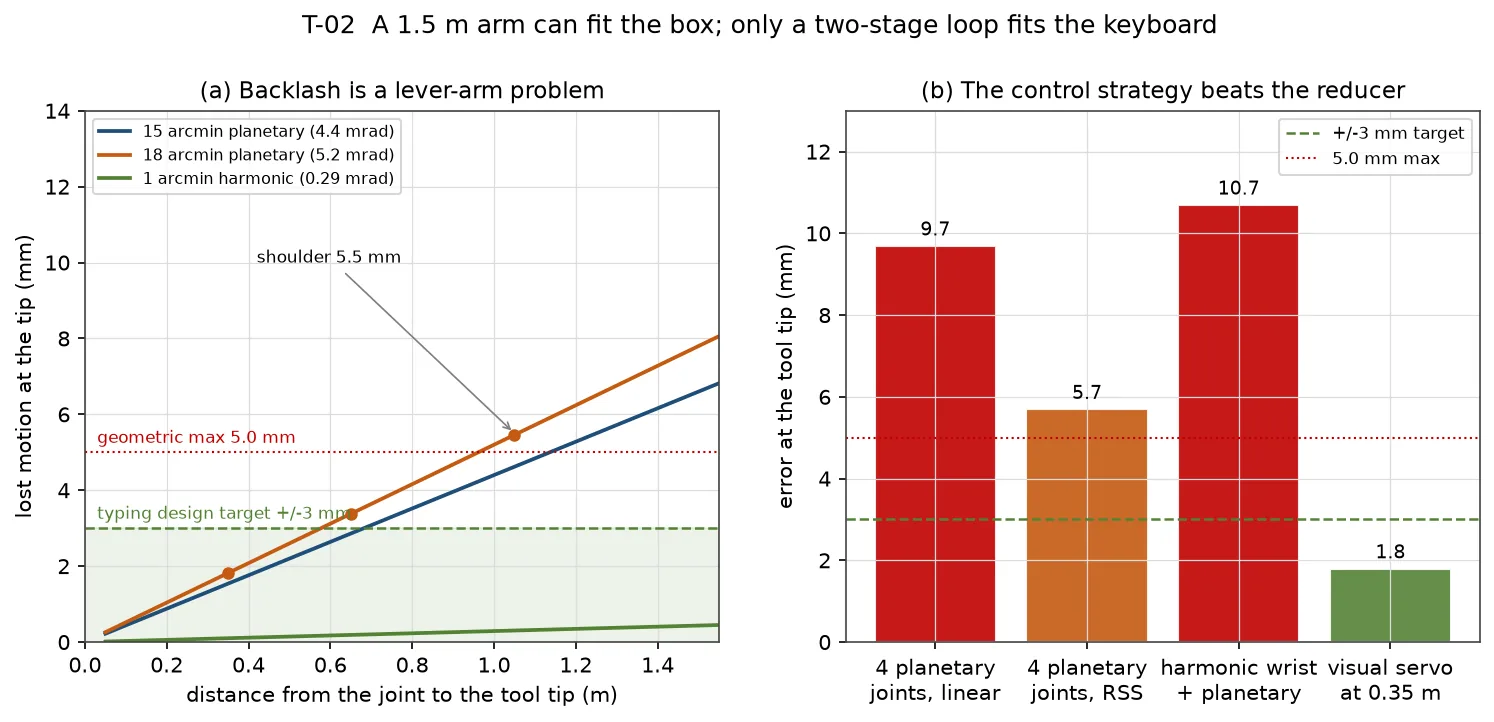
Backlash converts into tip error through the lever arm, and the shoulder owns the lever. Integrated actuators quote 15–18 arcmin, or 4.4–5.2 mrad, in their datasheets S-CUBEMARS-AK S-ROBOTIS-XM540.
| Joint, five-axis arm | Lever to tip (m) | Error at 4.4 mrad (mm) | Error at 5.2 mrad (mm) | Error at 1 arcmin (mm) |
|---|---|---|---|---|
| Shoulder | 1.05 | 4.6 | 5.5 | 0.30 |
| Elbow | 0.65 | 2.9 | 3.4 | 0.19 |
| Wrist pitch | 0.35 | 1.5 | 1.8 | 0.10 |
| Wrist roll | 0.15 | 0.7 | 0.8 | 0.04 |
| Linear sum | 9.7 | 11.4 | 0.6 | |
| Root sum square | 5.7 | 6.7 | 0.4 |
The typing budget is ±3 mm design and 5.0 mm geometric maximum, from a 13–14 mm keycap top and a 3 mm tip on a keyboard at 19.05 mm pitch S-URC27-TASKHW. Open-loop planetary joints are two to four times over that budget before any vision error is counted, and fitting a harmonic wrist alone still leaves 10.7 mm because the shoulder dominates. Closing the last 30 mm with a wrist camera at a 0.35 m standoff turns 5.2 mrad into 1.8 mm, inside the budget. Missouri S&T aims a laser and presses with a linear axis, BYU uses a visual-servo library, and ARES detects the keyboard with a learned model S-MST-GH-ROVECOMM S-BYU-SAR26 S-ARES-SAR26.
The structure pays for reach as well. The shoulder passes 176 N·m peak and 78 N·m static into the chassis, so a folding elbow must carry that through a lock rather than through a continuous member. A stalled joint draws 20 A and 140 W and reaches 60 K above ambient in four to five minutes, which is a thermal event inside a task that already has a clock on it.
Recommended starting point
A 6R serial arm with 0.95–1.05 m links, the shoulder at 0.45–0.55 m from the front face, one fold at the shoulder and elbow laying the arm along the deck, a body-mounted drill, and a wrist camera running a two-stage loop: move to 20–30 mm from the key, then servo the last 30 mm and press with compliance. No telescoping arm and no body lift in a first build.
Flips when the task must be typed open loop, which puts a harmonic or cycloid drive at the shoulder where the 1.05 m lever is; when the parked budget falls below 0.12 m, which removes anything hanging below the forearm; or when the arm must be 5 kg or less, which is the RSX class at 4.42 kg and 0.87 m with reduced payload. Settled by: a full-scale lander panel, all nine Equipment poses, and the folded envelope measured with a tape.
Wheel diameter, the four-way coupling
T-03 is the only number that changes obstacle climbing, centre of gravity, stowed size and drivetrain torque at once, and it does so in conflicting directions. Once the wheels and gear ratios are made it is irreversible, which is why it is frozen at the PDR rather than at the critical design review.
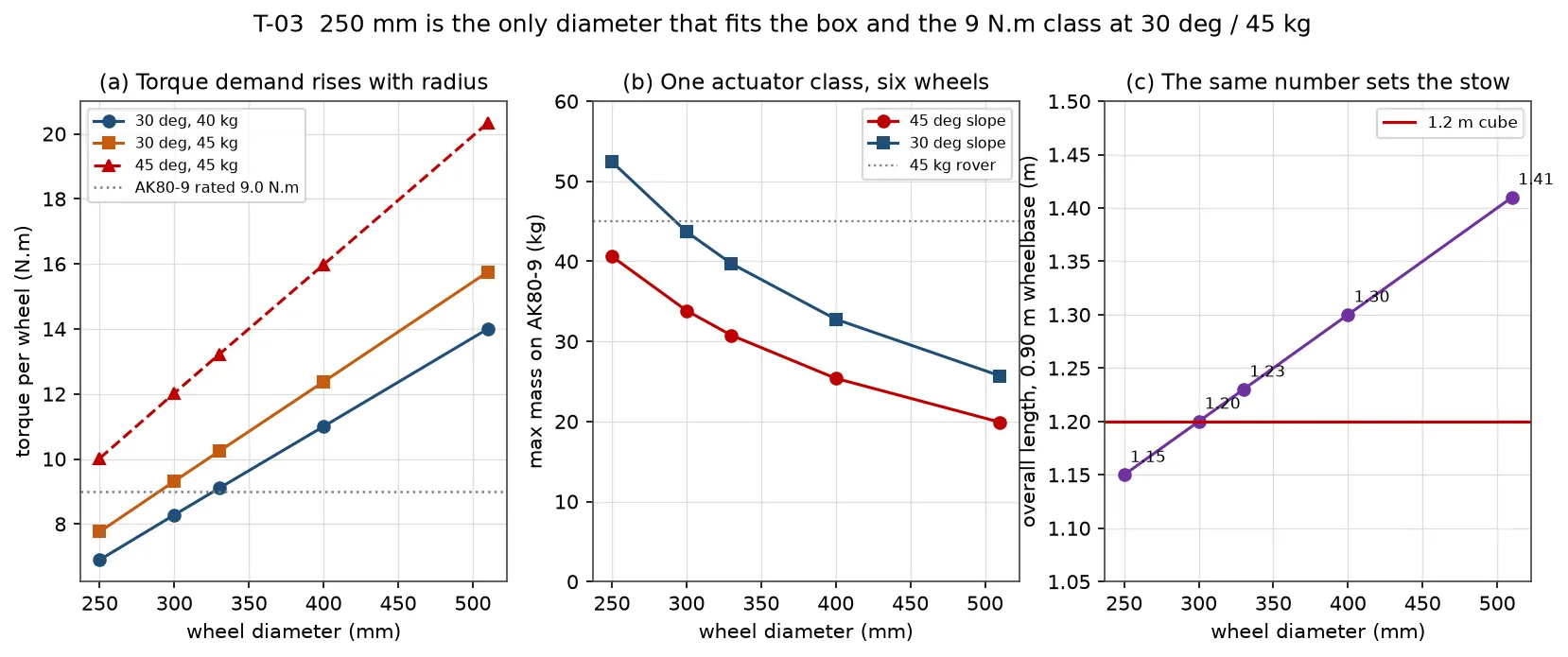
| Wheel diameter | Length at 0.90 m wheelbase | Centre of gravity (m) | Static tip angle | Six printed wheels (kg) | Torque per wheel at 40 kg, 30° (N·m) | Maximum mass on six 9.0 N·m actuators, 30° and 45° | Verdict |
|---|---|---|---|---|---|---|---|
| 250 mm | 1.15 m | 0.258 | 61.5° | 6.0 | 6.9 | 52.4 and 40.6 kg | Recommended |
| 300 mm | 1.20 m | 0.289 | 58.8° | 8.6 | 8.3 | 43.7 and 33.8 kg | Only with a mass diet or a larger actuator |
| 330 mm | 1.23 m | 0.307 | 57.1° | 10.5 | 9.1 | 39.7 and 30.8 kg | Fails the cube at 0.90 m |
| 400 mm | 1.30 m | 0.350 | 53.6° | 15.4 | 11.0 | 32.8 and 25.4 kg | Needs a fold or a shorter wheelbase |
| 510 mm | 1.41 m | 0.418 | 48.6° | 25.0 | 14.0 | 25.7 and 19.9 kg | Only as a four-wheel wheg layout |
The 45 kg example decides it. At 40 kg a 250 mm wheel needs 6.9 N·m; at 45 kg it needs 7.76 N·m, inside the 9.0 N·m rating. At 300 mm and 45 kg the demand is 9.31 N·m, three per cent over the rating before shock, slip or efficiency margin. A 300 mm wheel is therefore either a different drivetrain class, at 2.7 kg for six actuators, or a rover at 43.7 kg or less. Top speed is never the constraint: 250 mm already gives 5.1 m/s, five times the 1.0–1.5 m/s target.
The best-documented teams moved smaller for the same reason. WVU ran 20-inch whegs in 2024, 24-inch folding whegs in 2025 and returned to 20-inch wheels with no folding mechanism in 2026 S-WVU-SAR2025 S-WVU-SAR2026; Missouri S&T independently built a compact suspension that no longer needs to fold S-MST-SITE-ATHENA. Geometry beat mechanisms in both programmes in the same year.
Recommended starting point
250 mm printed TPU wheels with 10–15 mm V-chevron grousers, a 0.85–0.95 m wheelbase, six wheels and no fold, on the 9.0 N·m actuator class. Choose the diameter from the box, then the wheelbase from the terrain, then the motor from the torque.
Flips when 200 mm steps or vertical faces are confirmed as the Delivery bottleneck, which points to 330–400 mm, a shorter wheelbase, a larger actuator and a fold or a diagonal stow; when a tilted or diagonal weigh-in is proven with a timber box and accepted, which stops the box setting the diameter; or when the weigh-in exceeds 50 kg, at which point 250 mm is the only diameter that saves mass without changing the drivetrain. Settled by: the 1.2 m box first, then a half-scale rocker rig over a rock pile, measuring step climb at 250, 300 and 400 mm before a wheel is printed.
Battery capacity, mass and the peak-current trap
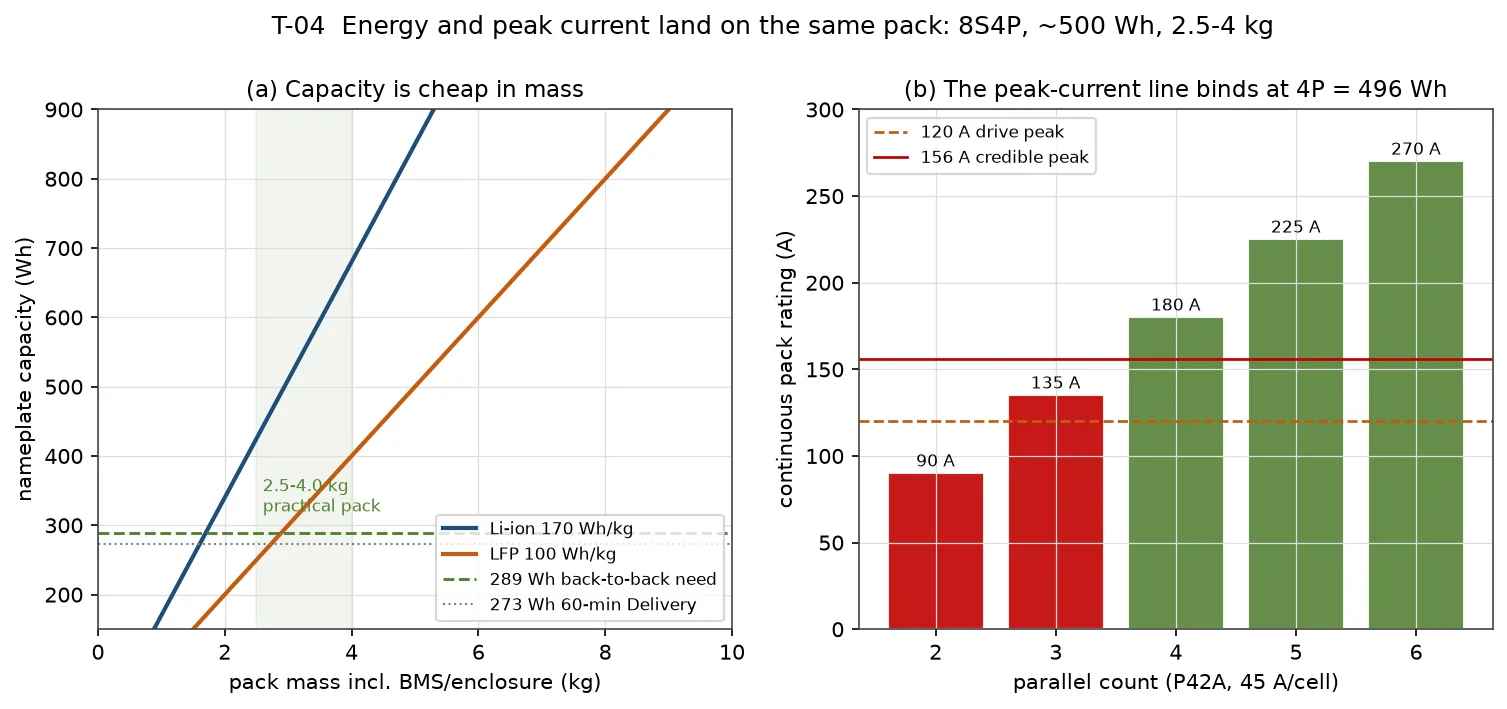
T-04 is a new conflict in 2027. Energy is cheap in kilograms, peak current is expensive in parallel cells, and both land on the same pack. The mission needs are 273 Wh for the 60-minute Delivery at 50 kg, 289 Wh for a 40-minute autonomy run followed by a 30-minute servicing run, and 410 Wh for a 90-minute sensitivity case. The credible simultaneous peak is 156 A: 120 A of drive, 26 A of arm and 10 A of hotel load.
| Pack | Capacity | Continuous rating | What it buys and costs |
|---|---|---|---|
| 8S4P 21700 | 496 Wh | 180 A | 2.9 kg of cells plus 0.5–1.0 kg of BMS and enclosure; covers 289 Wh with 70 % headroom and the 156 A peak, and is the recommendation |
| 8S3P 21700 | 372 Wh | 135 A | About 0.6 kg less pack and 0.5 kg less BMS; below the 156 A peak unless a drive and arm interlock is proven |
| 8S6P 21700 | 744 Wh | 270 A | 4.4 kg of cells, 1.5 kg more than the 8S4P, for energy that no 2027 mission needs |
| Lithium iron phosphate, 24 V | 480–840 Wh | pack-dependent | Safety and deep discharge, at 1.7 times the mass per watt-hour: 8.4 kg at 840 Wh |
| Two 40 V 4 Ah packs | 320 Wh | pack-dependent | A between-mission swap is free; 320 Wh covers 289 Wh with 11 % headroom, which is thin |
The energy loop does not bind. Adding 100 Wh adds 0.59 kg of pack, 1.4 W of drive load and 0.01 kg of pack, a gain of 0.0137 kg of battery per kilogram of rover, so capacity is almost linear in mass. What binds is a continuous rating above 156 A. Three parallel strings cover the 120 A drive peak but not the credible coincidence of a climb and a stalled arm; four is the honest minimum, and four lands at 496 Wh, the same place the energy requirement lands. Missouri S&T’s 80 A distribution limit with a 10 ms BMS trip fired on a legitimate peak, and their design auto-restored after three seconds S-MST-2023-POWER.
Recommended starting point
8S4P 21700 lithium-ion, about 496 Wh, 2.5–4.0 kg including the BMS and enclosure, with a BMS rated 150 A or more and a 1–3 s trip delay, precharge, a coordinated fuse, and the pack in its own compartment. A second pack travels as a spare, because spares do not count against the 50 kg S-URC27-RULES §2.a.iii.
Flips when a tested drive-and-arm interlock and a stall timeout make 3P at 372 Wh adequate, saving about 0.6 kg; when the worst case is confirmed at 90 minutes, which points to 6P at 744 Wh and reopens T-01 by 1.5 kg; or when chemistry is chosen for safety, which adds 2.1 kg at 500 Wh or 3.5 kg at 840 Wh. Settled by: a bench discharge on the real profile and a current log of a hill climb with the arm stalling. No team publishes a measured watt-hour per mission.
Compute power against thermal load
T-05 is the trade where the cheap quantity and the expensive one are different. Compute power is cheap at 15–25 W average. Compute heat is expensive, and it is paid in enclosure volume, filter maintenance and a separate battery compartment rather than in watts. The box is 0.4 × 0.3 m with 0.52 m² of surface and 0.12 m² of top, in 38 °C ambient air.
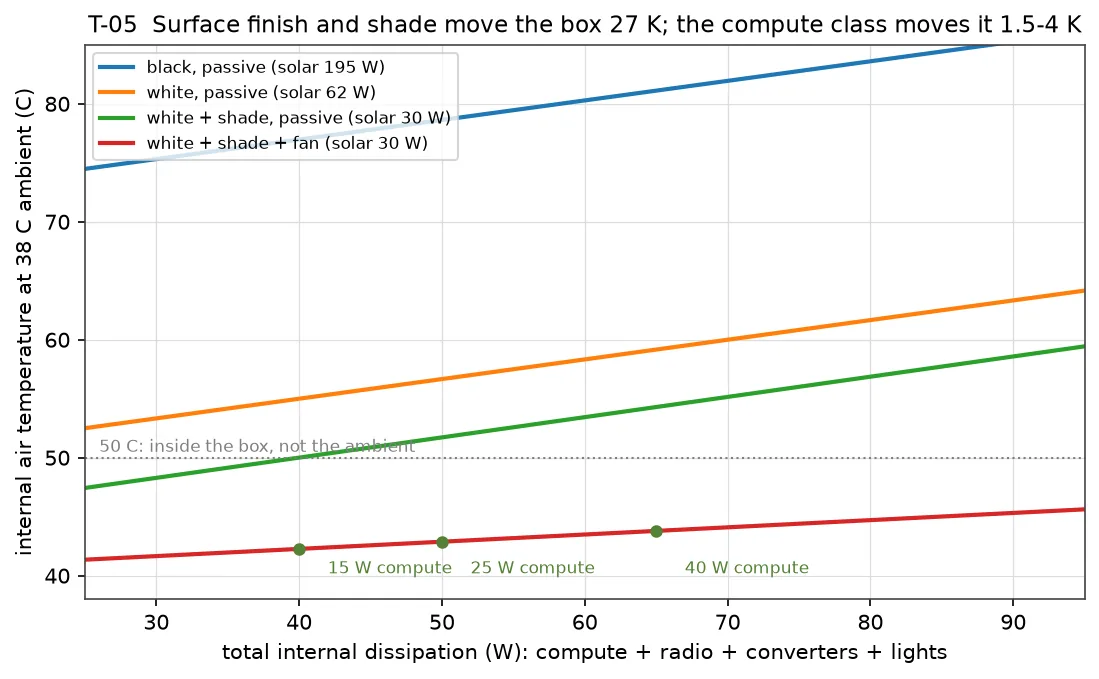
| Treatment | Solar absorbed (W) | Internal air at 40 W total | Internal air at 15, 25 and 40 W of compute, plus a 25 W balance | Mass |
|---|---|---|---|---|
| Black, passive | 195 | 77 °C | 77.0, 78.6 and 81.1 °C | none |
| White, passive | 62 | 55 °C | 55.0, 56.7 and 59.2 °C | paint |
| White plus sunshade | 30 | 50 °C | 50.0, 51.7 and 54.3 °C | 0.35 kg |
| White, shade and filtered fan | 30 | 42 °C | 42.3, 42.9 and 43.8 °C | 0.2 kg of fan and duct |
The compute class moves the box by 1.5 to 4 K. Finish and shade move it by 27 K. The second-order cost is the one that catches teams: if the computer shares the battery compartment, the pack sits at 50–77 °C, and a lithium-ion cell stored at 40 °C and full charge retains about 65 % of its capacity after a year S-BU-808. The thermal design therefore forces a separate battery compartment, which is a volume claim inside the cube. The fan itself needs 13 CFM at 1,309 m plus 30–50 % for filter back-pressure, so 20 CFM free delivery is the design point, and the whole thermal stack is about 1.5 kg and 2 W.
Recommended starting point
A 15–25 W Jetson-class computer, a white enclosure with a sunshade and a filtered fan, heat-sunk to the skin, the battery in its own compartment, 1.5 kg and 2 W budgeted for thermal hardware, and a commanded degrade mode that drops visual odometry, a camera or a network before the box derates on its own.
Flips when the enclosure must be sealed and fanless, which caps compute at 15 W and moves heavy perception to the base station, where a white passive box sits at 50 °C; when onboard power passes 40 W, which points to a larger box and a second fan; or when a hot-day test holds 45 °C or less passively, which removes the fan and the filter burden. Settled by: a 38 °C sun test with a thermocouple in the box and a 30-minute full-stack run, repeated with the filter half-clogged.
Mast height, stow and link quality
T-06 begins by correcting a rule that is widely misread. The 3 m limit applies to the base-station antenna, which must be within 5 m of the C2 station, with guys within 10 m and at least 25 m of cable S-URC27-RULES §2.c.iv REQ COM 009. The rover mast is bounded by the 1.2 m cube. A 2.0 m rover mast is a design choice; a 3.0 m base antenna is a rule.
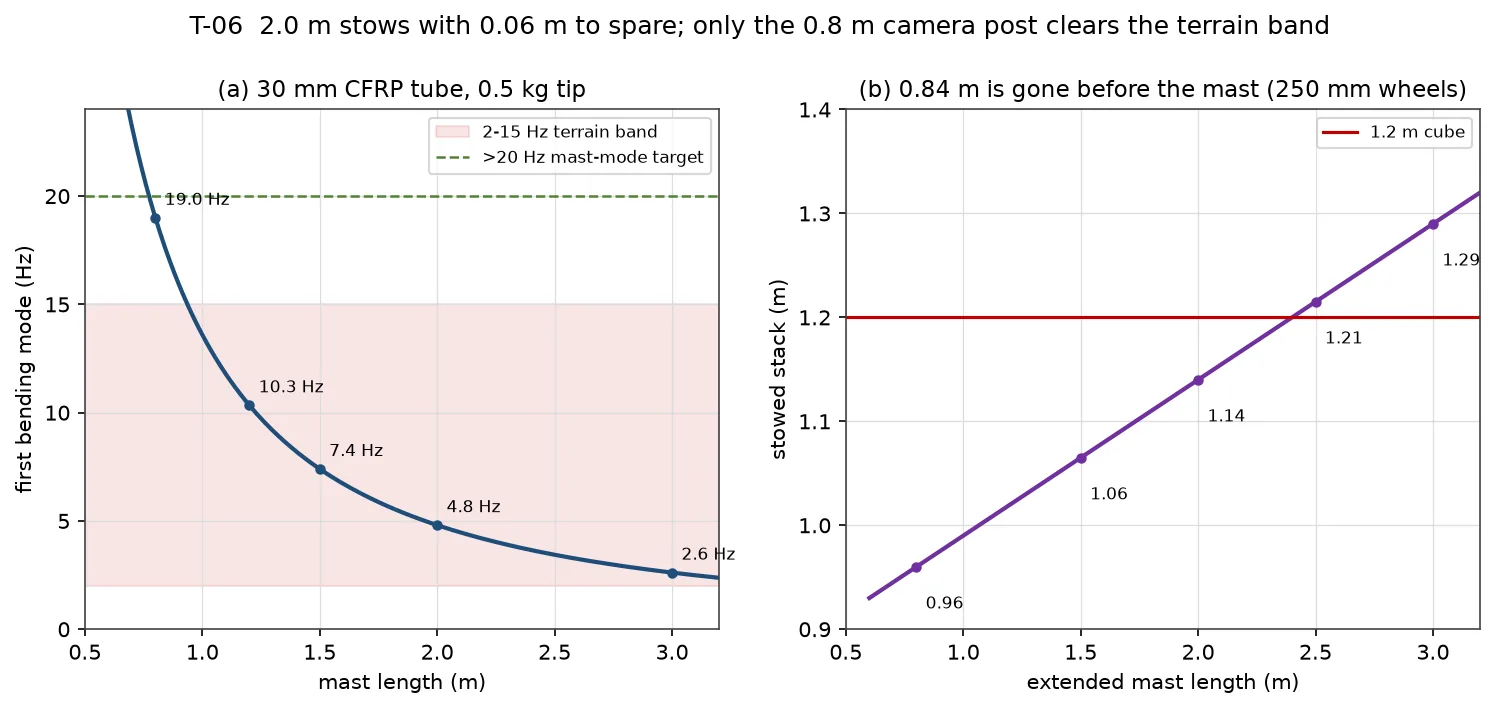
The stow stack before the mast is 0.84 m: 0.255 m to the axle, 0.255 m of wheel, 0.16 m of deck, 0.12 m of parked arm and 0.05 m of antenna and gimbal. With a five-segment mast collapsing to 15 % of its extended length, the numbers run as follows.
| Extended mast | 0.8 m | 1.5 m | 2.0 m | 2.5 m | 3.0 m |
|---|---|---|---|---|---|
| Stowed stack | 0.96 m | 1.06 m | 1.14 m | 1.22 m | 1.29 m |
| First bending mode | 19.0 Hz | 7.4 Hz | 4.8 Hz | 3.4 Hz | 2.6 Hz |
| Tip deflection at 5 N | 0.7 mm | 4.6 mm | 10.9 mm | 21.4 mm | 36.9 mm |
Two things are visible in that table. A 2.0 m mast fits the cube with 0.06 m to spare but sits at 4.8 Hz, inside the 2–15 Hz band that terrain excites, and a 3.0 m mast fails the cube before it helps the link. A 20 mm tube is worse still, at 9 Hz for a 0.8 m post.
Height is not the whole link argument either. At 1 km a 915 MHz path wants 5.5 m of Fresnel clearance that no rover mast provides, while 900 MHz carries 28.2 dB of non-line-of-sight margin against minus 7.6 dB for 2.4 GHz. The wind case is the last constraint: a 65 km/h gust gives a dynamic pressure of about 155 Pa, which is 23 N·m on a 0.15 m² antenna at a 1 m lever and 78 N·m on a 3 m mast with a 0.5 m² dish, enough to bend a 25 mm tube and to sway the tip about 170 mm.
Recommended starting point
Two masts. A 0.8 m, 30 mm carbon-fibre camera post at 19 Hz, and a 1.5–2.0 m telescoping radio mast carrying antennas only, collapsing to 0.30 m and stowing at 1.06–1.14 m. The base antenna stands on its own tripod of 3 m or less at the C2 station, with at least 25 m of cable, surveyed the day before.
Flips when a 1 km non-line-of-sight test passes with the 900 MHz plane at 1.5 m, which frees 0.14 m of stow margin; when perception needs an eye height above 1.0 m, which points to a 1.2 m camera post at 10.3 Hz with isolators and a single-axis gimbal; or when the stow margin falls below 0.03 m, which drops the radio mast to 1.5 m before anyone considers a tilt. Settled by: a range test at 1 km line of sight and 300 m non-line of sight with the real antennas. WVU measured its own envelope at 750 m line of sight and 164 m non-line of sight in 2026 S-WVU-SAR2026, so the test envelope, not the link budget, is the binding constraint.
Drone or no drone
T-07 is unusual because the answer is a null recommendation, and the argument is arithmetic rather than capability. A drone is optional and scores no points directly: full points are possible without one S-URC27-RULES §2.b.i. It buys time in Delivery and can relay a link, and it costs a C2 seat, a field spotter, a registration and a landing step that the Autonomy mission makes mandatory before the rover may proceed.
| 2027 constraint | Requirement | Consequence |
|---|---|---|
| Mass | 5 kg or less, including a dummy mass equal to the battery S-URC27-RULES §2.b.v | Airframe and payload are 5 kg minus two battery masses |
| Rover limits | Drones are excluded from the rover’s weight and size restrictions S-URC27-RULES §2.b.vii | Outside the 50 kg and the 1.2 m cube |
| 70 kg total | Whether a drone counts among fielded rover parts is not published | Design as if it does not, plan as if it might |
| Missions | No drone in Astrobiology or Equipment Servicing S-URC27-QA RQ9 | The two missions where scouting helps most are closed |
| Autonomy | Land at the designated pad before the rover proceeds S-URC27-RULES §1.e.xiv | Reconnaissance only during astronaut assistance |
| Crew | A pilot in C2 plus a designated field spotter in visual line of sight S-URC27-RULES §2.b.ii | One C2 seat and one field body out of six seats and fourteen people a day |
| Law | Registration above 250 g, remote identification, below 120 m, class G airspace S-URC27-RULES §2.b.vii | Paperwork and a trained pilot |
The record is the argument. WVU’s 2023 custom quadrotor was the primary autonomy vehicle, had nine minutes of flight and was in early testing at the SAR; the rover scored 56 in Autonomy S-WVU-SAR2023 S-URC23-SCORES. WVU then moved autonomy to the rover and kept a commercial quadcopter for Delivery scouting. Missouri S&T’s first drone never flew at the competition, and its 2026 aircraft scouts and relays S-MST-SITE-HYPERION S-MST-SITE-ATHENA. No team publishes a drone mass, and the 2027 limit is a weighing rule.
Recommended starting point
No drone in the 2027 first build. Spend the 1.0 kg deployables line on a 900 MHz repeater if the link needs one, and spend the pilot’s C2 seat on a second rover operator. The drone buys time in one mission, not points, and the scarcest resource in a first build is integration hours.
Flips when the Delivery first-stage search is confirmed as the bottleneck and rover detection range is insufficient, which points to a commercial airframe under 5 kg at the PDR rather than a custom one; when the 900 MHz non-line-of-sight link fails at 1 km, which makes a relay drone a communications asset that helps Delivery only; or when the team has eight field-ready people and a registered pilot by January. Settled by: a timed Delivery rehearsal with and without a spotter, and a written answer on how the drone counts against 70 kg.
Modular or single configuration
T-08 asks whether the 70 kg fielded-parts total should become an architecture. The rule gives a 50 kg rover 20 kg of headroom for a second configuration, and the best-documented team moved away from using it over three years.
| Quantity | Value | Basis |
|---|---|---|
| Per-mission cap | 50 kg per configuration | S-URC27-RULES §2.a.iii |
| Fielded-parts total | 70 kg, so 20 kg of headroom over a 50 kg rover | S-URC27-RULES §2.a.iii |
| Second configuration | Must itself be 50 kg or less | S-URC27-RULES §2.a.iii |
| Setup | 15 minutes including weigh-in and all communications | S-URC27-RULES §1.a.ii |
| Autonomy to Equipment | As short as 10 minutes, including a possible re-weigh | S-URC27-QA EQ4 |
| C2 | Six students; 24 registered, two advisors, 14 people a day | S-URC27-RULES S-URC-LOGISTICS §3.b.ii |
| Runner rule | A member who leaves C2 to intervene cannot return to operate that mission | S-URC27-RULES §3.e.i |
| The failure the rule creates | USU 2025: 46.9 kg science configuration, 51.8 kg arm configuration | S-USU-2025-POSTER |
WVU’s three-year migration is the evidence. A front-half chassis swap took second place in 2024 with 391.80 points, payload inserts through the chassis took second again in 2025 with 396.17, and a single integrated chassis with a two-bolt end-effector change took fourth in 2026 with 376.70, while the architecture simplified each year S-WVU-SAR2024 S-WVU-SAR2025 S-WVU-SAR2026 S-URC24-SCORES S-URC25-SCORES S-URC26-SCORES.
The arithmetic of a swap inside ten minutes includes the swap, a possible re-weigh of unmeasured duration, a re-point of the antennas, and two operators unavailable for the next mission if they leave C2 under the runner rule. With fourteen people a day and six seats, there are about two spare bodies. A whole-chassis swap is a schedule with no failure budget.
Recommended starting point
One integrated rover plus a two-bolt, one-connector end-effector change. Use the 70 kg allowance as a reserve rather than an architecture: keep a 5 kg science-module option inside the 20 kg headroom, but do not design a mission day around changing it. The SAR splits 40 report, 48 video and 12 judges S-URC26-SAR, and 48 video points need an integrated rover by February.
Flips when the single configuration cannot close at 48.5 kg or less by the PDR after the T-01 cuts, which points to a two-bolt science-module change of 5 kg or less rehearsed to eight minutes with two named people including a re-weigh; or when the Equipment cache question, CF-11, resolves to a different container, which is a change of end-effector rather than of module. Settled by: ten rehearsals with the real crew and rover against a ten-minute clock, weighing the heaviest configuration at every one.
Science payload against arm payload
T-09 separates two costs that look like one. Science mass is cheap: three kilograms costs about 0.5 N·m per wheel and 0.04 kg of battery. Science integration is not cheap, because the same decision forces a reaction-torque path, a sealed heated bay and a 10.5-minute block of the 25-minute clock.
| Line | Value | Effect on the rover |
|---|---|---|
| Science bay with body-mounted drill | 3.5–4.5 kg | 0.5 N·m per wheel at 30°, 0.04 kg of pack, no cliff |
| Cache: 50 mL tube and holster | 0.15–1.0 kg | Handled by the arm; 5 kg or less by rule |
| Arm payload requirement | 5 kg, 7.5 cm grasp, 40 cm cube | Sets shoulder torque at practical reach |
| Arm design torques | Wrist 11 N·m, elbow 53 N·m, shoulder 176 N·m peak | A wrist drill loads the weakest joint |
| Drill reaction torque | Not published | Body mounting routes it into the chassis |
| Science power | 30–100 W drill, 10–20 W heater, 5–10 Wh per mission | The peak coincides with drive and arm |
| Chemistry storage | 38 °C or less; one amplification method needs 65 °C for 30 minutes | Sealing against dust fights venting a heater |
| Mission clock | 25 minutes, of which acquisition and documentation are 10.5 | The drill is the critical path, not the chemistry |
| Second assay | About 3.5 minutes to load and 2 minutes to read | A 30-minute incubation cannot be the second capability |
| Fluids | 12 mL of liquid, 10 mL of waste | Contained, under a no-spill rule |
The wrist is the wrong place for the drill, and the numbers say so: the wrist is designed for 11 N·m, the elbow for 53 and the shoulder for 176. A 30 cm drill on a compliant wrist wanders, and it also spends 1.5–2.5 kg at the worst lever, cutting usable payload to about 2.5–3.5 kg. Drilling costs about 8 Wh for five minutes at 100 W, six per cent of a 125 Wh mission, but it lands on the same bus as a 120 A drive peak and a 1.1 kW arm peak, so the science rail is fused and isolated. WVU solved the same problem with a dedicated drill on a linear actuator S-WVU-SAR2025.
Recommended starting point
A body-mounted auger or drill on a 200 mm linear stage with a graduated clear liner and a scoop fallback; 3.5–4.5 kg of science in a sealed bay with desiccant and a heater isolated from the electronics; a 1 kg cache; an 8 kg arm class with 5 kg of payload; and two assays on one detector with the pair chosen by December, so the assay appears in the SAR video by 2027-03-05 S-URC27-RULES §1.b.i.
Flips when two assays need more than 5 kg or 5 L, which points to a shared detector or an optical second capability with a written answer from URC; when hard or rocky soil defeats the auger, which adds a percussive drill of about 1 kg and reopens T-01; or when a wrist drill is unavoidable for reach, which steps the elbow to 53 N·m and moves to the 14 kg arm class, reopening T-01 and T-03 together. Settled by: the cam-lock, latch and drawer mocks, a 10 cm soil column, and a 25-minute dry run that measures reaction, depth provenance and the two-assay clock.
Teleoperation against autonomy investment
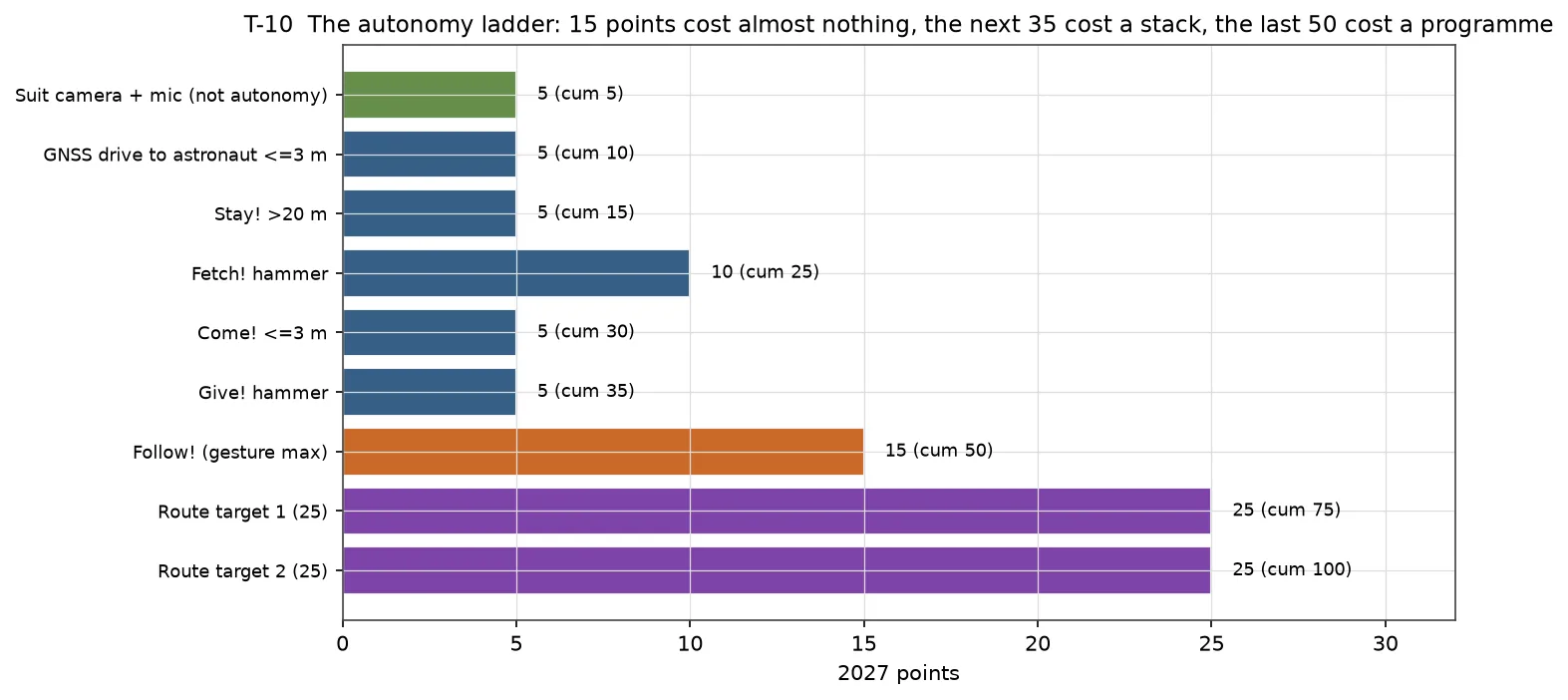
T-10 is the highest-variance decision in the season. Autonomy is the mission with the widest spread in the record, at a mean of 26.7 and a standard deviation of 27.8, with 41 % of team-years scoring zero across 162 finals appearances from 2022 to 2026. It is also the only 2027 mission whose points are fully published, which makes its value calculable rather than assumed.
| Element | Points | Cumulative | What it needs |
|---|---|---|---|
| Suit camera and microphone, not an autonomy element | 5 | 5 | A coverall, a 5.8 GHz pod and a C2 display |
| GNSS drive to the astronaut and stop within 3 m | 5 | 10 | RTK and a waypoint controller |
| Hold while the astronaut moves more than 20 m | 5 | 15 | A latching hold and a disabled planner |
| Fetch the hammer | 10 | 25 | Person and hammer detection plus an autonomous grasp |
| Come within 3 m | 5 | 30 | Detection at 20 m or more, or a suit beacon |
| Give the hammer | 5 | 35 | An autonomous place or drop |
| Follow, gesture at maximum | 15 | 50 | Person tracking on natural terrain with a 3 m stop |
| Route target 1 | 25 | 75 | Hill route, 1 m stop and a visible state light |
| Route target 2 | 25 | 100 | No link, an onboard decision and a visible state light |
The effort curve is not linear. The first 15 points need RTK, a state machine and a light, which is hardware the rover already carries. The next 35 need person detection, an autonomous grasp and a safety case with a person inside the motion envelope. The last 50 need a planning stack that works with no link behind a hill and stops within a metre, and 41 % of the field has scored zero on that family. The 2026 ceiling of 86 is a property of the rubric, not a capability limit.
WVU’s investment is the counter-example to the software-only view. It logs a minimum of 100 practice hours per operator, and its systems-engineering presentation reports that 50 hours or more of testing found many mechanical, electrical and software faults S-WVU-SAR2026 S-WVU-INCOSE2026. The hardware is unremarkable: a 2.4 GHz primary link, a lower-band recovery link and GNSS with LiDAR navigation. The hours are the investment.
Recommended starting point
Secure the 15-point floor in the first build, build toward the 35-point astronaut tier by the SAR, and attempt the 50 route points only if RTK with a terrain model completes three of five full runs by January. The rules guarantee the geometry of the astronaut tasks: a published stand-off, an exact target coordinate and a required hold. Do not buy a sixth camera or a second computer before the route gate is cleared.
Flips when fewer than two dedicated software people are available by December, or no RTK fix is available by February, in which case stop at 15–20 points and put the hours into Delivery and Equipment Servicing; or when route autonomy runs three of five by the SAR, which is the largest single block in the competition. Settled by: five full mock runs on hilly terrain with the real link, scored by someone who did not write the code. One run is a demonstration; five are a capability.
Camera count against link budget
T-11 is a communications decision disguised as a perception decision, and it converts into points through the speed at which an operator can drive safely. The arithmetic is unforgiving. Six cameras at 720p30 and 3 Mbit/s each is 18 Mbit/s; the 900 MHz link carries 200 kbps at 1 km, which is 1.1 % of that demand. The 2.4 GHz radio carries 6 Mbit/s at 2.62 km or 54 Mbit/s at 0.42 km, and 5.8 GHz with the radio at the mast carries 6 Mbit/s at 21.4 km or its top modulation at 1.90 km. Dropping the top modulation to 6 Mbit/s buys about nine times the range. Latency of 100–300 ms means a rover at 1.0 m/s travels 0.25 m between a command and the image of it.
| Option | Streams | Demand | Where it survives |
|---|---|---|---|
| Drive and wrist only | 2 | 4–6 Mbit/s | A 900 MHz-only day |
| Drive, wrist, science still and rear | 4 | 8–12 Mbit/s, adaptive | All four missions on 2.4 GHz close in and 5.8 GHz at range |
| Six streams | 6 | 18 Mbit/s | Close in only; operator overload becomes the limit |
| One stream plus stored stills | 1 | 2–3 Mbit/s | The worst link, with no live arm view |
Recommended starting point
Four cameras at 720p30 (drive, wrist, science still and rear) at 2–4 Mbit/s adaptive, plus a high-resolution still path. Freeze the count against the link rather than against the sensor catalogue, and keep the 900 MHz sub-band plan for every link, including drone and astronaut, in the same interface document, which is due 2027-04-30 S-URC27-RULES §2.c.v.
Flips when a 5.8 GHz test with the radio at the mast shows 20 Mbit/s or more at 1 km, which makes six streams feasible subject to operator load; when the day is 900 MHz only, which leaves one or two streams plus stored stills; or when autonomy earns the route points, which reduces the number of streams an operator needs. Settled by: a measured bitrate per camera at the intended resolution, and one full route driven on the final antennas.
E-stop scope against communications and logging
T-12 is the trade with a pass-or-fail rule behind it. One button must cease all power draw from any and all batteries, including compute, communications and payload S-URC27-RULES §2.a.v. The radio dies with everything else, so the C2 station sees nothing and the field judge reads the rover’s state from its own light.
| Option | Description | Cost | Verdict |
|---|---|---|---|
| Single normally-open contactor loop | One button opens a loop that drops the main contactor; every rail is downstream | $$ | Recommended; one action kills everything and can be tested with a current probe |
| Distributed contactors | One per battery or rail, all driven by the same button | $$$ | Needed only when two packs run at different voltages |
| Software stop | Firmware stops the motors and keeps the computer alive | $ | Non-compliant with §2.a.v; no partial credit |
Five design rules follow. One precharge and contactor loop, with the state-light driver on a branch inside the loop but independent of the computer. No software in the kill path. Mode and task transitions written to non-volatile storage immediately, because the E-stop kills the logger. A passive mechanical state flag so the judge can read the state after the link is gone. And a bench test with a current probe: press the button and verify zero amps at the pack, including the computer and the radio.
Recommended starting point
A single normally-open loop, with the state light on its own branch inside the loop, a precharge, a fuse coordinated below the contactor rating, and a documented kill-chain test in the SAR video.
Flips when two packs at different voltages appear, which needs distributed contactors on one loop; or when a judge explicitly requires post-kill telemetry, for which no ruling was found, and only then a non-battery last-gasp indicator. Settled by: 50 presses under load with a voltmeter on every rail, photographed for the review package.
The decision chain
The trades are not independent. An edge in the chain below means the downstream number cannot be frozen until the upstream one is.
| Decision | Trade | Freezes at | Waits on |
|---|---|---|---|
| D01 Mission targets, including autonomy tier and drone | T-07, T-10 | 2026-11-15 | nothing |
| D02 Configuration strategy, single or modular | T-08 | 2026-11-15 | nothing |
| D03 Mass allocation at 40.0 kg plus 15 % | T-01 | PDR | D01, D02 |
| D04 Wheel diameter and wheelbase at 250 mm and 0.90 m | T-03 | PDR | D03 |
| D05 Actuator class, 9 N·m or the next step | T-03 | PDR | D04 |
| D06 Bus voltage, 24 V or 48 V | T-04, T-12 | 2026-11-30 | D05 |
| D07 Arm reach and stow, 6R at 1.05 m with a body drill | T-02 | PDR | D03, D04, D09 |
| D08 Arm precision strategy, wrist camera and visual servo | T-02 | PDR | D07 |
| D09 Science assay pair | T-09 | December 2026 | D03 |
| D10 Battery capacity and parallel count at 8S4P | T-04 | CDR | D05, D06 |
| D11 Compute class and thermal treatment | T-05 | PDR | D01, D10 |
| D12 E-stop topology, single loop | T-12 | 2026-11-30 | D06, D10 |
| D13 Camera count and frequency bands | T-11 | 2027-04-30 | D01, D11 |
| D14 Mast architecture, two masts | T-06 | PDR | D11, D13 |
| D15 Interface document version 1 and procurement | all twelve | 2026-11-30, orders 2026-12-15 | D07, D08, D09, D11, D12, D14 |
| D16 Build, integrate and test, power-on | all twelve | 2027-01-31 | D15 |
The critical path is D01, D03, D04, D05, D06, D10, D11, D13, D14, D15, D16. Nothing on it can be compressed by working harder, only started earlier. D04 has no upstream dependency other than the allocation and is irreversible after tooling, so freezing it early is worth more than optimising it. D09 is the only December decision off the PDR path, and it feeds the SAR video, which makes it both the longest-lead science item and the most likely to slip. D06 and D12 must be frozen before any harness exists. There is deliberately no edge from the drone to the mass allocation, because the drone sits outside the 50 kg and the 1.2 m cube; it feeds the 70 kg question carried inside D01.
The dates that bind these trades
| Date | Event | Decisions frozen |
|---|---|---|
| 2026-10-30 | Registration closes S-URC27-RULES §3.a.i | Team scope and mission targets, D01 |
| 2026-11-15 | Internal | Autonomy tier and drone, D01; single or modular, D02 |
| 2026-11-30 | Internal | Interface document version 1, D15: bus voltage, connectors, mounts; E-stop topology, D12 |
| 2026-12-02 | PDR S-URC27-RULES §3.a.ii | Mass allocation, D03; wheel diameter, D04; arm concept, D07; configuration, D02 |
| December 2026 | Internal | Science assay pair, D09; the SAR video must show it S-URC27-RULES §1.b.i |
| 2026-12-15 | Internal | Long-lead orders released: motors, gearboxes, boards, composite stock |
| 2027-01-31 | Internal | Power-on of the integrated rover; compute and thermal, D11 |
| 2027-02-14 | Internal | Full system integrated; camera count, D13, proven |
| 2027-02-01 to 02-20 | Internal | SAR filming, current architecture only |
| 2027-03-05 | SAR S-URC27-RULES §3.a.iii | Frozen mass, stow, E-stop evidence, assay footage |
| 2027-04-10 | Internal | Software feature freeze |
| 2027-04-24 | Internal | Mechanical configuration freeze |
| 2027-04-30 | Communications documentation S-URC27-RULES §2.c.ii | Bands, antennas, drone and astronaut links, licence basis |
| 2027-05-21 | Science Plan S-URC27-RULES §1.b.i | Assay pair, sites, interpretation |
| 2027-05-26 | Expense Report S-URC27-RULES §3.c.ii | Work-package expenses |
| 2027-06-02 to 06-05 | Finals | Repairs only |
What a first build does first
- Take the irreversible decisions first: mass allocation, wheel diameter and bus voltage. Each is cheap to decide now and expensive to change later, and everything downstream becomes a re-test rather than a redesign.
- Design to 46 kg with a 4 kg reserve, not to 50 kg. The field is pinned at 49–50 kg because the cap decides there, not because 50 kg is optimal. A 33 kg rover won in 2023 S-WVU-SAR2023.
- Buy typing precision with a camera, not with joints. The shoulder lever defeats a reducer budget; at a 0.35 m standoff, 5.2 mrad becomes 1.8 mm.
- Choose the wheel from the box, the wheelbase from the terrain, and the motor from the torque, in that order.
- Size the pack against the 60-minute Delivery and the back-to-back autonomy and servicing case, and check the 156 A peak before choosing the BMS. Both answers land at four parallel strings.
- Treat thermal design as a mass and volume item. A white shell, a shade and a filtered fan, with the battery in its own compartment; the computer class is the small term.
- Use two masts, and remember that 3 m is the base-station rule. A 3 m rover mast fails the cube before it helps the link.
- Do not fly a drone in the first build, and use the 70 kg allowance as a reserve rather than an architecture.
- Measure the six numbers nobody publishes: mass, watt-hours per mission, weigh-in duration, setup time, teleop ground speed, and arm backlash under load at 38 °C. Each converts an estimate into a measured value.
What would change a recommendation
| Gap | Why it matters here | What closes it |
|---|---|---|
| Whether a drone counts against the 70 kg total | Changes the headroom in T-08 and the accounting in T-07 | A written question to the URC Director before the PDR |
| Whether the Equipment Servicing cache is the team’s own Astrobiology cache | Changes the mass, thermal and end-effector answer in T-09 | A written question before December |
| Weigh-in duration | Decides whether a module change fits the 10-minute window | Ten weigh-ins timed at a mock event |
| Teleop ground speed on real terrain | The 1 km and 30-minute arithmetic in T-10 and T-11 | A field log at an analogue site |
| Arm backlash under load at 38 °C | The datasheet figure is nominal, and T-02’s 1.8 mm depends on it | An output-encoder lost-motion test |
| Drill reaction torque in MDRS-type soil | Decides wrist or body mounting, which is T-09 | A load cell on the auger in three soils |
| Effective rolling resistance on the site terrain | The dominant assumption in T-03 and T-04 | A tow test at 40 kg on sand and gravel |
| The 2027 Autonomy rubric and any ceiling | The investment target in T-10 | Re-read the rules and the Q&A monthly from December |
| Whether the 3 m antenna limit applies to a separate GNSS base | Affects T-06 and the survey-in plan behind CF-13 | A written question, asked with the December batch |
| Drone masses for WVU, Monash and Missouri S&T | The 5 kg rule is a weighing rule and no team publishes a number | Ask, and weigh one at the 2027 finals |
Further reading
- Mass and power derives the 249 W average, the 3.7 kW peak and the pack sizing that T-01 and T-04 use.
- Interfaces and couplings works the 66 interfaces, of which 37 are high criticality.
- Mobility and arm and end-effectors carry the full comparison tables behind T-02 and T-03.
- The 13-week plan and the first 90 days put these freeze dates on a calendar.
- 110 engineering problems turns each recommendation into a row with an experiment and a success criterion.
Sources for this page
- S-URC27-RULESUniversity Rover Challenge 2027 – Requirements and GuidelinesOriginal Archived copy
- S-ARES-PAPER-2025"Development of a Multifunctional Rover System for Mars Exploration and Operations in the University Rover Challenge" (RSJ 2024, 2K2-07)Original
- S-MONASH-GH-NOVAMonashNovaRover/nova, "The Monash Nova Rover mono-repo" (Apache-2.0; default branch main; 2,389 files; last push 2026-10-23)Original
- S-RSX-ARM-URDFRSX 2025 arm URDF + meshes (6 revolute joints, link masses)Original
- S-WVU-SAR2023Team Mountaineers System Acceptance Review 2023 (rover "Wanderer"): Cambium PTP 450 900 MHz link, 850 m LOS / 300 m NLOS, 2 m telescoping mast, drone 900 MHz + 2.4 GHzOriginal
- S-URC23-SCORESURC2023 Official ScoresOriginal
- S-USU-2025-POSTERUSU Mars Rover 2025, SOPHIA final report poster (mass 46.9–51.8 kg, suspension clearance 0.32 m)Original
- S-CUBEMARS-AKCubeMars AK series product/specification pages: AK60-6, AK70-9, AK70-10, AK80-9, AK10-9 (prices, torque, mass, backlash, encoder)Original
- S-ROBOTIS-XM540Robotis DYNAMIXEL XM540-W270-R product page (stall torque derivation, 15 arcmin backlash, USD 494.39)Original
- S-URC27-TASKHW2027 task hardware resolved from the rulebook's own hyperlinks (keyboard, display, hammer, hose)Print copy
- S-MST-GH-ROVECOMMRoveComm_Base README, the full RoveComm manifest.json documentation: every board IP, command, telemetry packet and enum (drive, arm, auger, Raman, PMS, nav, camera, signal stack, drone GPS)Original
- S-BYU-SAR26BYU Mars Rover, URC 2026 System Acceptance Review (video; ViSP typing, wrist depth camera)Original
- S-ARES-SAR26ARES Project, URC 2026 System Acceptance Review (video)Original
- S-WVU-SAR2025Team Mountaineers System Acceptance Review 2025 (rover "Daedalus"): 2.4 GHz 90° sector + 3 m rover mast, 70 cm HAM packet radios, 433.25 MHz amateur-TV analog video, 750 m LOSOriginal
- S-WVU-SAR2026Team Mountaineers System Acceptance Review 2026 (rover "Deimos"): tri-modal 2.4 GHz + 5.8 GHz + 70 cm, gimbal camera on antenna mast, 750 m LOS / 164 m NLOS high-noise test, antenna + radio budget linesOriginal
- S-MST-SITE-ATHENAAthena (2026) rover page, compact suspension, 3D-printed wheels, hub motors, STM32/CAN controllers, simulator arm, LiDAROriginal
- S-MST-2023-POWERRemote Power System Monitoring and Management of a Teleoperated Mars Rover (ITC 2023)Original
- S-BU-808BU-808: How to Prolong Lithium-based BatteriesOriginal
- S-URC27-QAURC2027 Questions & Answers (updated through 2026-10-11)Original Archived copy
- S-MST-SITE-HYPERIONHyperion (2024) rover page, Cartesian arm, all-spectroscopy science, first drone Zephyr, C++ autonomy, managed switchOriginal
- S-URC-LOGISTICSURC LogisticsOriginal Archived copy
- S-WVU-SAR2024Team Mountaineers System Acceptance Review 2024 (rover "Heimdall"): dual-band 2.4 GHz + 900 MHz, 90°/120° sector antennas, 250 m / 1 km tested, antenna and radio budget linesOriginal
- S-URC24-SCORESURC2024 Official ScoresOriginal
- S-URC25-SCORESURC2025 Official ScoresOriginal
- S-URC26-SCORESURC2026 Official ScoresOriginal Archived copy
- S-URC26-SARURC2026 System Acceptance Review Requirements + SAR Q&AOriginal
- S-WVU-INCOSE2026INCOSE URC 2026, Team MountaineersOriginal