QSET: Queen’s Space Engineering Team (Queen’s University)
QSET is one of the established Canadian programmes, with a finals appearance in every season of the current window and an unbroken run that the university traces back to the competition’s creation. Its results are carried and lost by the arm. Equipment Servicing has moved from 7 to 47 to 15 to 41 to 50.53 in five consecutive seasons, while the total has moved from 182.60 to a peak of 310.03 and back to 229.08. The team also documents its process more completely than most of its peer group, which makes the arm sequence readable rather than mysterious.
What this team shows
- The arm decides the season. Equipment Servicing reads 7, 47, 15, 41 and 50.53 across five years, and the total follows it S-URC22-SCORES S-URC26-SCORES.
- The 2025 rover was the most complete: a new six-degree-of-freedom arm, a 48 V pack and three radio bands, with every mission scoring S-QSET-SAR25 S-URC25-SCORES.
- The 2026 rover had the best servicing score in the team’s record and still fell to 17th, because Delivery dropped to 10 and Autonomy to zero in the year the navigation stack changed S-QSET-SAR26 S-URC26-SCORES.
- The team’s mock-mission and checklist practice, introduced in 2023, is the most transferable process idea in this file.
Identity and results
| Year | Total | Rank | SAR | Science | Delivery | Equipment | Autonomy |
|---|---|---|---|---|---|---|---|
| 2022 | 182.60 | 18 | 80.60 | 55 | 0 | 7 | 40 |
| 2023 | 286.94 | 7 | 88.98 | 93.96 | 15 | 47 | 42 |
| 2024 | 295.11 | 7 | 93.11 | 71 | 74 | 15 | 42 |
| 2025 | 310.03 | 9 | 91.03 | 88 | 48 | 41 | 42 |
| 2026 | 229.08 | 17 | 80.55 | 88 | 10 | 50.53 | 0 |
All five rows reproduce the published results S-URC22-SCORES S-URC23-SCORES S-URC24-SCORES S-URC25-SCORES S-URC26-SCORES. The team calls 2023 its best-ever percentile, when it was first in Canada and seventh in the world S-QSET-QUEENSNEWS. No award is recorded in the 2026 coverage, and no individual rover nickname appears in any public source.
Rover generations
2022: the arm is built. The mechanical priority was turning the arm designed remotely in 2021 into hardware, which also meant a new motorised wide-angle camera rig, a redesigned scoop, a modular chassis with an embedded thread matrix, and third-generation airless tyres with more TPU. Software moved to Ubuntu 18 and ROS Melodic on a Jetson Xavier NX, with a probabilistic search and a custom wrist servo driver. Electrical added a fuse box, joint limit switches, a second E-stop that cuts motor power only, and revised battery-monitor circuits. The result was 18th and a zero in Delivery S-QSET-SAR22.
2023: the process year. A lighter chassis, an implement bay that takes either the science payload or the arm, a rocker differential, a flexible printed wheel, brushed drive with per-motor PID, a seven-cell battery tested to 1 h 15 min, a 2.4 GHz Ubiquiti link on an extendable mast, nine cameras with onboard encoding, differential GNSS fused with wheel odometry and two depth cameras. The team also introduced per-mission mock tasks and task checklists. It finished seventh S-QSET-SAR23 S-URC23-SCORES.
2024: brushless drive. Aluminium hubs with printed TPU treads, each wheel on a brushless motor with an integrated CAN driver and its own PID loop, which cut drive-system weight by 45 %. An eight-cell pack added 50 % capacity and reached 1 h 25 min. Two Ubiquiti radios covered 2.4 and 5 GHz over an extendable mast at 1 km line of sight. Software moved from ROS 1 to ROS 2 with ArUco detection, point-cloud obstacle handling and a neural network for mallets and bottles. It produced the best review score and the best Delivery score of the record, but Equipment Servicing fell to 15 S-QSET-SAR24 S-URC24-SCORES.
2025: the complete rover. A new differential with cross-roller bearings at the rocker pivots, carbon-fibre panels bonded to an aluminium skeleton, two six-cell packs in series for 48 V and up to 2 h, three radio bands, and a new six-degree-of-freedom arm driven by brushless motors with integrated planetary reduction and a servo-driven differential wrist. Autonomy gained differential GNSS with a claimed 4 cm accuracy, a spiral search, YOLOv11 and a planner built on existing LiDAR survey data of the competition site. Every mission scored and the total peaked at 310.03 S-QSET-SAR25 S-URC25-SCORES.
2026: torque control and a new wrist. Custom low-latency loops between each motor driver and the rover computer replaced open-loop throttle, giving torque modulation for traction control and braking. A custom quadcopter with 23 minutes of flight fed a stabilised camera into the operator interface. The arm gained a differential-drive wrist with a slip ring for continuous roll, a rack-and-pinion effector with an integrated camera and solenoid, and Cartesian control through MoveIt Servo. Autonomy moved from the custom stack to Nav2 S-QSET-SAR26.
Subsystems
Mobility. A rocker differential with cross-roller bearings and a carbon-fibre and aluminium chassis. Wheels are aluminium hubs with printed TPU treads, and steering is skid steer throughout. A swerve conversion was announced for the following year in 2025 but is not claimed in 2026, which suggests it slipped. Wheel diameter, width and mass are never published S-QSET-SAR25 S-QSET-SAR26.
Arm and end-effector. The 2023 and 2024 arms had five degrees of freedom with a continuous-roll grabber and inverse kinematics. The 2025 arm moved to six degrees of freedom with brushless and planetary joints, a differential wrist and a custom control board with two three-axis joysticks. The 2026 wrist adds a slip ring for continuous roll, and the effector uses a rack-and-pinion drive with a camera and a solenoid. Putting the solenoid in the effector means the gripper is not asked to press keys, which removes a class of grasp-precision requirements S-QSET-SAR24 S-QSET-SAR25 S-QSET-SAR26.
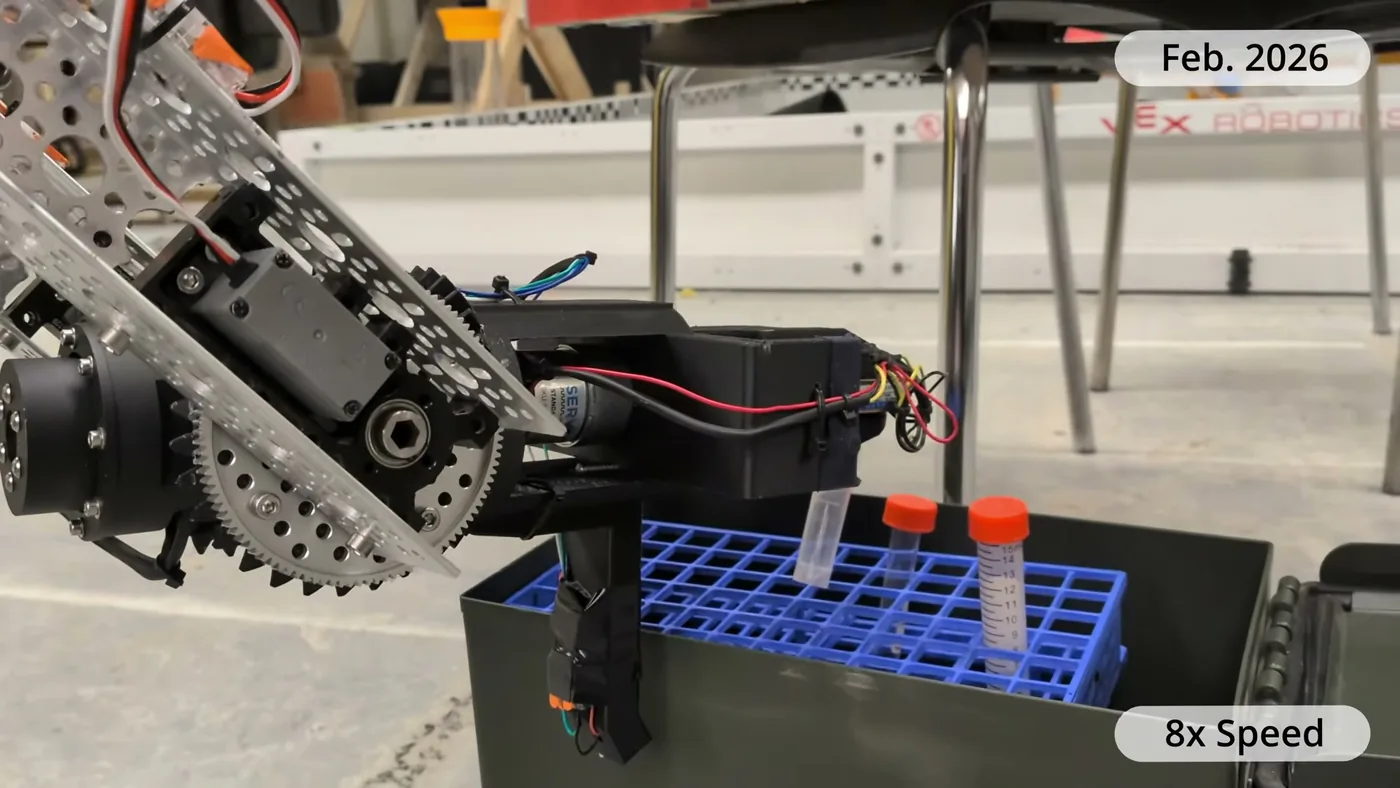
Science. The payload carries a UV-visible spectrometer fed by fibre optics, an in-suite camera and a microscope camera, and a set of environmental sensors for carbon dioxide, humidity, pressure and volatile compounds. The assays have become more specific each year: BCA at 562 nm, molybdenum blue at 660 nm and DNSA at 540 nm by 2026, with a sulfide test read by colour chart. Sample handling uses four scoops and an auger to 15 cm with a sealable cache. Quoting wavelengths and calibration curves is more checkable than most review prose S-QSET-SAR22 S-QSET-SAR23 S-QSET-SAR25 S-QSET-SAR26.
Communications. The band history is the clearest engineering arc in the dossier. A single 2.4 GHz Ubiquiti link gave way to selectable 2.4 and 5 GHz, then to 2.4, 900 and 433 MHz in parallel, and finally to 900 MHz as the primary control link with 2.4 GHz carrying video. The 2026 specification card states up to 35 Mb/s and twelve H.265 streams on 2.4 GHz, and up to 12 Mb/s and four streams on 900 MHz S-QSET-SAR24 S-QSET-SAR25 S-QSET-SAR26.
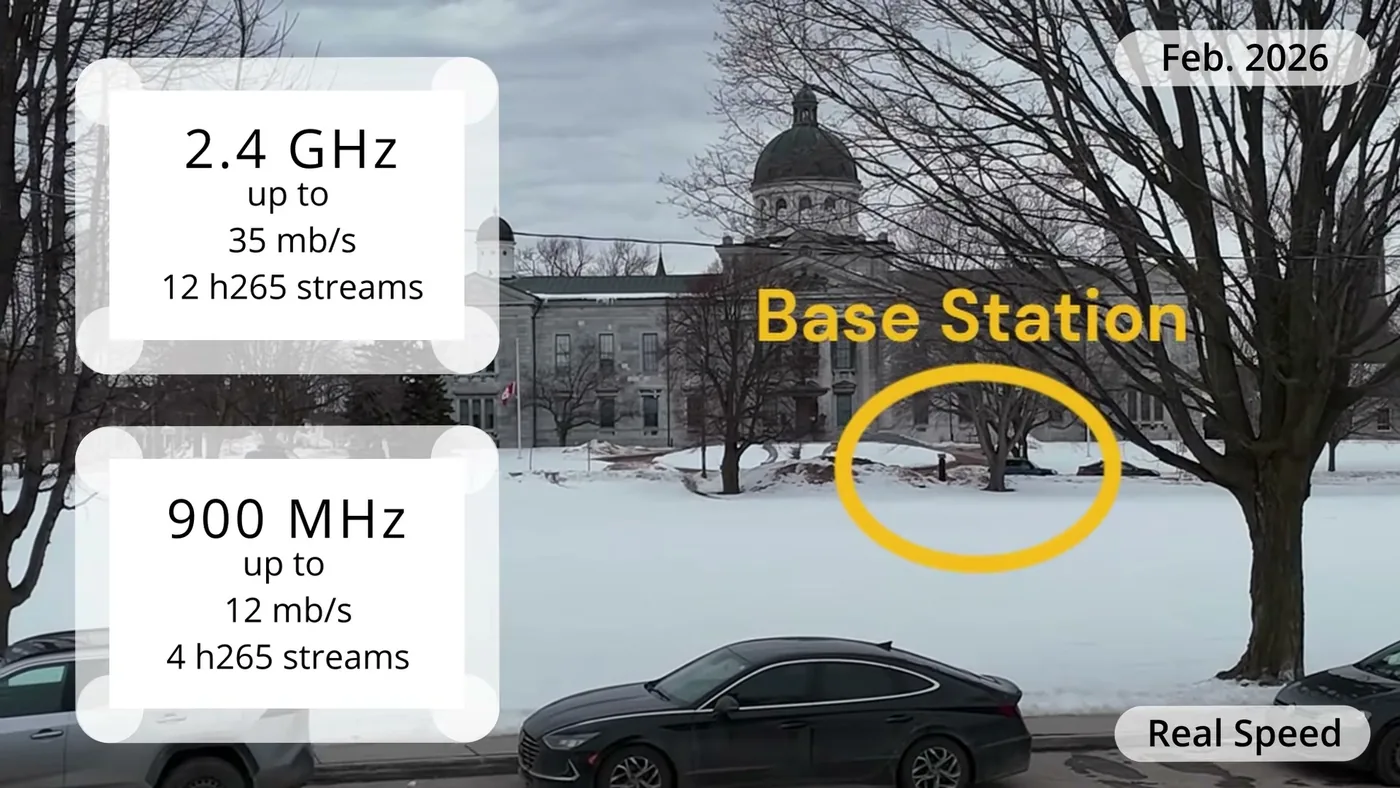
Power and compute. A seven-cell lithium polymer pack in 2023, an eight-cell lithium-ion pack in 2024 and two six-cell packs in series for 48 V in 2025, with endurance claims rising from 1 h 15 min to 1 h 25 min to about 2 h. Distribution uses independently fused branches with back-drive protection diodes. Compute moved from a Jetson Xavier NX to an unspecified rover computer whose integrated graphics unit runs detection at up to 40 frames per second S-QSET-SAR23 S-QSET-SAR24 S-QSET-SAR25 S-QSET-SAR26.
Mission performance
The 2022 season is the low point: Delivery zero and Equipment Servicing 7 on a rover whose arm had just been rebuilt S-URC22-SCORES. The 2023 season is the step change, and it coincides with the introduction of mock missions and per-task checklists rather than with a new arm S-QSET-SAR23.
The 2024 season produced the best Delivery score of the record, 74, and the best review score, 93.11, but Equipment Servicing fell to 15 with no stated cause. The arm description barely changed between 2023 and 2024, so the drop is more likely operational than architectural S-QSET-SAR24 S-URC24-SCORES.
The 2025 season is the most complete: every mission between 41 and 88, the review at 91.03, a total of 310.03 and a ninth place S-URC25-SCORES. The 2026 season then inverted again. Equipment Servicing reached 50.53, the best in the record, while Delivery fell to 10 and Autonomy to zero. Those are execution failures in a season with a capable arm, and they are the most useful thing in this dossier for another team to study S-URC26-SCORES.
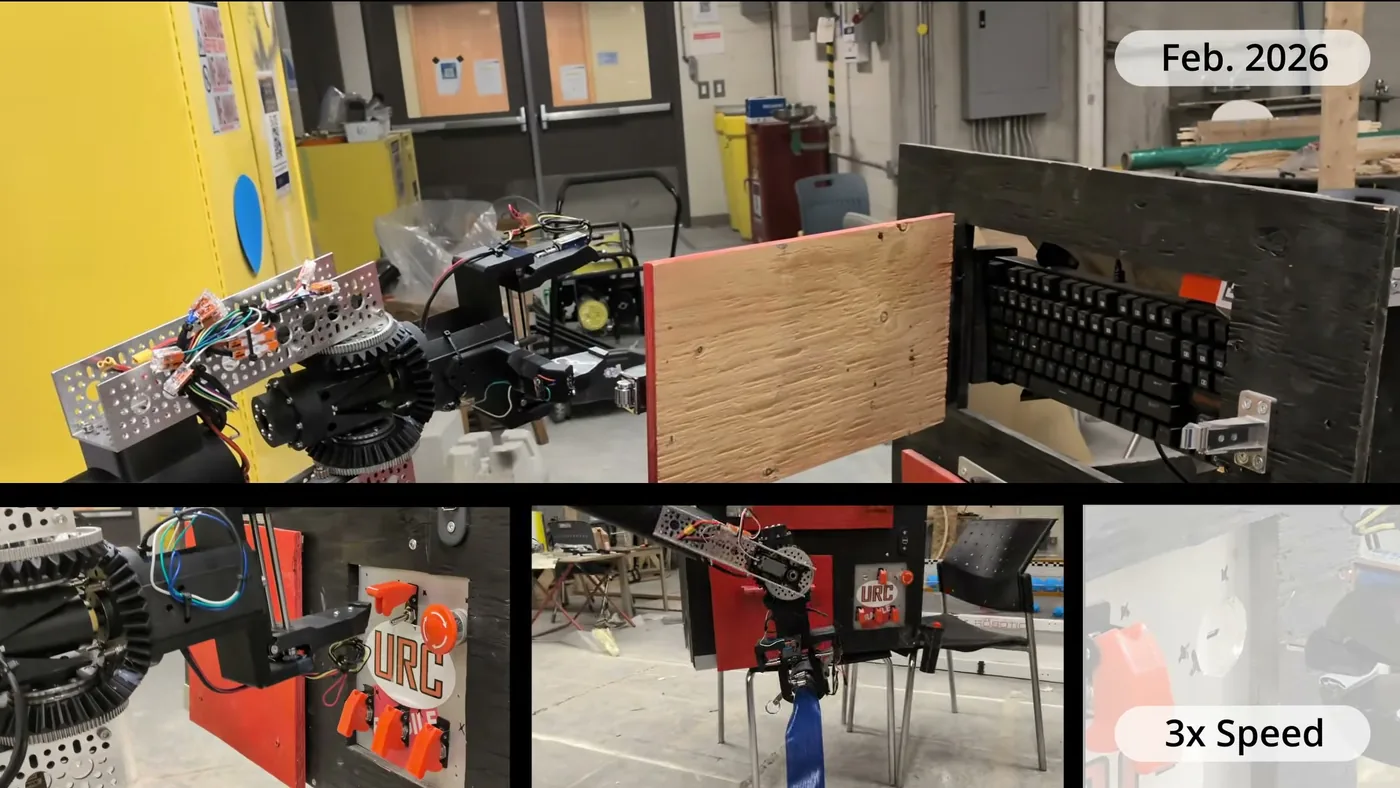
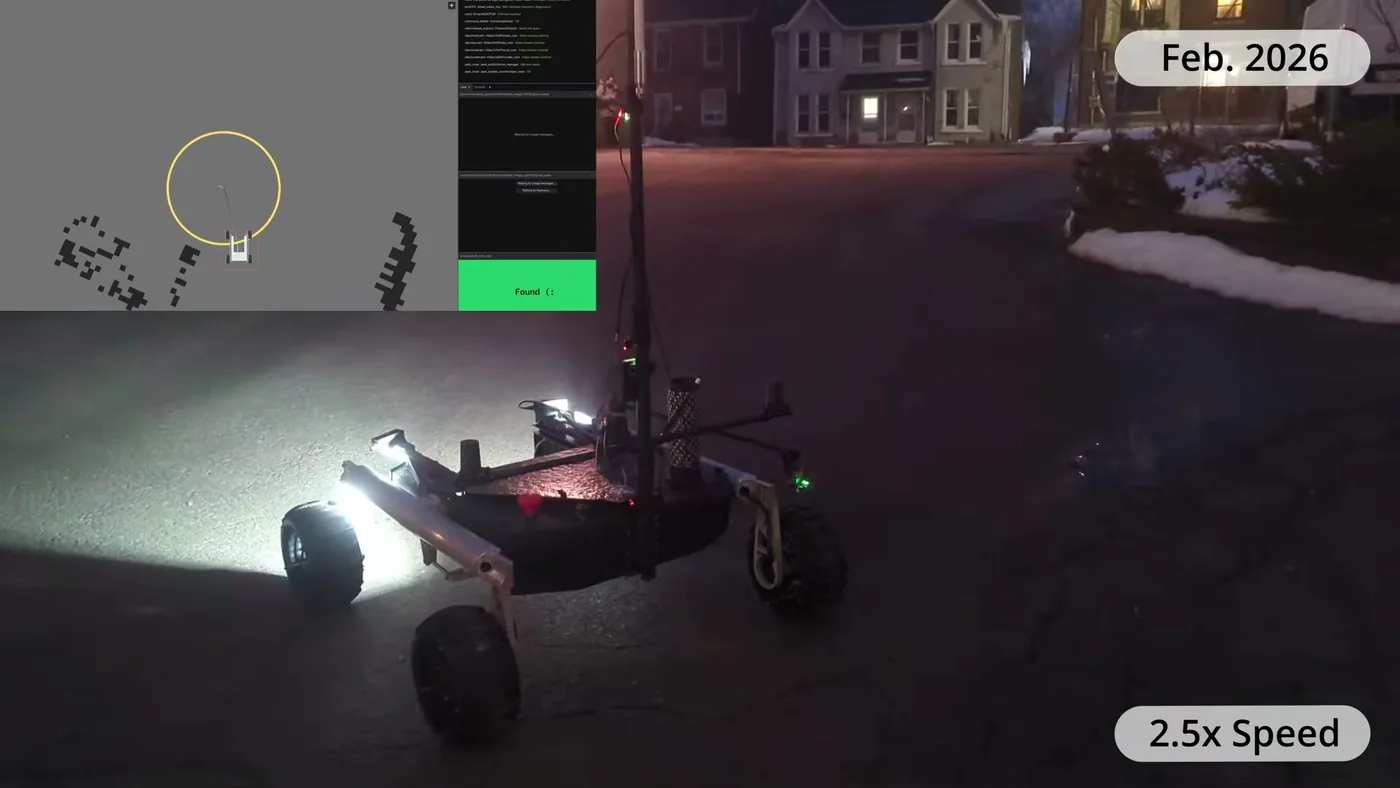
The operator station deserves a note of its own. The team runs a custom control board with two three-axis joysticks, a separate end-effector panel and dual displays for up to eight camera feeds, and a web application consolidating heading, position, velocity and subsystem diagnostics. A perimeter LED strip shows whether the rover is manual, autonomous or arrived, which makes the mode legible to judges and spotters from a distance S-QSET-SAR25 S-QSET-SAR26.
Lessons for a first build
- Architect the arm around the missions, not the other way round. Each arm generation moved the servicing score, and the 2026 wrist and effector are the most task-specific hardware on the rover.
- Run mock missions and write the checklists. QSET introduced both in the same season it moved from 18th to 7th. The practice is cheap and it targets integration bugs rather than design bugs.
- Do not replace a working autonomy stack in a competition year. The move to Nav2 coincided with an Autonomy score of zero. The migration may still have been right; the timing was not free.
- Make the rover’s mode visible. A perimeter LED strip that redraws manual, autonomous and arrived states costs grams and removes operator confusion.
- Publish one measured number. No mass, dimension, wheel size or battery capacity has ever been released. For a team at this level that is the largest remaining gap.
What remains uncertain
Mass, dimensions, wheel size, arm reach, battery watt-hours and drone mass are all unpublished, and no design report, drawing or code exists in public. Every mechanical statement in this dossier is either narrated in a review film or read from a frame. The cause of the 2024 servicing collapse is not stated, and neither is the cause of the 2026 autonomy zero. The correction source behind the differential GPS claim is not named, so the 4 cm figure cannot be assessed. The pre-2022 record is asserted by the university but was not checked against a results archive.
Team sources
- qset.ca, the team site.
- qset.ca/rover, the rover sub-team page.
- 2026 review film, the source of every frame on this page.
- 2025 review film, the peak season.
Sources for this page
- S-URC22-SCORESURC2022 Official ScoresOriginal
- S-URC26-SCORESURC2026 Official ScoresOriginal Archived copy
- S-QSET-SAR25Queen's Space Engineering Team SARPrint copy
- S-URC25-SCORESURC2025 Official ScoresOriginal
- S-QSET-SAR26Queen's Space Engineering Team SARPrint copy
- S-URC23-SCORESURC2023 Official ScoresOriginal
- S-URC24-SCORESURC2024 Official ScoresOriginal
- S-QSET-QUEENSNEWSQSET competes in the URC this SummerOriginal
- S-QSET-SAR22Queen's Space Engineering Team SARPrint copy
- S-QSET-SAR23Queen's Space Engineering Team SAR Video 2023 (YouTube, 5:10)Original
- S-QSET-SAR24Queen's Space Engineering Team SARPrint copy