Missouri S&T Mars Rover Design Team (MRDT)
Missouri S&T is the benchmark of the current field. It won the 2025 and 2026 competitions back to back, took a perfect 100 in Delivery and Equipment Servicing in 2026, and has built a new rover every year since 2013. It is also unusually transparent at the architecture level: public repositories, a documentation site, a simulator and a conference-paper series. That transparency makes it the best single team to study for how a mature programme organises a rover.
What this team shows
- A new rover every year is a deliberate strategy, not a reset. The team keeps a named platform family, a suspension architecture and an operator interface while changing the subsystems that need it.
- The 2026 win came from packaging and integration as much as from any single component: a compact suspension that no longer folds, hub motors, printed treads and a CAN-based control spine.
- The programme treats the review as a mission. Its SAR scores are consistently in the high 90s, and its 2026 score of 90.57 was achieved with a package that had to explain a much more complex rover.
- The weak point is public mass data. The team documents architecture in depth and bill-of-materials almost not at all.
Identity and results
| Year | Rover | Total | Rank | SAR | Science | Delivery | Equipment | Autonomy |
|---|---|---|---|---|---|---|---|---|
| 2022 | Prometheus | 370.71 | 3 | 94.71 | 96 | 80 | 58 | 42 |
| 2023 | Helios | 298.24 | 6 | 94.07 | 79.17 | 15 | 68 | 42 |
| 2024 | Hyperion | 341.54 | 4 | 94.54 | 82 | 15 | 94 | 56 |
| 2025 | Talos | 412.27 | 1 | 97.27 | 96 | 70 | 93 | 56 |
| 2026 | Athena | 469.57 | 1 | 90.57 | 93 | 100 | 100 | 86 |
The trajectory is the clearest in the field. The team returned from the pandemic in 2022 with a rover and a travel team that had never been to competition, finished third, dropped to sixth in 2023, then improved every year. The inflection is 2025, when the total jumped by 70 points. Most of that jump came from Delivery, which went from 15 to 70 to 100 in three seasons S-URC23-SCORES S-URC24-SCORES S-URC25-SCORES S-URC26-SCORES.
The 2023 and 2024 Delivery failures are the most useful part of the record. In 2023 the team ran out of time in Stage 1 without enough points to proceed. In 2024 mechanical failures in the rover-side signals and in the vertical axes of the arm ended the run. The 2025 and 2026 rovers were designed around those failures, and the result was two perfect Delivery scores.
Rover generations
2017 to 2021: the Mantis platform. Gryphon won in 2017 with the first Mantis suspension, custom motor controllers and flight-stick control from the base station. Atlas added inverse-kinematics control of the arm. Valkyrie added the largest science-mechanical effort to date, then lost its suspension at competition and finished fifth. Icarus and Aurora covered the two pandemic seasons; Aurora was a four-wheel omni-directional excursion that the team reversed the next year S-MST-SITE-ROVERS.
2022: Prometheus. A return to the six-wheel Mantis platform with priority on robust, reliable and manufacturable systems. The rover had a six-axis arm and on-board chemical analysis, and it finished third S-MST-SITE-ROVERS.
2023: Helios. A simplified drivetrain with the gas springs removed, an improved six-axis arm, and a science system with both chemical tests and a custom fluorometer. Delivery collapsed to 15 because the team ran out of time in Stage 1. A broken belt and AR-tag detection errors also cost points in Equipment Servicing S-MST-SITE-ROVERS S-MST-NEWS2023.
2024: Hyperion. The biggest architectural swing in the record: a Cartesian arm with one linear and one rotary axis, all wet chemistry replaced by custom spectrometers including Raman, a drone that never flew at competition, a managed-switch network, and autonomy rewritten in multi-threaded C++. Equipment Servicing rose to 94, but Delivery failed again at 15 with mechanical failures in the rover-side signals and the arm's vertical axes S-MST-SITE-HYPERION S-MST-NEWS2024.
2025: Talos. A hybrid Cartesian-rotary arm with a linear x-axis, custom inverse kinematics and a purpose-built simulator; a new autofluorescence microscope and a redesigned Raman spectrometer; a base station rewritten in Blazor Server; and autonomy matured in an Unreal Engine simulator, including autonomous typing. It won with the highest SAR score in the field, 97.27, and a 93 in Equipment Servicing S-MST-SITE-TALOS S-URC25-SCORES.
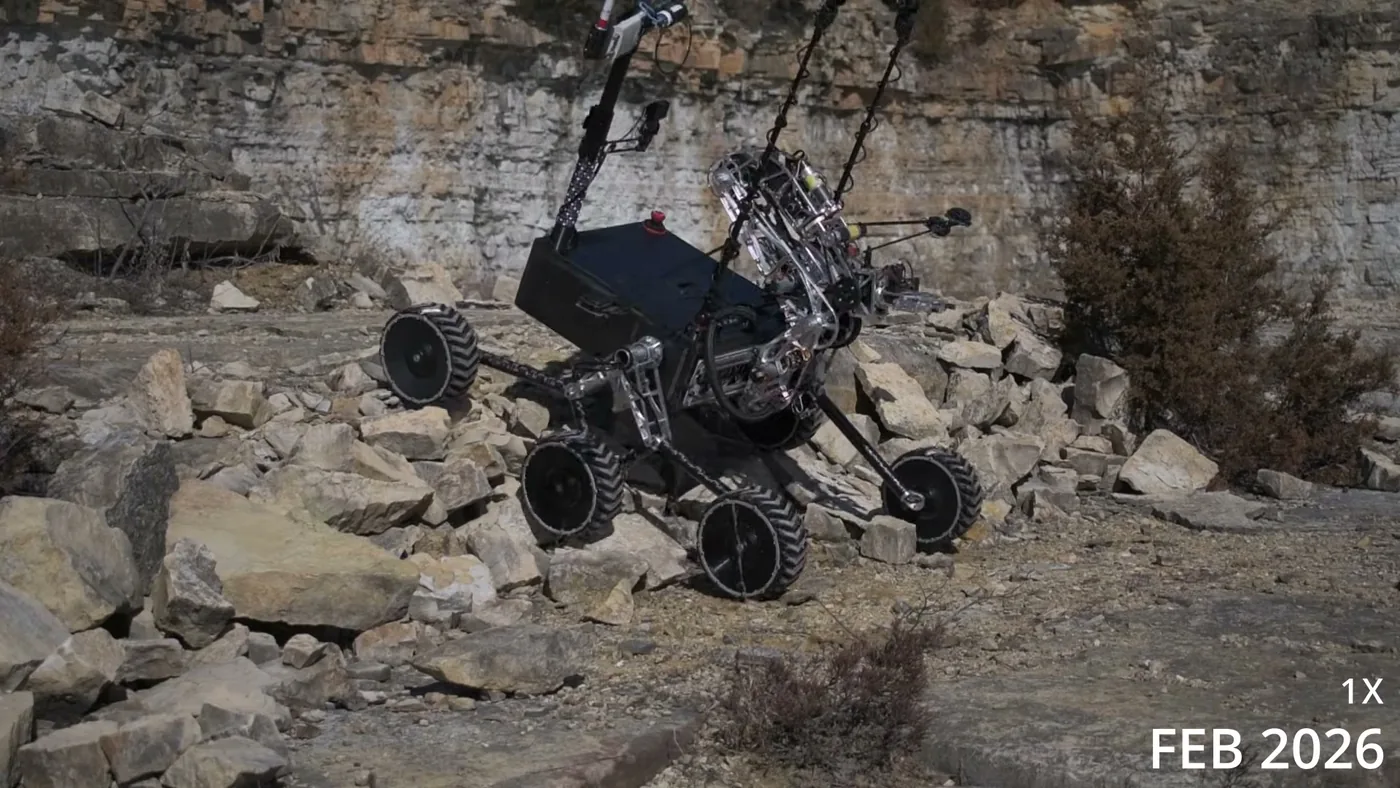
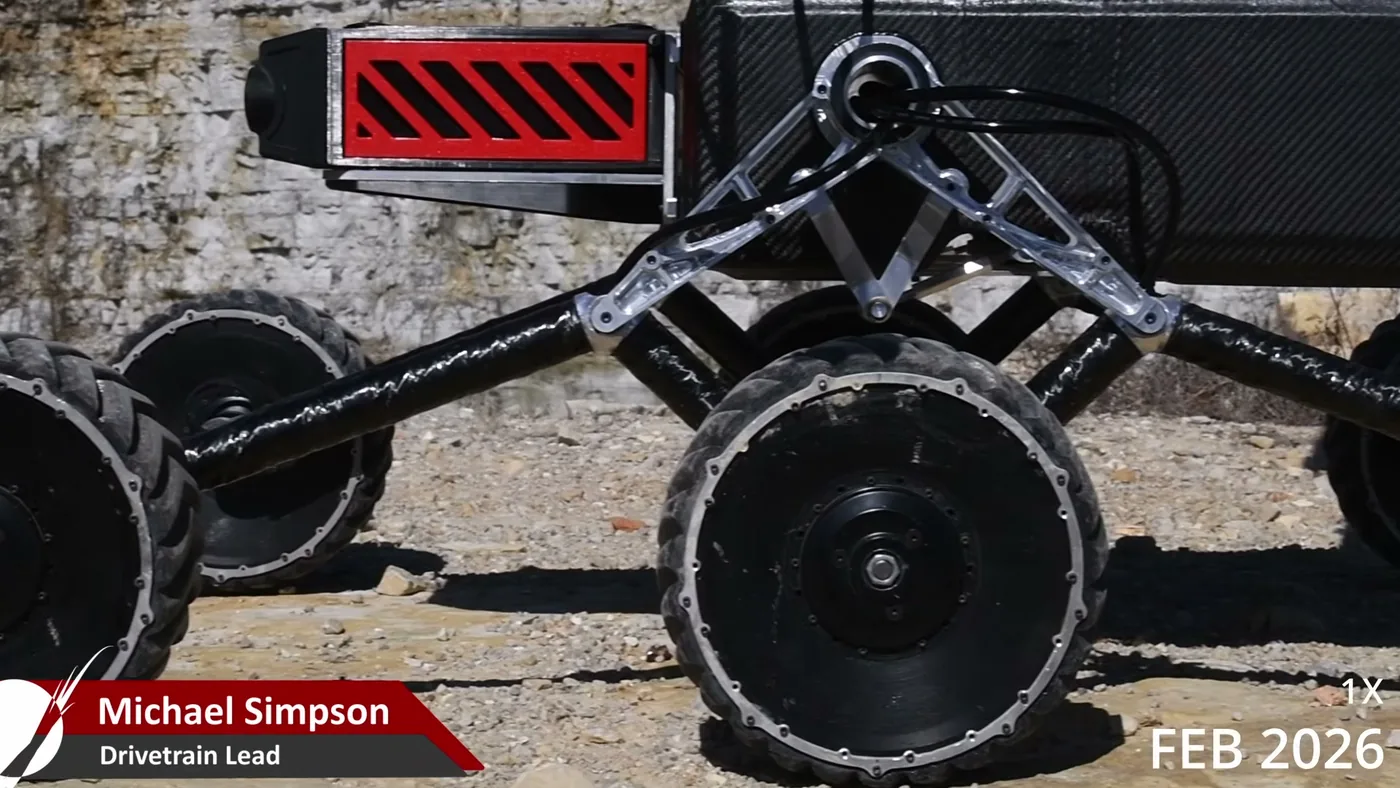
2026: Athena. A compact suspension that no longer needs to fold to fit the 1.2 m box, 3D-printed wheels with exchangeable TPU treads, hub motors replacing the previous propulsion units, custom brushed motor controllers on a central CAN board, and LiDAR plus satellite terrain data for hazard avoidance. It scored 100 in Delivery and 100 in Equipment Servicing S-MST-SITE-ATHENA S-URC26-SCORES.
Subsystems
Mobility. Six wheels on a compact Mantis suspension, skid steered, with hub motors and printed TPU treads in 2026. The design target is a rover that fits the cube without folding. The team's own history is the argument: folding adds joints, and joints are where the 2019 suspension failed S-MST-SITE-ATHENA S-MST-SITE-ROVERS.
Arm and end-effectors. The arm moved from six rotary axes to a Cartesian-rotary hybrid and back toward a compact six-axis layout. The 2025 and 2026 arms were designed around the servicing panel and the keyboard, with a custom simulator for operator practice and a compliant end effector for typing. The 2024 arm's vertical-axis failures are the cautionary case S-MST-SITE-TALOS S-MST-SITE-ATHENA.
Science. The payload moved from wet chemistry to a spectrometer suite and then to a mixed payload with an autofluorescence microscope and Raman. The 2026 payload scored 93, and the team's documentation shows the instrument suite rather than a single life-detection channel S-MST-SITE-ATHENA.
Communications. A 900 MHz base-station link with a mast-mounted antenna, a separate video plane, and a managed network on the rover. The 2026 SAR film shows the antenna sweep and the base-station layout S-MST-SITE-ATHENA.
Power and compute. Custom brushed motor controllers, each with an on-board STM32, on a central CAN board; a ZED camera bar and LiDAR for perception; and a base station that runs multiple synchronised clients. The architecture is distributed at the control layer and centralised at the data layer S-MST-SITE-ATHENA.
Mission performance
Missouri S&T is the only team in the 2022-2026 window with two overall wins. Its 2026 total of 469.57 is the highest in the record, and its 100s in Delivery and Equipment Servicing are the two missions that most often separate the top from the rest S-URC26-SCORES.
The 2026 Autonomy score of 86 is more instructive than the total. It is not a perfect score, and the team still won comfortably. The lesson is not that autonomy does not matter; it is that a team can win by being excellent at the missions it can control while being merely good at the one with the highest variance. The 2027 rules add astronaut assistance, which raises the autonomy risk for every team, including this one.
Lessons for a first build
- Build a new rover, keep a platform. The named rovers change, but the suspension family, the operator interface and the review process persist. A first build should copy the persistence, not the annual redesign.
- Fix Delivery before adding sophistication. Two seasons of 15-point Delivery were cured by designing around the Stage-1 gate, not by adding autonomy.
- Package the cube early. The 2026 suspension change came from a packaging requirement, not a performance one. A first build should own a physical 1.2 m gauge from week three.
- Treat the review as a mission. The SAR scores are consistently high because the team plans the evidence, not because the writing is elegant.
- Publish the architecture, not the bill of materials. The public record is rich enough to copy an architecture and too thin to copy a mass budget. A first build has to weigh its own parts.
What remains uncertain
The team does not publish its SAR paper, and no mass, dimension, wheel-size, motor-model or battery-capacity figure appears in a public source. Any mass claim about this rover should be treated as unsourced until proven. The 2026 battery chemistry, pack capacity and centre of gravity are not public. The 2026 arm's stiffness and backlash are not published, and the team's own films show the result rather than the measurement.
Team sources
- marsrover.mst.edu, the team site, with a page per rover.
- Athena, 2026, the 2026 rover page.
- RoveSoDocs, the documentation site source.
- MissouriMRDT on GitHub, the team's repositories.
- 2026 SAR film, the primary video for the 2026 rover.
- 2023 SAR film, the Helios walkthrough.
- University news, 2026, the win release and the SAR score.
Sources for this page
- S-URC23-SCORESURC2023 Official ScoresOriginal
- S-URC24-SCORESURC2024 Official ScoresOriginal
- S-URC25-SCORESURC2025 Official ScoresOriginal
- S-URC26-SCORESURC2026 Official ScoresOriginal Archived copy
- S-MST-SITE-ROVERS"Our Rovers" index, all 14 rovers with per-year design narrativeOriginal
- S-MST-NEWS2023MRDT Winter 2023 Newsletter (PDF, 4.2 MB), URC 2023 review (belt break, Stage-1 delivery failure, rain delay) and 2024 design intentOriginal
- S-MST-SITE-HYPERIONHyperion (2024) rover page, Cartesian arm, all-spectroscopy science, first drone Zephyr, C++ autonomy, managed switchOriginal
- S-MST-NEWS2024MRDT Newsletter Winter 2024–25 (PDF, 7.5 MB), URC 2024 review with failure forensics, 2025 design update, 88 active membersOriginal
- S-MST-SITE-TALOSTalos (2025) rover page, autofluorescence microscope, hybrid arm, Unreal sim, Blazor basestationOriginal
- S-MST-SITE-ATHENAAthena (2026) rover page, compact suspension, 3D-printed wheels, hub motors, STM32/CAN controllers, simulator arm, LiDAROriginal