Mass and power
A first 2027 build should mass 45–46 kg with 4 kg of reserve, draw 95–160 W average and 3–4 kW at peak, and carry 400–500 Wh, about 2.4–2.9 kg of pack. The rest of this page gives the evidence and the arithmetic behind those numbers. The evidence is thin on purpose: fourteen of 187 team-years publish a total mass, exactly one mass was read off a judge’s scale, one team publishes a subsystem breakdown, and no team publishes a measured energy figure for a mission.
Key takeaways
- The 50 kg limit is a constraint, not a target. Seventeen configurations from eight teams have a mean mass of 47.9 kg and a median of 49.1 kg, with several pinned just under the cap and three at exactly 50.0 kg, which is not an engineering optimum.
- The 1.2 m cube is the higher-stakes limit. The oversize penalty is 40 % of one event’s points, the equivalent of 8 kg of overweight at a score of 80, against 5 % per kilogram for mass.
- The hotel load is nearly mass-independent and drive is strictly proportional. The fixed load grows from 46 W at 35 kg to 63 W at 50 kg, while drive power grows with mass, so cutting 10 kg saves about 25 W of drive and almost nothing off the hotel.
- Peak current, not energy, often sets the pack. The credible simultaneous peak is 120–160 A at 24 V, three to four kilowatts, on a 95–160 W average, and a 4P cell stack rated 180 A lands at 496 Wh, inside the recommended band.
Three mass budgets, and what one kilogram costs
The 2027 rules create three mass budgets, not one S-URC27-RULES §2.a.ii–iii. The first is 50 kg per mission configuration, with 5 % of that event’s points per kilogram over. The second is 70 kg across all fielded parts, the union of rover, arm, science module and deployables, which is not a second free rover. The third is a 1.2 m cube at every weigh-in, wheels and antenna included, foldable but not disassemblable, penalised at 40 % of that event’s points.
| Budget | Limit | Consequence of exceeding |
|---|---|---|
| Per-mission configuration | 50 kg | 5 % of the points scored in that event, per kilogram over |
| All fielded parts | 70 kg | The union is over budget even when each configuration is legal |
| Stowed envelope | 1.2 × 1.2 × 1.2 m | 40 % of that event’s points |
Three consequences follow. Mass is the mild penalty and size is the severe one: scoring 80 and being 1 kg over costs 4 points, while a 40 % oversize penalty costs 32 points, the equivalent of 8 kg of overweight, per event. Weight rounds down: 50.9 kg is recorded as 50 kg and the cliff is at 51.0 kg S-URC27-RULES §2.a.iii. The weigh-in target should still be 49.5 kg or less on the team’s own scale, with the rounding treated as unearned. Penalties multiply the points scored and add across events, so 2 kg heavy costs 10 % of the score, and the better the missions go the more mass costs.
The enforcement record is nearly empty. Across 187 team-year rows in the 2022–2026 sheets the penalty column is non-empty exactly once: Mars Rover UdeG Space, 2025, 16.39 points, with the cause not stated S-URC25-SCORES. USU measured 51.8 kg in arm configuration in 2025 and carries no penalty in the sheet S-USU-2025-POSTER. The practical implication is that a first team cannot learn the real cost of being overweight from past results, only from the rule arithmetic.
The mass database: seventeen configurations from eight teams
Seventeen configurations across eight teams have a mass figure of some kind. Each row gives its basis: a team specification, a judge’s scale, a university report or arithmetic from a stated change.
| Team | Year | Rover | Configuration | kg | Evidence basis |
|---|---|---|---|---|---|
| UIU | 2022 | Maven | competition | 49.8 | stated by the team S-UIU-ROVER-PAGES-EARLIER-GE-03 |
| UIU | 2023 | Telos | competition | 47.8 | stated by the team S-UIU-ROVER-PAGES-EARLIER-GE-02 |
| UIU | 2024 | Yggdrasil | competition | 49.2 | stated by the team S-UIU-ROVER-PAGES-EARLIER-GE |
| UIU | 2025 | Axios | competition | 48.5 | stated by the team S-UIU-AXIOS-2025 |
| UIU | 2026 | Aurion | competition | 47.5 | stated by the team S-UIU-ROVER-PAGE-AURION |
| BRACU Mongol-Tori | 2025 | Hypersonic | competition | 48.0 | stated by the team S-BRACU-SITE-HYPERSONIC |
| BRACU Mongol-Tori | 2026 | Taurus | competition | 50.0 | stated by the team S-BRACU-ROVER-PAGE-TAURUS-2026 |
| WVU Team Mountaineers | 2022 | predecessor | competition | ≈53.0 | from a stated change S-WVU-SAR2023 |
| WVU Team Mountaineers | 2023 | Wanderer | competition incl. 5-DoF arm | 33.0 | stated by the team S-WVU-SAR2023 |
| Northeastern | 2025 | unnamed | competition | ≈51.0 | from a stated change S-NEU-NEWS-2026 |
| Northeastern | 2026 | unnamed | competition | ≈46.0 | university news S-NEU-NEWS-2026 |
| Monash Nova Rover | 2021 | Wombat | ARC competition | 49.1 | stated by the team S-MONASH-ROVERS |
| Utah State | 2025 | Sophia | science configuration | 46.9 | stated by the team S-USU-2025-POSTER |
| Utah State | 2025 | Sophia | arm configuration | 51.8 | stated by the team S-USU-2025-POSTER |
| Toronto MetRobotics | 2026 | Ingenuity | competition | 50.0 | stated by the team S-TMR-METROBOTS |
| MIST Mongol Barota | 2021 | Phoenix | virtual URC, judge-weighed | 42.1 | judged at weigh-in S-MIST-VURC2021 |
| MIST Mongol Barota | 2025 | Aurora X | competition | 50.0 | stated by the team S-MIST-SITE-ROVERS |
Mean 47.9 kg, median 49.1 kg, range 33.0–53.0 kg; fifteen of the seventeen sit between 42.1 and 51.8 kg.
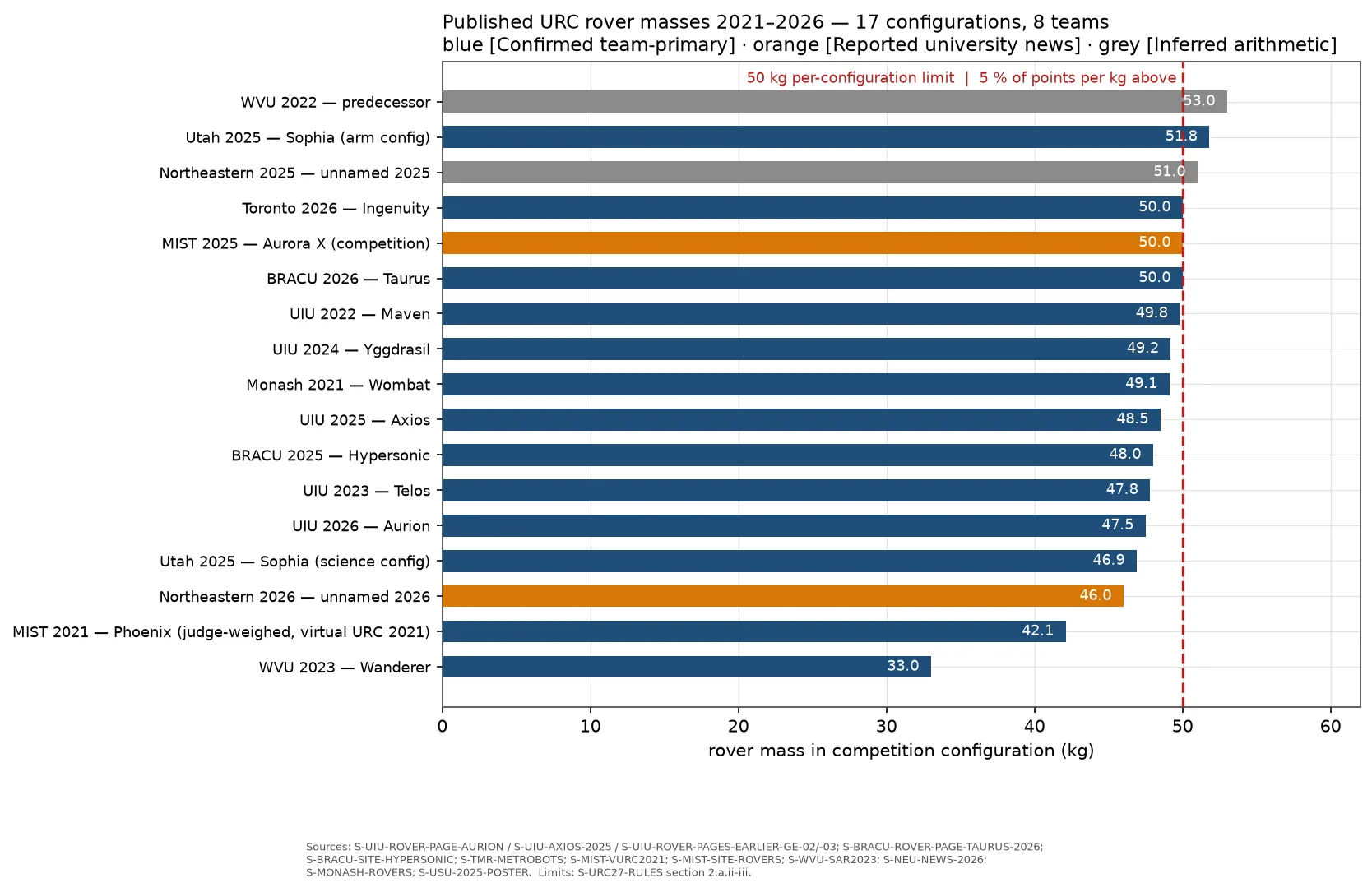
- The median is 49.1 kg because the cap is what gets measured. Several configurations sit at 49.8 kg or more, three of them at exactly 50.0 kg, and the pile-up under the line is not explained by any engineering argument.
- WVU’s 33 kg is the most important datum here. Wanderer won 425.35 points at 33 kg with a 5-DoF arm lifting 8 kg at full extension, and the 20 kg reduction came from fabrication, semi-monocoque sheet metal and composite wheels, not from a diet S-WVU-SAR2023 S-URC23-SCORES. Fifty kilograms is 1.5 times a championship rover.
- UIU is the best natural experiment in the field. Five generations sit at 47.5–49.8 kg while the score rises from 236.67 to 400.44 and the battery grows from 432 to 840 Wh S-UIU-ROVER-PAGE-AURION S-UIU-AXIOS-2025. Mass is the stable variable and capability is the moving one.
- The only judge-weighed mass disagrees with the team’s card. The virtual-2021 stream read 42.1 kg where the team reports 45 kg, and the judge’s number wins S-MIST-VURC2021 S-MIST-SITE-ROVERS.
- Four of the five championship titles from 2022 to 2026 were won without a published mass: Michigan 2022, AGH 2024, and Missouri S&T in both 2025 and 2026 S-URC22-SCORES S-MST-GH-ORG. Any mass quoted for Missouri S&T is invented until sourced.
The full dataset behind the numbers on this page, including the per-row source for every mass, is the table below. It switches between its seven sections and searches every row.
Where the mass goes
The only measured breakdown in the public record is Monash’s 2026 robot description, covering the rolling chassis and arm only: no battery, electronics, science or drone S-MONASH-GH-NOVA. Of its 30.88 kg, the wheels are the largest single line.
| Element | Mass (kg) | Share of the 30.9 kg accounted |
|---|---|---|
| Wheels ×4 | 7.40 | 24.0 % |
| Suspension legs | 6.72 | 21.8 % |
| Arm incl. gripper | 6.54 | 21.2 % |
| Chassis | 5.46 | 17.7 % |
| Ankles and pivots ×4 | 4.32 | 14.0 % |
| Differential bar | 0.42 | 1.3 % |
| Accounted total | 30.88 | 100 % |
Three things follow. Wheels outweigh the arm, so a 0.6 kg printed wheel instead of a 1.85 kg composite-spoke wheel saves 5 kg on a four-wheel rover. Suspension and pivots are 36 % of the accounted mass, which is where a six-wheel rover pays its bill against a four-wheel one. And arm, wheels and chassis are comparable, so a 50 kg rover is five or six decisions of 5–8 kg, any one of which going 50 % over eats the reserve.
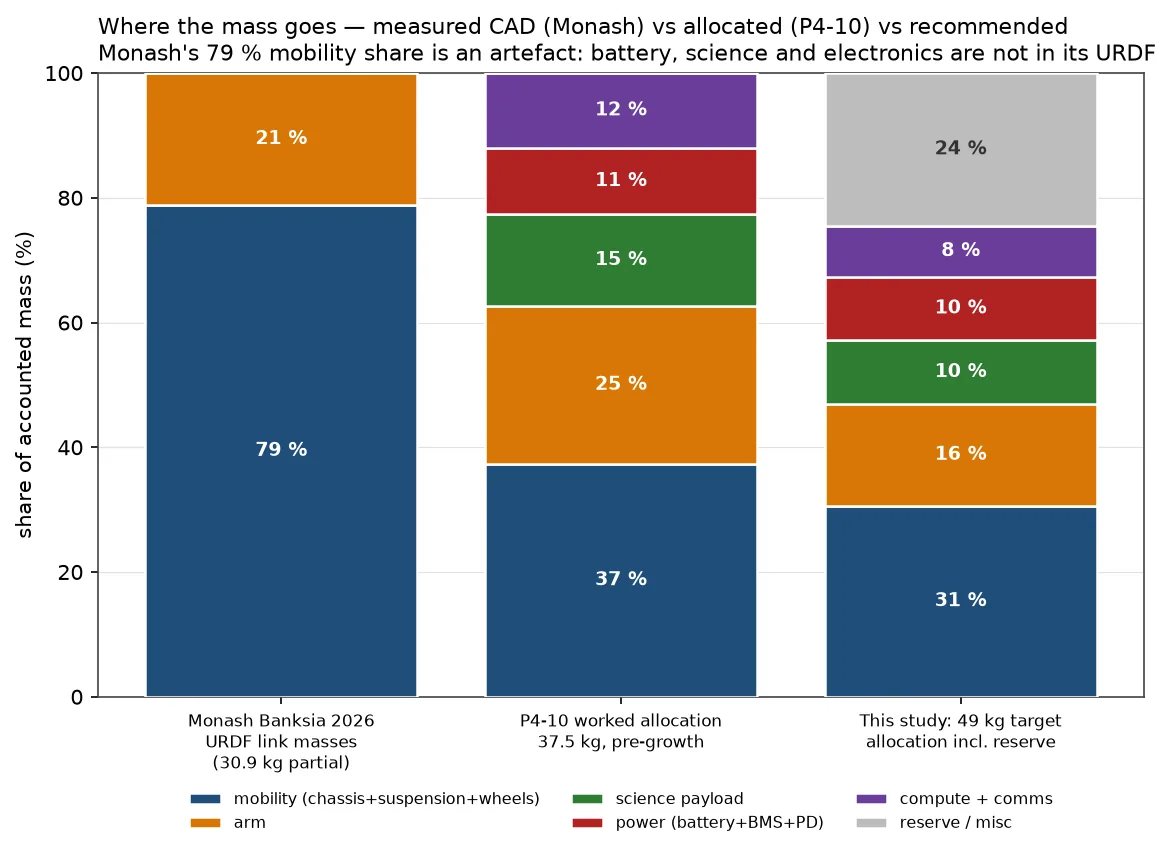
At a 49 kg target the allocation is explicit, and the reserve is the payload line:
| Line | kg | Share of 50 kg |
|---|---|---|
| Mobility, six wheels and six motors | 15.0 | 30 % |
| Arm, 5–6 DoF, about 1 m, gripper | 8.0 | 16 % |
| Power, 500 Wh pack with BMS and distribution | 5.0 | 10 % |
| Compute, sensors, comms, antennas | 4.0 | 8 % |
| Science payload | 5.0 | 10 % |
| Structure, fasteners, cable, mast hardware | 2.0 | 4 % |
| Subtotal | 39.0 | 78 % |
| Reserve | 10.0 | 20 % |
| Total | 49.0 | 98 % |
The science payload itself is 3.5–5 kg, so most of the 10 kg reserve is not science. A team that plans a 9 kg science module against the 50 kg limit and then adds a mast, a drone battery and two kilograms of brackets discovers that the module was never the last line in the budget.
The arm is the only subsystem with a real spread. Cornell and Toronto RSX both fly six-degree-of-freedom arms at 3.53 kg and 4.42 kg, against 9.4 kg for WVU’s five-degree-of-freedom arm and 14.0 kg for ARES with a 400 mm linear stage, a spread of 4.0 times S-RSX-ARM-URDF S-WVU-SAR2025 S-ARES-PAPER-2025. The reducer and the linear stage carry the mass, not the link length.
What the rover draws
The power model is a first-order estimate, not a measurement; its purpose is to show which assumptions dominate. Loads are separated into the hotel, the drive, the arm and the science payload, and every mission is priced at 35 kg and at 50 kg.
| Load | 35 kg design | 50 kg design | Basis |
|---|---|---|---|
| Hotel at the battery | 46 W | 63 W | Compute, radios, cameras, fans and LEDs, plus 8 % conversion loss |
| Drive, while driving | 86 W | 123 W | 2.46 W/kg at a rolling resistance of 0.12, a 3° mean grade and 0.8 m/s |
| Arm, while arm-active | 20 W | 29 W | 3.0 W/kg of arm; the arm is 19 % of rover mass |
| Science, while science-active | 25 W | 25 W | Mass-independent |
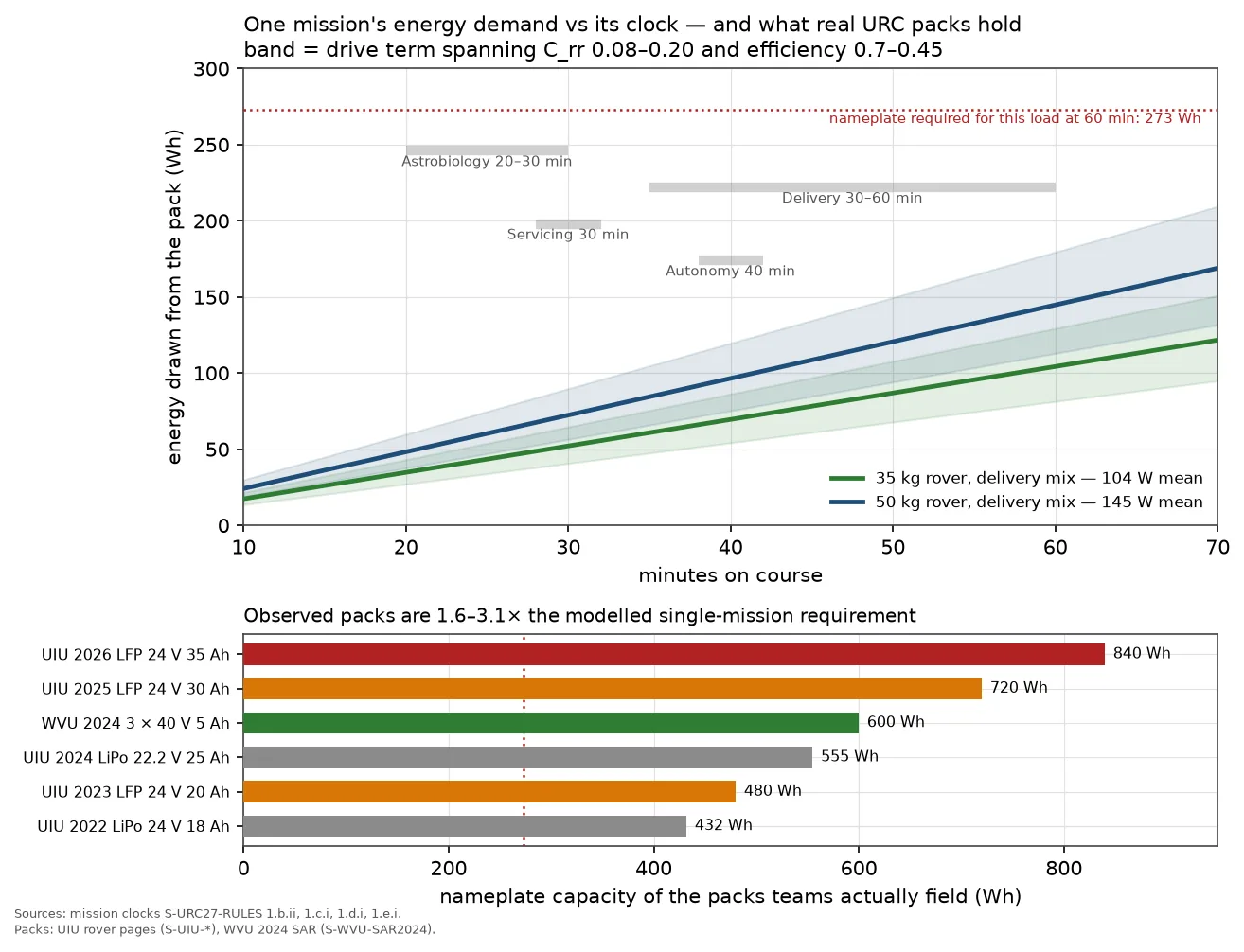
Cutting 10 kg saves about 25 W of drive power and almost nothing off the hotel. A light rover is hotel-dominated and a heavy rover is drive-dominated, and that is the whole mass-power relationship in one sentence. The power study’s independent 50 kg table lands in the same place: 249 W mean and 146 Wh over a 35-minute mission, against 123 W while driving and 74 W averaged over a 60-minute Delivery in this model, and 3.7 kW at the simultaneous peak. The mission clocks are the rule clocks: 20–30 minutes for astrobiology, 30–60 for Delivery, 30 for servicing and 40 for autonomy S-URC27-RULES §1.b.ii–§1.e.i.
| Mission and clock | 35 kg | 50 kg |
|---|---|---|
| Astrobiology, 30 min | 46 Wh | 62 Wh |
| Delivery, 30 min | 52 Wh | 72 Wh |
| Delivery, 60 min | 104 Wh | 145 Wh |
| Equipment Servicing, 30 min | 35 Wh | 47 Wh |
| Autonomy, 40 min | 76 Wh | 106 Wh |
| Autonomy then Servicing, 70 min | not modelled | 153 Wh |
| Nameplate, one 60-minute Delivery | 197 Wh | 273 Wh |
| Nameplate, the back-to-back pair | not modelled | 289 Wh |
The worst case is the clock, not the mission. Every mission except the 60-minute Delivery fits inside about 106 Wh at any mass, and the rules allow servicing to begin ten minutes after autonomy, so the back-to-back pair totals 153 Wh before margin S-URC27-RULES §1.d.i. Sizing a pack on a generic 30-to-40-minute mission sizes for about 70 % of the worst case.
Peak current is the number that sizes the fuse and often the pack. At 25.6 V, a 30° climb at 50 kg draws 11 A, a single stalled shoulder joint 24 A, and six motors at their controller limits 120 A. The credible simultaneous peak, climb plus one joint plus hotel, is 156 A or about 4.0 kW; the power study’s estimate of everything at once is 145 A and 3.7 kW.
| Case | W | A |
|---|---|---|
| Hill climb, 50 kg, 30°, 0.5 m/s | 269 | 11 |
| One shoulder joint at stall | 624 | 24 |
| Wheel slip at the controller limits | 3 072 | 120 |
| Credible simultaneous peak | 3 994 | 156 |
| Independent estimate, everything at once | 3 712 | 145 |
The peak is 20 to 30 times the power a rover draws while rolling, and about 15 times the 249 W mission average. The ratio drives four decisions: the parallel count of the pack, a time delay on the battery-management trip so a legitimate peak does not shut the rover down, a software interlock between drive and arm, and a fuse rated above the peak rather than above the average. The protection chain is ordered controller limits, then the battery-management trip, then the fuse curve, then wire ampacity, then connector rating. Missouri S&T’s 80 A trip at 10 ms would open on a legitimate 156 A peak, which is why their published design restores automatically after 3 s S-MST-2023-POWER.
Sizing the pack: 273 to 289 Wh, then choose 400 to 500 Wh
From mission energy to nameplate, the derating chain multiplies four factors, and the result for the 60-minute Delivery at 50 kg is 273 Wh:
| Step | Value | Basis |
|---|---|---|
| Mission energy | 145 Wh | 60-minute Delivery at 50 kg |
| Plus 25 % mission margin | 181 Wh | Unmodelled hills, radio at maximum, extra arm moves |
| ÷ depth of discharge 0.80 | 227 Wh | 80 % discharge is about 400 cycles against 600 at 60 % S-BU-808 |
| ÷ temperature and ageing 0.92 | 246 Wh | 38 °C ambient plus end-of-life capacity loss |
| ÷ path efficiency 0.90 | 273 Wh | Sized at the bus, not at the cells |
| Combined usable fraction | 0.662 | 0.80 × 0.92 × 0.90 |
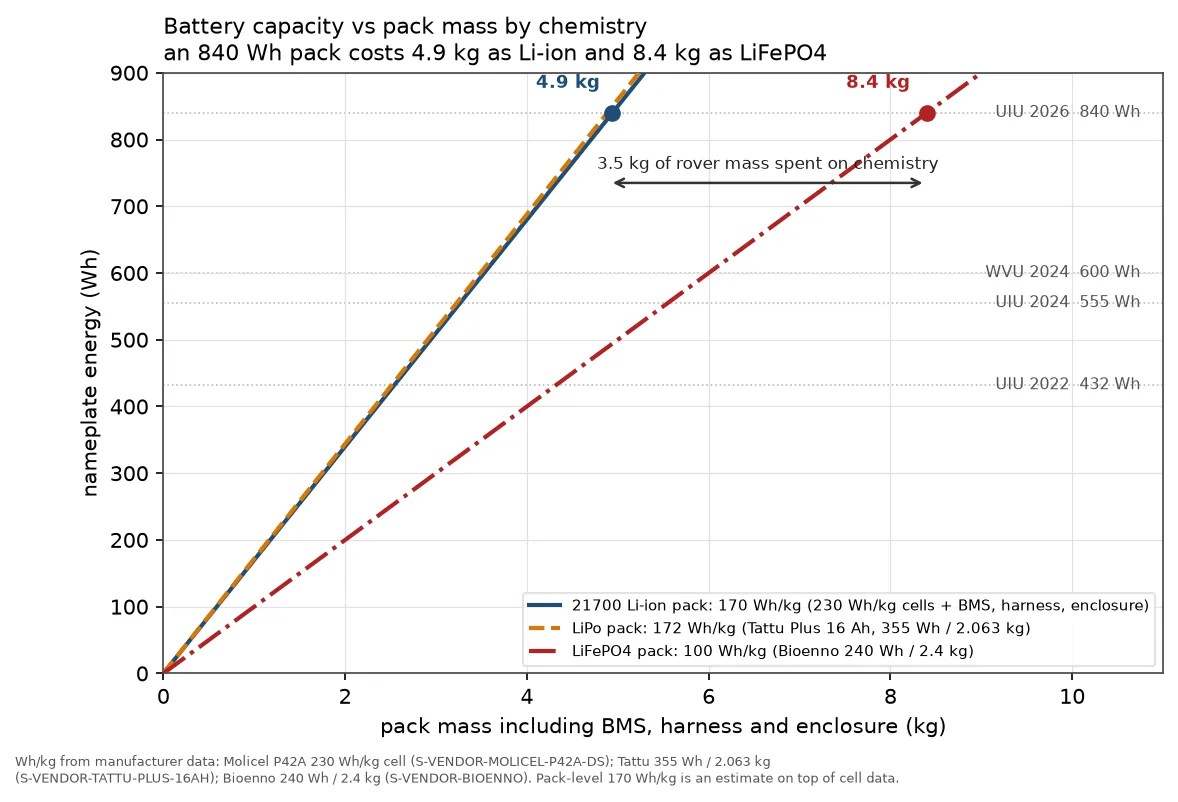
Chemistry changes the derating and the mass in opposite directions. Packaged LiFePO4 accepts a deeper discharge, 0.90 instead of 0.80, so it needs 243 Wh of nameplate, but at 100 Wh/kg instead of 170 Wh/kg it masses 2.4 kg against 1.6 kg for the same mission.
| Chemistry | Usable fraction | Nameplate for the same mission | Wh/kg at pack level | Pack mass |
|---|---|---|---|---|
| 21700 Li-ion (P42A class) | 0.662 | 273 Wh | 170 | 1.6 kg |
| LiPo pouch | 0.662 | 273 Wh | 172 | 1.6 kg |
| Packaged LiFePO4 | 0.745 | 243 Wh | 100 | 2.4 kg |
The recommendation is 400–500 Wh of nameplate at 8S, Li-ion 21700, 2.4–2.9 kg including battery management and enclosure, and two packs rather than one big one. Two 450 Wh packs mass 5.3 kg fielded, one flies while the other charges, and a pack carried as a spare but not fitted does not count against the 50 kg S-URC27-RULES §2.a.iii. The band covers the 289 Wh back-to-back case with 38–73 % headroom and keeps the current rating comfortable, because 4P of that cell is rated 180 A continuous and 8S4P is 496 Wh S-VENDOR-MOLICEL-P42A-DS.
Why the packs teams field are 1.6 to 3.1 times the model. Current-driven sizing explains 400–500 Wh without any energy argument. Two missions on one charge adds about 100 Wh. Conservative derating adds 10 %. Unmodelled hotel growth is real: WVU ran eleven cameras, a three-dimensional lidar, three radios and two computers in 2026, and UIU grew from 432 to 840 Wh while mass stayed flat S-WVU-SAR2026 S-UIU-ROVER-PAGE-AURION. LiFePO4 costs 50 to 100 % more watt-hours for the same mass. And nobody can calibrate, because no team publishes a measured figure.
What the model cannot do. Varying the five main assumptions moves the nameplate requirement across 221 to 410 Wh, and the two that matter are mission duration and mean speed. The energy budget is a driving-distance budget in disguise, so a rover that is 20 % more efficient but drives 30 % further uses more energy.
Mass against score: a marker, not a lever
The mass analysis asks whether mass predicts score. The answer is a correlation that fails both causal tests.
| Test | Value | Reading |
|---|---|---|
| Spearman correlation, mass against total, n = 12 | −0.60, p = 0.04 | Statistically real in this sample |
| Score normalised within year | −0.52, p = 0.08 | Partly a year effect in disguise |
| The two inferred masses dropped, n = 10 | −0.72, p = 0.02 | Strengthens, so interpolation is not driving it |
| Leave-one-out range | −0.48 to −0.75 | No single point dominates |
The mission decomposition is backwards from the physics. The most mass-sensitive mission, Delivery, correlates weakest at −0.46 (p = 0.13), while Equipment Servicing, whose workload barely depends on mass, correlates at −0.61 (p = 0.03); autonomy is −0.67 (p = 0.02) and science −0.12 (p = 0.70). That is what a confounder looks like: heavy teams are heavy because the design did not converge, and the same failure costs points everywhere.
Within a team the correlation disappears entirely. UIU moved −2.3 kg for +164 points, WVU −20 kg for +157, Northeastern −5 kg for −12 and BRACU +2 kg for +30 S-UIU-ROVER-PAGE-AURION S-WVU-SAR2023 S-NEU-NEWS-2026 S-BRACU-ROVER-PAGE-TAURUS-2026. Heavier and better, lighter and worse.
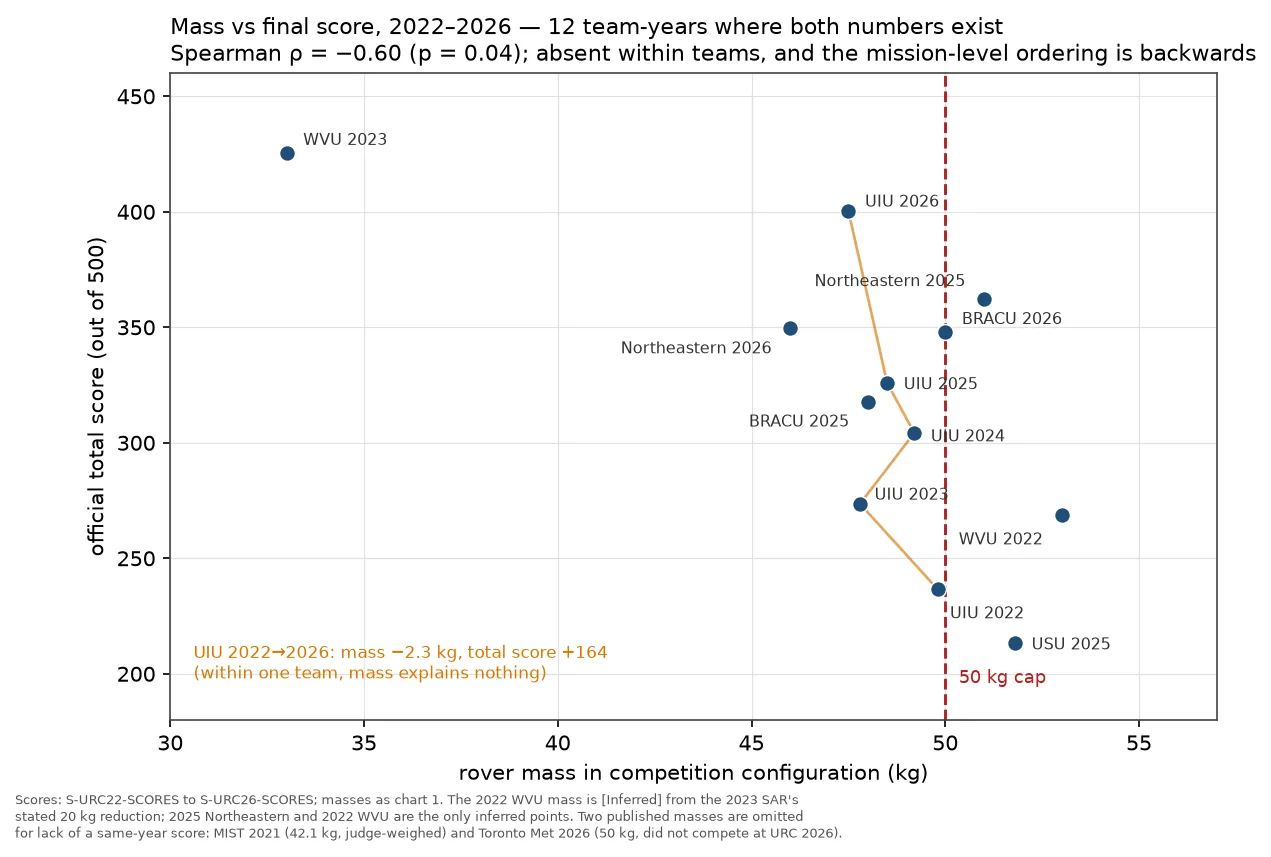
There is no interior optimum in the observed range. The 33 kg winner and the 42–50 kg cluster both score between 200 and 425. The question for a first build is not how heavy but how much reserve: 45 kg with 4 kg unspent beats 49.5 kg with none, because the last 3 kg of a first build arrive in the final six weeks.
Margin policy and the weigh-in plan
| Stage | Allowance | What it covers |
|---|---|---|
| Preliminary design | +20 % on estimated structure and mechanism mass | Parts not yet designed |
| Critical design, CAD complete | +10 % on unbuilt parts, 0 % on measured | Machining tolerance, fasteners, brackets |
| Integration, hardware exists | +5 % on the whole rover | Cable, tape, the second E-stop |
| Weigh-in target | 49.5 kg or less on the team’s own scale | Scale variance between events, dust, humidity, rounding |
| Science module reserve | 6 kg or more of the 50 kg | A module added after the first weigh-in |
The weigh-in plan matters as much as the budget. USU measured 51.8 kg in arm configuration and 46.9 kg in science configuration from the same programme, a 4.9 kg spread between two legal-looking builds, one of them over S-USU-2025-POSTER. That is the failure mode: not a rover that is obviously too heavy, but one whose heaviest configuration is discovered at the field. The defence is to weigh the bare chassis, each subsystem as it is completed, the integrated rover at three points, and the heaviest mission configuration rather than the science one.
Open problems
- What is Missouri S&T’s competition mass? No public number exists for the 2025 and 2026 champion, after a documented search of the team site, 224 public code projects, four SAR videos and twelve papers S-MST-GH-ORG. It is the highest-value missing datum in the field.
- What is the real rolling resistance at MDRS? The whole power model rests on an assumed 0.12 for a six-wheel skid-steer on sand, gravel and rock. A tow test at 40 kg would close it in an afternoon.
- How many watt-hours does a mission actually take? No team publishes a measured figure, so every energy number here is a model with a stated basis.
- Was the 51.8 kg Utah State configuration penalised? The official sheet shows no penalty, and whether the penalty column is complete is not published.
- Does a drone count toward the 70 kg fielded total? The rules exclude it from the rover’s own mass and size limits and are silent on the union S-URC27-RULES §2.b.vii.
Further reading
- Interfaces and couplings works the arm-mass and wheel-diameter couplings that decide this budget.
- How rovers fail explains why the pack’s sag and the arm’s zero cost more than the mass penalty.
- Mass and power data carries the full appendix behind the table on this page.
- Systems engineering and power hold the subsystem-level budgets.
- Missouri S&T and UIU are the two dossiers with the most mass evidence.
Sources for this page
- S-URC27-RULESUniversity Rover Challenge 2027 – Requirements and GuidelinesOriginal Archived copy
- S-URC25-SCORESURC2025 Official ScoresOriginal
- S-USU-2025-POSTERUSU Mars Rover 2025, SOPHIA final report poster (mass 46.9–51.8 kg, suspension clearance 0.32 m)Original
- S-UIU-ROVER-PAGES-EARLIER-GE-03One page per rover generation with spec lists, the clearest public record of a 5-generation design evolution.Original
- S-UIU-ROVER-PAGES-EARLIER-GE-02One page per rover generation with spec lists, the clearest public record of a 5-generation design evolution.Original
- S-UIU-ROVER-PAGES-EARLIER-GEOne page per rover generation with spec lists, the clearest public record of a 5-generation design evolution.Original
- S-UIU-AXIOS-2025UIU Mars Rover Team, AXIOS rover page (URC 2025, 100/100 science)Original
- S-UIU-ROVER-PAGE-AURION5th-gen flagship. Headline specs on the homepage: 47.5 kg total mass (under 50 kg limit), 2.0 m/s max, 6-DOF carbon-fibre manipulator, dual RealS…Original
- S-BRACU-SITE-HYPERSONICRover page, Hypersonic (2025): 48 kg, rocker-bogie with arched base, segmented chassis, 6-DOF 1.4 m / 120°, 3 × 18 V 9 Ah, HP Mini PC + Pixhawk, the analysis/airMAX/Walksnail, Molisch/ninhydrin/UV-C, 19-item Parts IndexOriginal
- S-BRACU-ROVER-PAGE-TAURUS-2026Spec table: mass 50 kg; four-wheel rocker-bogie; 7-DOF arm; lifts >5 kg, grips objects >7.5 cm. Narrative: ground-up redesign of Hypersonic ret…Original
- S-WVU-SAR2023Team Mountaineers System Acceptance Review 2023 (rover "Wanderer"): Cambium PTP 450 900 MHz link, 850 m LOS / 300 m NLOS, 2 m telescoping mast, drone 900 MHz + 2.4 GHzOriginal
- S-NEU-NEWS-2026"Lighter, faster and more agile. Meet Northeastern's new Mars rover", states the 2026 rover is ~46 kg (101 lb), 10 % lighter than 2025Original
- S-MONASH-ROVERSOur Rovers, per-rover specification sheets (2017–2025)Original
- S-TMR-METROBOTS"Metrobots" robot specification page, Ingenuity: 6-wheel double lambda rocker-bogie, 50 kg, 6-DOF arm, soil sampling drill + on-board life-detection assays, autonomy = GNSS + point cloud + object detectionOriginal
- S-MIST-VURC2021"Virtual URC 2021: MIST Mongol Barota, Session 1" on the official University Rover Challenge channel (1:20:42, uploaded 2021); full judged run: weigh-in 42.1 kg, box check 1.047 m, Equipment Servicing 100/100, Autonomous Navigation failure + manual intervention; auto-caption transcript retrieved with yt-dlp,write-auto-subOriginal
- S-MIST-SITE-ROVERSRover lineage pages.Original
- S-URC23-SCORESURC2023 Official ScoresOriginal
- S-URC22-SCORESURC2022 Official ScoresOriginal
- S-MST-GH-ORGGitHub organisation MissouriMRDT, 224 public repos, created 2013-01-31, last push 2026-10-22; per-repo descriptions and licence metadata queried via the REST APIOriginal
- S-MONASH-GH-NOVAMonashNovaRover/nova, "The Monash Nova Rover mono-repo" (Apache-2.0; default branch main; 2,389 files; last push 2026-10-23)Original
- S-RSX-ARM-URDFRSX 2025 arm URDF + meshes (6 revolute joints, link masses)Original
- S-WVU-SAR2025Team Mountaineers System Acceptance Review 2025 (rover "Daedalus"): 2.4 GHz 90° sector + 3 m rover mast, 70 cm HAM packet radios, 433.25 MHz amateur-TV analog video, 750 m LOSOriginal
- S-ARES-PAPER-2025"Development of a Multifunctional Rover System for Mars Exploration and Operations in the University Rover Challenge" (RSJ 2024, 2K2-07)Original
- S-MST-2023-POWERRemote Power System Monitoring and Management of a Teleoperated Mars Rover (ITC 2023)Original
- S-BU-808BU-808: How to Prolong Lithium-based BatteriesOriginal
- S-VENDOR-MOLICEL-P42A-DSMolicel INR-21700-P42A product data sheetOriginal
- S-WVU-SAR2026Team Mountaineers System Acceptance Review 2026 (rover "Deimos"): tri-modal 2.4 GHz + 5.8 GHz + 70 cm, gimbal camera on antenna mast, 750 m LOS / 164 m NLOS high-noise test, antenna + radio budget linesOriginal