Northeastern University Mars Rover Team (“NURover”)
Northeastern finished 3rd in 2025 and 6th in 2026, with back-to-back science scores of 98. It is also the only Tier A team in this field with no design report, no public code and no readable team site, so almost everything below comes from eight annual review films, one university article and one former member’s portfolio. That contrast is the finding: performance at the top of this competition does not select for documentation.
What this team shows
- The documented way to improve here was incremental. The 2025 rover was a year of refinements and scored 362.42; the 2026 full rebuild scored 349.56 S-URC25-SCORES S-URC26-SCORES.
- The review is a scored mission and this team won it once. Its best review, 94.42 in 2025, came in the year it was not rebuilding the whole rover; the 2026 review fell to 76.93, 33rd of 36 S-URC25-SCORES S-URC26-SCORES.
- Four-wheel swerve is rare in this field, and the team de-risked it at the Canadian International Rover Challenge before bringing it to Utah S-NEU-2026-SAR.
- A partner club builds the drone, and it doubles as a radio relay: where terrain blocks the rover’s link, the drone can pass commands through its line of sight to the base station S-NEU-YOUTUBE-SAR-2025.
Identity and results
| Year | Rover | Total | Rank | SAR | Science | Delivery | Equipment | Autonomy |
|---|---|---|---|---|---|---|---|---|
| 2019 | not published | 192.27 | 27 | 83.27 | 75 | 30 | 4 | 0 |
| 2022 | not published | 207.88 | 16 | 82.88 | 75 | 25 | 25 | 0 |
| 2023 | not published | 256.86 | 13 | 93.05 | 89.61 | 15 | 31.2 | 28 |
| 2024 | not published | 271.69 | 10 | 92.09 | 73 | 25 | 25.6 | 56 |
| 2025 | Watney, Mark 6 | 362.42 | 3 | 94.42 | 98 | 59 | 55 | 56 |
| 2026 | Watney, Mark 7 | 349.56 | 6 | 76.93 | 98 | 54 | 62.63 | 58 |
The 2019 rank is derived from the total because that year’s sheet is printed alphabetically S-URC-HISTRESULTS. Rover names before 2025 are not published; the 2025 and 2026 machines are Watney, Mark 6 and Mark 7 S-NEU-YOUTUBE-SAR-2025 S-NEU-2026-SAR.
The trajectory is a monotone climb from 16th in 2022 to 3rd in 2025, then a fall to 6th in 2026. The 2026 arithmetic is the interesting part: science held at 98, equipment and autonomy improved, delivery fell by 5, and the net gain across the four missions was 4.63 points while the review fell by 17.49, so a from-scratch rebuild cost far more in review points than it returned on the field S-URC25-SCORES S-URC26-SCORES.
Rover generations
2019 to 2023: the six-wheel years. No design document exists for these seasons. The electrical architecture is documented only through a former electrical lead’s portfolio: two power rails, one for low-current loads and one for motors and actuators, boards stacked and daisy-chained for power and a custom CAN bus, three packs monitored by a cell-voltage chip on a microcontroller that broadcasts over ROS, and a Jetson Orin module S-NEU-ELECTRICAL-LEAD-PORTFO. In 2021 the team tried to integrate six motor-controller circuits onto one board, abandoned it for parts reasons, and used off-the-shelf drivers with a pulse-width driver chip in 2022. That is the clearest statement in the file that field reliability beat integration.
2024: the arm. The university article treats 2024 as the year the team “totally transformed” its arm, and autonomy doubled from 28 to 56 S-NEU-NEWS-2026 S-URC24-SCORES. Beyond the redesign itself, the arm’s configuration is not described in the available sources.
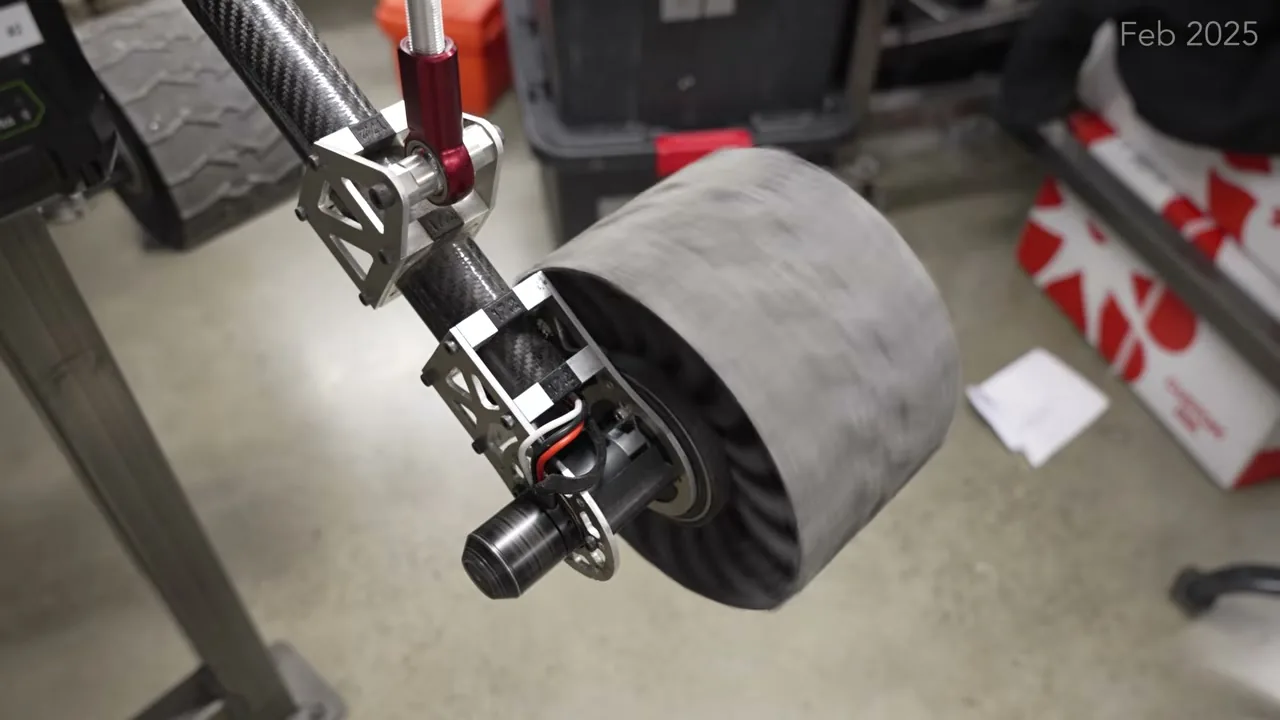
2025: Watney, Mark 6. A 5052 aluminium chassis with a grid of mounting holes for serviceability, a new rocker-bogie in carbon fibre and 6061 aluminium, new brushless drive motors, and the arm carried over with incremental changes: re-routed wiring, a stronger shoulder mount, a revised wrist with multi-turn potentiometers and finer gear reduction. A rigid subsurface sampling tube is added, the rover moves to 24 V, and two batteries are combined through a power diode so a pack can be swapped without powering down S-NEU-YOUTUBE-SAR-2025. Result: 3rd.
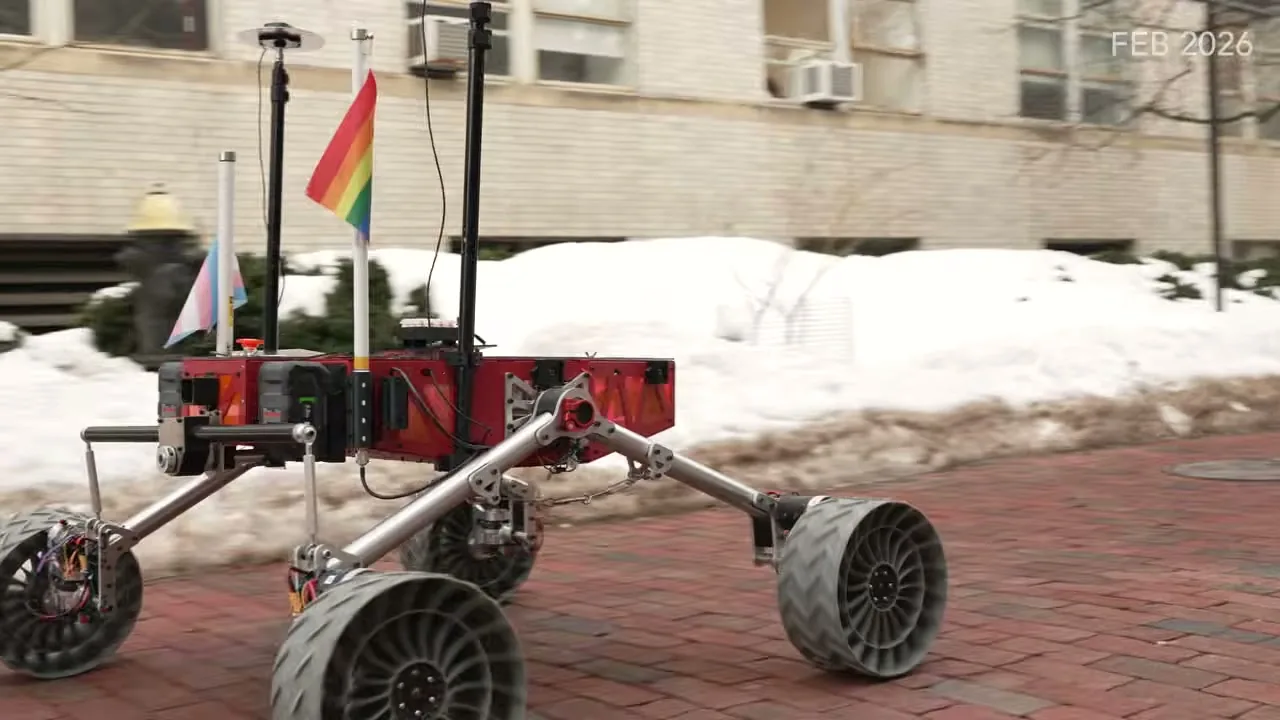
2026: Watney, Mark 7, the first from-scratch rebuild. The team states this is the first time the club has rebuilt its rover completely, against a usual habit of refining one or two parts. The six-wheel tank layout becomes four-wheel swerve, the chassis is thinner sheet metal with new cross rails and half-height rear rails, the arm is redesigned around frameless inrunner motors and harmonic strain-wave gearboxes on every joint, and power distribution is rebuilt on custom boards. Mass is about 46 kg, or 101 lb, which the team reports as 10 % lighter than 2025 S-NEU-2026-SAR S-NEU-NEWS-2026. Result: 6th.
Subsystems
Mobility. A 5052 aluminium chassis, sheet metal in 2026, with four wheels. Steering is the departure: the swerve modules allow movement in any direction, replacing a tank layout that could only drive fore and aft S-NEU-2026-SAR S-NEU-NEWS-2026. The 2026 film shows each wheel at the end of a tubular aluminium link pivoting on the chassis centreline, while the spoken commentary still says “rocker”, so the most likely configuration is four swerve modules on a rocker-type linkage rather than a pure skid-steer platform. Wheel diameter, width, material and mass are unpublished.
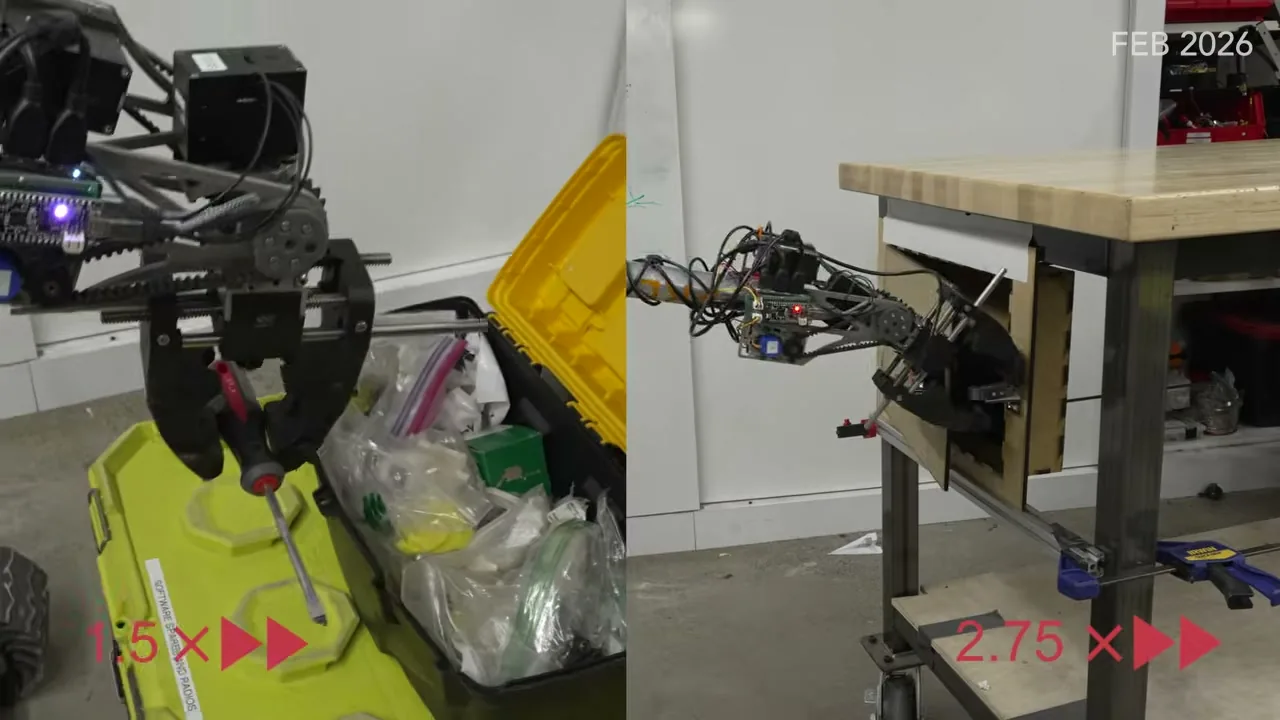
Arm and end-effectors. Six degrees of freedom on the 2021 and 2022 platform, with at least three end-effector joints and the gripper on serial-bus servos S-NEU-ELECTRICAL-LEAD-PORTFO. The 2026 arm uses frameless inrunner motors and harmonic strain-wave gearboxes on every joint, with directly driven independent wrist axes to remove backlash, and a single end-effector head with 180° rotation S-NEU-2026-SAR. Control is a puppet arm with an improved inverse-kinematics solver and a constant-orientation mode, plus a keypad for preset poses S-NEU-YOUTUBE-SAR-2025. In February 2026 the new arm was still integrating and the previous arm was keeping the team operating, which is a schedule pattern a first build should assume it cannot absorb.
Science. A chassis-mounted subsurface sampler: a thin metal tube spun while a lead screw drives it into the soil, then retracted and sealed for analysis, with a retention cap and a threaded tube added in 2026 to reduce the driving force S-NEU-YOUTUBE-SAR-2025 S-NEU-2026-SAR. The 2025 payload ran colorimetric glucose, oxalic and lactic acid tests plus a protein assay, then quantified DNA, chlorophyll-a and organic carbon with a spectrometer. The 2026 version is a diffraction spectrometer: light through the sample cuvette is diffracted by a 1000 nm grating, imaged by a camera and read by custom software against a spectral database S-NEU-2026-SAR. Two consecutive science scores of 98 across a full instrument redesign suggest the assay chain, not a particular mechanism, is what scores.
Communications. Modular radio sets on 900 MHz and 2.4 GHz, validated at up to 1.25 km with strong non-line-of-sight performance, plus a 5.8 GHz system above 50 Mbit/s for higher-resolution images and more simultaneous feeds, and an amateur-band 2 m and 70 cm link for long-range control during the autonomy mission S-NEU-YOUTUBE-SAR-2025. Video is streamed as RTSP with 15 feeds in 2025 and up to 16 streams in 2026, each stamped with position, scale and heading, alongside a live model of the rover’s state S-NEU-2026-SAR. In practice the operators worked from the back of a van about a kilometre away with no line of sight to the rover S-NEU-NEWS-2026. The drone, built with the university drone club, can relay commands through its own line of sight when terrain blocks the primary link S-NEU-YOUTUBE-SAR-2025.
Power, compute and software. The move to 24 V in 2025 removed a drive-motor regulator, which the team says cut mass, raised efficiency and removed a current limit on the motors S-NEU-YOUTUBE-SAR-2025. Batteries are combined through a power diode for hot swap and monitored by a battery sensor board; 2026 replaces wiring with custom boards for distribution, arm, drive and radio, feeding a Jetson Orin AGX and a PCIe card S-NEU-2026-SAR. Perception is a stereo camera used both for costmaps and for visual-inertial odometry, with dual real-time kinematic GPS in 2026 and no LiDAR in any source S-NEU-2026-SAR. Autonomy uses state machines, A* planning with a Monte-Carlo path-following optimiser, frontier exploration to find tags and objects, and a modern detector trained with synthetic imagery generated in a game engine S-NEU-YOUTUBE-SAR-2025 S-NEU-2026-SAR.
Mission performance
The 2025 season is the breakout and the least documented: science jumped from 73 to 98 and delivery from 25 to 59 on the same rover family, and no mission failure is described anywhere S-URC25-SCORES. The recap films carry music and no narration, so only the scores survive.
The 2026 season is the decision-relevant one. Equipment rose to 62.63, science held at 98 and autonomy edged to 58, but delivery fell by 5 and the review by 17.49, and the team dropped three places. Whether the review fell because the rebuild was documented late or because reviewers penalised an unproven platform is not published S-URC26-SCORES.
Autonomy is a plateau, not a climb: 56, 56 and 58 in the last three seasons, after a fast rise from zero in 2022 S-URC22-SCORES S-URC26-SCORES. No post-mortem explains why.
Lessons for a first build
- Incremental cadence beat revolution here, on the team’s own scores. One season of refinements produced the podium; a full rebuild produced a lower total, and the team’s reason for rebuilding anyway is that new members learn by designing rather than inheriting S-NEU-NEWS-2026.
- Documentation is a scored mission. The same team scored 94.42 and 76.93 on review two seasons apart, a 17.49-point swing that is larger than any mission change it made S-URC25-SCORES S-URC26-SCORES.
- De-risk a novel drivetrain at another competition. The swerve platform was exhibited at the Canadian International Rover Challenge before Utah, which is transferable whatever the mechanism S-NEU-2026-SAR.
- A partner club is a legitimate way to staff a drone. Borrowing the university drone club is cheaper than building a drone sub-team, and the operational idea of a drone as a radio relay is more valuable than the aircraft S-NEU-YOUTUBE-SAR-2025.
- An amateur-band control link is unusual and licensing-dependent, and it changes the comms architecture in a way that never appears in a paper S-NEU-YOUTUBE-SAR-2025.
- Two full arm redesigns in three years is a schedule risk. The team was still operating the old arm in February of the rebuild year S-NEU-2026-SAR.
- A team with no public code cannot be learned from. For a club that wants its work used later, publishing the review and the code is the only route; nobody reconstructs a rover from eight short films S-NEU-YOUTUBE-CHANNEL.
What remains uncertain
Almost every number below the vehicle level is unpublished: wheel diameter, mass and material; arm link lengths, reach, gear ratios and mass; battery chemistry and capacity; motor, controller and radio models; antenna gains and heights; and any per-subsystem mass or power budget. The only mass figure in the record is the team’s own 46 kg for 2026 S-NEU-NEWS-2026. Team size is not stated in any source.
Whether the 2026 rover is a four-wheel rocker with swerve modules or a pure swerve platform is left open by the sources: the film says “rocker”, the video shows four wheels on pivoting links, and the university article says the tank layout was replaced. The reason the review fell by 17.49 points is not published, and the persistent autonomy plateau has no public explanation. No design report, code or machine-readable site exists for any year, so none of this is recoverable from the public record.
Team sources
- Team channel, eight annual review films from 2019 to 2026.
- Review film, 2026, the most informative single source: swerve, arm actuators, spectrometer, power and autonomy.
- Review film, 2025, the podium-year rover in detail.
- University news, 2026, the rebuild, the mass figure and the operator set-up.
- Electrical portfolio of a former lead, seven power and control boards with rail names and bus detail.
- Team site, which redirects to a hosted workspace that did not render.
Sources for this page
- S-URC25-SCORESURC2025 Official ScoresOriginal
- S-URC26-SCORESURC2026 Official ScoresOriginal Archived copy
- S-NEU-2026-SARNortheastern University Mars Rover Team, SAR 2026 (video; new chassis/rocker)Original
- S-NEU-YOUTUBE-SAR-2025SAR 2025, 5:09.Original
- S-URC-HISTRESULTSURC results database: derived 2022–2026 statistics (§4–§5) and archived official results 2013–2019 (§7)Print copy
- S-NEU-ELECTRICAL-LEAD-PORTFO"As the Electrical team lead of NURover … I lead the development of 7 custom PCBs used in the Rover's various subsystems", per-board descripti…Original
- S-NEU-NEWS-2026"Lighter, faster and more agile. Meet Northeastern's new Mars rover", states the 2026 rover is ~46 kg (101 lb), 10 % lighter than 2025Original
- S-URC24-SCORESURC2024 Official ScoresOriginal
- S-URC22-SCORESURC2022 Official ScoresOriginal
- S-NEU-YOUTUBE-CHANNEL"Northeastern University Mars Rover Team". Annual SAR videos, continuous.Original