How the missions evolved
The 2027 competition is the visible end of five separate task lineages, four of them older than the autonomy mission. Read as task designs rather than as rules, the history explains why each 2027 mission looks the way it does: what the rover has to do, on which objects, measured against which tolerance, and what was deliberately taken out. Two facts surprise most first-time readers. Autonomy became a scored mission only in 2017, and the drone arrived in 2022 as an explicitly unscored trial.
Key takeaways
- Autonomy is the youngest mission and the most changed one. It began in 2017 as a waypoint traverse, became object recognition by 2026, and in 2027 becomes human assistance plus terrain route finding with a 1 m tolerance.
- Science has tightened into a payload specification. The 2023 mission accepted any one method and a 1–10 g surface sample; 2027 requires two life detections, one of them a bioassay, from at least 10 cm depth.
- Equipment servicing lost a fifth of its drive and gained dexterity. The approach fell from 0.5 km to 100 m while the manipulation set grew, and the recurring core is torque plus insertion at 1.5 m with a small visual marker.
- The drone became a field asset. It entered as a consultation, was briefly allowed to replace the rover, and is now a pad-launched Delivery and Autonomy assistant with no wind waiver.
The five mission families
| Family | First appears | Name in 2027 | Lineage |
|---|---|---|---|
| Science | 2007, as the Scientific Task | Astrobiology Mission | Scientific Task 2007, Geology and Soil Characterization 2008, Site Survey and Sample Return 2011–2012, Sample Return 2013–2015, Science Cache 2016–2018, Science 2019–2026, Astrobiology 2027 |
| Delivery | 2008, as Emergency Navigation | Delivery Mission | Emergency Navigation 2008, Astronaut Assistance 2011–2016, Extreme Retrieval and Delivery 2017–2022, Extreme Delivery 2023, Delivery 2024–2027 |
| Equipment servicing | 2008, as Construction | Equipment Servicing Mission | Construction 2008, Equipment Servicing Task 2011–2016, Equipment Servicing Mission 2017–2027 |
| Autonomy | 2017 | Autonomy Mission | Autonomous Traversal 2017–2019, Autonomous Navigation 2020–2026, Autonomy in two sub-missions 2027 |
| Aerial | 2022, as an unscored demo | A regulated equipment class | Demo 2022, rover substitute 2023, Delivery assistant 2024–2026, Delivery and Autonomy assistant 2027 |
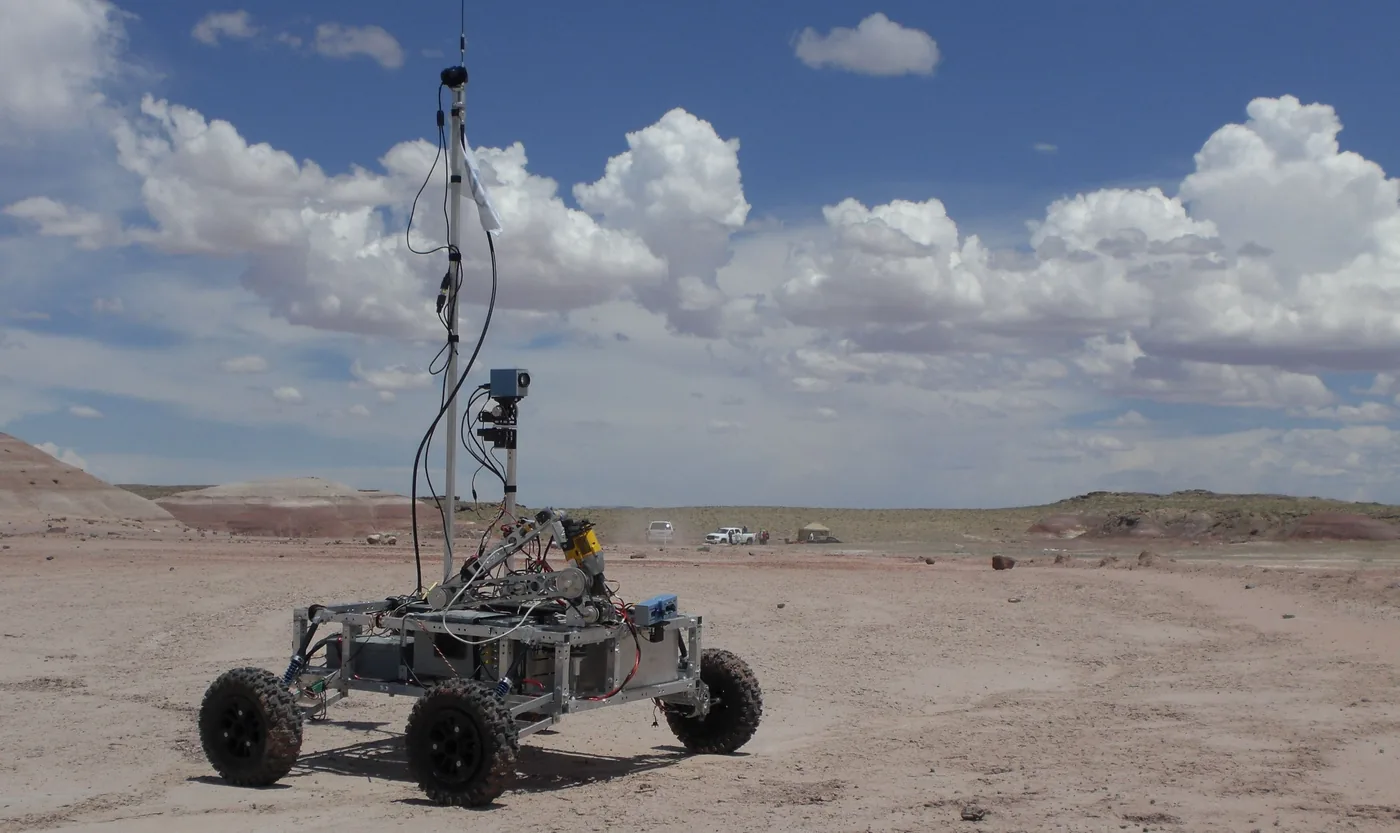
Science: the measuring stick
| Years | Roving time | Life detection minimum | Sample | Cache | Stratigraphic profile |
|---|---|---|---|---|---|
| 2007 | 1–3 h | Investigate geology and palaeontology; digging allowed, no explosives, on-site analysis only | Not specified | None | No |
| 2008 | 30–60 min plus equal preparation | Two separate events, one using visible and infrared spectral analysis | Soil and subsurface probes | None | No |
| 2011–2012 | 30–60 min | Site Survey and Sample Return as separate tasks | Not specified | None | No |
| 2016–2018 | Not stated | A science cache with a judged hand-off | Sample in a cache | Container opened by judges | No |
| 2023 | 20–35 min | One method or assay of the team’s choosing, onboard | 1–10 g, surface, no depth rule | Closed container | No |
| 2024–2026 | 20–30 min | One capability plus a second capability of the team’s choosing | At least 10 cm deep, at least 5 g | Sealed, spill-proof when inverted, removable in 5 min | Required |
| 2027 | 20–30 min | Two life detections, at least one a bioassay | At least 10 cm deep, at least 5 g, unchanged | Sealed, unchanged | Removed |
Three breaks matter more than the trend line. In 2008 science was two scored events with two different instrument classes, so the year rewarded breadth in a way no later year did. In 2013 the survey event disappeared and science became one task. In 2024 the mission gained the 10 cm depth rule, the 5 g floor, the sealed cache, the two-site comparison and the stratigraphic profile all at once, and only the profile came out in 2027 S-URC08-RULES S-URC13-RULES S-URC24-RULES S-URC27-RULES §1.b §1.b.
The design consequence is blunt. An auger producing 1–10 g of surface material satisfied 2023 and fails every rulebook since. Sub-surface acquisition to at least 10 cm with a documented depth has been mandatory for four consecutive seasons, and 2027 adds the bioassay on top of it S-URC24-RULES S-URC27-RULES §1.b.vi §1.b.v.
Delivery: from a speed race to a staged mission
The family starts as Emergency Navigation in 2008: deliver a supply container to a simulated astronaut as fast as possible, with the container capped at 30 × 30 × 15 cm and 6 kg, orientation-independent, and covered in hook-and-loop so the rover had to strap it on rather than grip it. Delivery was within 1 m of the suit, the astronaut was up to 1.5 km away, and line of sight was guaranteed for only 80 % of the course S-URC08-RULES. From 2011 the task became Astronaut Assistance, then a staged retrieval and delivery mission in 2017, and Delivery from 2024.
By 2027 the menu is a set of capabilities rather than a course: open boxes with hinged lids, pick up and deliver objects, read signs carried by astronauts or placed in the field, find equipment in a large search area, and find objects where radio reception is poor. The 2027 rewrite removed one item, the precise marked-path drive, and emphasised that objects appear in a variety of sizes, shapes and weights S-URC26-RULES S-URC27-RULES §1.c.iii §1.c.iii.
| Object envelope | Value | Years in force |
|---|---|---|
| Mass | Up to 5 kg | 2026–2027, with 6 kg for the 2008 container |
| Bounding size | Under 40 × 40 × 40 cm | 2018 onward, unchanged |
| Grasp feature | 7.5 cm diameter | 2026–2027, widened from 5 cm |
| Object identity | Disclosed at the delivery location, not before | 2026–2027 |
| Aerial help | Drone allowed, no mobile deployable | 2026–2027 |
The 7.5 cm grasp feature is the sharpest mechanical constraint in the competition. Rocks with natural features are legal targets, so the end effector cannot be designed around a known handle. A 5 kg object with an unknown centre of gravity and a 40 cm envelope is the design case, not an object with a moulded grip.
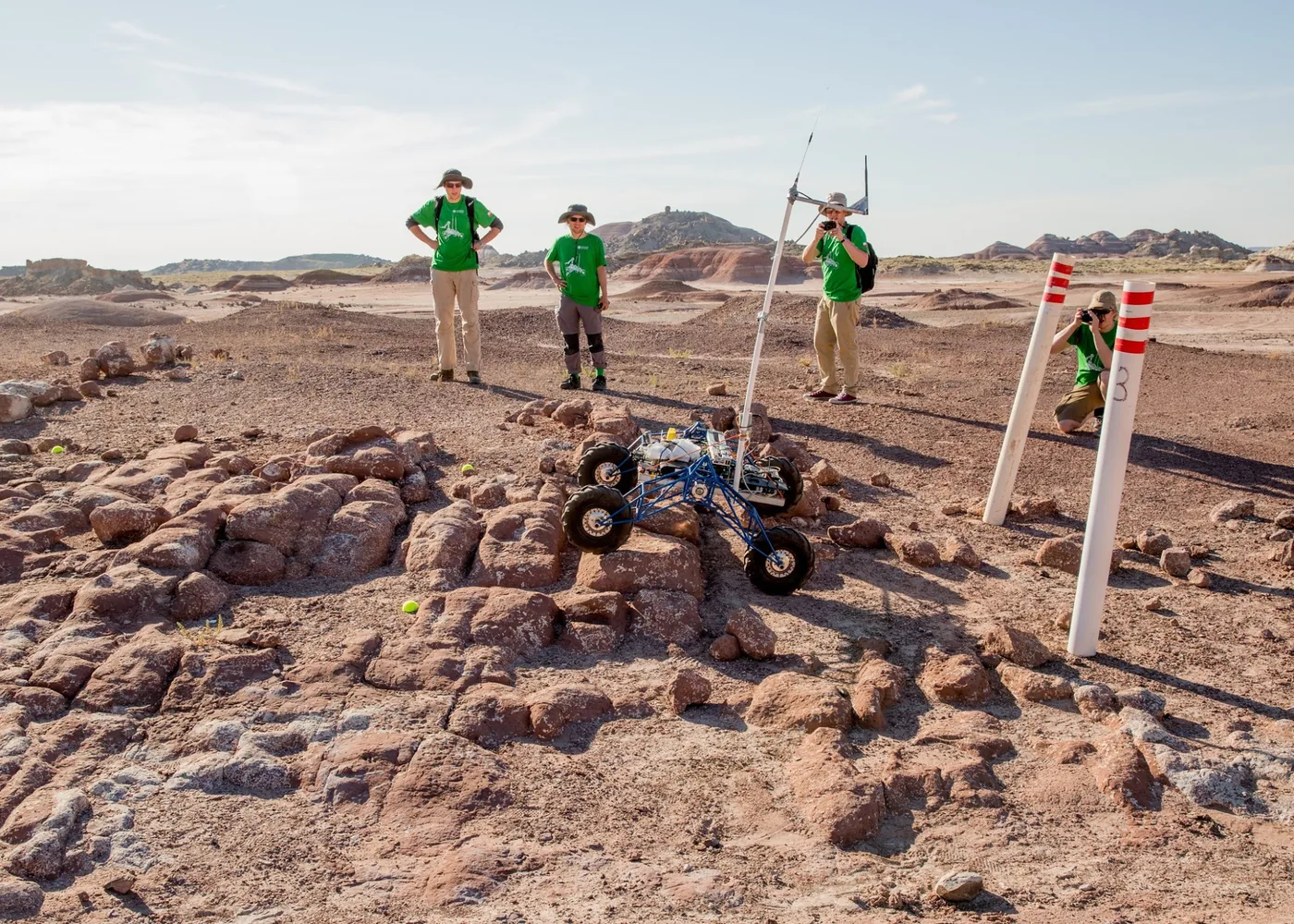
Equipment servicing: the drive collapsed, the dexterity grew
The mission began in 2008 as a construction task: secure half-inch hex bolts on a mock panel between 15 cm and 75 cm above the ground, at up to 45° of inclination, on a drive of up to 0.5 km. In 2011 it became a read-the-instructions task with a printed sequence and 3-prong plugs S-URC08-RULES S-URC11-RULES §3.e.
| Years | Approach distance |
|---|---|
| 2011–2016 | 0.5 km |
| 2017–2025 | 0.25 km |
| 2026–2027 | 100 m |
A fivefold reduction in the drive over sixteen years, with the manipulation content increasing. That is the clearest statement in the rulebook that this mission is an arm mission, not a mobility mission.
| Task | Years present | What it demands |
|---|---|---|
| Push buttons, flip switches, turn knobs | 2011–2027 | Force and travel against an unpublished value |
| Read a printed sequence on the panel | 2011 | Text legibility on a vertical surface |
| Connect a three-prong plug | 2011 | Insertion with orientation |
| Sample tube into cache, close lid, turn lock | 2026–2027 | Insertion plus torque in one sequence |
| Carry the cache, open the drawer, insert and close | 2019–2027 | Grasp, alignment and a tight fit |
| Tighten a captive screw | 2019, 2022 | Torque with an Allen key |
| Autonomous typing on a vertical keyboard | 2019–2027 | Precision with a 2 cm fiducial at the corners |
| Insert a USB connector | 2022, 2026 | Fine connector alignment |
| Turn a quarter-turn lever valve | 2026–2027 | Torque through 90° |
| Push a 1.5 in cam-lock hose onto a fitting | 2026–2027 | Push force, travel and retention |
| Remove a key, insert it into a second lock, turn it | 2027 | Grasp, keyway alignment and torque on a 1 cm tag |
The churn is constant and the handedness is stable. Every year since 2019 has had at least one torque task and at least one insertion task, and the recurring core is reach at 1.5 m to the ground, grasp of a 5–10 cm feature, torque application, and a small visual marker for feedback S-URC19-RULES S-URC27-RULES §3.d §1.d.ii. A first build can treat that core as the durable requirement and the object list as the annual variable.
The 2027 geometry also reverses the back-to-back order: 2026 ran servicing into autonomous navigation, while 2027 runs Autonomy into Equipment Servicing, possibly only ten minutes apart, from the same command post on an adjacent course S-URC26-RULES S-URC27-RULES §1.a.iv §1.a.iv. That makes the payload and sensor configuration part of the schedule, not only part of the design.
Autonomy: from waypoints to a walking astronaut
Before 2017 no mission required autonomy. The rulebooks said the rover was not required to be autonomous, and the 2017 rules still confined the requirement to one task. It then went from optional to a fifth of the score in a single season S-URC07-RULES-L2 S-URC16-RULES S-URC17-RULES §2.c.
| Period | Shape | Tolerance | Abort cost | Human role |
|---|---|---|---|---|
| 2017 | Reach an object and waypoint set, partial credit within 5 m | 5 m for partial credit | Not stated | None |
| 2019–2022 | Staged legs between physical markers: tennis balls, then gates, then AR tags | Marker coordinates approximate, search required | Not stated | None |
| 2026 | Two coordinate points, two tagged posts and three objects to highlight on the display | 3 m and 2 m | Autonomous return free, teleoperation 20 % | None |
| 2027 | Astronaut assistance worth 50 and route finding worth 50 | 1 m at targets, 3 m at the astronaut | 20 % on a stop or return, 50 % for teleoperation, capped at 50 % | A suited astronaut who walks, waits, receives and hands over |
The 2027 Follow! task is the one place where the method itself is scored, and the spread is large enough to be a design decision rather than a preference S-URC27-RULES §1.e.vi.
| Follow! method | Points | Share of the 15 available |
|---|---|---|
| Astronaut-carried device | 5 | One third |
| Visual sign | 5 | One third |
| Spoken word or phrase | 10 | Two thirds |
| Beckoning gesture | 15 | Full |
The gesture path is worth three times the device path, and it is a perception problem rather than a radio problem. Everything else in the sub-mission is binary, which is why a reliable simple method for Stay!, Fetch!, Come! and Give! is enough.
The drone: five years from demo to field asset
| Year | Role | Launch and mass |
|---|---|---|
| 2022 | Optional demonstration, not scored, with an open invitation for feedback on making it a mission | 5 kg cap, 250 g registration threshold, dummy mass guidance |
| 2023 | Allowed to fly instead of the rover in Autonomous Navigation | 5 kg, dummy mass separate; required dummy mass waived above 24 km/h |
| 2024 | Delivery assistant only | Drone plus payloads plus dummy mass at 5 kg; waiver above 24 km/h |
| 2025 | Delivery assistant | 5 kg including dummy mass; waiver above 24 km/h |
| 2026 | Delivery assistant | Launch from the rover or a start location near the command post; waiver above 24 km/h |
| 2027 | Delivery and Autonomy assistant | Designated landing pad only; never waived; over 5 kg not permitted to fly |
The permanent constraints arrived with the demonstration and never left: rotary wing only and able to hover, no lighter-than-air vehicle, no fixed wing, FAA Remote ID, a TRUST certificate carried by every pilot, below 120 m above ground in Class G airspace, not in the national park, give way to manned aircraft near Hanksville, and a spotter with continuous visual line of sight S-URC22-RULES S-URC27-RULES §4 §2.b. The 2027 change is not a new capability but a narrowing: the airframe is a field asset with a pad, a pilot in the command post and a spotter on the ground.
The review never got easier
| Years | Review element | Scored | Cut |
|---|---|---|---|
| 2007–2014 | None; a video presentation from 2011 | Presentation only | None |
| 2015–2016 | Critical Design Review | No, a down-selection gate | Pass or fail |
| 2017 | Critical Design Review | Yes, 100 of 500 | Pass or fail |
| 2018 | Preliminary Design Review added, CDR becomes the System Acceptance Review | Yes, 100 of 500 | Pass or fail |
| 2019–2027 | PDR and SAR | Yes, 100 of 500 | Top 36 |
The review has been a fifth mission since 2017: 100 points and a gate on the other 400. For a first-time team it is the highest-leverage document of the season, and it rewards collected test evidence rather than prose.
Three readings for a first build
- The physical problem is twenty years old. 50 kg, off-grid, about 100 °F, no direct view and a real-time link have survived every rulebook read. Time spent on a robust chassis, a thermal margin and a reliable link is never wasted S-URC07-RULES-L1 S-URC27-RULES §2.a.
- The score has migrated from manipulation and driving to perception and science. The servicing drive fell fivefold, autonomy went from nothing to 100 points and now includes human interaction, and the science payload went from any instrument to two life detections with a bioassay S-URC11-RULES S-URC27-RULES §1.b.v.
- Treat every sub-task as temporary. The 2008 spectral analysis, the 2011–2012 site survey, the 2019 board swap, the 2022 USB insertion, the 2026 object recognition and the 2026 stratigraphic profile all disappeared. Modularity at the end effector and the payload bay outlasts any specific object list. The reading of a judging-reliability motive behind the removals is an inference, not a published policy.
Further reading
- Rule history, 2007-2027 dates every change to the rulebook that carries it.
- Missions and scoring states the 2027 tasks and their point values.
- Mission-by-mission backfit turns each 2027 task into a design choice.
- Astronaut interaction and the EVA suit covers the newest mission in depth.
- Where the competition is going extends the same record into 2028.
Sources for this page
- S-URC08-RULESUniversity Rover Challenge 2008 – Requirements and Guidelines (4 pp PDF)Print copy
- S-URC13-RULESUniversity Rover Challenge 2013 – Requirements and GuidelinesOriginal
- S-URC24-RULESUniversity Rover Challenge 2024 – Requirements and Guidelines (Drive file University Rover Challenge Rules 2024.pdf)Original
- S-URC27-RULESUniversity Rover Challenge 2027 – Requirements and GuidelinesOriginal Archived copy
- S-URC26-RULESUniversity Rover Challenge 2026 – Requirements and GuidelinesOriginal Archived copy
- S-URC11-RULESUniversity Rover Challenge 2011 – Requirements and GuidelinesOriginal
- S-URC19-RULESUniversity Rover Challenge 2019 – Requirements and GuidelinesOriginal
- S-URC07-RULES-L2University Rover Challenge 2007, Level 2 Requirements and Guidelines (prevails over Level 1)Print copy
- S-URC16-RULESUniversity Rover Challenge 2016 – Requirements and GuidelinesOriginal
- S-URC17-RULESUniversity Rover Challenge 2017 – Requirements and GuidelinesOriginal
- S-URC22-RULESUniversity Rover Challenge 2022 – Requirements and GuidelinesOriginal
- S-URC07-RULES-L1University Rover Challenge 2007, Level 1 Requirements and GuidelinesPrint copy