Deadlines and milestones
The 2027 season has six fixed dates and one of them gates the field. Registration closes in October 2026, the Preliminary Design Review is due in December, the System Acceptance Review in March 2027 decides which 36 teams travel, and the finals run from 2 to 5 June 2027. Every date below is a rule rather than a plan, and each one is earlier than a team that starts in January expects.
Key takeaways
- The System Acceptance Review is the only gate that removes a team from the field. It is worth 100 of the 500 points, carries a competitive cut at the top 36, and is due 5 March 2027 S-URC27-RULES §3.a.iii.
- The review is one five-minute video and one seven-page report, and material beyond those limits is not read, so 48 of its 100 points are decided in the video S-URC26-SAR.
- The Preliminary Design Review on 2 December 2026 is non-competitive but it is the first evidence that the team can be ready, and it sits about five weeks into the season.
- The Rover Expense Report is due 26 May 2027 and loses 10 % of the total points for each day it is late, with disqualification if it is not submitted by the end of the event on 5 June 2027 S-URC27-RULES §3.c.ii.
The six fixed dates
| Date | Submission | What it requires | Consequence | Clause |
|---|---|---|---|---|
| 2026-10-30 | Registration | Declare intent and supply team details through the URC site | Eligibility for the season | §3.a.i |
| 2026-12-02 | Preliminary Design Review | Team structure, resources, project management and the current state of design and prototyping | Readiness assessment; not scored | §3.a.ii |
| 2027-03-05 | System Acceptance Review | Written report and video showing each mission capability and the overall design | 100 points and the top-36 field cut | §3.a.iii |
| 2027-04-30 | Communications documentation | Device details, operator licences and the regulations the links rely on | Compliance, and notification of any change | §2.c.ii |
| 2027-05-21 | Science Plan | The written plan that expands the review’s science section, with background science | Counts toward the Astrobiology score | §1.b.i |
| 2027-05-26 | Rover Expense Report | Equipment list in work-breakdown structure form; an update is allowed on 2027-06-02 | 10 % of total points per day late | §3.c.ii |
All six dates are fixed by the rulebook S-URC27-RULES §3.a §2.c.ii §1.b.i §3.c.ii. The finals run from 2027-06-02 to 2027-06-05, and the four missions plus the review are 500 points in total S-URC27-RULES §1.a.i.
Registration and the compliance clock
Registration closes on 30 October 2026 and is the one deadline with no engineering content: it needs a declared intent and the team details the competition asks for S-URC27-RULES §3.a.i. It is also the point at which the slow, non-engineering work starts.
- Radio licensing and the communications documentation. The communications package is due on 30 April 2027 and must document the licence, the regulations and every device, with changes notified S-URC27-RULES §2.c.ii. Licensing takes longer than writing the document, so it starts in the registration window.
- Drone registration, Remote ID and the trust certificate. A drone is optional, but if one is planned the compliance work is not: registration above 250 g, Remote ID, a trust certificate, a 400 ft ceiling, class G airspace only, no flight inside a national park, and a visual spotter S-URC27-RULES §2.b.
- The Q&A is binding and it moves. It changed twice within a month of publication, on 3 and 11 October 2026, so the current rulings are re-read before each milestone rather than once at the start S-URC27-QA.
Preliminary Design Review, 2 December 2026
The Preliminary Design Review is a non-competitive readiness review. Reports are assessed on their own merits and the judges are asking one question: is this team likely to be ready in time S-URC27-RULES §3.a.ii. There is no published evidence that a team has been removed at this stage, so the working assumption, by inference from the published rules, is that the review cannot save a season and cannot practically end one.
The 2026 template is the best available guide to the shape, because the 2027 specification was not published when this edition was prepared S-URC26-PDR. It is five pages: pages 1 and 2 carry text and graphics, pages 3 to 5 carry graphics and captions only, with no other text. Letter paper, one-inch margins, 11 pt text, a single PDF, a header block naming the team, the university, the city, the country and the student lead, submitted through a form before 23:59 MST.
The content list is a checklist worth building against, because it maps to the work a first season has to do anyway: team structure and leadership, departments represented, relevant experience, the recruiting and training plan, an educational and public outreach plan distinct from recruiting, the project management method with a schedule, and the current state of the design, development and prototyping.
System Acceptance Review, 5 March 2027
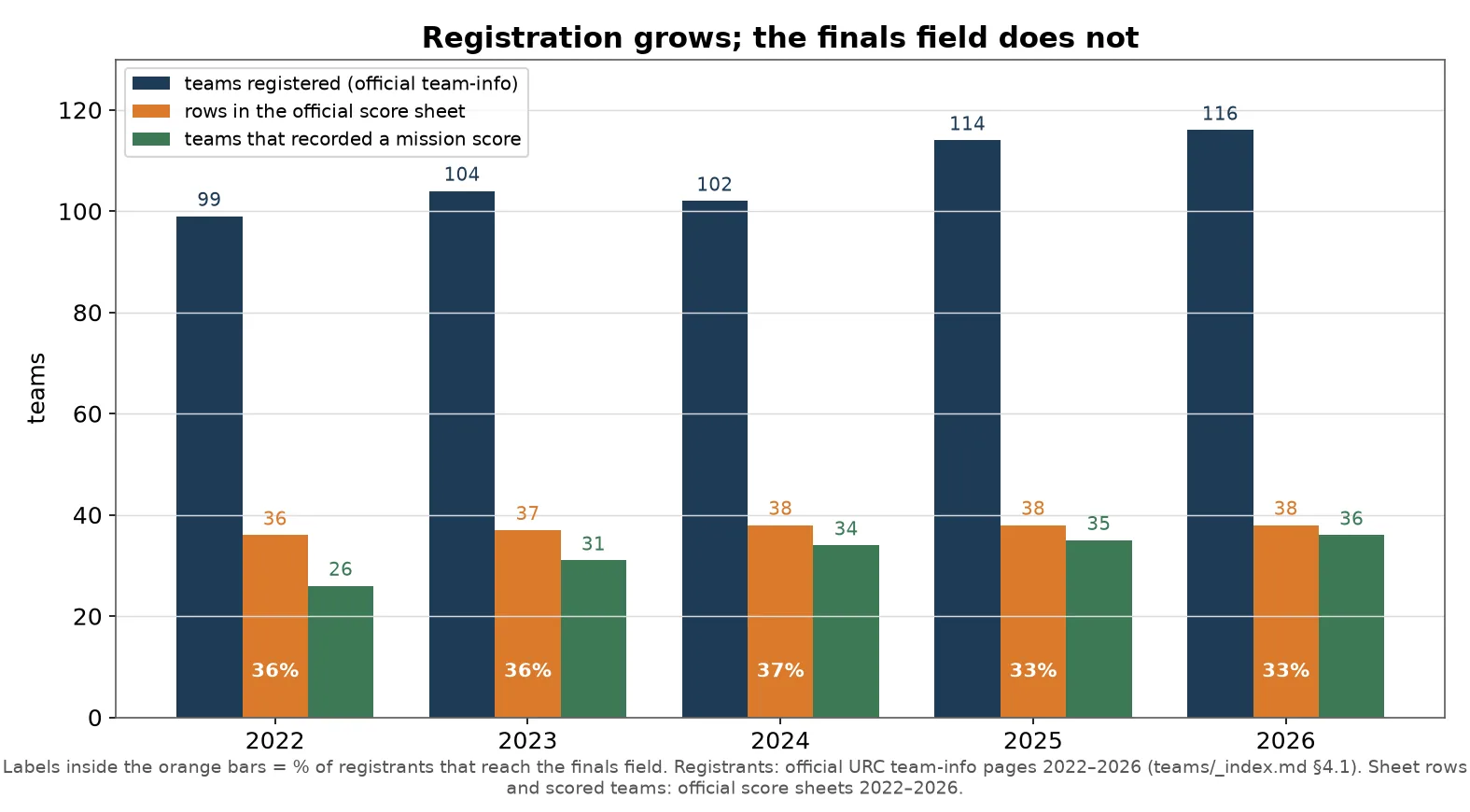
The review is the fifth mission and the only gate to the field. It is a written and video package that demonstrates the capabilities and customisation of the rover for each mission, including the overall system design and the progress to date, and it is judged against other teams rather than against a rubric alone S-URC27-RULES §3.a.iii. The aim is not the highest score: the top 36 are invited, and the field has been expanded to 37 or 38 when scores cluster S-URC23-NEWS S-URC24-NEWS S-URC25-NEWS S-URC26-NEWS.
The 2026 rubric is the only published one, and it is worth knowing in detail even though the 2027 rubric is not out. It splits 100 points into 48 for the five-minute video, 40 for the seven-page report and 12 for the judges’ assessment S-URC26-SAR. Content beyond five minutes or beyond seven pages was not read. Audio quality was called imperative, even at the expense of video quality, and a claim that is not shown on camera cannot be credited.
The cut is competitive and the historical line is visible in the official scores. The lowest admitted review score was 85.10 in 2023, 84.04 in 2024, 86.90 in 2025 and 75.86 in 2026, which is about 11 points below the 2025 line in the year the rubric was rebuilt S-URC23-SCORES S-URC24-SCORES S-URC25-SCORES S-URC26-SCORES. A 2027 package should therefore be planned against its own coverage of the rubric rather than against a 2025 score.
Two consequences follow for the calendar. First, the review needs filmed evidence of a working rover, so the integration date is set by March, not June. Second, the science section of the review is a page and a few minutes of video, while the Science Plan due in May ran to about five pages in 2026, so the two are written from the same material rather than from scratch S-URC26-SAR.
The four later submissions
After the review the deadlines are documents rather than demonstrations, and they arrive while the rover is being tested.
| Date | Submission | What it costs | What it needs from the season |
|---|---|---|---|
| 2027-04-30 | Communications documentation | Compliance, and any change must be notified | The licence work started at registration |
| 2027-05-21 | Science Plan | A share of the Astrobiology score | The review science page, expanded with background science |
| 2027-05-26 | Rover Expense Report | 10 % of the total per day late | A work-breakdown structure maintained from week one |
| 2027-06-02 | Expense Report update | Final figures before the field | Receipts collected during the build |
The expense report is the one document that can damage a season after the rover works. The penalty is 10 % of the total points per day, and a submission that is still missing at the end of the event on 5 June 2027 is a disqualification S-URC27-RULES §3.c.ii. The competition’s own cap on fielded equipment is $26,000, and the report is how that cap is evidenced S-URC27-RULES §3.c.
The finals, 2 to 5 June 2027
The exact field schedule is published about one week before the first field day, and the task order is drawn per team, so no plan survives contact with the schedule unchanged S-URC27-QA. Three facts shape the four days.
- Mission pairing. On a day a team competes in Astrobiology or Delivery it competes in only that mission; Equipment Servicing can start as soon as 10 minutes after Autonomy, from the same command station, on an adjacent course S-URC27-RULES S-URC27-RULES §1.a.iv §1.d.i.
- Attendance. A team may register 24 students and two advisors, with 14 people on site per day and no more than six students in the command station at once; advisors are not permitted inside it S-URC-LOGISTICS.
- No rehearsal at the site. There is no testing at the Mars Desert Research Station before, during or after the event, and the environment runs to 37.8 °C at 1,309 m in full sun with dust and possible light rain S-URC27-RULES S-URC-LOGISTICS §3.d.
The 90 days before the design review
The 90-day window runs from 26 October 2026 to 23 January 2027, with the Preliminary Design Review inside it on 2 December. Four gates close it, and each one is a state of the work rather than a document.
| Gate | By | The state it proves | If it fails |
|---|---|---|---|
| G1 | End of week 1 | Registered, every lead named, one calendar owner, the Q&A on file | Nothing else has an owner |
| G2 | End of week 6 | Designable: an architecture, a mass allocation and a measured force budget | The design review has no content |
| G3 | End of week 8 | The irreversible chemistry choice made, with the deferral list written and two legal field sites identified | The payload cannot be designed or measured |
| G4 | End of week 13 | Filmable: an integrated rover on the clock, on camera, with two operators in a mock command station | The review becomes documents only, and the cut risk rises |
The detailed week-by-week sequence, with the measurement campaign, the mass register and the two prototype builds, is on the first 90 days page.
What the dates force
Three conclusions follow from the calendar rather than from engineering.
- The season is built to March. The review needs demonstration footage, and the 90 days end 41 days before it is due, so the rover has to be demonstrable about three months before the field event.
- The expense report is a running record, not a December task. Ten per cent of the total is 50 points a day, so three late days cost more than a perfect mission score, and the work-breakdown structure the report requires is the same structure the review report uses.
- The rule documents can change inside a season. The Q&A changed twice in October 2026, and the 2027 review and Science Plan specifications were still unpublished when this edition was prepared S-URC27-QA S-URC27-SAR. Each milestone is a checkpoint at which the current documents are re-read, which is why they appear in the 90-day sequence and not only in the reading list.
Further reading
- The 2027 competition for the missions that the dates protect.
- Review, judging and awards for the rubric in full, including the on-site categories.
- System Acceptance Review for what the review evidence has to show per mission.
- The 13-week plan for the work between registration and the design review.
Sources for this page
- S-URC27-RULESUniversity Rover Challenge 2027 – Requirements and GuidelinesOriginal Archived copy
- S-URC26-SARURC2026 System Acceptance Review Requirements + SAR Q&AOriginal
- S-URC27-QAURC2027 Questions & Answers (updated through 2026-10-11)Original Archived copy
- S-URC26-PDRURC2026 Preliminary Design Review RequirementsOriginal
- S-URC23-NEWSURC2023 News (champions, 37 finalists, expansion rationale)Original
- S-URC24-NEWSURC2024 News (champions, 38 finalists)Original
- S-URC25-NEWSURC2025 News (champions, 38 finalists)Original
- S-URC26-NEWSURC2026 News (champions, 38 finalists, INCOSE award announcement, ProtoSpace credit)Original
- S-URC23-SCORESURC2023 Official ScoresOriginal
- S-URC24-SCORESURC2024 Official ScoresOriginal
- S-URC25-SCORESURC2025 Official ScoresOriginal
- S-URC26-SCORESURC2026 Official ScoresOriginal Archived copy
- S-URC-LOGISTICSURC LogisticsOriginal Archived copy
- S-URC27-SARURC System Acceptance Review page, states "URC2027 SAR Requirements will be posted in early 2027!"Original