SKA Robotics (Warsaw University of Technology)
SKA Robotics nearly doubled its total between two appearances. In 2023 it finished 28th of 31 with Delivery, Equipment Servicing and Autonomy all at zero. In 2025 it finished 12th of 35 with every mission between 40 and 78, a gain of 139.4 points. The programme is the robotics division of a long-running student space association, and its public repositories show the discipline behind the recovery: a written mechanical module standard, a simulator, a drone sub-project and a human-machine interface. It has also competed in only two of the five seasons from 2022 to 2026, which is the constraint that explains the rest.
What this team shows
- The 2023 collapse had a clean cause. Science scored 64.38, so the rover drove to the site and analysed a sample, but the three missions that need an arm or autonomy scored zero S-URC23-SCORES.
- The 2025 recovery was distributed across all three of those missions, not concentrated in one. Delivery 40, Equipment 42 and Autonomy 42 is what a rebuilt system looks like S-URC25-SCORES.
- Cadence is the binding constraint. The team has appeared in two of the five seasons from 2022 to 2026, so its rank record is noise rather than a trend.
- Its mechanical repository uses six named supermodules with a fastener convention, which is the most reusable practice in this dossier.
Identity and results
The 2016 season ran in a second bracket, so its total is not comparable. The 2019 row carries a 10 % penalty, and 2022, 2024 and 2026 were non-entries rather than unmeasured entries S-URC-HISTRESULTS S-URC23-SCORES S-URC25-SCORES.
| Year | Rover | Total | Rank | SAR | Science | Delivery | Equipment | Autonomy |
|---|---|---|---|---|---|---|---|---|
| 2016 | Not published | 152.3 | 14 | Not scored | Not scored | Not scored | Not scored | Not scored |
| 2019 | Not published | 207.59 | 23 | 88.66 | 92 | 30 | 20 | 0 |
| 2023 | Not published | 150.71 | 28 | 86.33 | 64.38 | 0 | 0 | 0 |
| 2025 | Sirius II | 290.15 | 12 | 88.15 | 78 | 40 | 42 | 42 |
The 2016 rank is within the Phobos bracket. The 2019 mission scores do not add to the printed total because that season carries a 10 % penalty. The 2025 row reproduces the published result S-URC25-SCORES. The team was absent from the official team list in 2022, 2024 and 2026, so those years are not qualification failures; they are seasons the programme did not enter S-URC22-TEAMS S-URC24-TEAMS S-URC26-TEAMS. No award is documented in the sources reached.
Rover generations
Skarabeusz to Ares II. The team traces its lineage from Skarabeusz, described as the first Polish analogue Mars rover, through Ares II. The 2016 and 2019 entries predate Sirius II, and the 2019 season is the better documented: Science 92 and a review score of 88.66, with autonomy at zero and a 10 % penalty whose cause is not stated S-SKA-SITE S-URC-HISTRESULTS.
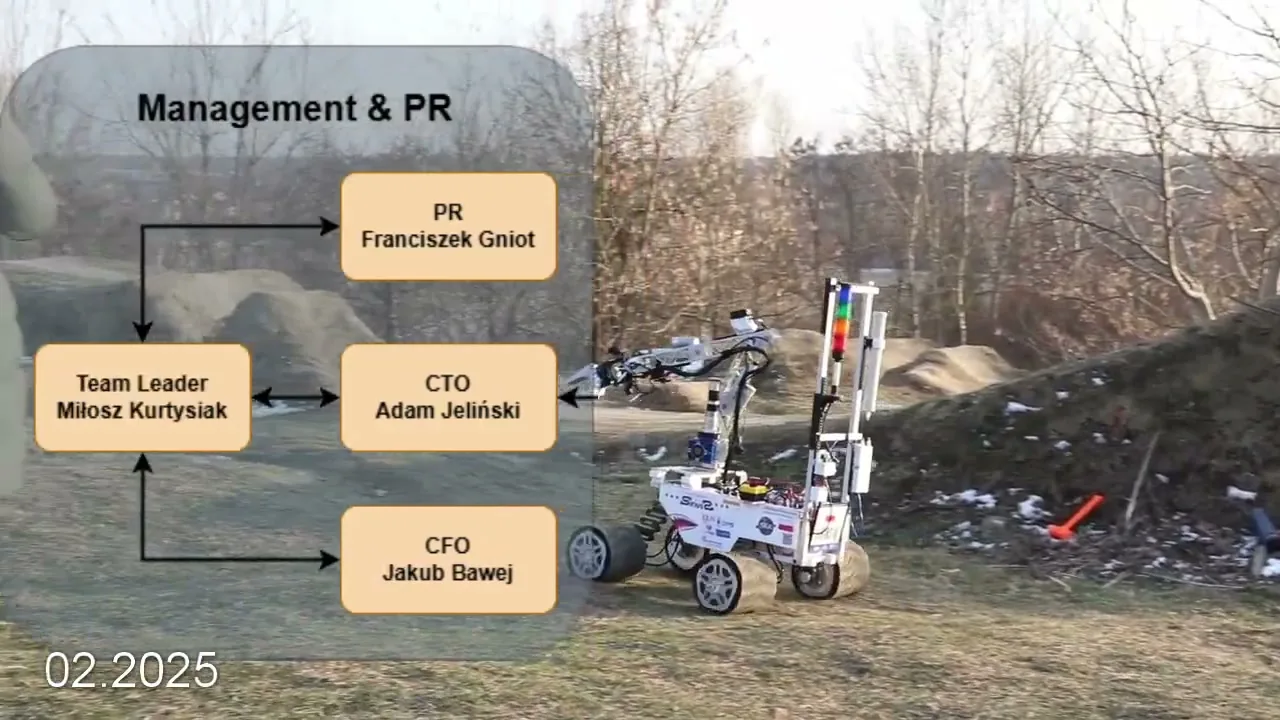
Sirius II. The 2025 rover is a six-wheel platform with a white painted shell over an aluminium extrusion and tube space frame, the name “Sirius 2” on the side, a front-mounted articulated arm stowed forward of the chassis, and a rear mast carrying vertical antennas with a coloured indicator stack. It scored in all four missions S-SKA-URC25 S-URC25-SCORES.
Proxima and Dedal. Proxima is the rover in development through 2026, described by the association as bringing new suspension, mobility and sampling work, with no specification attached. Dedal is a quadcopter with its own ROS 2 packages and autonomy archive, which treats the delivery drone as a sub-project rather than an accessory S-SKA-SITE S-SKA-GH.
Subsystems
Mobility. Six wheels on an aluminium space frame under a painted shell. Proxima is claimed to advance the suspension, mobility and sampling, but no geometry or mass is published, so the claim cannot be checked. The 2025 rover’s wheel count is read from the video report rather than stated S-SKA-URC25.
Mechanical architecture. The CAD repository is organised into six supermodules: base, drive, manipulator, mast, science and cameras, each divided into numbered modules. Fasteners live in per-module folders with their standard in the filename. This is a written convention that keeps a shared CAD tree navigable, and it costs nothing but discipline S-SKA-GH.
Electronics and drive. A dedicated electronics repository and a custom DC motor driver with its own firmware repository show the team working below the off-the-shelf controller level. A tuning package for a commercial brushless driver sits beside a 2022 ROS driver for ODrive controllers over CAN, which indicates the drive electronics have migrated at least once S-SKA-GH.
Software. ROS 2 packages are split by platform: a Sirius group and a Proxima group, each with its own common utilities, plus a shared interface package and a human-machine interface. Keeping a simulator and a physical robot in step through the same common package is the practical reason for the split S-SKA-GH.
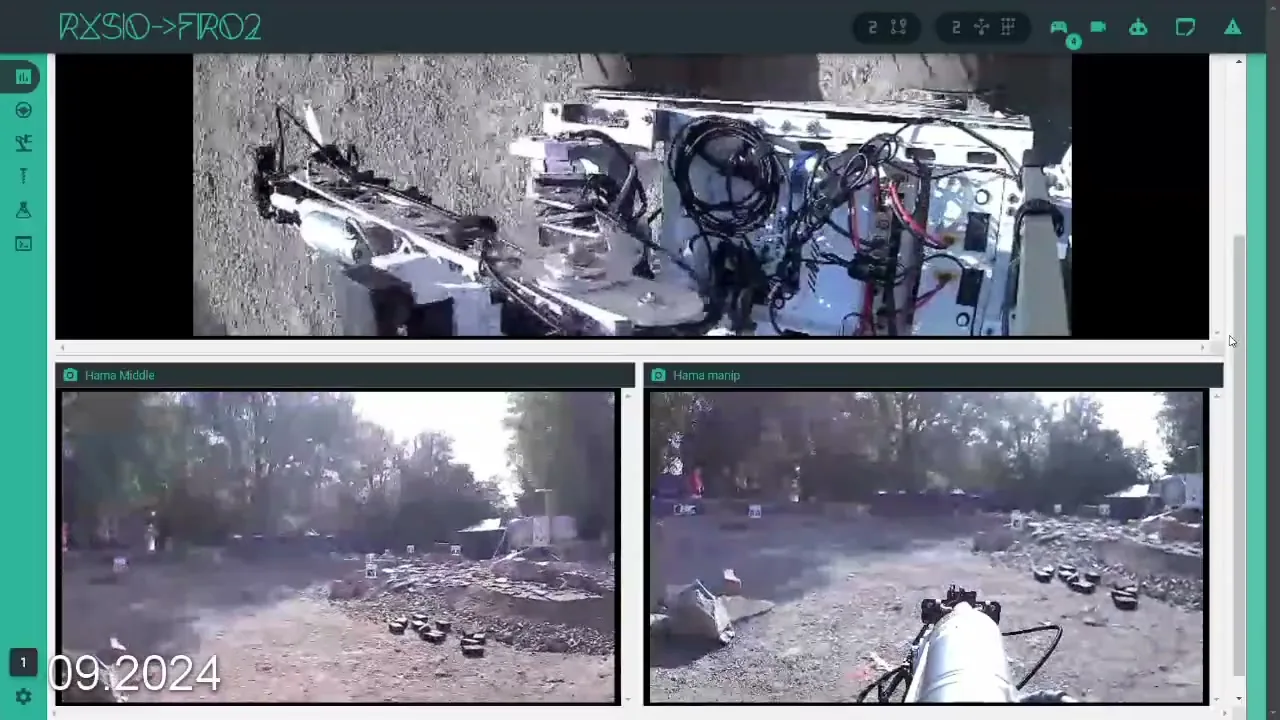
Operator station. The 2025 video report shows a custom multi-camera ground station: a tiled interface with a live rover view, two labelled camera feeds, a timestamp overlay and a device-status strip. That is a bespoke application rather than an off-the-shelf dashboard S-SKA-URC25.
Mission performance
The 2019 season is the first well-documented one: Science 92, review 88.66, Delivery 30 and Equipment 20, with autonomy at zero. It finished 23rd and carried a 10 % penalty S-URC-HISTRESULTS.
The 2023 season is the archetypal science-only failure. Science scored 64.38 and the review 86.33, while the three missions that require an arm or a drive-autonomy capability scored zero. It finished 28th of 31 S-URC23-SCORES.
The 2025 season is the recovery. Science rose to 78 and the other three missions all scored, which produced 290.15 points and 12th place. The improvement is distributed across the three previously-zero missions, and that distribution is what makes it credible as a rebuilt system rather than a lucky day S-URC25-SCORES.
The 2024 and 2026 absences have a visible explanation in the repositories. Sirius packages were active in 2025 and Proxima packages were pushed through 2026, so the programme was building for a later season rather than stopping. Whether that is a deliberate every-other-year cadence or a resourcing constraint is not stated S-SKA-GH.
Lessons for a first build
- A named module standard is free and permanent. Six supermodules with numbered submodules and fasteners filed by standard is the difference between CAD that a new member can use and CAD that only the person who built it can.
- Split the software by platform, share the common layer. A Sirius group and a Proxima group over one common package is how a simulator and a robot stay in step across a redesign.
- Three zeros have one cause. The 2023 rover could analyse a sample but not manipulate or drive autonomously. A first build should test the arm and the autonomy on the same day as the science, not in separate weeks.
- Treat the drone as a sub-project. A quadcopter with its own packages and its own autonomy archive is the delivery mission’s second vehicle, not an accessory.
- Cadence is a design decision. Two finals in five seasons produces a record that cannot show improvement. A team that skips years should say so and plan the return.
What remains uncertain
Why 2024 and 2026 were skipped is not stated, and whether the team intends to enter 2027 with Proxima is unknown. Mass, wheel dimensions, drive motors, battery, radios, compute and arm geometry are unpublished; the repositories contain code and CAD but no bill of materials. The cause of the 2019 penalty is not stated. What changed between the 2023 and 2025 rovers is the most valuable missing comparison. The relationship with the other Warsaw University of Technology entry in the census is not documented, and the two appear to be separate organisations.
Team sources
- ska.pw.edu.pl, the association site.
- ska-robotics on GitHub, the mechanical, electronics and software repositories.
- 2025 video report, the source of the frames on this page.
- 2023 video report, the three-zero season.
Sources for this page
- S-URC23-SCORESURC2023 Official ScoresOriginal
- S-URC25-SCORESURC2025 Official ScoresOriginal
- S-URC-HISTRESULTSURC results database: derived 2022–2026 statistics (§4–§5) and archived official results 2013–2019 (§7)Print copy
- S-URC22-TEAMSURC2022 Team List ("URC2022 Featured 99 Teams, 15 Countries")Original
- S-URC24-TEAMSURC2024 Team ListOriginal
- S-URC26-TEAMSURC2026 Team ListOriginal Archived copy
- S-SKA-SITEStudents' Space Association (SKA) site, Warsaw University of Technology, 30-year organisation with four divisions; Robotics Division lineage Skarabeusz → Ares II → Sirius II → Proxima + Dedal droneOriginal
- S-SKA-URC25"SKA Robotics URC25 Video Report", video, 5:28; leadership chart (Team Leader Miłosz Kurtysiak, CTO Adam Jeliński, CFO Jakub Bawej, PR Franciszek Gniot); custom multi-camera ground station UIOriginal
- S-SKA-GHska-robotics GitHub organisation, 40 repositories incl. sirius_robot, sirius_simulator, sirius_common, proxima_common, proxima_utils, proxima_hmi, dedal_drone, mechanics, electronics, interface, DriverFirmware, MAB_PID_tuner, odrive_can_ros_driver, sirius2_manip, sirius-telemetry-setupOriginal