Executive summary
The 2027 University Rover Challenge asks a team to build, from nothing, a rover that finds signs of life, delivers loads across rough terrain, services equipment built for a suited astronaut, and navigates while assisting a human in the field. Four missions plus a written review, 500 points, 36 to 38 teams in the field at the Mars Desert Research Station in June 2027. This page is the argument in one reading: ten findings, ten decisions, eight risks and the next 90 days.
Key takeaways
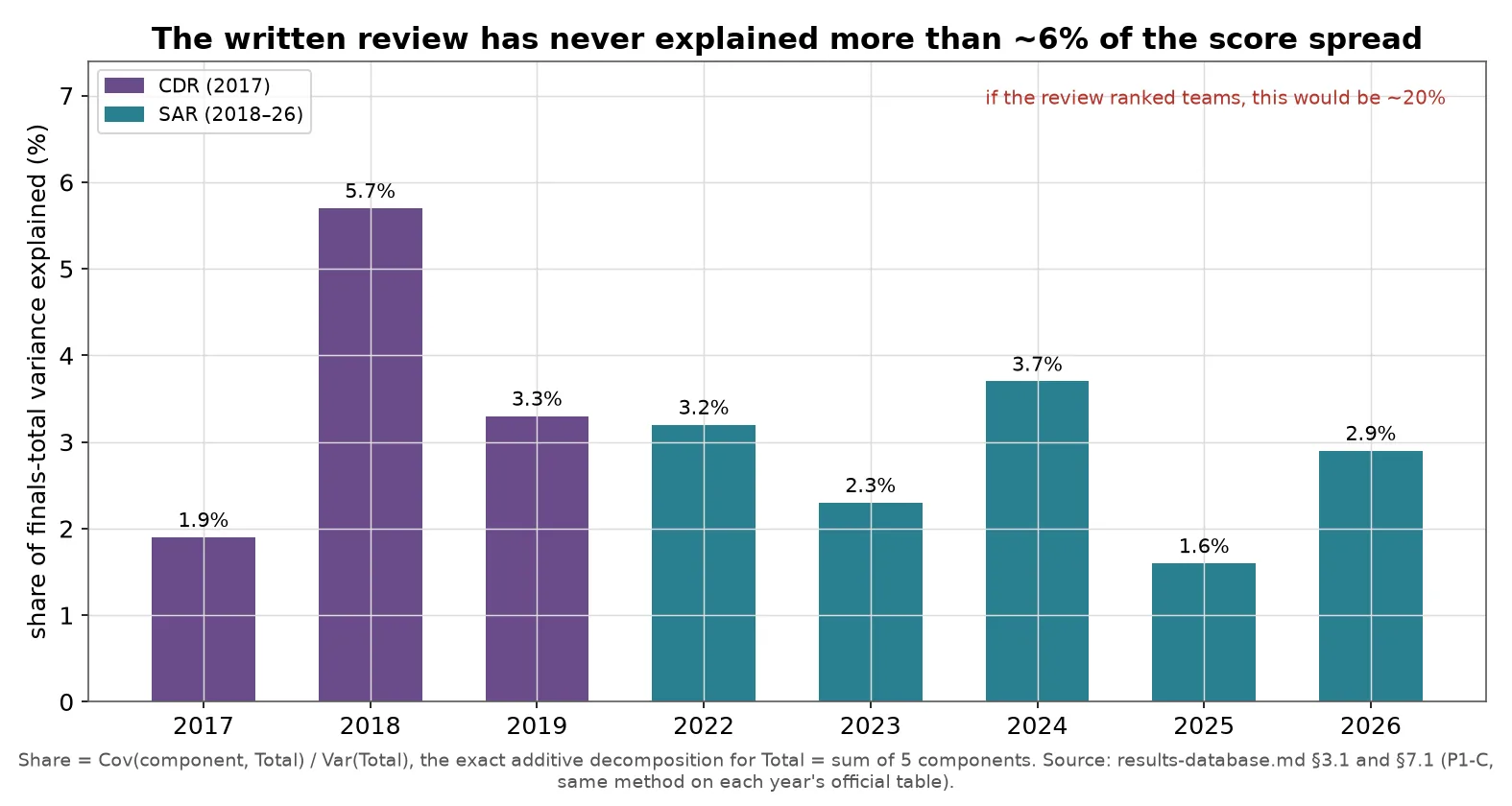
- The review decides who competes and the missions decide who wins. The System Acceptance Review is 100 of the 500 points and explains only 2.8 % of the variation in final totals, while the four field missions carry about 97 %.
- Autonomy is 20 % of the score and 95 of its 100 points need genuine autonomy, so a teleoperated rover caps itself at about 405 of 500 before any other loss.
- The mass and size limits did not move while the work grew: 50 kg per deployed configuration, 70 kg fielded, 1.2 m on every axis.
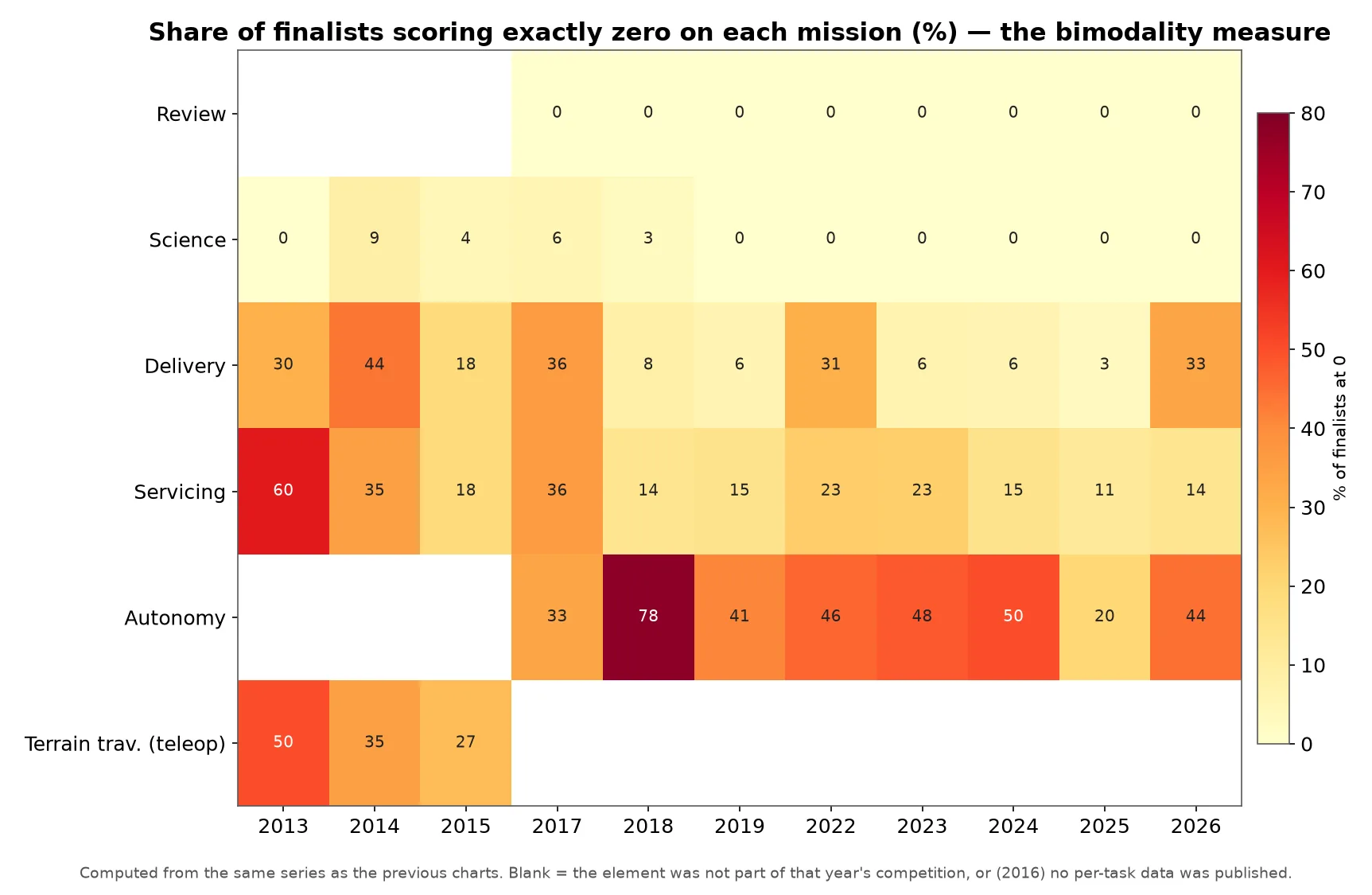
- Science scores reliably and Autonomy does not. Across 2022 to 2026 Science never produced a zero, and Autonomy averaged a 41 % zero rate over 162 finals team-years.
The task
The competition is run by The Mars Society at the Mars Desert Research Station, near Hanksville, Utah, from 2 to 5 June 2027 S-URC27-RULES S-URC-LOGISTICS §1.a.i. Registration closes on 30 October 2026, the System Acceptance Review is due 5 March 2027, and the four missions are graded at the field event: Astrobiology, Delivery, Equipment Servicing and Autonomy, at 100 points each, plus the review at 100 S-URC27-RULES §3.a.
About 116 teams register in a typical year. The review admits the top 36, in practice 37 or 38 when scores cluster, and the field is where the ranking is decided S-URC26-SCORES S-CENSUS. A first-time team is therefore solving two different problems in one season: qualification through a written and filmed review, then completion of four missions under a clock.
Ten findings
1. 2027 is the largest rule change in five years, and two changes carry the most risk for a first build. The Science Mission became the Astrobiology Mission and now requires two life-detection capabilities, at least one a bioassay that detects a biomolecule such as a protein, a sugar, a nucleic acid, ATP or chlorophyll; a chemical assay alone is not enough S-URC27-RULES S-URC27-QA §1.b.v. The Autonomous Navigation Mission became the Autonomy Mission, whose first half requires the rover to assist a walking astronaut in a suit: follow, stay, fetch a 0.9 kg rock hammer, come and give S-URC27-RULES §1.e. URC ran an astronaut task from 2011 to 2016 and required sign reading from 2017, so the navigation half has precedent; the commanded interaction does not.
2. The limits did not move, so the new capabilities come out of the same 50 kg. The rover must be at or below 50 kg in every deployed configuration and 70 kg across all fielded parts, and must fit inside 1.2 m on every axis at each weigh-in. Overweight costs 5 % of the mission’s points per kilogram above 50; a rover that does not fit the box loses 40 % S-URC27-RULES §2.a.ii §2.a.iii. A team that adds a bioassay payload without removing mass elsewhere either fails weigh-in or arrives heavier, slower and hotter.
3. Autonomy is 20 % of the score, and almost all of it needs real autonomy. A teleoperated rover earns about 5 of the 100 Autonomy points, which caps the total near 405 of 500 before other losses S-URC27-RULES §1.e.iv §1.e.x. The follow command is graded by interaction modality: a device command earns 5 points, a visual sign 5, a spoken phrase 10 and a beckoning arm, leg or torso gesture the full 15 S-URC27-RULES §1.e.vi. That is a deliberate, testable choice worth 10 points over the easiest option.
4. Communications is the most common reason teams fail. This is the judges’ own headline advice rather than a deduction: they write that “communication failures are far and away the most common problem that stops a team from being a top contender” S-URC-ADVICE. The 2027 environment makes it harder: a 1 km range, no guaranteed line of sight for more than half the Delivery course, a second autonomy target that is deliberately out of sight, a metal command trailer, a 3 m antenna limit, and 900 MHz operation confined to three 8 MHz sub-bands that must be selectable per mission S-URC27-RULES S-URC27-RULES §2.c §3.d.ii.
5. Science is the reliable points; Delivery and Autonomy are where the field breaks. Across 2022 to 2026 Science never produced a zero and averaged between 72 and 81, with the narrowest spread. Autonomy produced 7 to 17 zeros a year and Delivery between 1 and 12, with Delivery’s worst season 2026 at 12 zeros S-URC22-SCORES S-URC26-SCORES. A rover that simply completes those two missions gains 20 to 30 places.
6. Mass and power are dominated by peaks, not averages. A 50 kg rover draws about 249 W average on a URC mission and about 3.7 kW at peak, roughly 15 times as much, and the peak sizes the fuse, the contactor and the wiring. A pack sized only for energy sags about 15 % on a hill with the arm loaded, and a battery management system set to trip at a safe current will shut the rover down during a legal arm hold. The binding mission is the 60-minute Delivery clock, so the pack is sized at 400 to 500 Wh rather than at the average.
7. The E-stop rule tightened, and older team designs are now a trap. Since 2026 a single red push button must stop movement and cease all power draw from every battery, switching off all systems S-URC27-RULES §2.a.v. Designs published in 2024 and 2025 that only kill the drive bus are non-compliant, and copying one is a plausible way to fail scrutineering or to start a fire.
8. The 2027 task hardware is named by hyperlink, and its physical properties set real requirements. The typing keyboard is a Redragon K552 with a 19.05 mm key pitch, roughly 2 mm actuation and about 0.45 N of force; the Fetch object is a 0.91 kg all-steel rock pick of 300 mm; the hose coupling is a 1.5 in cam-lock whose gasket changed from removed in 2026 to cut to half thickness in 2027, which makes it stiffer to push onto S-URC27-RULES S-URC27-RULES §1.d.ii §1.e.viii. Key and lock markers are 1 × 1 cm and keyboard markers 2 × 2 cm, which sets camera resolution and arm repeatability.
9. The review is a form, not an essay. In 2026 the System Acceptance Review split into 48 points for a five-minute video, 40 for a seven-page report and 12 for the judges’ assessment, and material beyond the limits was not read S-URC26-SAR. The lowest admitted score was 85.10 in 2023, 84.04 in 2024, 86.90 in 2025 and 75.86 in 2026, so the 2026 drop tracks a rebuilt rubric rather than a weaker field S-URC23-SCORES S-URC24-SCORES S-URC25-SCORES S-URC26-SCORES. Cross-year review benchmarks are not comparable.
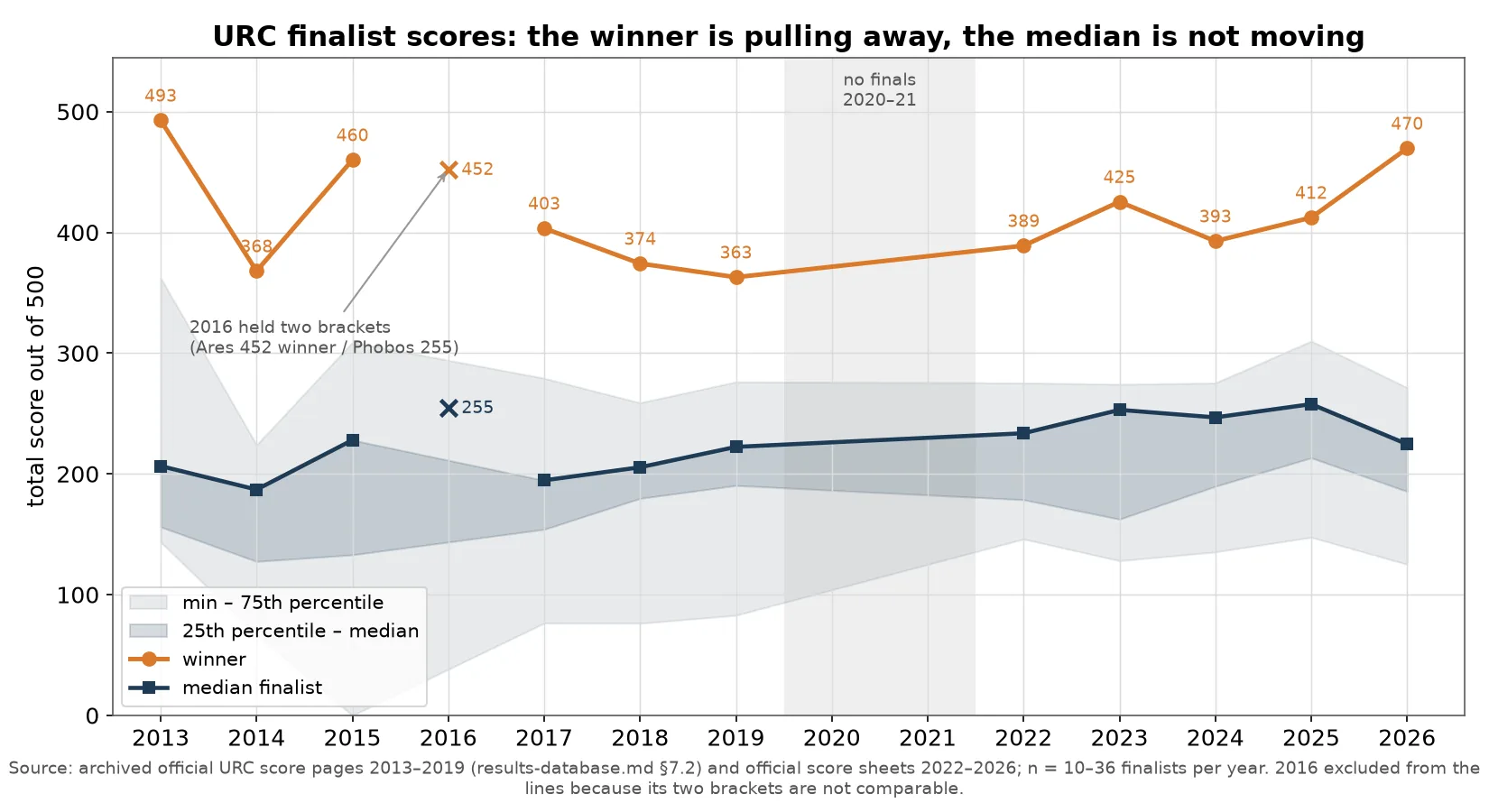
10. A first-year team’s realistic target is the middle of the field, and that is a good result. The median team that recorded mission scores finished between 224 and 258 points of 500 in each of the last five seasons, and 54 teams that appear on two or more official team lists never reached a finals score sheet at all S-URC22-SCORES S-URC26-SCORES S-CENSUS. Qualifying, finishing all four missions at 50 to 60 % of the available points, and returning for a second season is the strategy the historical data supports.
The ten decisions to take first
These are ordered by how much downstream design each one unlocks. The mission backfit turns each into a trade study, and the problem register turns it into tasks.
| # | Decision | Why it comes first | Where it is worked |
|---|---|---|---|
| D1 | Mass and configuration strategy: one rover, or a common chassis with swappable arm and science modules | Sets the 50 kg and 70 kg budgets, the packing problem and the 10-minute Autonomy to Equipment transition | Systems engineering |
| D2 | Mobility architecture: six-wheel rocker-bogie, four-wheel independent, or articulated | Drives wheel size, torque, mass, packaging and terrain capability | Mobility |
| D3 | Arm architecture: degrees of freedom, reach, stow and end-effector strategy | The hardest integration constraint, 1.5 m of reach inside a 1.2 m cube, and the most task-specific | Arm and end-effectors |
| D4 | Science payload concept: the two life-detection methods and the bioassay | A new 2027 requirement that locks mass, power, fluids, time and contamination control | Science |
| D5 | Communications architecture: band, radio, antenna and relay strategy | The dominant failure mode, and it determines mast, power and operator workflow | Communications |
| D6 | Autonomy ambition: teleoperation only, GNSS waypoints, or perception with person following | Determines compute, sensors, software effort and the 20 % of the score that is autonomy | Software and autonomy |
| D7 | Drone: yes or no | Optional and useful in Delivery and Autonomy, never required, and it adds a second vehicle and a pilot | Delivery and drones |
| D8 | E-stop and electrical safety architecture | Pass or fail at scrutineering, and late changes are expensive | Power and safety |
| D9 | Operator station and staffing model | Six seats, no view of the rover, missions of 30 to 40 minutes: the human system is part of the design | Operations |
| D10 | Review strategy: what evidence the video and report will show, and when it must be true | The gate to the field, and it dates the build backwards from March 2027 | Review, judging and awards |
The eight main risks, in order
- Communications failure at the field. The judges’ most-cited cause of a motionless rover.
- Mass and packing overrun. The 50 kg and 1.2 m constraints surface late and force redesign.
- Autonomy under-delivery. A fifth of the score needs real autonomy, and the astronaut sub-mission has no precedent to copy.
- Science payload infeasibility. A bioassay means chemicals, fluids, containment, time and a safety plan for both; a payload deferred until after the review will not work in June.
- Thermal and dust. A sealed box in Utah sun, where electronics that pass on a bench fail at the station.
- Schedule. Preliminary Design Review on 2 December 2026, the System Acceptance Review on 5 March 2027, finals on 2 June 2027: the rover must be demonstrable in March.
- Safety and compliance. E-stop, battery fire, spectrum and weigh-in failures cost the whole event rather than points.
- Team capacity. 24 students, six of them in the command station, learning twelve subsystems at once S-URC-LOGISTICS.
The next 90 days
The window runs from 26 October 2026 to 23 January 2027, with the Preliminary Design Review inside it on 2 December. The full sequence is on the first 90 days page; the six items below are the ones that change later decisions.
- Registration closes on 30 October 2026 S-URC27-RULES §3.a.i. It also starts the compliance clock: radio licensing, drone registration and Remote ID if a drone is planned, and the communications documentation due on 30 April 2027 S-URC27-RULES S-URC27-RULES §2.b §2.c.ii.
- The task hardware must be measured. Judge-like mock-ups of the keyboard, tubular lock, cam-lock hose, cache handle, drawer, latch and rock pick make every unpublished force, torque and clearance measurable. That single campaign closes most of the unknowns that block the arm.
- The two highest-uncertainty subsystems need prototypes first: a radio link that reaches 1 km without line of sight, and a drive and suspension mock-up that climbs a loose 30° slope with the intended payload.
- The mass and configuration strategy has to be settled before detailed design, because it constrains wheel size, arm class, packaging and the operator plan.
- The review evidence starts now. The video carried 48 of 100 review points in 2026 and has to show a working rover, so the build schedule is set by March rather than June S-URC26-SAR.
- The Q&A is binding and it moves. It changed twice within a month of publication, in October 2026, so the current rulings are re-read before each milestone S-URC27-QA.
How the book continues
| Part | What it adds to this summary |
|---|---|
| The competition | The four missions decoded, the hard limits, the 155 requirements and the Q&A rulings |
| The field | The 68-team census, five seasons of results and 51 dossiers |
| Subsystems | Twelve studies with comparison tables, failure modes and a shortlist for a first build |
| Cross-cutting analysis | Mass, power, the 66 interfaces and what separates the top from the rest |
| Mission backfit | Each mission and task against what the strongest teams did and what 2027 invalidates |
| The build plan | 110 problems in five waves, 70 risks and 77 open questions |
| Statistics | Every headline number with its sample, period and chart |
Sources for this page
- S-URC27-RULESUniversity Rover Challenge 2027 – Requirements and GuidelinesOriginal Archived copy
- S-URC-LOGISTICSURC LogisticsOriginal Archived copy
- S-URC26-SCORESURC2026 Official ScoresOriginal Archived copy
- S-CENSUSURC team census, master index (68 teams, 187 team-year rows, tiers, documentation test)Print copy
- S-URC27-QAURC2027 Questions & Answers (updated through 2026-10-11)Original Archived copy
- S-URC-ADVICEURC Advice (judges' systems-engineering lessons)Original Archived copy
- S-URC22-SCORESURC2022 Official ScoresOriginal
- S-URC26-SARURC2026 System Acceptance Review Requirements + SAR Q&AOriginal
- S-URC23-SCORESURC2023 Official ScoresOriginal
- S-URC24-SCORESURC2024 Official ScoresOriginal
- S-URC25-SCORESURC2025 Official ScoresOriginal