Subsystem comparisons
Twelve subsystem chapters, eleven of them backed by a dedicated study, describe the same rover from twelve directions. Put side by side, they answer a different question from any one of them: which boundaries carry the system. The arm, compute and perception each touch nine high-criticality interfaces, the wheels are 24 % of the one measured mass breakdown, and the arm spans 4.0× in published mass, from 3.53 kg to 14.00 kg. This page is the comparison table set, with the numbers and the page that derives each one.
Key takeaways
- The arm and compute are the most coupled subsystems. Nine high-criticality interfaces each. A first build that leaves the arm last and chooses cameras as it goes has chosen the two worst places to defer decisions.
- No single subsystem dominates the mass. Monash’s measured chassis is 24 % wheels, 22 % suspension, 18 % chassis, 14 % ankles, 21 % arm. A 50 kg rover is five or six decisions of 5 to 8 kg.
- The arm is the widest discretionary item. Independent measurements run from 3.53 kg to 14.00 kg for 0.87 to 1.17 m of reach, a 4.0× spread on the same requirement.
- Power and environment touch everything. Every power interface except one is electrical, and a single E-stop rule makes power a system function rather than a subsystem.
The twelve subsystems on one page
The sizing number is the value each study uses to close its design. The mass figures are the published ranges from the mass model.
| # | Subsystem | The number that sizes it | Typical mass | High interfaces | Detail |
|---|---|---|---|---|---|
| 01 | Mobility | 7.72 N·m per wheel at 30° for a 45 kg rover | 14–29 kg (28–58 %) | 7 | Mobility |
| 02 | Arm and end-effectors | 233 N·m static and 176 N·m peak at the shoulder; 0.87–1.17 m reach | 6–14 kg (12–28 %) | 9 | Arm and end-effectors |
| 03 | Science payload | 3.5–4.5 kg for a two-assay payload; 30–100 W drill | 3.5–6 kg (8–15 %) | 5 | Science and astrobiology |
| 04 | Delivery and drones | 5 kg objects at 40 × 40 × 40 cm, grasp within 7.5 cm | Mission, not a subsystem | 1 | Delivery and drones |
| 05 | Communications | 12–200 kbps at 900 MHz; 6 Mbps at 2.62 km on 2.4 GHz | 3–5 kg with compute | 7 | Communications |
| 06 | Power and electrical safety | 120 A drive peak and 1.1 kW arm peak; 249 W average | 4–6 kg (8–12 %) | 6 | Power and safety |
| 07 | Compute and perception | 10–40 W compute; 3–11 cameras; ArUco at 10–30 Hz | 3–5 kg with comms | 9 | Compute and perception |
| 08 | Software and autonomy | 100–200 Hz joint loop; telemetry at 2 Hz or more in 2 kB messages | No mass | 6 | Software and autonomy |
| 09 | Operations | Six command seats; 15 minutes to set up, 10 to tear down | Ground station, not rover | 6 | Operations |
| 10 | Systems and integration | 37.5 kg allocation plus 15 % growth, 43.1 kg; 1.2 m cube | Owns the allocation | 7 | Systems engineering |
| 11 | Environment and repair | 37.8 °C; 65 km/h gust to 155 Pa; 10 g transport shock | Imposes mass, owns none | 7 | Environment and repair |
| 12 | Astronaut interaction | 50 points; 3 m stand-off; stay test beyond 20 m | Suit is not rover mass | 4 | Astronaut interaction |
The 1.2 m cube and the 50 kg limit are fixed by the rules S-URC27-RULES S-URC27-RULES §2.a §1; the 5 kg and 40 × 40 × 40 cm delivery objects and the 50 astronaut points are fixed by the missions S-URC27-RULES §1. The arm masses are five independent published values, from Cornell at 3.53 kg to ARES at 14.00 kg S-WVU-SAR2025 S-ARES-PAPER-2025 S-RSX-ARM-URDF S-MONASH-GH-NOVA, with the Cornell figure taken from the team description files listed in the mass and power data.
Mass shares
| Subsystem | Typical share of a 45–50 kg rover | Evidence | Confidence |
|---|---|---|---|
| Mobility | 28–45 % (14–22 kg) | Monash measured, plus allocations | Medium |
| Arm | 12–28 % (6–14 kg) | Five independent published masses | High |
| Science payload | 8–15 % (3.5–6 kg) | Two independent derivations | Medium |
| Power | 8–12 % (4–6 kg) | 500–600 Wh at 170 Wh/kg plus electronics | Medium |
| Compute, comms, antennas | 6–10 % (3–5 kg) | Module and camera masses | Medium |
| Fasteners, brackets, cable | 3–5 % | Build experience | Low |
The mobility range widens to 14–29 kg and 28–58 % when every published and allocated estimate is included, which is the range used in the first table. The narrower 28–45 % band is the central estimate for a first build.
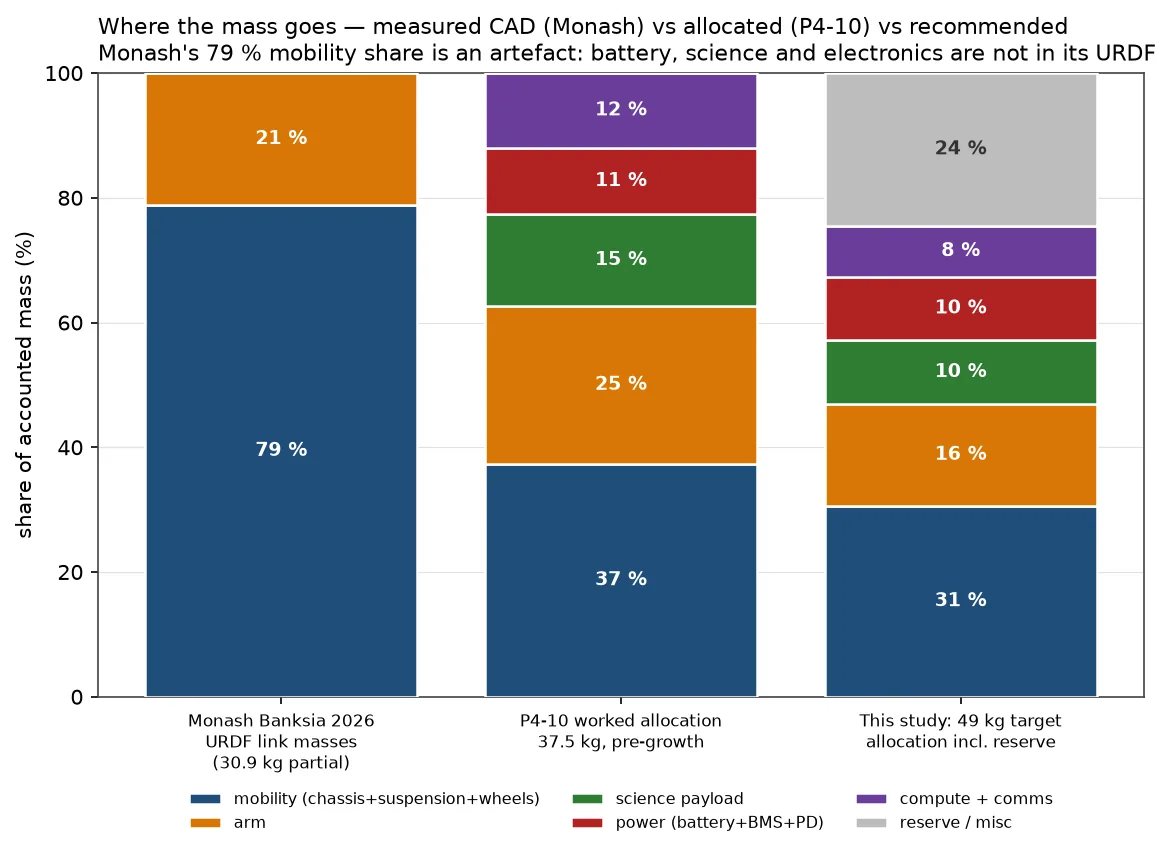
The measured case and the two allocations bracket the same design, and their differences are instructive:
| Subsystem | Systems allocation | Recommended target | Why they differ |
|---|---|---|---|
| Mobility | 14.0 kg (37 %) | 15.0 kg (31 %) | The allocation assumes 0.6 kg printed wheels; Monash’s real wheels are 1.85 kg each |
| Arm | 9.5 kg (25 %) | 8.0 kg (16 %) | Bought integrated actuators land at 6–9 kg; three published arms are below 7 kg |
| Science | 5.5 kg (15 %) | 5.0 kg (10 %) | An independent derivation gives 3.5–4.5 kg |
| Power | 4.0 kg (11 %) | 5.0 kg (10 %) | A 500 Wh pack is about 2.9 kg plus distribution and harness |
| Compute, comms, fasteners | 4.5 kg (12 %) | 4.0 kg (8 %) | One computer, six to eleven cameras, three radios |
| Reserve | 0 kg | 12.0 kg (24 %) | The allocation recovers margin by adding 15 % growth; the target carries the reserve explicitly |
| Total | 37.5 kg | 49.0 kg | One is a pre-growth estimate, the other a design target |
Interfaces by subsystem
The matrix has 66 interfaces between the twelve subsystems, every pair has at least one, and 37 are high criticality, 25 medium and 4 low. The degree of a subsystem is the count of high-criticality interfaces it touches, and it is the best available proxy for where a late change propagates.
| Subsystem | High interfaces | What it means for a schedule |
|---|---|---|
| Compute and perception | 9 | Perception is the most coupled data subsystem |
| Arm | 9 | The arm is the most coupled mechanical subsystem |
| Environment | 7 | Thermal and dust touch every sealed box |
| Systems | 7 | Every allocation is an interface |
| Communications | 7 | The link is a system property, not a radio choice |
| Mobility | 7 | The deck, the cube and the mass budget all run through it |
| Operations | 6 | Clocks convert into points |
| Software | 6 | Data and timing cross most boundaries |
| Power | 6 | Every power interface except the thermal one is electrical |
| Science | 5 | Mostly mechanical and data, one timing link |
| Astronaut | 4 | Data and timing dominated |
| Delivery | 1 | Delivery re-uses existing interfaces; its risk is in the mission sequence |
The full network and the criticality definitions are on Failures and interfaces. Two cells are deliberately not high: the astronaut camera link is worth 5 points and changes nothing else, and the power-to-systems link is the mass allocation rather than a physical boundary.
The values on this page
| Statistic | Value | Definition | Period | Sample | Source | Chart and chapter |
|---|---|---|---|---|---|---|
| Subsystems | 12 | Chapters in the subsystem set | 2027 | 12 chapters | Analysis | Subsystem studies |
| Interfaces | 66 | Pairs across twelve subsystems | 2027 | 12 × 12 matrix | Analysis | Failures and interfaces |
| High interfaces | 37 | Interfaces that force a redesign or cost 10 points | 2027 | 66 interfaces | Analysis | Failures and interfaces |
| Most coupled | 9 each | Arm and compute and perception | 2027 | 66 interfaces | Analysis | Interfaces and couplings |
| Mobility mass | 14–29 kg | Published and allocated range | 2021–2026 | 8 teams | S-MONASH-GH-NOVA | Mobility |
| Arm mass | 3.53–14.00 kg | Five independent published values | 2025–2026 | 5 teams | S-WVU-SAR2025 | Arm and end-effectors |
Evidence note
The mass shares rest on one measured CAD breakdown, one worked allocation and one recommended target, not on a statistical sample. The interface counts are exact for the matrix as written and are only as good as the twelve studies behind it; the delivery node is the weakest, because it has no dedicated study and is reconstructed from the rules and the other chapters. The failure record is counted on the next page.
Sources for this page
- S-URC27-RULESUniversity Rover Challenge 2027 – Requirements and GuidelinesOriginal Archived copy
- S-WVU-SAR2025Team Mountaineers System Acceptance Review 2025 (rover "Daedalus"): 2.4 GHz 90° sector + 3 m rover mast, 70 cm HAM packet radios, 433.25 MHz amateur-TV analog video, 750 m LOSOriginal
- S-ARES-PAPER-2025"Development of a Multifunctional Rover System for Mars Exploration and Operations in the University Rover Challenge" (RSJ 2024, 2K2-07)Original
- S-RSX-ARM-URDFRSX 2025 arm URDF + meshes (6 revolute joints, link masses)Original
- S-MONASH-GH-NOVAMonashNovaRover/nova, "The Monash Nova Rover mono-repo" (Apache-2.0; default branch main; 2,389 files; last push 2026-10-23)Original