BRACU Mongol-Tori
BRAC University has built a named rover every season since 2018 and keeps a specification page for each of them, with mass, wheel size, battery, radio models and computer for all eight. That makes Mongol-Tori the best-documented Tier B team in the field and the only one where a first-time team can follow a complete design lineage at component level from public sources. The record is a slow climb: 16th in the first finals year, 21st, 8th, then seventh in 2026 with the best total in the team’s history.
What this team shows
- A per-year specification table is the cheapest documentation a team can publish, and it is what makes eight rovers comparable. It names components and headline numbers, not part numbers or quantities.
- Six seasons of an actuated, expanding suspension were ended by a fixed low-centre-of-gravity chassis. The actuators solved a tipping problem that a lower centre of gravity then solved for free.
- The complexity budget went into radio links, and the Delivery score followed: 15, 15, 22, then 61 after a five-path frequency-diverse rebuild.
- The stated 50 kg competition mass sits exactly on the 2027 limit, with no breakdown and no margin.
Identity and results
| Year | Rover | Total | Rank | SAR | Science | Delivery | Equipment | Autonomy |
|---|---|---|---|---|---|---|---|---|
| 2023 | Encephalon | 253.03 | 16 | 90.17 | 85.26 | 15 | 29 | 33.6 |
| 2024 | Phoenix | 210.38 | 21 | 87.38 | 78 | 15 | 30 | 0 |
| 2025 | Hypersonic | 317.87 | 8 | 89.87 | 95 | 22 | 55 | 56 |
| 2026 | Taurus | 347.81 | 7 | 78.81 | 95 | 61 | 69 | 44 |
The table starts with the first finals year. The 2022 season was a submitted review with no finals place, so it carries one score, 86.39, and no mission results S-URC22-SCORES. From 2023 the total rose every year and the rank rose every year except 2026, where a 30-point gain bought one place because the field compressed.
Science is the strongest column: 85.26, 78, 95 and 95, a mean of 88.3 across the four finals. Delivery is the weakest at a mean of 28.25, and it is the only column that moved in more than 30-point steps S-URC23-SCORES S-URC24-SCORES S-URC25-SCORES S-URC26-SCORES.
Two pages of the team’s own site disagree with the official record: the timeline gives 11th place for 2024 where the score sheet has 21st, and it describes 2022 as a debut at the Utah finals where the record shows a review submission only S-BRACU-SITE-ABOUT S-BRACU-SITE-COMPETITIONS S-URC24-SCORES S-URC22-SCORES. The 2023 finals appearance is the first that both sources support.
Rover generations
2018: Revolution. The move from six wheels to four, on a “modified rocker-bogie” whose bogies expand from 0.76 m to 1.2 m under two linear actuators, a rebuilt arm with four linear actuators and two direct-current motors, and a control room of three laptops. The chassis is a 0.7 × 0.55 m ladder and space frame S-BRACU-SITE-REVOLUTION18.
2019: Mongol-Tori. The same 0.7 × 0.55 m frame and expanding bogies with a lower centre of gravity, 0.3 m stainless-steel wheels with U-shaped rims and rubber grip pads, a 6-DOF arm with three interchangeable claws, a five-test onboard laboratory fed by a printed soil distribution system, and autonomy on satellite position plus a magnetometer plus a detector at 81 % S-BRACU-SITE-MT2019.
2020: Mongol-Tori. Mechanical carry-over with a new electrical and autonomy stack: six 10,000 mAh batteries into one distribution board, an ArduRover autopilot giving 50 cm waypointing, a 360° lidar, and Raman spectroscopy added to the science suite. No event was held that year S-BRACU-SITE-MT2020.
2022: Encephalon. A new H-frame chassis, a custom linear-actuator extender with an in-house planetary gearbox, stainless wheels grooved and wrapped with jute-fibre rope for traction, a 6-DOF arm with a chain-and-sprocket wrist and a worm-gear base lock, four purpose-built boards on an 18 V 10 Ah pack, and a custom differential satellite algorithm because real-time kinematic hardware was unavailable after the pandemic S-BRACU-SITE-ENCEPHALON22.
2023: Encephalon. A refinement rather than a replacement: an extender driven by a 65 rpm window motor, a tilted-wheel mechanism for slow descents, 0.29 × 0.112 m stainless wheels, two satellite receivers for differential correction, and a split power system with a four-cell pack for the router and a 24 V lead-acid pack for everything else. First finals appearance, 16th S-BRACU-SITE-ENCEPHALON23.
2024: Phoenix. The omni-wheel year. Four omni wheels whose angle is set to 0°, 45° or 90° by linear actuators, giving skid steering, spot rotation and lateral strafing; an aluminium and ebonite chassis; a 5-DOF arm with mass at the base; and a custom ultraviolet-visible spectrometer covering 250 to 800 nm with 15 quartz cuvettes. Autonomy scored zero S-BRACU-SITE-PHOENIX.
2025: Hypersonic. Back to a rocker-bogie with an arched base support, a segmented chassis with a flipping mechanism that separates the control bay from the electronics, and a 6-DOF arm with 1.4 m reach and 120° base rotation. Power moved to three hot-swappable 18 V 9 Ah packs, and autonomy to a differential satellite receiver with two stitched stereo cameras covering 200°. Eighth place S-BRACU-SITE-HYPERSONIC S-BRACU-NEWS-REVEAL25.
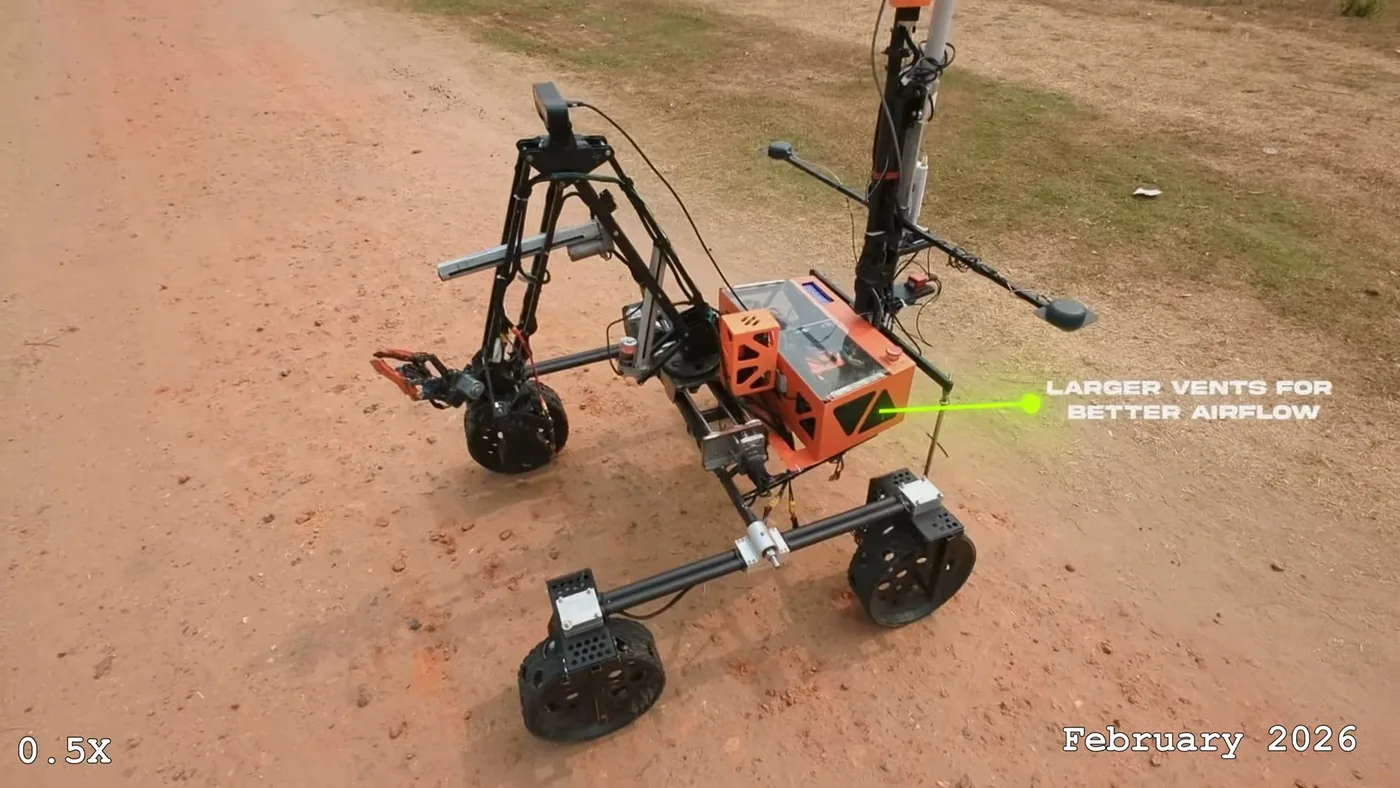
2026: Taurus. A ground-up redesign keeping only the chassis concept: carbon-fibre tube with an in-house aluminium extrusion, a lower centre of gravity aimed at the tipping that had plagued autonomous runs, 12-inch slotted wheels, a 7-DOF arm on a linear rail, and a CAN network of custom ESP32 nodes. Seventh place S-BRACU-SITE-TAURUS.
What changed, 2023 to 2026
Each row is the team’s own comparison of the two rovers S-BRACU-SITE-ENCEPHALON23 S-BRACU-SITE-TAURUS.
| Subsystem | 2023 Encephalon | 2026 Taurus | Stated driver |
|---|---|---|---|
| Wheels | 0.29 × 0.112 m stainless, rubber grippers | 12-inch slotted, bolted tread blocks | Traction and simplicity |
| Suspension | Rocker-bogie, extender by window motor | Fixed rocker-bogie, lower centre of gravity | Cure tipping in autonomous runs |
| Arm | 6-DOF, worm-gear base lock | 7-DOF plus linear rail, dual end effector | Task coverage |
| Feedback | Potentiometers | Magnetic encoders on every joint | Precise angular feedback |
| Control | Arduino and Cytron drivers | ESP32 CAN nodes with distributed PID | Cut main-computer load |
| Compute | Jetson Nano and single-board computer | Jetson Orin | Graphics for ROS 2 and detection |
| Comms | Dual 5.8 GHz, 13 and 19 dBi | 5 GHz with 2.4 GHz fallback, 900 MHz and 433 MHz | Prior 5 GHz failures in Delivery |
| Mass | Not published | 50 kg stated | No margin against the 2027 limit |
Subsystems
Mobility. Four wheels since 2018. The defining early choice was the expanding bogie: the wheelbase widened from 0.76 m to 1.2 m before a vertical drop, in the team’s words to “widen the rover’s base to prevent it from flipping over”. It cost two actuators and a sliding joint per side S-BRACU-SITE-MT2020. The differential was a U-shaped rear bar with two universal joints to maximise bogie rotation. In 2026 that whole arrangement was replaced by a fixed geometry with a lower centre of gravity, aimed squarely at tipping during autonomous missions S-BRACU-SITE-TAURUS. The 2026 chassis keeps interface points for a future omni-wheel module, which is an honest way to shelve the 2024 experiment. Drive motors and gearbox ratios are unpublished in every year; what is published is the driver stack, two 60 A dual-channel and four 10 A dual-channel controllers S-BRACU-SITE-TAURUS.
Arm and end effectors. Six axes from 2018 to 2023, five in 2024, six with 1.4 m reach in 2025 and seven plus a linear rail in 2026. The jump tracks the servicing task list rather than payload: the 2026 page says the rail and base rotation enable connector insertion, switch flipping, latched doors, test tubes and hose connections S-BRACU-SITE-TAURUS. Joint feedback moved from potentiometers to magnetic encoders with local proportional control at each CAN node. The one motor model named anywhere in the team’s material is a frameless actuator used for end-effector pitch S-BRACU-SITE-TAURUS.
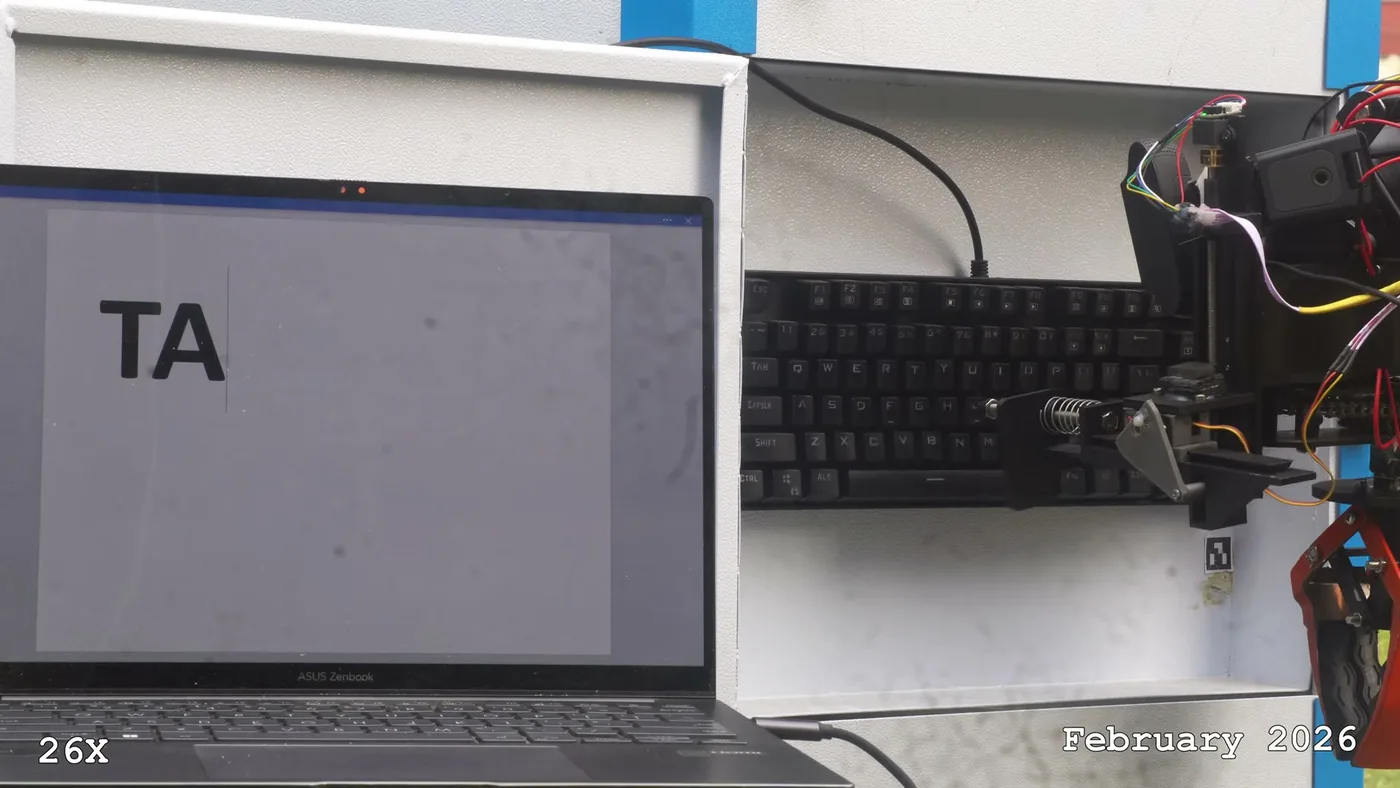
The end effector is the most distinctive part of the design. A dual independent pitch and roll head carries a gripper on one side and a keyboard clicker with a laser crosshair on the other, switching between teleoperation and closed-loop typing. It evolved from a clip-on 2-DOF typing arm added in 2025 S-BRACU-SITE-HYPERSONIC. Two fixed end effectors selected by wrist orientation avoids an actuated quick-change interface entirely.
Science. A broad sensor and wet-chemistry suite rather than an instrument-led payload. The 2026 list runs a temperature, humidity, pressure and air-quality sensor, electrochemical oxygen, carbon dioxide, light, ultraviolet index, particulates and methane, plus a soil probe over a serial bus and a servo-mounted camera that stitches a panorama for stratigraphic profiling S-BRACU-SITE-TAURUS. Life detection uses a hydrogen-peroxide organic-matter test, an electrical-conductivity test offered as evidence of extant life, phosphate by the Olsen method and ultraviolet protein detection at 260 to 280 nm S-BRACU-SITE-TAURUS. Sampling is an auger with interlocking soil claws on a rotating head, drilling beyond 15 cm into a printed load-cell cuvette under a no-contamination policy.
The gap is analytical depth. The 2024 rover carried a real ultraviolet-visible spectrometer and 2025 carried one too; the 2026 instrument list contains none, and the team does not say why S-BRACU-SITE-PHOENIX S-BRACU-SITE-TAURUS.
Communications. This is the most engineered subsystem and the one the team credits for the 2026 improvement. Five paths: a 5 GHz link with a 13 dBi omni as primary; a 2.4 GHz fallback that shifts automatically by signal strength; 900 MHz and 433 MHz telemetry paths; and an in-house digital video link on an open router firmware stack with a packet-loss mitigation layer S-BRACU-SITE-TAURUS. The team’s own diagnosis is explicit: after prior 5 GHz failures during the Delivery mission, it introduced frequency diversity S-BRACU-SITE-TAURUS. Its field notes from a European event the year before say the same thing, that a communications dropout during the navigation task “cost us valuable points” S-BRACU-NEWS-ERC2024.
The claimed 3.3 km non-line-of-sight range is a 3.3-fold jump on the 2025 claim of 1 km line of sight, with no link budget, signal log or throughput figure published S-BRACU-SITE-HYPERSONIC S-BRACU-SITE-TAURUS. Treat it as a claim to test.
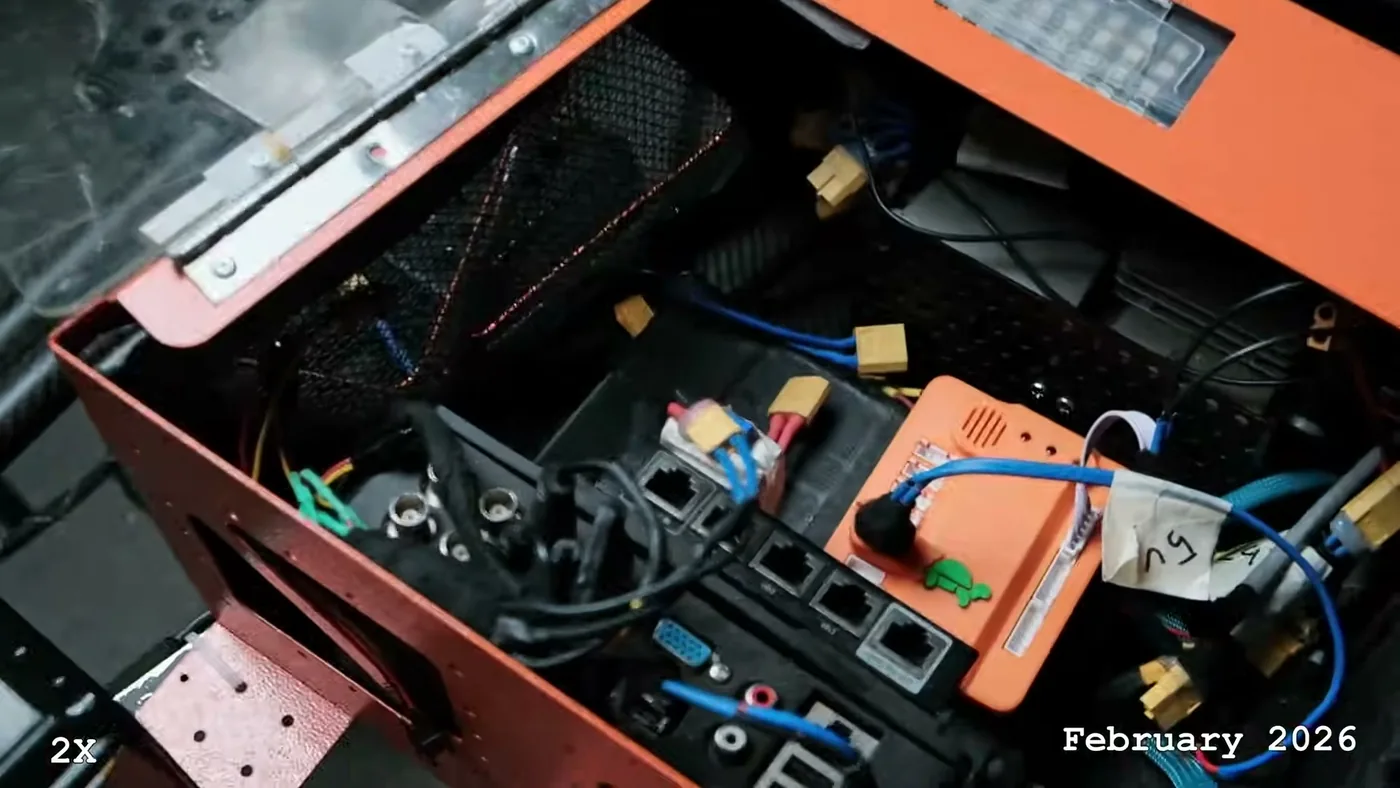
Power and safety. Hot-swappable 18 V 9 Ah lithium-ion packs feed isolated rails at 5, 12, 19.5 and 24 V to keep radio-frequency loads apart, with reverse-polarity protection and a physical kill switch S-BRACU-SITE-TAURUS. Pack count and total energy are unpublished for 2026; 2025 carried three packs at the same rating with a claimed 90 minute runtime, which is about 486 Wh installed S-BRACU-SITE-HYPERSONIC. The base station runs from an uninterruptible supply with four hours of backup S-BRACU-SITE-TAURUS.
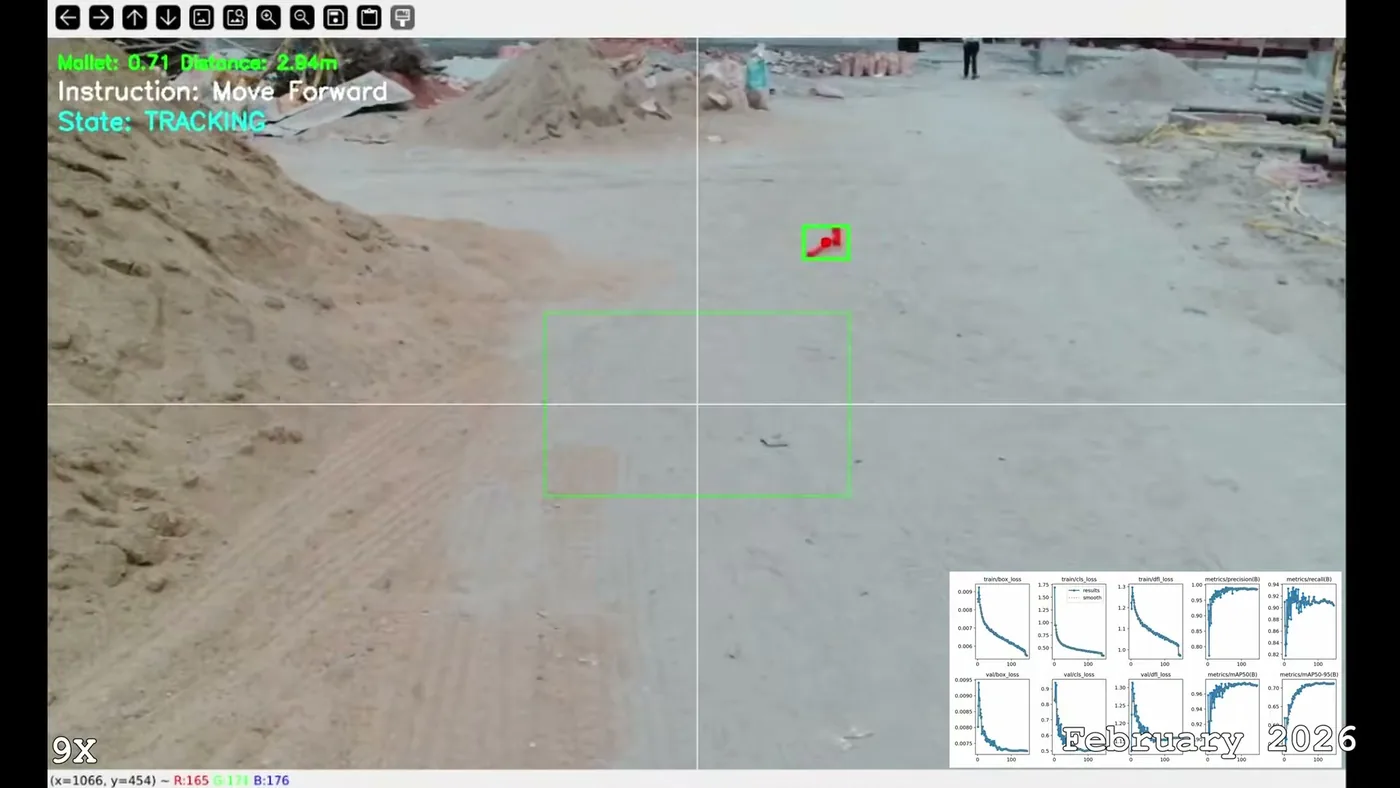
Compute and autonomy. A Jetson Orin is the main computer. Autonomy splits into a high-level control system in Python on ROS 2 Humble and low-level control on the ESP32 nodes under a real-time operating system with local proportional-integral-derivative loops. The planner pairs a satellite waypoint planner with a local costmap built from a single stereo camera, sweeping headings from −60° to +60° and biasing toward the goal S-BRACU-SITE-TAURUS. That is a sampled-heading local planner rather than a global grid search, which suits one depth camera. Behaviour includes a square search when the target is not found, an approach to 1.5 m, and a status display on the rover.
The team also built a Unity digital twin with physics for pre-deployment validation, which is the same strategic move as a full simulator programme at far lower cost S-BRACU-SITE-TAURUS.
Mission performance
2023: the Delivery gate. Science 85.26 was competitive; Delivery at 15 and Equipment at 29 were not. No team-written account of the year exists. What the 2024 page does say is that Phoenix retained the proven suspension while adding omni wheels and a “lighter base-heavy 5-DOF arm”, which reads as a response to an arm that was too heavy and too high S-BRACU-SITE-PHOENIX.
2024: autonomy at zero. A total mission failure, with Delivery again at 15 and Science down to 78 S-URC24-SCORES. At a European event that season the team’s field notes record that the manipulator “performed flawlessly” while a communications dropout cost points in navigation S-BRACU-NEWS-ERC2024. That is the clearest statement in the record of the split: manipulation worked, radio and autonomy did not.
2025: science and servicing. Science rose from 78 to 95 and Equipment from 29 to 55, carrying a 107-point year S-URC25-SCORES. The changes that plausibly explain it are the 6-DOF arm with 1.4 m reach and 120° base rotation, the clip-on typing arm, the expanded chemistry and the stereo search for markers S-BRACU-SITE-HYPERSONIC.
2026: best rank, weakest review. Delivery jumped from 22 to 61 and Equipment from 55 to 69, while autonomy fell from 56 to 44, science held at 95 and the review score dropped 11 points to 78.81, the lowest in the team’s record S-URC26-SCORES. A ground-up redesign in nine months costs documentation time, and the team’s own claim of advancing the rover five technology-readiness levels in that cycle is consistent with spending the effort on hardware S-BRACU-SITE-TAURUS.
Lessons for a first build
- Publish a specification table per rover. Eight small tables of mass, wheels, battery, radio and computer make a whole programme legible. It is the reason this team is usable as evidence at all, and it costs one page a year S-BRACU-SITE-ROVERS.
- Do not start with an actuated suspension. Six seasons of expanding bogies solved a tipping problem at the cost of two actuators and a sliding joint per side. Lowering the centre of gravity in 2026 made the mechanism unnecessary. A first build should buy the geometry fix, not the mechanism.
- Spend the complexity budget where the failures are. Five radio paths, an antenna tracker, a video link with packet-loss mitigation and a base-station uninterruptible supply followed one documented link failure, and Delivery went from 22 to 61 S-BRACU-NEWS-ERC2024 S-BRACU-SITE-TAURUS.
- A cheap CAN node beats bespoke electronics. An off-the-shelf microcontroller with local control loops and a CAN transceiver drives every actuator and takes load off the main computer. It is the same idea as a fleet of custom boards at a fraction of the design effort S-BRACU-SITE-TAURUS.
- Two fixed end effectors beat a changer. A gripper and a clicker on one head, selected by wrist orientation, needs no alignment mechanism and no actuated interface. The 2025 clip-on typing arm is the even cheaper version of the same idea S-BRACU-SITE-HYPERSONIC.
- Check the team’s own numbers against the official sheet. This team’s site gives 11th in 2024 where the record says 21st, and a 2022 finals debut that did not happen. Both are small, and both would matter if they were copied into a comparison table S-BRACU-SITE-ABOUT S-URC24-SCORES.
What remains uncertain
The 50 kg competition mass is a team statement with no weighing method, no CAD mass and no subsystem split, and it sits exactly on the 2027 limit. Stowed dimensions are unpublished for every rover after 2020, which is the single largest gap for a 1.2 m packaging study. Drive motors, gearbox ratios, wheel width and tyre construction are all unpublished; only the driver models are named.
Much of the communications claim rests on one sentence. The 3.3 km non-line-of-sight figure has no measurement data behind it and is a large jump on the previous season. The custom CAN node’s protocol and firmware are private: the link on the team’s own site returns a server error, so the software is the least inspectable part of a well-documented team. Pack count and total energy for 2026 are unpublished. Which of the four chemistry tests the team would offer as its bioassay in 2027 is a question the team has not answered. Team size appears as 37, 41, 50 and “60+” on four pages of one site.
Team sources
- bracu-mongoltori.com, the team site, with a page per rover.
- Rover index, all eight generations.
- Taurus, 2026, the 2026 specification table and subsystem notes.
- Research index, three paper abstracts including one on vision-based navigation.
- 2026 System Acceptance Review, the primary film for Taurus.
- Field notes, European event 2024, the communications dropout account.
Sources for this page
- S-URC22-SCORESURC2022 Official ScoresOriginal
- S-URC23-SCORESURC2023 Official ScoresOriginal
- S-URC24-SCORESURC2024 Official ScoresOriginal
- S-URC25-SCORESURC2025 Official ScoresOriginal
- S-URC26-SCORESURC2026 Official ScoresOriginal Archived copy
- S-BRACU-SITE-ABOUT"About Us", founding year, timeline (incl. the disputed "2024 11th place" / "2022 URC debut"), advisor, "60+ members"Original
- S-BRACU-SITE-COMPETITIONS"Competitions", results board with #7/116 (2026), #8/114 (2025), #21/114 (2024), TBD for 2018–2023Original
- S-BRACU-SITE-REVOLUTION18Rover page, Revolution (2018): six→four wheel change, first expanding bogies, rebuilt 6-DOF arm, three-laptop command stationOriginal
- S-BRACU-SITE-MT2019Rover page, Mongol-Tori 2019: K-frame, expanding bogies 0.76→1.2 m, 0.3 × 0.10 m stainless wheels, 4 linear actuators + 2 DC motors, G-5500 trackerOriginal
- S-BRACU-SITE-MT2020Rover page, Mongol-Tori 2020: six 10,000 mAh batteries, Pixhawk 4.0/ArduRover, Raman added, claw 20 cm/80 gOriginal
- S-BRACU-SITE-ENCEPHALON22Rover page, Encephalon (2022): custom double-sided linear-actuator extender + planetary gearbox, jute-fibre wheels, ROS Melodic, custom DGPS, LSTM weather modelOriginal
- S-BRACU-SITE-ENCEPHALON23Rover page, Encephalon (2023): 0.7 × 0.55 m H-frame, expanding bogies, 0.29 × 0.112 m wheels, 6-DOF + 2-DOF EE, 5.8 GHz P2P 13/19 dBi, custom EPS PCB, Cytron driversOriginal
- S-BRACU-SITE-PHOENIXRover page, Phoenix (2024): omni wheels 0°/45°/90°, 5-DOF 7 kg arm, dual 4S LiPo, Intel NUC/ROS Noetic, UV-Vis spectrometer 250–800 nmOriginal
- S-BRACU-SITE-HYPERSONICRover page, Hypersonic (2025): 48 kg, rocker-bogie with arched base, segmented chassis, 6-DOF 1.4 m / 120°, 3 × 18 V 9 Ah, HP Mini PC + Pixhawk, the analysis/airMAX/Walksnail, Molisch/ninhydrin/UV-C, 19-item Parts IndexOriginal
- S-BRACU-NEWS-REVEAL25"Meet Hypersonic: Unveiling Our 2025 Competition Rover", chassis "sheds nearly four kilograms", onboard spectrometer + soil-sampling augerOriginal
- S-BRACU-SITE-TAURUSRover page, Taurus (2026): spec strip (50 kg, 4-wheel rocker-bogie, 7-DOF, >5 kg / >7.5 cm), six "innovations", six subsystem blocks, Telemetry block, 23-item Parts IndexOriginal
- S-BRACU-SAR20262026 URC System Acceptance Review, "BRACU Mongol-ToriPrint copy
- S-BRACU-NEWS-ERC2024"Field Notes from the European Rover Challenge 2024", comms dropout during navigation cost points; manipulator "performed flawlessly" in maintenanceOriginal
- S-BRACU-SITE-ROVERS"Our Rovers" fleet index, all eight rovers 2018–2026 with mass / drive / arm DoF per generationOriginal