Project Scorpio (Wrocław University of Science and Technology)
Project Scorpio finished second in 2013, third in 2015, and then settled into the most stable mid-field record in the modern field: 14th, 14th and 13th across 2022 to 2024. It has since stopped producing a URC result while continuing to win the Anatolian and Australian Rover Challenges. The programme is therefore a study in a specific strategic choice, because it is not a team that lost the ability to build a rover. It is a team that stopped optimising for this mission set.
What this team shows
- A podium programme can be built on science and manipulation. The 2013 runner-up scored 92 in sample return and 80 in astronaut assistance while terrain scored 63 S-URC-HISTRESULTS.
- Rank stability can hide subsystem churn. The team finished 14th in both 2022 and 2023 with a completely different internal balance S-URC22-SCORES S-URC23-SCORES.
- Delivery has never exceeded 20 in the modern record, across three seasons and two rover generations. That is an unfixed weakness, not a run of bad luck.
- The team now wins the Anatolian and Australian Rover Challenges. URC credibility is no longer what the programme optimises for.
Identity and results
The modern record uses the current mission names. The historic era used a different task set, so its scores are given in the text rather than forced into modern columns S-URC-HISTRESULTS S-URC22-SCORES S-URC23-SCORES S-URC24-SCORES.
| Year | Rover | Total | Rank | SAR | Science | Delivery | Equipment | Autonomy |
|---|---|---|---|---|---|---|---|---|
| 2022 | Not published | 230.63 | 14 | 90.63 | 99 | 20 | 21 | 0 |
| 2023 | Scorpio 7 | 254.69 | 14 | 90.56 | 86.13 | 15 | 63 | 0 |
| 2024 | Infinity | 251.61 | 13 | 88.61 | 70 | 15 | 25 | 53 |
The team is registered for 2025 with no row in that season’s score sheet, and it was absent from the 2026 team list S-URC25-TEAMS S-URC26-TEAMS. The three rows above reproduce the published results S-URC24-SCORES.
The historic record is stronger than the modern one. The team was third in 2011, fifth in 2012, second in 2013 and third in 2015, with a further third place in the second bracket of 2016. In the 2013 runner-up season it scored 92 in sample return, 80 in astronaut assistance, 73 in equipment, 63 in terrain and 92.75 in presentation, for 400.75 points. It fell to 24th in 2017 with 171.6, and in 2019 it recorded a review score of 82.93 with no mission result S-URC-HISTRESULTS.
Rover generations
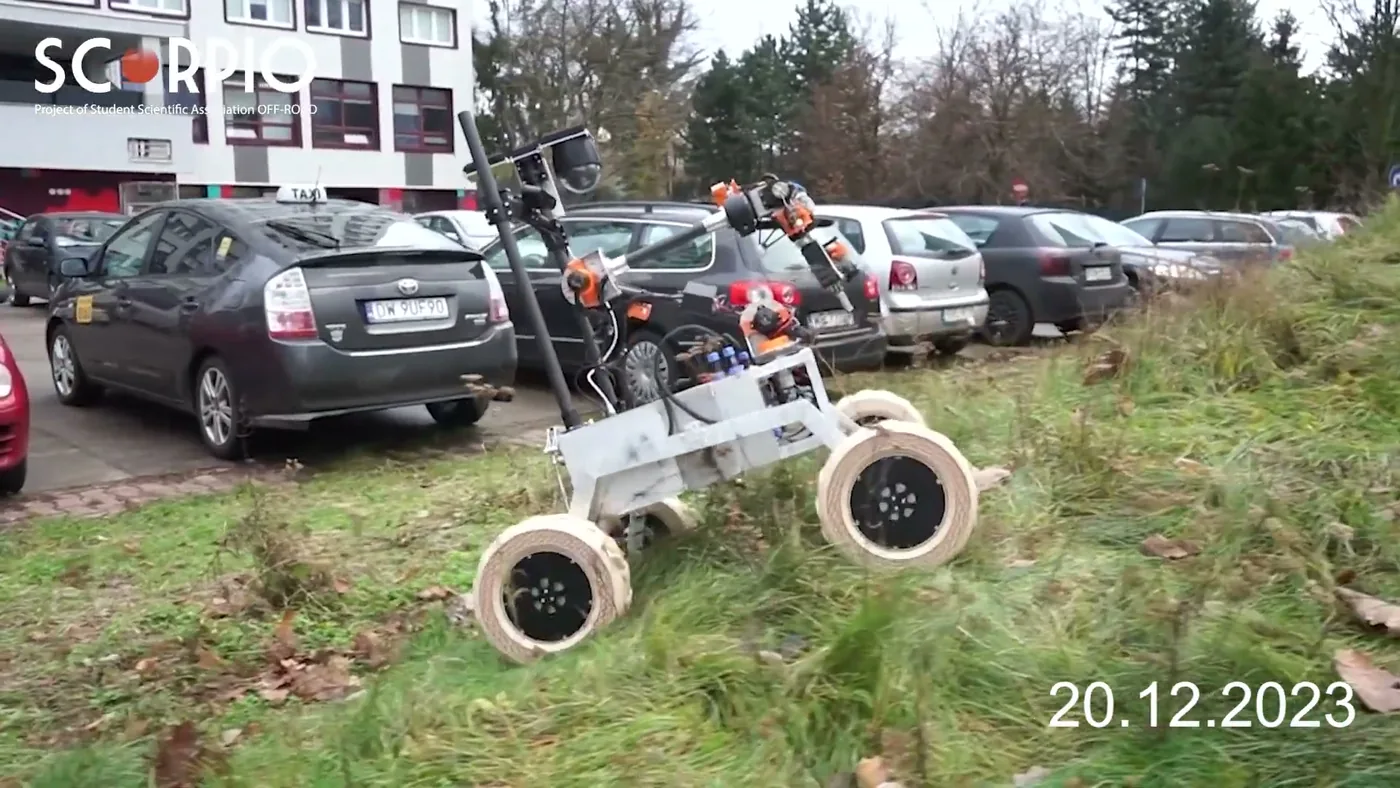
Scorpio 1 to 7. The team has built a numbered generation roughly every two years since 2011. Scorpio 3 was the 2013 runner-up, and Scorpio 7 competed in 2023. Its documented features are unusually specific: a modular body that doubles as the electronics enclosure, polyamide, aerospace aluminium and carbon fibre construction, a suspension of two wishbones coupled by a differential mechanism, and wheels made from Cordura fabric filled with polyurethane foam on 3D-printed rims. The team reports that the new differential reduced mass and increased stiffness compared with Scorpio 6 S-SCORP-PROJECTS.
Infinity. The eighth generation premiered in November 2023 and competed in 2024. It replaced the fabric wheels with tyres printed from flexible filament, introduced BLDC motors with a team-designed planetary gearbox, and widened the wheel. The stated design intent is faster access to the science and electronics modules during competition, which is an operations requirement expressed as a mechanical one S-SCORP-PROJECTS.
The 2024 season. The review film shows a four-wheel platform with a pale chassis, a long carbon-fibre mast at the front carrying a sensor pod and two antennas, and an arm with orange printed joint housings. The wheel count is the biggest visible difference from the six-wheel mainstream, and it is inferred from the film rather than stated by the team S-SCORP-SAR2024.
Subsystems
Mobility. Two wishbones coupled by a differential mechanism form the suspension, with the differential redesigned for Scorpio 7 to save mass and add stiffness. Cordura and polyurethane foam gave way to flexible-filament printed tyres on Infinity, with BLDC drive through a team-designed planetary gearbox. This is one of the few documented non-moulded wheel programmes in the field, and it is cheap to copy S-SCORP-PROJECTS.
Chassis and packaging. The chassis itself is the electronics enclosure, with modular access panels. That is the same conclusion several top teams reached from the opposite direction: make the structure do the protecting, then make the protected volume easy to open S-SCORP-PROJECTS.
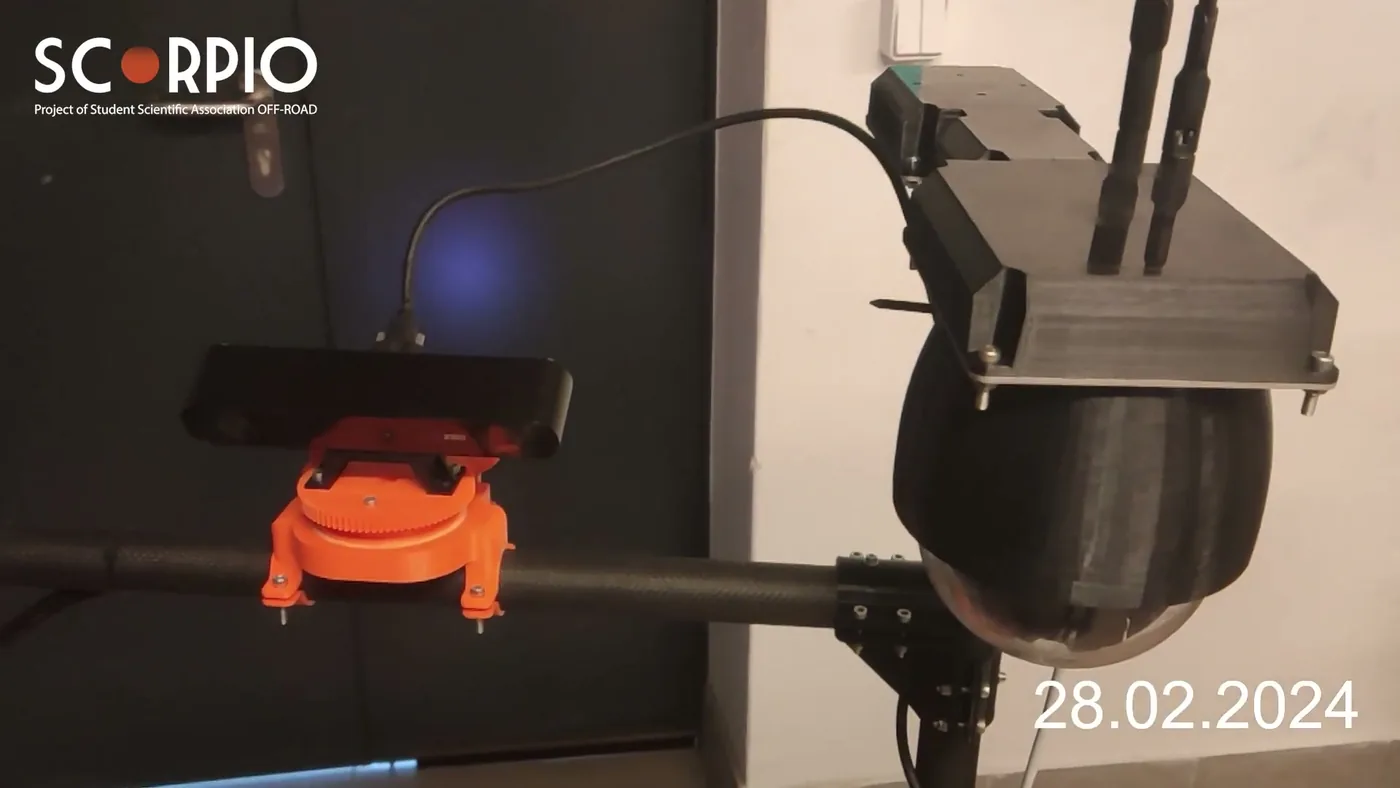
Arm and end-effector. An articulated arm with printed joint housings is visible in the 2024 film. Degrees of freedom, reach, actuator family and end-effector geometry are not published. The Equipment Servicing record is the useful evidence: 21 in 2022, 63 in 2023 and 25 in 2024, a swing that no single hardware description explains S-URC22-SCORES S-URC23-SCORES S-URC24-SCORES.
Science. Science scored 99 in 2022, then 86.13 and 70. The 2022 result was produced by a rover whose autonomy scored zero, which is the strongest possible statement that the payload was self-contained. The instruments are not published S-URC22-SCORES.
Mission performance
The early record is a genuine front-runner: third in 2011, fifth in 2012, second in 2013, third in 2015 and third in the 2016 Phobos bracket. Then came 24th in 2017 and a reset S-URC-HISTRESULTS.
The modern record is defined by balance rather than excellence. Science averages about 85 across 2022 to 2024, while Delivery reads 20, 15 and 15 and autonomy reads 0, 0 and 53. The 2023 season is the clearest example: Equipment Servicing jumped from 21 to 63 and Science held at 86, yet the rank stayed at 14 because Delivery stayed at 15 S-URC22-SCORES S-URC23-SCORES S-URC24-SCORES.
The explanation the public record supports is portfolio focus. In 2024 the team ran four competitions in seven months: the Australian Rover Challenge, URC, the Anatolian Rover Challenge and the European Rover Challenge. It reports first place in each mission at the first of those events S-SCORP-SEASON2024. A programme optimised for a series is not the same as a programme optimised for one mission set, and the persistent Delivery score is what that difference looks like on a score sheet.
Lessons for a first build
- Rank stability is not subsystem stability. Two 14th places in a row came from completely different mission profiles. Track the mission scores, not the rank.
- Fix the mission that never works. Delivery at 20, 15 and 15 across two rover generations is a design and practice gap. A first build should give the delivery task its own owner and its own test day.
- A small rover can be a deliberate choice. Four wheels on a differential-coupled wishbone suspension is a documented alternative to six wheels, with a different traction and packaging budget.
- Make the structure the enclosure. Using the chassis as the electronics housing with modular access panels is cheap, and the team names it as the reason for the Infinity layout.
- Choose the competition set deliberately. Four events in seven months buys series wins and costs URC mission practice. Either choice is legitimate; drifting into both is not.
What remains uncertain
Why Delivery has never exceeded 20 in the modern record is not stated anywhere public. Whether the team is still a URC entrant is unknown: it registered for 2025 without a result and was absent from the 2026 team list. Mass, wheel diameter, motor and gearbox specification, battery, radios, compute and arm geometry are all unpublished. The 2013 entry is treated here as the same programme only because the team’s own achievements page lists the 2013 runner-up result.
Team sources
- scorpio.pwr.edu.pl, the team site, with an English section.
- Rover pages, one page per generation.
- Achievements, the competition record across four series.
- 2024 season summary, the four-competition campaign.
- 2024 review film, the source of the frames on this page.
Sources for this page
- S-URC-HISTRESULTSURC results database: derived 2022–2026 statistics (§4–§5) and archived official results 2013–2019 (§7)Print copy
- S-URC22-SCORESURC2022 Official ScoresOriginal
- S-URC23-SCORESURC2023 Official ScoresOriginal
- S-URC24-SCORESURC2024 Official ScoresOriginal
- S-URC25-TEAMSURC2025 Team ListOriginal
- S-URC26-TEAMSURC2026 Team ListOriginal Archived copy
- S-SCORP-PROJECTS"Projekty", rover lineage Scorpio 1–7 and Infinity: modular build, rocker-bogie-inspired suspension with two wishbones coupled by a differential, Cordura/polyurethane-foam wheels with 3D-printed rims, BLDC + in-house planetary gearbox, flexible-filament printed tyres, polyamide/aluminium/carbon-fibre structure, chassis as electronics enclosureOriginal
- S-SCORP-SAR2024"Project Scorpio - System Acceptance Review - URC 2024", video, 5:19, uploaded 2024-03-01Original
- S-SCORP-SEASON2024"Podsumowanie sezonu 2024", the four-competition 2024 season (AuRC Adelaide → URC Utah → ARC Ankara → ERC Kraków) in seven months; first place in each of the four missions at the first event; Infinity described as adapted to both Martian and lunar terrain classesOriginal