IMPULS (Kielce University of Technology)
Kielce University of Technology finished third at its second University Rover Challenge in 2018, then won the 2019 competition outright with a perfect 100 in the science mission and 362.87 points. It was fifth in 2022, submitted a review without a finals place in 2023, did not appear in 2024 or 2025, and returned in 2026 in 33rd place with Equipment Servicing and Autonomy both at zero. The seven-year span runs from 362.87 to 153.2, and the design knowledge survived the gap even though the field results did not.
What this team shows
- A championship platform does not survive a two-year absence. The 2026 rover keeps the suspension, the six-axis arm and the strain-wave gearing of the winning era, and scored zero in the two missions that reward field integration.
- Science is the mission that carried the titles. A suite of weather and soil chemistry plus a chlorophyll spectrometer scored 100 in 2019, which is an argument about completeness rather than about instrument cost.
- Two cheap hardware choices show up early here: strain-wave gearing on a student arm in 2019, and in-house printed flexible tyres in 2026.
- The public record is video only. Eight annual review films are the whole archive, and they are the reason the state of the design is unrecoverable for the seasons the team did not compete.
Identity and results
| Year | Rover | Total | Rank | SAR | Science | Delivery | Equipment | Autonomy |
|---|---|---|---|---|---|---|---|---|
| 2018 | IMPULS Mars Rover | 322.32 | 3 | 87.67 | 95.65 | 50 | 49 | 40 |
| 2019 | IMPULS Mars Rover | 362.87 | 1 | 93.87 | 100 | 80 | 69 | 20 |
| 2022 | IMPULS Mars Rover | 317.05 | 5 | 89.05 | 96 | 32 | 58 | 42 |
| 2026 | IMPULS Mars Rover | 153.2 | 33 | 87.2 | 46 | 20 | 0 | 0 |
The team registered for 2023 and appears in that year’s sheet with a review score and no mission results, which means it was reviewed and not scored on the field S-URC23-TEAMS S-URC23-SCORES. It is absent from the 2024 and 2025 team lists S-URC24-TEAMS S-URC25-TEAMS. The two virtual editions of the competition, in 2020 and 2021, produced no finals field S-URC-HISTORY.
The team uses one name for every rover, IMPULS Mars Rover, and publishes no per-year generation names. Its only listed web presence is a social media page; it has never had a website on the competition’s team lists S-URC23-TEAMS S-URC25-TEAMS.
Rover generations
2018 and 2019: the championship platform. Third place with 322.32 in 2018, then the title with 362.87 in 2019. Both totals rest on science scores of 95.65 and 100 and on Delivery of 50 and 80, with Equipment Servicing in the high forties and sixties and Autonomy at 40 then 20 S-URC18-SCORES S-URC19-SCORES.
2022: still a top-five team. Fifth place with 317.05, science 96 and Delivery down to 32 S-URC22-SCORES. The platform still worked; the manipulation missions had begun to slip.
2023: registered and reviewed. A review score of 91.13 with no finals result S-URC23-SCORES.
2026: the return. Thirty-third place with 153.2: review 87.2, Science 46, Delivery 20, and Equipment Servicing and Autonomy at zero S-URC26-SCORES. The one number that held is the review score, which has stayed between 87 and 94 across four appearances and eight years.
Subsystems
Basis of this section
The team publishes no design document, CAD, bill of materials or code. Design detail here is read from the team’s own annual review films, which are listed under Team sources, and from the official score sheets. No mass, dimension, power or radio figure exists in public for any IMPULS rover.
Mobility. The 2026 film shows six wheels, three per side, with red flexible tyres that the team says are fully printed in its own laboratory, on pale five-spoke hubs with a knobbly tread rather than straight grousers. The frame reads as a light lattice of thin square-section beams milled from a high-strength polyamide, a change from the earlier chassis that the team describes as inspired by its previous design. The suspension is described as the proven and reliable system, carried over rather than redesigned. Drive moved to in-wheel motors that the team calls significantly more powerful than before. The 2019 review gave a 300 mm wheel diameter and more than 200 N·m applied at each wheel, which is a torque-per-wheel figure rather than a motor rating.
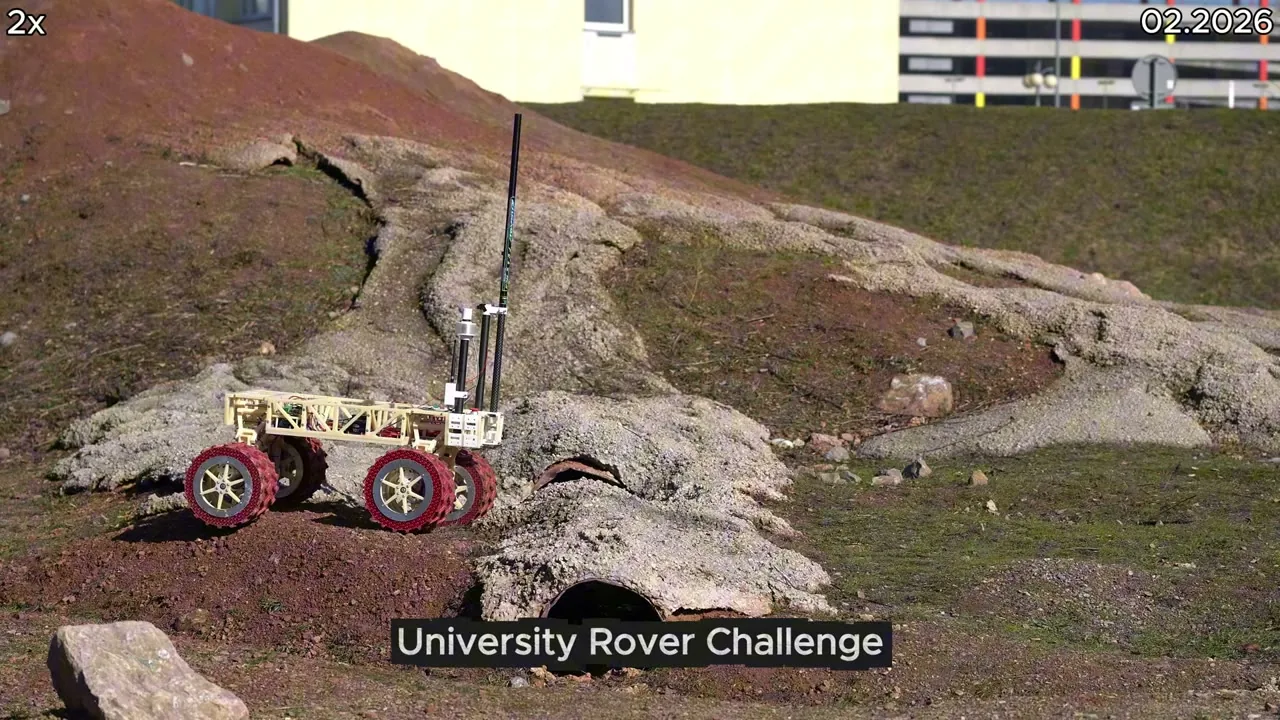
Arm and end effectors. Six axes in 2019 and six again in 2026. The joint actuation has used strain-wave, or harmonic, gearing since at least 2019, with closed-loop control at each joint, which is unusual for a student arm of that date. The 2026 film adds a custom microcontroller mainboard for faster processing and a cleaner link to the control station. The demonstrated tasks in 2026 are lifting a 5 kg cache, inserting a connector, and pushing buttons and flipping switches; in 2019 the same gripper handled a screwdriver. Inverse kinematics drives keyboard work and small-part handling in both eras.
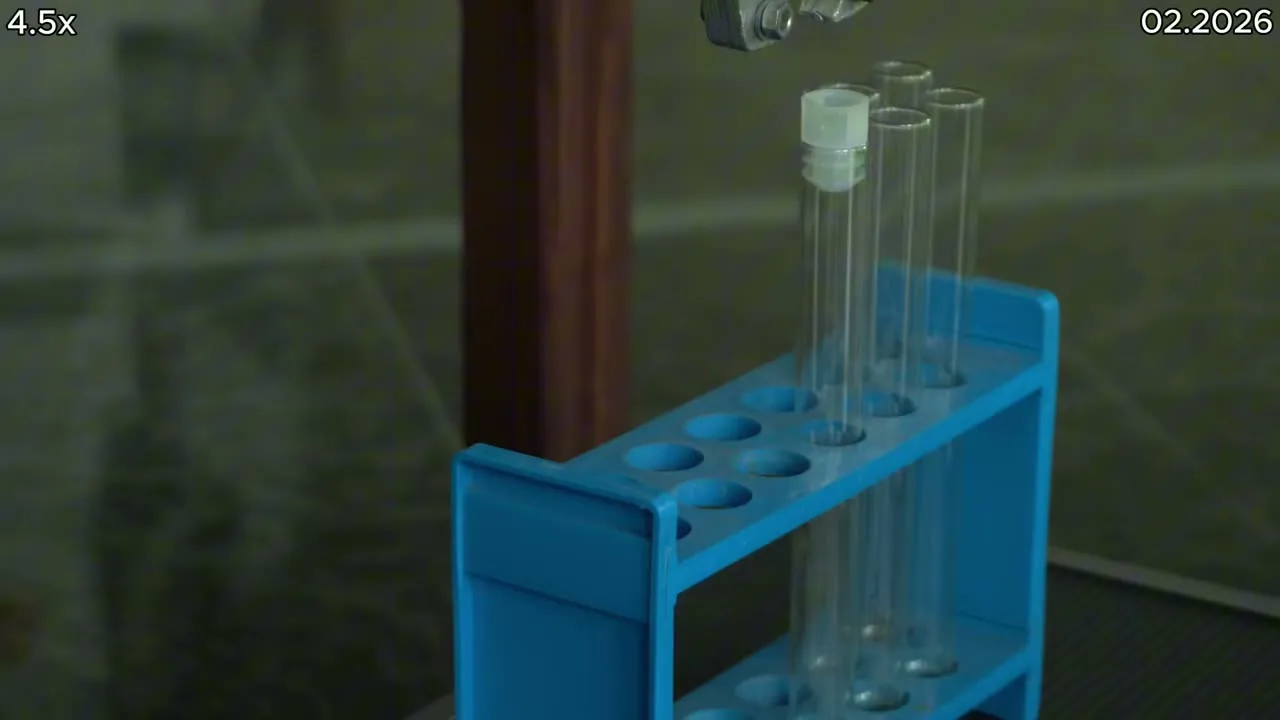
Science. The 2026 chain is deliberately simple: ultraviolet illumination to check natural fluorescence, an automated soil pH test, and an ATP bioluminescence assay presented as definitive life detection, with the sample taken from at least 10 cm and sealed in an onboard container. The 2019 suite was broader and older in style: ambient temperature and moisture, pressure, methane and carbon monoxide, ultraviolet level, relative elevation, wind speed and direction, soil nitrogen, phosphorus and potassium, calcium carbonate, and a chlorophyll spectrometer. That 2019 suite scored 100.
The comparison is the point. Complexity was not what the science judges rewarded in 2019; a complete site account was. In 2026 the simpler chain scored 46, which suggests the loss was in the write-up and the sampling rather than in the chemistry.
Communications. A 900 MHz link with a motorised antenna mast that the team describes as providing a stable connection over long distances. A motorised mast is unusual in this field, where most teams fix the antenna. Throughput, latency, gain and transmit power are unpublished.
Power, compute and autonomy. The electronics were replaced wholesale for 2026. Autonomy runs on a Jetson-class computer with a stereo camera that carries its own processing, detecting fiducial markers and obstacles, with custom object models for the mallet and bottle classes and a high-power light array to signal arrival at a waypoint. Battery chemistry, capacity and distribution are unpublished for every year.
Mission performance
2019: the title. A perfect science score carried a 362.87 total, with Delivery at 80, the best of the team’s four appearances, and Autonomy at 20 S-URC19-SCORES. It is the only title in the team’s record and the highest total it has scored.
2022: the last top-five finish. Fifth with 317.05. Science held at 96 and Equipment Servicing at 58, while Delivery fell from 80 to 32 S-URC22-SCORES.
2026: the return. Two missions at zero and Delivery at 20, on a rover whose review film demonstrates a working six-axis arm, a subsurface sampler and a stereo autonomy payload S-URC26-SCORES. The score says it did not deliver on the field, and no post-competition account exists to say why.
The pattern that matters is not the fall in points. It is which missions fell. Review, which is written work, held at 87.2. Science, which is bench and field procedure, halved. Equipment Servicing and Autonomy, which are the two missions that depend on rehearsal with the actual rover on the actual field, went to zero. A team that keeps its design and loses its practice produces exactly this profile.
Lessons for a first build
- Continuity of practice is a subsystem. The same club, the same suspension and a modernised version of the same arm returned to 33rd. Design knowledge was retained; operator practice and integration were not, and the two zero missions are where that shows S-URC26-SCORES.
- Complete beats sophisticated in Science. A weather and soil-chemistry suite with a chlorophyll spectrometer scored 100 in 2019. A first build should aim to answer the whole science question with simple instruments rather than one question with an expensive one S-URC19-SCORES.
- Strain-wave gearing is within reach of a student arm. This team used harmonic reduction on a six-axis manipulator in 2019, years before it became common in the field. Low-backlash reduction is a purchasable component, not a research project.
- Print the tyres. In-house printed flexible tyres remove moulds, make the tread tunable and turn a worn wheel into a replacement part. The trade is durability and consistency.
- Build a yard, not just a rover. The team’s permanent analogue track on its own campus was still the training ground when it returned after two seasons away. A fixed site is an asset that outlives a cohort.
- A film is not a field result. The 2026 review demonstrates an autonomy stack that scored zero. The gap between what a review shows and what a competition scores is the whole margin between 33rd and the top ten.
What remains uncertain
Every quantitative specification is missing for every year: mass, wheel diameter for the current rover, arm reach and mass, gear ratios, motor and controller models, battery chemistry and capacity, computer model, radio power and antenna gain, and the sample depth actually achieved on the day.
Why the 2026 rover scored zero in Equipment Servicing and zero in Autonomy, having demonstrated both in February, is unanswered in public. What the 2023 review-only season means, whether the team withdrew, failed to qualify or did not travel, is also unknown. Whether the 2026 rover is the 2019 platform modernised or a new machine is not stated, and the team’s own accounts support both readings.
Team sources
- Mars Rover IMPULS TEAM on YouTube, annual review films from 2018 to 2026.
- 2026 System Acceptance Review, the primary film for the 2026 rover.
- 2019 System Acceptance Review, the championship platform.
- European Rover Challenge 2023 profile, affiliation, team size and the team’s own summary of its record.
- Team page on Facebook, the only web presence the competition’s team lists record.
Sources for this page
- S-URC23-TEAMSURC2023 Team ListOriginal
- S-URC23-SCORESURC2023 Official ScoresOriginal
- S-URC24-TEAMSURC2024 Team ListOriginal
- S-URC25-TEAMSURC2025 Team ListOriginal
- S-URC-HISTORYURC History indexOriginal
- S-URC18-SCORESURC2018 Scores (SAR + 4 missions)Original
- S-URC19-SCORESURC2019 Scores (SAR + 4 missions, alphabetical)Original
- S-URC22-SCORESURC2022 Official ScoresOriginal
- S-URC26-SCORESURC2026 Official ScoresOriginal Archived copy