Robotics for Space Exploration (RSX), University of Toronto
RSX publishes more engineering than almost any team outside the top tier. Its public repository organisation carries separate packages for the rover, the arm, the science payload, the custom CAN bus and the electrical boards, and its 2025 arm ships as a complete model with joint definitions and link masses. On the field the same programme has finished 25th, 20th and 15th. That pair of facts is the value of this dossier: open engineering and competitive rank are independent axes, and a first build should not confuse one with the other.
What this team shows
- Documentation does not predict rank. RSX publishes models, configurations, a CAN library and waypoint sets, and still finished 25th, 20th and 15th in its three modern finals.
- The published arm is measured evidence. Six revolute joints, 0.87 m and 4.42 kg is one of the few complete arm descriptions in the field S-RSX-ARM-URDF.
- The review score is consistently excellent, 92.66 to 93.96 since 2024, and the mechanical missions are not. Delivery reads 10, 25 and 8 in the same years S-URC24-SCORES S-URC26-SCORES.
- Hardware disclosure is the opposite of software disclosure. There is no total mass, no battery figure and no radio model anywhere in the public record.
Identity and results
RSX has competed since 2014. The modern finals are 2024, 2025 and 2026; the team was registered in 2023 and published a review film in 2022, but neither season produced a score sheet row S-URC22-SCORES S-URC23-SCORES S-URC24-SCORES.
| Year | Total | Rank | SAR | Science | Delivery | Equipment | Autonomy |
|---|---|---|---|---|---|---|---|
| 2014 | 134.5 | 17 | 42 | 3 | 0 | 0 | 89.5 |
| 2015 | 155 | 15 | 53 | 1 | 0 | 27.2 | 73.8 |
| 2017 | 192.3 | 19 | 89.3 | 85 | 18 | 0 | 0 |
| 2018 | 240.47 | 11 | 83.82 | 95.65 | 40 | 21 | 0 |
| 2024 | 193.66 | 25 | 92.66 | 64 | 10 | 27 | 0 |
| 2025 | 238.67 | 20 | 93.67 | 78 | 25 | 0 | 42 |
| 2026 | 236.49 | 15 | 93.96 | 72 | 8 | 18.53 | 44 |
The 2014 and 2015 columns are positional: those seasons used a five-task set, so the review column holds the presentation score and the autonomy column holds terrain. The 2016 total, 181.25 and 14th in the Ares bracket, is not comparable across brackets and is omitted from the mission columns S-URC-HISTRESULTS. The 2026 row reproduces the published result S-URC26-SCORES. No award is recorded in any year.
Rover generations
2014 to 2018: the early rovers. The team reached 11th in 2018, its best finals rank, on Science 95.65 and Delivery 40. Autonomy scored zero in both 2017 and 2018, which is the signature of a science-first rover in that era S-URC-HISTRESULTS.
2024 and 2025: the extruded aluminium rover. A four-wheel rocker with a rear differential bar and an extruded aluminium chassis. The 2025 arm is the best-documented single component in the dossier: a six-revolute-joint model, 0.87 m long, with a total link mass of 4.42 kg, plus a motion-planning configuration for the same geometry S-RSX-ARM-URDF S-RSX-MOVEIT. The 2024 season scored 25th and the 2025 season 20th S-URC24-SCORES S-URC25-SCORES.
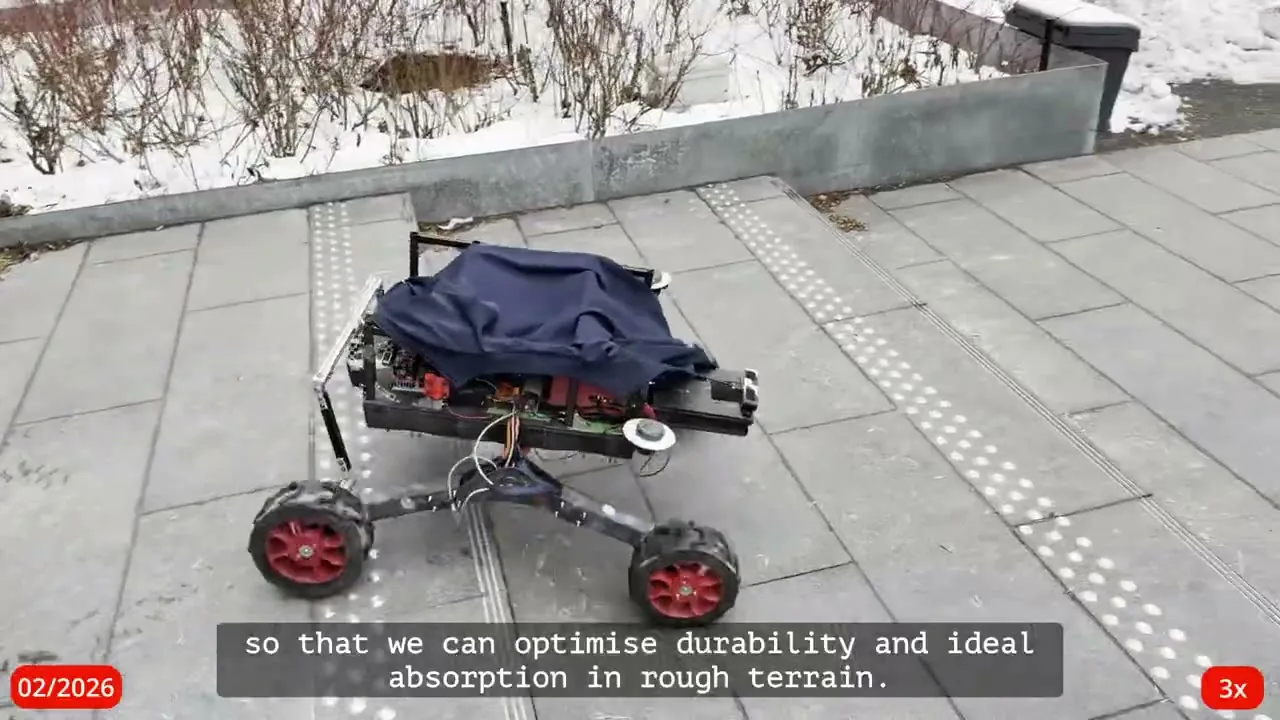
2026: carbon fibre and harmonic drive. The team’s 2026 review film describes a carbon-fibre base plate and tube frame replacing the aluminium chassis, a retained four-wheel rocker, a completely redesigned arm with harmonic gearboxes on every joint, and its first drone. Compute was consolidated onto a single Jetson Orin. It finished 15th, the best modern result, with autonomy at 44 and Equipment Servicing at 18.53 S-URC26-SCORES.
Subsystems
Mobility. The 2026 review film shows a four-wheel rocker with a rear differential bar, retained from 2025 and rebuilt in carbon-fibre tubing on a steel axle. The film states an intention to upgrade the differential bar to a truss. Wheels are printed in two parts: an outer TPU tread with a gyroid infill to distribute deformation, and an inner PLA+ rim. Diameter, mass and top speed are not published.
Arm and end-effector. The 2025 model gives six revolute joints, 0.87 m and 4.42 kg S-RSX-ARM-URDF. The 2026 film describes an arm redesign with harmonic gearboxes on every joint for zero backlash, a lift capacity above 5 kg, and compliant fingers with a high-friction outer layer to reduce grip force. Limit switches give absolute joint reference at startup. Control uses inverse kinematics and a standard motion-planning configuration for Cartesian motion and autonomous keyboard typing driven by vision S-RSX-MOVEIT.
Science. The team’s science repositories and 2026 film describe a science end-effector built in-house for drilling, with a linear actuator and an electromagnet that picks up and drops the temperature and humidity sensor. A gear-driven mechanism sorts cache samples from surface samples. Life detection uses fluorescence, upgraded from a photomultiplier tube to a miniature spectrometer to detect green fluorescence from flavin, alongside iodine for starch and ninhydrin for amino acids read by an onboard camera. The payload modules talk over a custom CAN bus built on TJA1050 and MCP2515 transceivers, published as a reusable library.
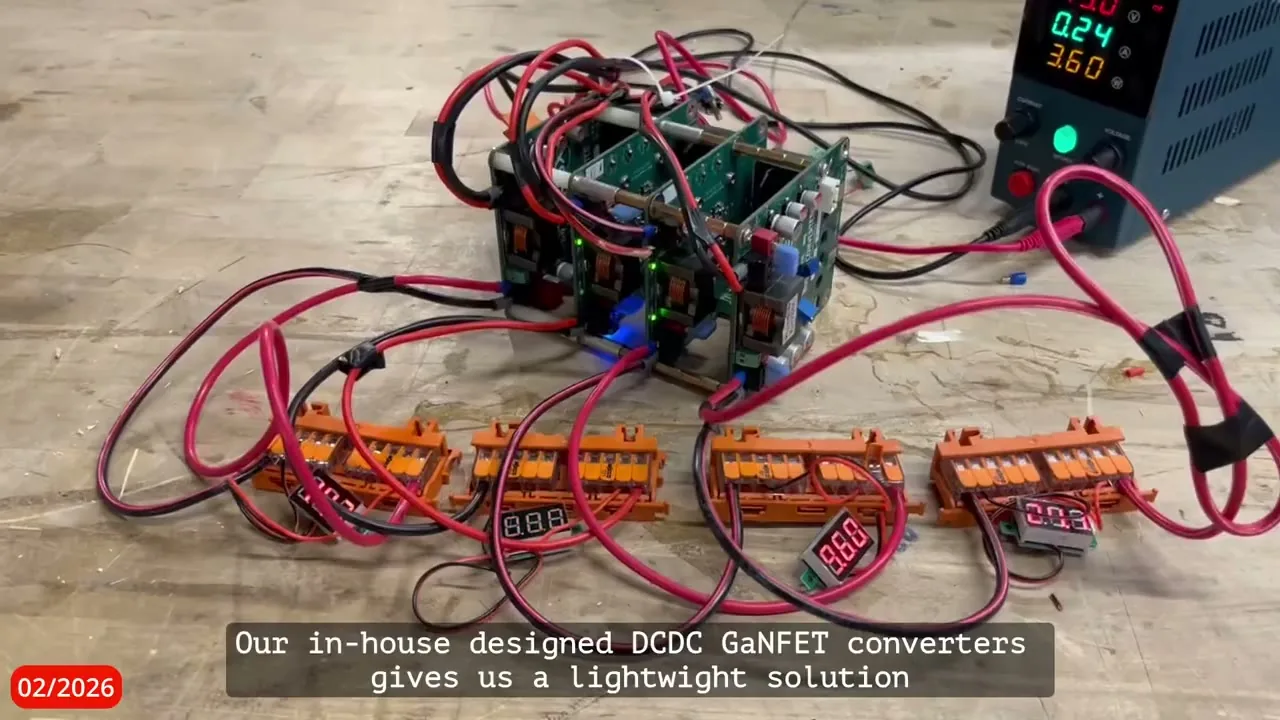
Communications and power. All modules communicate over ROS 2 DDS, which the 2026 film states works to 500 m for telemetry and data streaming. No radio model, band, power or antenna data is published, so 500 m is the only range figure the team gives. Power distribution is a custom panel with voltage and current monitoring, in-house DC-DC converters, a custom battery management board that relays pack voltage and state of charge with undervoltage protection, and both a physical E-stop and a network E-stop. The remote stop depends on the link staying up.
Autonomy. The public rover repository and the 2026 film describe ROS 2 Humble on Ubuntu 22.04, with C++ and Python around a centralised state machine. Each mission starts by navigating to a GNSS coordinate, fusing satellite position with odometry into a global path. A global planner runs A* over a terrain cost map and a local planner handles real-time avoidance. Object search uses a grid pattern around the waypoint, then homing on pose estimation, then re-acquisition from the last known pose if contact is lost. The rover repository also ships the actual competition waypoint sets for three seasons.
Mission performance
The modern record is a slow climb from 25th to 15th, and the climb did not come from the review score. The review was already excellent in 2024 at 92.66, while the rank was 25th. What changed by 2026 was Equipment Servicing, from 27 to zero to 18.53, and autonomy, from zero to 42 to 44 S-URC24-SCORES S-URC25-SCORES S-URC26-SCORES.
Delivery has never worked. It reads 10, 25 and 8 in the three modern seasons, and no RSX source describes a rover-side capture mechanism. The 2026 drone was built for the delivery mission, with a gripper and a stated heavy-payload endurance of about 20 minutes, but the review film describes it as still being tested and tuned, and Delivery scored 8 S-URC26-SCORES. The gap between a documented arm and an Equipment Servicing score of zero in 2025 is the most striking discrepancy in this file.
The written review and the field result measure different things. Three seasons of scores above 92 on the review, alongside Delivery at 10, 25 and 8, is the cleanest evidence in this dossier that a well-regarded plan is not a working system.
Lessons for a first build
- Publish the model, not the brochure. A joint-level arm description with masses is worth more to the next team than any amount of prose, and it took a repository, not a document.
- Open software does not substitute for field practice. The same team that publishes a full stack scored zero in Equipment Servicing in 2025. Rehearse the mission, not only the code.
- A custom bus at the payload layer is cheap and debuggable. Raspberry Pi and Arduino modules over a published CAN library let the science payload be tested one module at a time.
- A remote E-stop is a convenience, not a safety function. Keep the physical button and treat the network stop as an addition.
- Name the radio and measure the range. A 500 m stated working range with no hardware named is the highest-value gap in an otherwise strong public record.
What remains uncertain
Total vehicle mass, power budget, battery configuration, radio hardware, drive motor models and wheel dimensions are unpublished. Why Equipment Servicing scored zero in 2025 and 18.53 in 2026 with a documented six-joint arm and a motion-planning configuration has no public explanation. Whether the 2026 drone flew at the competition is not stated. The 2022 and 2023 seasons produced registration and a review film but no score row. The team appears never to have named a rover.
Team sources
- rsx.skule.ca, the team site.
- rsx-utoronto on GitHub, the public repository organisation.
- 2025 arm model, the source of the arm figures.
- 2025 arm motion planning, the matching configuration.
- 2026 review film, the primary source for the current rover.
Sources for this page
- S-RSX-ARM-URDFRSX 2025 arm URDF + meshes (6 revolute joints, link masses)Original
- S-URC24-SCORESURC2024 Official ScoresOriginal
- S-URC26-SCORESURC2026 Official ScoresOriginal Archived copy
- S-URC22-SCORESURC2022 Official ScoresOriginal
- S-URC23-SCORESURC2023 Official ScoresOriginal
- S-URC-HISTRESULTSURC results database: derived 2022–2026 statistics (§4–§5) and archived official results 2013–2019 (§7)Print copy
- S-RSX-MOVEITRSX arm MoveIt package (KDL IK, OMPL/CHOMP configs, joint limits)Original
- S-URC25-SCORESURC2025 Official ScoresOriginal