Science and astrobiology payload
The 2027 payload rule is the hard change of this rulebook. Onboard equipment must now include two life-detection capabilities, at least one of them a bioassay of a molecule that only biology makes. A camera, a spectrometer or a Raman probe no longer counts on its own, which puts at least one wet biochemical reaction, with reagent storage, fluid handling and waste containment, on the rover. All of it has to happen at two sites inside a 20–30 minute roving window.
Key takeaways
- The clause is not an extra instrument. Q&A AQ9 accepts an assay of a molecule “currently known to be formed only by biological processes”, and names proteins, sugars, chlorophyll, nucleic acids, ATP and carotenoids. An amino-acid assay alone is explicitly not enough S-URC27-QA AQ9.
- A payload that scored 94 in 2026 can fail the 2027 clause unchanged. WVU called ninhydrin its primary life-detection experiment, and under AQ9 that channel is insufficient on its own S-WVU-2026-SCIPLAN S-URC27-QA AQ9.
- The clock binds, not the chemistry. Sample acquisition and documentation take 10.5 of 25 minutes, so the slowest assay starts first, at site 1, and runs while the rover drives.
- Depth is a record, not a claim. AQ10 makes the depth of any life detection part of the mission, so the sample needs a graduated liner and a logged stroke, not a verbal assurance.
What the subsystem must do
Inside a 20–30 minute window within 0.5 km of C2, and using rover-relayed data only, the payload selects sites, documents at least two, analyses samples onboard, collects a sub-surface sample from at least 10 cm with at least 5 g from below 10 cm, seals a cache that does not spill when inverted, hands it over within 5 minutes, and supports a post-mission debrief even if the rover failed S-URC27-RULES §1.b.ii–xi.
The three hardest constraints are traced as REQ-SCI-001 for the two capabilities, REQ-SCI-004 for depth and mass, and REQ-SCI-010 for the cache. Five clauses shape the design more than the mission flow does:
- Analysis is onboard. Samples may not be returned to the team for laboratory work; the cache handed to the judges is a sample, not an analysis S-URC27-RULES §1.b.iv.
- The second capability is defined narrowly. Two life-detection capabilities are required, at least one a bioassay S-URC27-RULES §1.b.v. Whether one combined assay can serve as both is not published.
- Chemicals stay on the rover. Water and every reaction product follow a no-spill policy in “a remote desert location with very limited water supplies”, and hazardous chemicals need transport, use, disposal and accident plans approved in advance S-URC27-RULES §1.b.ix. Judges approve plans rather than chemicals, and anything above US DOT limits is not allowed S-URC27-QA AQ4.
- Cleanliness is argued, not measured. There is no swab test and no bioburden number, so the scored artefact is a written justification of the level claimed S-URC27-QA AQ7.
- The Science Plan counts. It is due 2027-05-21, expands the System Acceptance Review version to about five pages, must explain the background science, and is factored into the score S-URC27-RULES S-URC27-QA §1.b.i AQ1.
What the rule actually changed
The change is not one more channel. It reclassifies most of the recent field.
| Dimension | 2023 | 2024–2026 | 2027 |
|---|---|---|---|
| Mission name | Science | Science | Astrobiology |
| Minimum life-detection methods | one | one, plus an optional second capability | two, at least one a bioassay |
| Is a biomolecule required | no | no | yes |
| Stratigraphic profile | not required | required | deleted |
| Sub-surface sample | 1–10 g, no depth | at least 10 cm, at least 5 g | at least 10 cm, at least 5 g |
| Cache | closed container | sealed, invertible | sealed, invertible, removable in 5 minutes |
| Sites evaluated | multiple | at least two | at least two |
Three consequences follow from AQ9, which is binding and narrow. An amino-acid assay such as ninhydrin can support a result but cannot be the bioassay. A habitability measurement, whether pH, moisture, mineralogy or carbonates, is not life detection at all: “for URC life detection capability is required, not habitability” S-URC27-QA AQ9. And a physical detection such as chlorophyll autofluorescence names a listed biomolecule without clearly being an “assay”, so it is best paired with a wet channel.
That is why Missouri S&T’s 2022 payload, with three wet biomolecule tests, was closer to the 2027 rule than the Raman-only 2024 payload that replaced it. Their science score went 96, 79.17, 82, 96 and 93 across the transition, which is not evidence that spectroscopy helped S-MST-ITC-2022 S-MST-HYPERION-2024 S-MST-TALOS-2025. WVU’s 2026 plan is the clearer warning: it scored 94 with ninhydrin as the primary life-detection experiment and resazurin for metabolic activity, and metabolism is not a molecule on the AQ9 list S-WVU-2026-SCIPLAN.
The numbers that size the design
The mass, power and fluid figures are class estimates for a first-order budget. The mission numbers are rules.
| Quantity | Value | Basis |
|---|---|---|
| Life detection | two capabilities, at least one a bioassay | S-URC27-RULES S-URC27-QA §1.b.v AQ9 |
| Roving window | 20–30 minutes, plus 5 minutes for cache removal | S-URC27-RULES §1.b.ii §1.b.vii |
| Site radius | 0.5 km from C2, at least two sites evaluated | S-URC27-RULES §1.b.ii |
| Sample | at least 10 cm deep, at least 5 g from below 10 cm | S-URC27-RULES §1.b.vi |
| Sample volume | 5–8 cm³ for 5 g; a 20 mm core to 10 cm is only about 3 cm³ | Geometry |
| Payload mass | 3.5–4.5 kg in the recommended configuration; 3–6 kg and 3–8 L overall | Class estimate, 6–12 % of the 50 kg limit |
| Peak power | 60 W drilling, 15 W assay, about 8 Wh for the window | Estimate from pump, heater and drill classes |
| Fluid inventory | about 12 mL total, about 10 mL waste | 2 sites × 4 reactions × 250 µL, plus extraction and flush |
| 2026 Science score | median 85, maximum 100, 13 teams at 90 or above | Official scores S-URC26-SCORES |
Design space, in one table
| Decision | Options | Recommended for a first build |
|---|---|---|
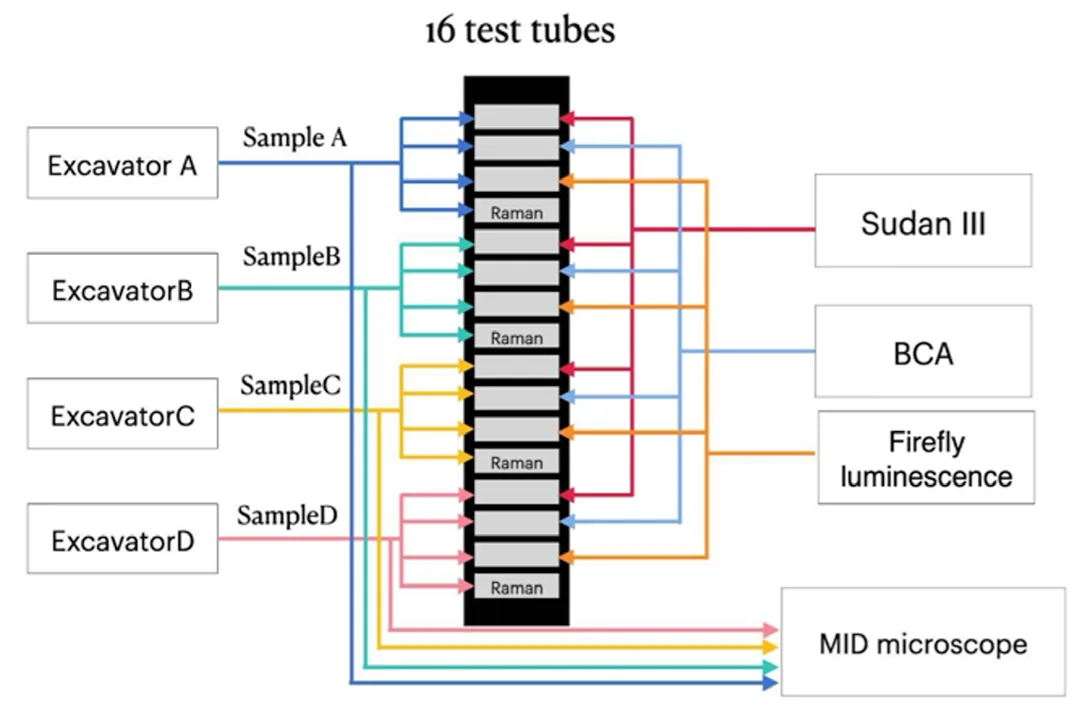
| Payload architecture | A: ATP and BCA, one detector · B: ATP and autofluorescence · C: LAMP and lateral flow | A: two unambiguous bioassays, one carousel, one detector |
| Bioassay channel | ATP luminometry · BCA or Bradford protein · lateral flow · LAMP · DNA stain | ATP first, because it reads in 10–60 seconds, then a rapid BCA |
| Sample acquisition | body-mounted auger · arm-held auger · core tube · scoop and trench | A body-mounted auger on a linear axis with a clear graduated liner, plus a scoop as backup |
| Fluid path | peristaltic pumps and a carousel · single-use path per site · paper microfluidics | Peristaltic pumps and an 8-cuvette carousel; single-use if the contamination argument must be strongest |
| Cache | screw-cap tube with an O-ring · dual topsoil and subsoil cache · bayonet · clamshell | A 50 mL screw-cap tube with an O-ring, or a dual cache that separates above and below 10 cm |
| Documentation | panorama with a placed scale bar, GNSS with elevation and accuracy | 8–12 frames, a north arrow, a scale bar, and a GNSS record with elevation and accuracy |
The 25-minute clock, not the chemistry
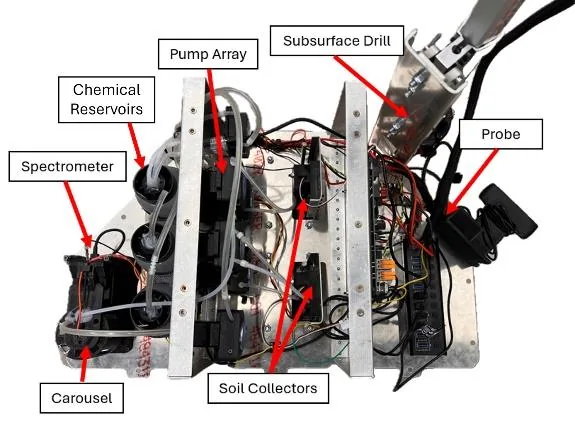
Two sites cannot be run serially. The worked sequence puts sample acquisition and documentation in the first 12 minutes, starts assay 1 at that point and lets it run while the rover drives to site 2. The second assay then has about 3.5 minutes of loading and 2 minutes of read.
| Step | Time | What runs alongside |
|---|---|---|
| Site 1 documented and sampled | 0:00–12:00 | Nothing; this is the critical path |
| Assay 1 loaded and started | 12:00–13:00 | The slowest assay starts first |
| Drive to site 2 | 13:00–15:00 | Assay 1 reads and the result is captured |
| Site 2 documented and sampled, assay 2 loaded | 15:00–21:30 | None; the clock is the constraint |
| Assay 2 read, negative control run | 21:30–23:30 | The operator writes the result summary |
| Cache sealed and stowed | 23:30–24:30 | None |
| Parked for handover | 24:30–25:00 | The team then has 5 minutes to remove the cache |
Three methods drop out of that timetable. Colorimetric LAMP needs 30 minutes at 65 °C and its master mix ships at −20 °C, which a desert rover cannot store, and acidic soil can turn its dye yellow for a false positive S-NEB-LAMP. PCR is slower still. A standard BCA run is 30 minutes at 37 °C, but the rapid variant is 5 minutes at room temperature, which is why it survives as the second channel S-THERMO-PROTEIN.
Two design rules come out of the arithmetic. Start the slowest assay first, at site 1. And treat a failed drill as the whole mission, because acquisition and documentation, not chemistry, hold the critical path: 10.5 of the 25 minutes.
Depth is a record, not a claim
AQ10 makes depth provenance part of the mission. The sample evaluated for life must come from at least 10 cm, must be a specific sample rather than a bulk mixture, and the location and the depth of any life detection must be identified S-URC27-QA AQ10. Five grams of soil is only about 5–8 cm³, and a 20 mm core to 10 cm holds about 3 cm³, so a 25–30 mm core or a repeated scoop is needed. That figure is geometry, not a published requirement.
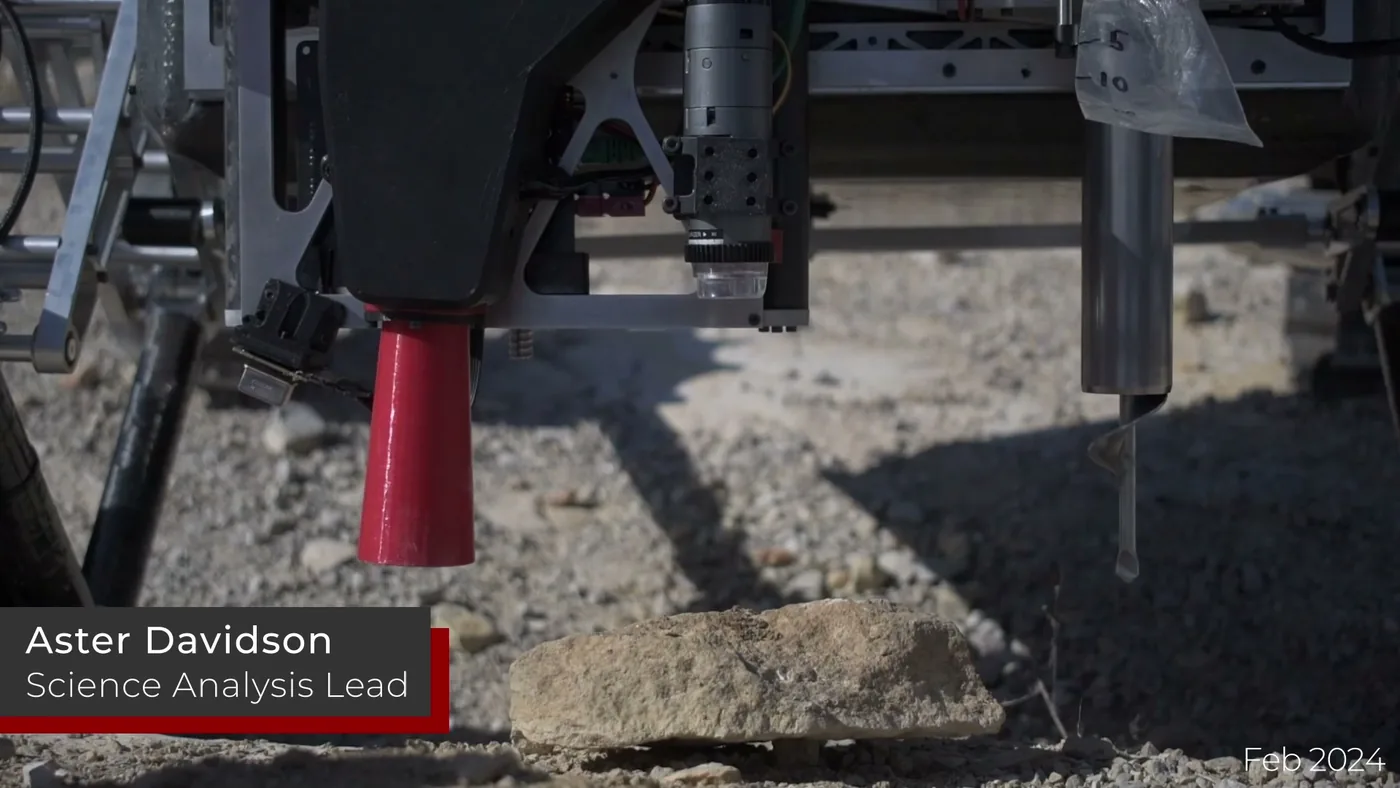
The design rule is to make the depth visible. Instrument the stroke with a linear encoder or limit switches and log it, keep the sample in a transparent liner with 1 cm bands so the portion below 10 cm can be photographed in place, and state the depth in the metadata and the debrief. The record costs about 50 g and one camera frame.
The cache then faces a real test rather than a statement: fill it with 10 g of analogue soil and 5 mL of water, shake it for 10 minutes at rover-representative levels, then invert it 20 times over 60 seconds above a pre-weighed absorbent pad. A mass gain above 0.1 g fails, and gloved removal should take no more than 60 seconds against a 5-minute rule.
Contamination is argued, not measured
AQ7 asks for a justification rather than a standard, so the deliverable is a short table: the contamination source, the control, the residual risk and the evidence. Five sources carry almost all of it: the sampler between sites, the wetted path, the operator’s gloves, the sample liner and the detector optics. Each needs a single-use component or a documented purge with a blank read, plus one sentence stating the level claimed.
A reagent blank in every mission is the cheapest credibility upgrade in the payload: one cuvette and a few hundred microlitres turn an assertion about cleanliness into a number on the results slide.
What the field scores
Science is the most forgiving of the four missions and the one where the new rule bites hardest, because a payload can score well under the old rules and fail the new clause.
| Year | Teams scored | Median | Maximum | Teams at 90 or above | Teams below 70 |
|---|---|---|---|---|---|
| 2022 | 26 | 82.0 | 100 | 11 | 6 |
| 2023 | 31 | 75.7 | 100 | 6 | 14 |
| 2024 | 34 | 73.0 | 100 | 1 | 10 |
| 2025 | 35 | 82.0 | 100 | 11 | 7 |
| 2026 | 36 | 85.0 | 100 | 13 | 11 |
At least one team reached 100 every year, and the median has never fallen below 73 across 162 team-years S-URC22-SCORES S-URC23-SCORES S-URC24-SCORES S-URC25-SCORES S-URC26-SCORES. The 2024 dip is the year the deeper sample and the sealed cache arrived, which suggests the field lost points on execution rather than on ideas. Scores in the forties and fifties look like a documented site with a failed sample, and the 2027 weights are not published, so that reading is a calibration hypothesis.
The documentary record is thin where it matters. Four of the six payloads that scored 100 have no public description, so they cannot be assumed to have done anything exotic. The one that is documented, UIU’s 2025 AXIOS, was a straightforward wet system: a deep soil auger, multi-chamber reagent testing read spectrophotometrically, and a Bradford protein assay S-UIU-AXIOS-2025. KARURA earned 74 in 2024 after its sampler was destroyed by a rock, which is the empirical case that observation and a good debrief carry real points S-KARURA-2024-PAPER.
Interfaces that bite
- Arm. The attachment interface needs at least 10 N of downforce at full reach and wrist rotation for cap torque, but a compliant wrist makes a 30 cm drill wander. The drill belongs on the body, not the wrist.
- Mobility. The rover must hold position while the drill applies downforce, and drilling on a slope loads the suspension. A braced stance or a ground-contact leg is worth about 0.5 kg.
- Power and heat. Drilling at 30–100 W and heating at 10–20 W can coincide with drive and arm peaks; the energy is small at about 8 Wh, but the peak is the problem. Reagents must also survive 38 °C, so a sealed reagent bay with desiccant fights the dust sealing that the rest of the payload needs.
- Communications. An 8–12 frame panorama at about 3 MB per frame is 24–36 MB, which no rover link carries live, so the panorama is stored and forwarded or compressed hard.
- Operations. Only team members who stayed in C2 and never saw the site may take part in the debrief S-URC27-QA AQ8. The person who understands the assay has to be the C2 operator, so the shift needs two people, not one.
Failure modes
| Mechanism | What happened | Design change that prevents it |
|---|---|---|
| Sampler struck an immovable rock | KARURA 2024 damaged its sampler during the mission, abandoned sampling and analysis, and still scored 74 through observation and discussion | A current-limited sampler with a slip clutch, force sensing, a second method such as a scoop, and rock rejection from the camera |
| Instrument too weak for the claim | KARURA’s Raman could not reach a level where organic compounds could be identified | Do not count Raman as life detection; prove sensitivity on an analogue soil before the System Acceptance Review |
| Assay time exceeded the window | KARURA’s BCA needed 30 minutes at 37 °C, so the extract was pre-heated before the mission | Start the slowest assay first, and choose the 5-minute room-temperature variant where one exists |
| Reagent cold chain | LAMP master mix ships and stores at −20 °C | Select room-temperature-stable reagents and test them at 38 °C for five days, or drop the method |
| False positive from soil pH | Acidic samples turn the colorimetric LAMP dye yellow | Buffer the extract, run a matrix blank, or choose a method that does not read pH |
| Debrief given by someone who saw the site | AQ8 restricts participation to C2-only members | Name the speaker in the operations plan, and keep that person in C2 |
Shortlist for a first build
| Configuration | Capability 1 | Capability 2 | Verdict |
|---|---|---|---|
| A: two wet assays, one detector | ATP luminometry | Rapid BCA protein | Recommended. Two clearly sufficient bioassays, one carousel, one detector, 8–12 minutes to two results |
| B: one wet, one optical | ATP luminometry | Autofluorescence microscopy | Lower fluid risk, but the second capability is ambiguous under AQ9; choose it only with a written answer from the URC Director |
| C: amplification | LAMP | Lateral flow | Not viable in 20–30 minutes with a −20 °C cold chain and soil DNA extraction |
Configuration A itemises to about 3.5–4.5 kg and 60 W peak: a body-mounted auger with a clear liner and a scoop as backup, two or three peristaltic pumps with an 8-cuvette carousel, an ATP channel with a dark cup, a BCA channel read by camera or photodiode, a panorama camera with a 20 cm scale bar, a GNSS receiver with the team’s own base, and a 50 mL screw-cap cache. Every mass is a class estimate and has to be replaced by a weighed part during the build.
Open problems
- Does one combined assay count as two capabilities? The rule is silent and AQ9 does not address it. A written answer from the URC Director changes the payload mass by about a kilogram, and the question should be asked well before the 2027-03-05 System Acceptance Review.
- How much ATP does the extraction recover from soil of the kind at the Mars Desert Research Station? A method that extracts a small fraction of the ATP reads negative on a living sample regardless of the biology.
- How large are the false positives? Extracellular ATP, clay-stabilised ATP and reagent contamination all mimic life, and a false positive is worse than a false negative. Oven-sterilised soil and a reagent blank give the answer.
- Do humic substances mimic protein? BCA depends on copper reduction, which soil organics also perform, and a standard-addition recovery of 80–120 % is the pass mark. A timed dry run with a mock sample is the only evidence that two results fit inside 25 minutes.
- Do the reagents survive five days at 38 °C? A denatured enzyme is a dead payload, and the chamber test takes five days, so it has to start early.
Further reading
- KARURA, WVU, Missouri S&T, UIU and Monash carry the documented payloads.
- Astrobiology maps the mission tasks to the payload.
- Mass and power places the payload in the 50 kg budget.
- Interfaces and couplings works the drill-torque and data-volume chains.
Sources for this page
- S-URC27-QAURC2027 Questions & Answers (updated through 2026-10-11)Original Archived copy
- S-WVU-2026-SCIPLANTeam Mountaineers URC 2026 Science Plan, BiRD digger, dual topsoil/subsoil cache, per-site fluid path, ninhydrin/resazurin/methylene blue, Ocean Optics UV-VisOriginal
- S-URC27-RULESUniversity Rover Challenge 2027 – Requirements and GuidelinesOriginal Archived copy
- S-MST-ITC-2022"Science System for a Prototype Mars Rover" (ITC 2022, Vol. 57), Dische DPA, propidium iodide, biuret, gas sensors, heater blocksOriginal
- S-MST-HYPERION-2024MRDT Hyperion (2024) rover page, "custom Raman spectrometer to replace all chemical tests"Original
- S-MST-TALOS-2025"Talos" rover page, 2025 URC world champion, Mantis suspension, redesigned propulsion unitsOriginal
- S-URC26-SCORESURC2026 Official ScoresOriginal Archived copy
- S-NEB-LAMPSARS-CoV-2 Rapid Colorimetric LAMP Assay Kit manual (WarmStart Colorimetric LAMP), 65 °C/30 min, −20 °C storage, acidic-sample interferenceOriginal
- S-THERMO-PROTEINProtein analysis workflow brochure, Pierce BCA 20–2,000 µg/mL, Micro BCA 0.5–20 µg/mL, Bradford 5–250 µg/mL, Rapid Gold BCA 5 minOriginal
- S-URC22-SCORESURC2022 Official ScoresOriginal
- S-URC23-SCORESURC2023 Official ScoresOriginal
- S-URC24-SCORESURC2024 Official ScoresOriginal
- S-URC25-SCORESURC2025 Official ScoresOriginal
- S-UIU-AXIOS-2025UIU Mars Rover Team, AXIOS rover page (URC 2025, 100/100 science)Original
- S-KARURA-2024-PAPER「学生による火星探査車の国際開発と生命探査」 (International development of a student Mars rover and life detection), *Planetary Science Society of Japan* journal 33(3), 342–349Original