Mass
Seventeen rover configurations from eight teams have a published mass of some kind, and thirteen of them are URC competition masses from 2022 to 2026. The values run from 33.0 kg to 53.0 kg with a mean of 47.9 kg and a median of 49.1 kg, which is not an engineering optimum: it is a pile-up against the 50 kg limit, with three configurations exactly at it. The database is small, mostly self-reported and self-selected toward organised teams, and every conclusion on this page is bounded by that.
Key takeaways
- The cap decides the distribution. Fifteen of the seventeen configurations sit between 42.1 and 51.8 kg, and several sit within a kilogram of the limit. Teams converge on 47–50 kg because that is where the rules stop them.
- There is no optimum mass. The 33.0 kg rover won in 2023 and the 42.1 kg rover is not in the score sheets, while the 42–50 kg cluster spans scores from 213 to 400.
- Mass correlates with score, and the correlation is not causal. The rank correlation is −0.60, yet the mission that should punish mass most, Delivery, correlates weakest at −0.46, and mass changes within a team explain none of their score change.
- The budget question is reserve, not target. A rover at 45 kg with 4 kg unspent is in a better position than one at 49.5 kg with none, because the last 3 kg of a build arrive in the final six weeks.
The database and its coverage
| Question | Answer |
|---|---|
| Teams in the 2022–2026 census | 68 teams, 187 team-years S-CENSUS |
| Team-years with any published total mass | 14, or 7.5 % of 187 |
| Configurations, including two outside the window | 17, from 8 teams |
| Configurations weighed by a judge rather than reported | 1, MIST 2021 at 42.1 kg S-MIST-VURC2021 |
| Teams publishing a subsystem breakdown | 1, Monash, chassis and arm only S-MONASH-GH-NOVA |
| Teams publishing measured energy per mission | 0 |
| Tier A teams publishing a total mass | 4 of 8: UIU, West Virginia, Northeastern and Monash for 2021 |
| Champions 2022–2026 with a published mass | 1 of 5, West Virginia in 2023 |
The thin coverage is the finding. A handful of teams produced all thirteen published masses, and four of the five champions published none. A statement that URC rovers typically mass a certain value rests on a self-selected sample, which is why the values here are reported configuration by configuration rather than summarised as a field norm.
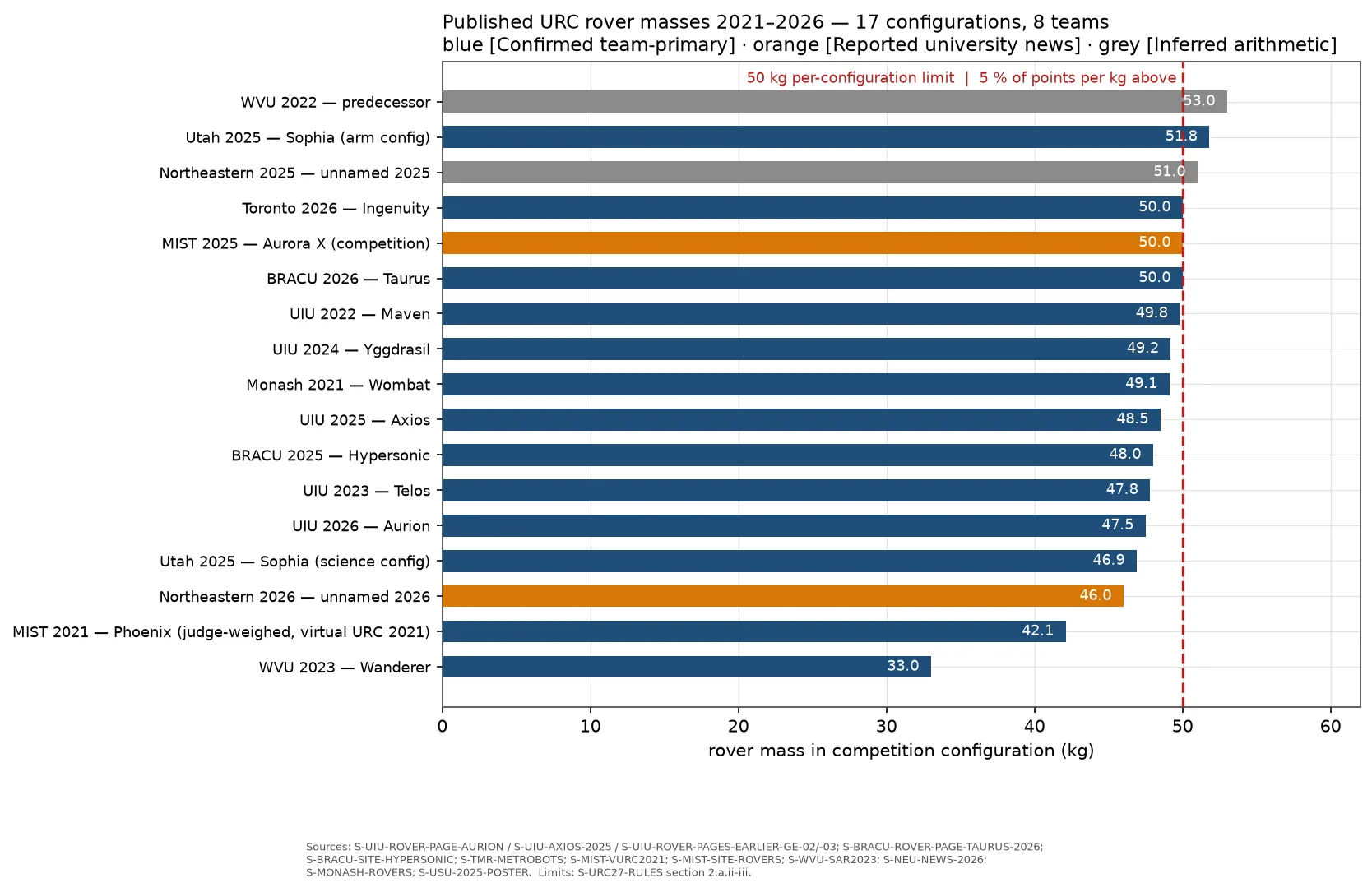
The interactive view plots the fourteen configurations that carry a numeric mass. The three estimates that carry an approximation sign, West Virginia 2022 and both Northeastern rovers, are omitted because the chart reads the value as a number.
Where the mass goes
Monash’s public robot description files are the only measured subsystem breakdown in the record. They cover the rolling chassis and the arm, not the battery, electronics or science payload.
| Element | Mass (kg) | Share of the 30.88 kg accounted |
|---|---|---|
| Wheels, four at 1.85 kg | 7.40 | 24.0 % |
| Suspension legs | 6.72 | 21.8 % |
| Chassis | 5.46 | 17.7 % |
| Ankles and pivots, four at 1.08 kg | 4.32 | 14.0 % |
| Arm, six degrees of freedom plus gripper | 6.54 | 21.2 % |
| Differential bar | 0.42 | 1.3 % |
Suspension, ankles and the differential bar together are 36 % of the accounted mass, and the wheels are 24 %, more than the arm. That is why wheel architecture is a first-order mass decision: a 0.6 kg printed wheel instead of a 1.85 kg composite wheel saves 5 kg on a four-wheel rover S-MONASH-GH-NOVA. The full three-way allocation, measured against the recommended 49 kg target, is on Subsystem comparisons.
The arm is the only subsystem with more than two independent measurements, and five of them span 4.0×: 3.53 kg for the Cornell arm, 4.42 kg for Toronto’s, 6.54 kg for Monash’s and 9.40 kg for West Virginia’s 5-DoF arm, with ARES at 14.00 kg for a longer arm with a linear stage S-WVU-SAR2025 S-RSX-ARM-URDF S-ARES-PAPER-2025 S-MONASH-GH-NOVA.
Mass against score
Twelve team-years have both a published mass and a same-year official total. The association is negative and holds up under three checks, and it is still not causal.
| Test | Result | Reading |
|---|---|---|
| Rank correlation, mass against total | −0.60, p = 0.04 | Heavier rovers scored lower in this sample |
| After normalising score within year | −0.52, p = 0.08 | Removes the year-to-year difficulty trend; no longer significant |
| Excluding the inferred masses, n = 10 | −0.72, p = 0.02 | Strengthens, so the association is not an artefact of the estimates |
| Leaving one point out | −0.48 to −0.75 | No single point drives the result |
The mission-level test is the one that matters. If mass caused the score, the missions that physically punish mass should correlate hardest: Delivery over up to a kilometre and Autonomy over 40 minutes of terrain. They do not.
| Mission | Correlation with mass, n = 12 | p |
|---|---|---|
| Science | −0.12 | 0.70 |
| Delivery | −0.46 | 0.13 |
| Equipment Servicing | −0.61 | 0.03 |
| Autonomy | −0.67 | 0.02 |
Equipment Servicing is 100 m of flat travel and dexterous work, the least mass-sensitive mission in the set, and it correlates as strongly as the total. That ordering is what a confounder looks like: heavy teams are not heavy because of the mission, they are heavy because their design did not converge, and the same failure costs points everywhere.
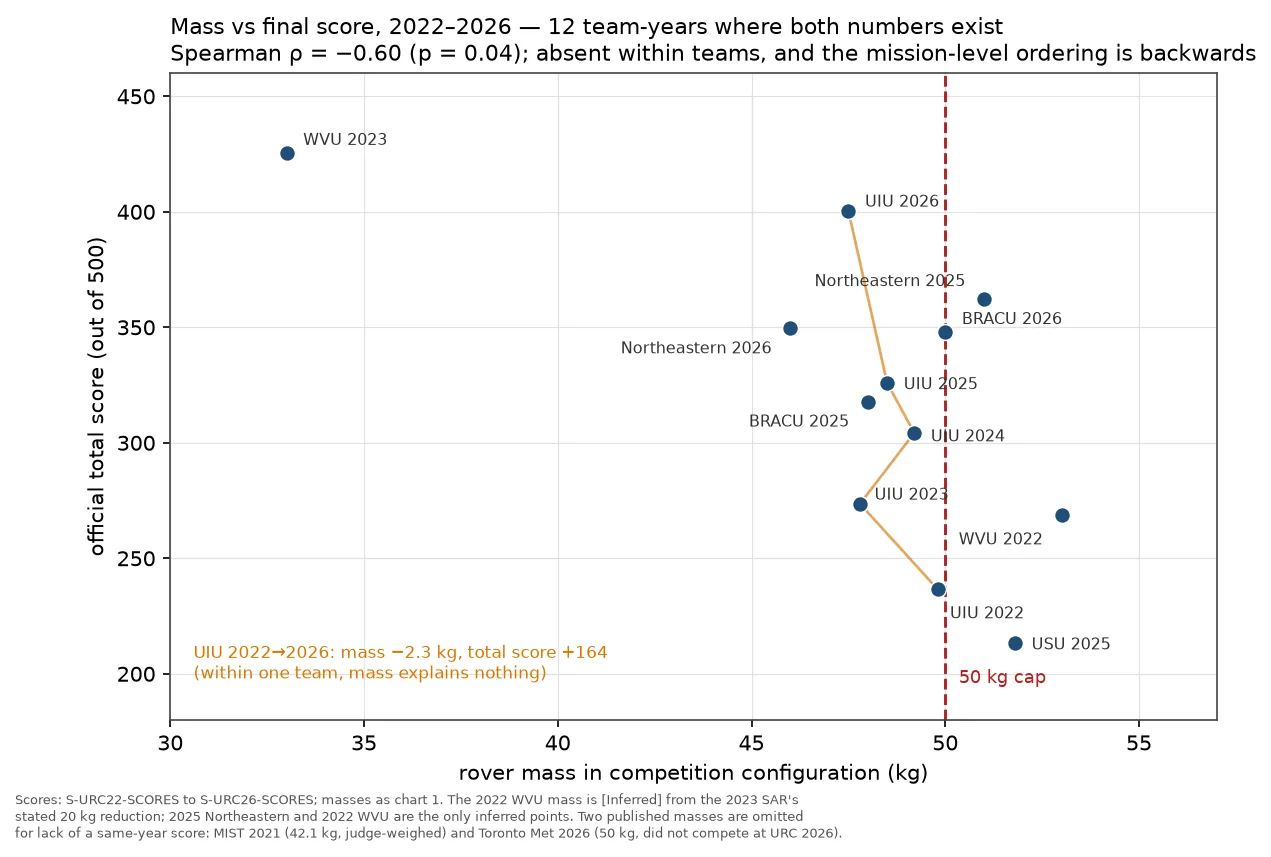
The within-team record settles the causal question. UIU went from 49.8 kg to 47.5 kg between 2022 and 2026, a 2.3 kg cut, and gained 164 points. West Virginia cut 20 kg between 2022 and 2023 and gained 157. Northeastern cut about 5 kg and lost 12. BRACU added 2 kg and gained 30. Mass change explains none of those four outcomes S-URC-RESULTS.
The cap is a constraint, not a target
The lightest configuration in the record is also the only far-below-cap winner: West Virginia’s Wanderer at 33.0 kg including a 5-DoF arm, which took 425.35 points in 2023. The team stated the 20 kg reduction came from a fabrication decision, a semi-monocoque sheet-metal chassis and composite wheels, not from a diet S-WVU-SAR2023.
At the other end, three different teams publish exactly 50.0 kg, all of them in the 2022–2026 window. BRACU’s 2026 Taurus is at the limit, Toronto MetRobotics’ 2026 Ingenuity is at the limit, and MIST’s 2025 Aurora X is reported at the limit. The mean of 47.9 kg is not a target that teams chose; it is the average of a distribution squeezed against a ceiling.
One measurement deserves a warning. MIST’s 2021 Phoenix is the only judge-weighed mass in the record, read aloud at 42.1 kg on the official stream, while the team’s own card for the same machine says 45 kg S-MIST-VURC2021 S-MIST-SITE-ROVERS. The judge’s number is 2.9 kg lighter than the team’s. Self-reported masses are directionally useful and not measurements.
The mass and power register
The values on this page
| Statistic | Value | Definition | Period | Sample | Source | Chart and chapter |
|---|---|---|---|---|---|---|
| Configurations | 17 | Rover masses in the database | 2021–2026 | 8 teams | S-URC27-RULES | Chart above; Mass and power |
| Mean mass | 47.9 kg | Arithmetic mean of the 17 | 2021–2026 | 17 configurations | S-URC27-RULES | Mass and power data |
| Median mass | 49.1 kg | Middle value of the 17 | 2021–2026 | 17 configurations | S-URC27-RULES | Mass and power data |
| Mass range | 33.0–53.0 kg | Minimum and maximum | 2021–2026 | 17 configurations | S-URC27-RULES | Chart above; Mass and power |
| At the limit | 3 | Configurations at exactly 50.0 kg | 2021–2026 | 17 configurations | S-URC27-RULES | Mass and power |
| Mass against score | −0.60 | Rank correlation, n = 12 | 2022–2026 | 12 team-years | S-URC-RESULTS | Chart above; Mass and power |
Evidence note
Of the 17 configurations, 15 are team-published, judge-weighed or university-reported and 2 are arithmetic from a stated reduction. Only one is judge-weighed. The 50 kg limit and the 5 % per kilogram penalty are fixed by the 2027 rules S-URC27-RULES §2.a.iii, and weight is rounded down before the penalty is applied, so the cliff is at 51.0 kg. No mass is imputed for Missouri S&T or any other team that does not publish one.
Sources for this page
- S-CENSUSURC team census, master index (68 teams, 187 team-year rows, tiers, documentation test)Print copy
- S-MIST-VURC2021"Virtual URC 2021: MIST Mongol Barota, Session 1" on the official University Rover Challenge channel (1:20:42, uploaded 2021); full judged run: weigh-in 42.1 kg, box check 1.047 m, Equipment Servicing 100/100, Autonomous Navigation failure + manual intervention; auto-caption transcript retrieved with yt-dlp,write-auto-subOriginal
- S-MONASH-GH-NOVAMonashNovaRover/nova, "The Monash Nova Rover mono-repo" (Apache-2.0; default branch main; 2,389 files; last push 2026-10-23)Original
- S-WVU-SAR2025Team Mountaineers System Acceptance Review 2025 (rover "Daedalus"): 2.4 GHz 90° sector + 3 m rover mast, 70 cm HAM packet radios, 433.25 MHz amateur-TV analog video, 750 m LOSOriginal
- S-RSX-ARM-URDFRSX 2025 arm URDF + meshes (6 revolute joints, link masses)Original
- S-ARES-PAPER-2025"Development of a Multifunctional Rover System for Mars Exploration and Operations in the University Rover Challenge" (RSJ 2024, 2K2-07)Original
- S-URC-RESULTSURC official scores 2022–2026, compiled CSVPrint copy
- S-WVU-SAR2023Team Mountaineers System Acceptance Review 2023 (rover "Wanderer"): Cambium PTP 450 900 MHz link, 850 m LOS / 300 m NLOS, 2 m telescoping mast, drone 900 MHz + 2.4 GHzOriginal
- S-MIST-SITE-ROVERSRover lineage pages.Original
- S-URC27-RULESUniversity Rover Challenge 2027 – Requirements and GuidelinesOriginal Archived copy