The 13-week plan
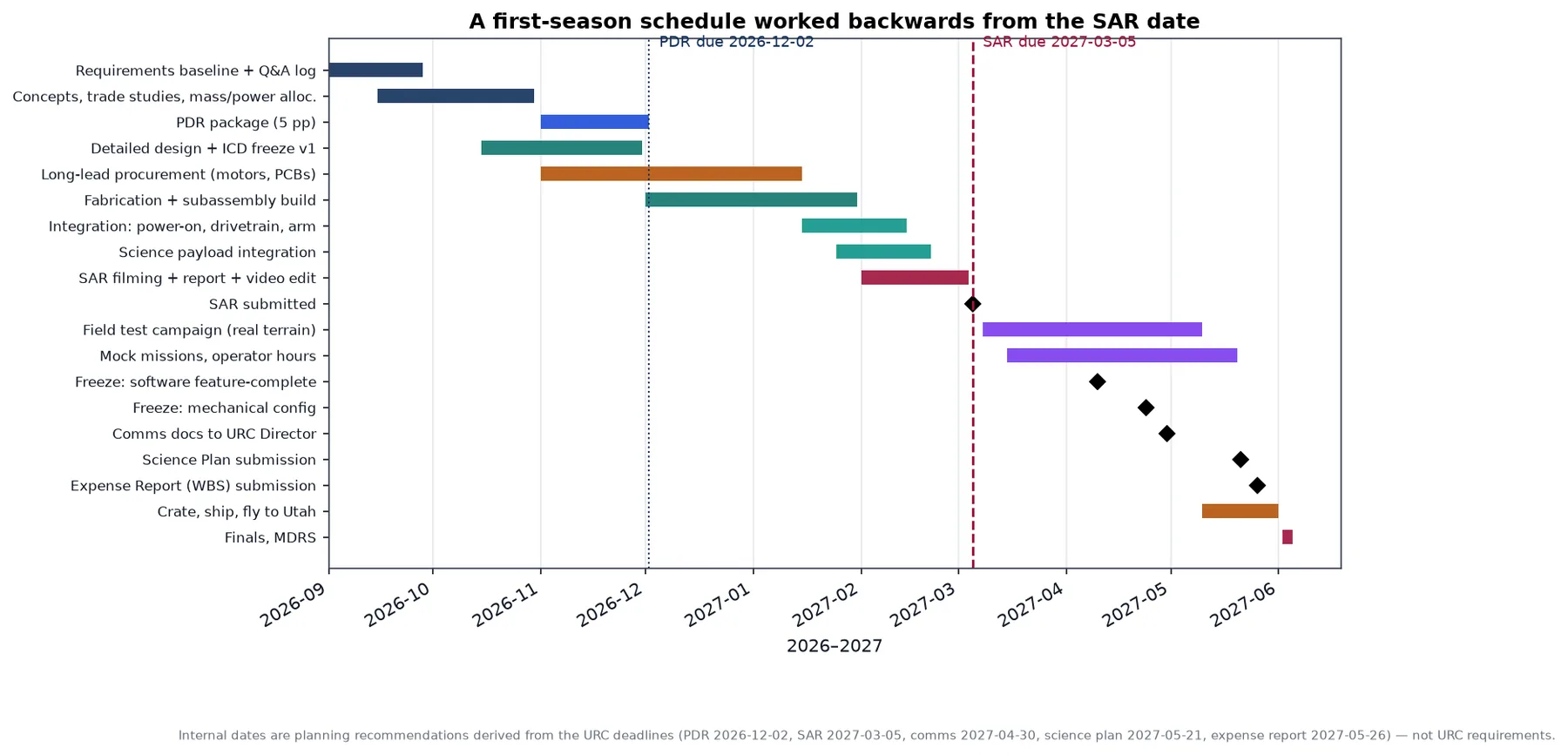
The thirteen weeks run from 2026-10-26 to 2027-01-23, one week per row below. Registration closes on 2026-10-30, the PDR is due 2026-12-02 in week 6 S-URC27-RULES §3.a.ii, and the SAR is due 2027-03-05, 41 days after the window closes S-URC27-RULES §3.a.iii. That last number is the design constraint on the whole window: the thirteen weeks have to end with something filmable rather than with a design review.
Key takeaways
- Dates come before engineering. Registration and the review calendar are closed in week 1, before any hardware is ordered.
- Week 2 is task hardware, week 3 is the weigh-in, week 4 is the link. Those three weeks decide the arm, the mass and the radios, and all three are cheap in November and expensive in February.
- The irreversible science decision is taken before the winter break, in weeks 6 to 8, so the fluidics has something to be designed around in January.
- Week 13 ends with footage, not with a drawing. If the integrated rover has not run on the clock by then, the review becomes documents only and the risk of missing the finals rises materially.
The four ordering rules
- Dates before engineering. Registration, the expense template and one named owner for every row come first, because an unowned calendar is itself one of the risks.
- Measurements aimed at more than one subsystem. The task-hardware mock-ups close six open questions in the requirements and four open arm problems with cardboard and a load cell, so they are worth more than any single subsystem’s design work in the same week.
- The two highest-uncertainty subsystems are prototyped before the architecture freezes: the link behind a hill, and arm precision.
- The irreversible decision, the chemistry, is taken before the winter break, because it is the longest-lead science item and the one the review video depends on.
Where the thirteen weeks sit in the season
The thirteen weeks
| Week | Dates | What is built or measured | Register rows | Decision it unlocks |
|---|---|---|---|---|
| 1 | 10-26 to 11-01 | Registration on Friday 10-30; every lead and a calendar owner named; the public Q&A page captured; the sixteen judge questions sent as one email; the expense template agreed | R-R13 closed, R-M05, owners for R-R09 and R-R10 | Every other row has a name attached |
| 2 | 11-02 to 11-08 | Task-hardware mock-ups built and measured: keyboard rig, tubular lock, cam-lock with a half gasket, cache, drawer, latch and valve panel, rock pick | R-T07, a reference for R-T08, and questions A1 to A5 | The arm torque and force budget, and the end-effector architecture |
| 3 | 11-09 to 11-15 | The 1.2 m gauge and the first weigh-in; a mass register per configuration and in aggregate, including drone, suit and repeaters; a 45 kg allocation; the PDR started | R-R03, R-R04 and R-R05 made visible; question A22 | Mass and configuration strategy, decision D2 |
| 4 | 11-16 to 11-22 | Communications bench and first field day behind a hill: sub-band change, occupied bandwidth, 25 m of cable and the mast, signal logging, the setup-time spectrum scan | R-T01, R-R06, tests C1 and C2 | The communications architecture: band, recovery plane, relay or not |
| 5 | 11-23 to 11-29 | PDR assembly: architecture version 1, a schedule with an integration bar, this register, the test plan; every item with a lead time over four weeks ordered | R-S02, R-S04 and the integration row R-S06 | Architecture version 1 and the long-lead order list |
| 6 | 11-30 to 12-06 | PDR submitted on Wednesday 12-02. The December gate opens: two life-detection methods shortlisted, one bioassay named with its biomolecule and its positive and negative controls | R-S02 closed, R-T10 approached | The payload concept, decision D5 |
| 7 | 12-07 to 12-13 | Chemistry decided in writing; the hazardous-chemical plan and the SAR science page written from one table; chemicals ordered | R-S03, R-R08 | Payload frozen enough to design the fluidics |
| 8 | 12-14 to 12-20 | The deferral list published with the scoring cost of each deferral; two legal field sites identified; bioassay bench work: spike and recover, blanks, stability at 38 °C | R-M04, R-S07 | Scope, and where the team tests |
| 9 | 12-21 to 12-27 | Arm bench week, portable over the winter break: backlash under load, 100 typing presses at ±3 mm, 50 key grasps, camera latency | R-T07 and R-T08 quantified | Whether open-loop fine work is possible, decision D10 |
| 10 | 12-28 to 01-03 | RTK week, portable: survey-in at 30, 60 and 120 minutes, the 30-run stop distribution, and day-to-day base repeatability | R-T12, R-T13 | The localisation architecture and the internal stop target |
| 11 | 01-04 to 01-10 | Autonomy smoke test: one planner, ten cold-boot runs, a forced link-down run, the state-light check in daylight | R-T19, R-O12 | Route finding alone, or with astronaut interaction: decisions D4 and D9 |
| 12 | 01-11 to 01-17 | Integration demonstration and the first SAR footage: drive, arm, link and camera on the clock, with two operators in a mock station that has no view. The session is filmed | R-S01, R-S06, R-M02 | Whether the review storyboard is achievable |
| 13 | 01-18 to 01-24 | Gate review: every row re-scored, the ninety-day report signed, the storyboard fixed against footage that exists, the freeze date published | every row re-scored | The build plan, taken backwards from the review |
Two rows carry more weight than the rest. Week 3 makes the mass a measured quantity, and week 4 makes the link a measured quantity; every decision after them is cheaper because of it. Week 12 is the only week whose output is footage, and its result decides whether the review can be assembled from evidence or only from drawings.
The four gates
| Gate | Closes at | Pass condition |
|---|---|---|
| G1 | End of week 1 | Registered, and every row has an owner |
| G2 | End of week 6 | Designable: an architecture, a mass allocation and a measured force budget |
| G3 | End of week 8 | The irreversible choices are made: chemistry, the chemical plan, the deferral list and the field sites |
| G4 | End of week 13 | Filmable: an integrated rover on the clock and on film |
If G4 fails, the review becomes documents only and the chance of missing the field entry rises materially. That is the one gate whose failure cannot be recovered by working harder in February, because the footage has to show a rover that already runs.
These four are management gates, tracking ownership and decision dates. The four technical gates, which close on a measured number and an artefact, are set out on the first 90 days page.
What is deliberately absent
The window is defined as much by what it does not attempt. There is no flight rover, no chassis fabrication, no second autonomy planner, no gesture recognition before its hardware test, no attempt at the key and lock task before the measurements, and no drone flight without a named pilot and spotter. Nothing in the thirteen weeks depends on an unpublished URC document.
That list is a scope decision, and it is the same decision the risk register asks for in week 8. A first build that tries to do these things and the measurements in the same window does neither.
What the window must hand the review
- Footage of an integrated rover doing something measurable, filmed in week 12.
- A measured force and torque table for every Equipment interface.
- A real weigh-in behind a mass table, with the heaviest configuration included.
- A repeatability distribution, not a best run, for the arm and for the 1 m stop.
- A link log with range, shadow point and sub-band evidence.
- A signed deferral list, and the answers to the judge questions on file.
- The register, re-scored, as the systems-engineering evidence the review looks for.
A note on week numbering
The problem register counts its rows from week 0, so the PDR appears in its week 5 and in week 6 of this calendar. Both refer to the six days ending 2026-12-06. The dates bind; the week labels differ only in where the count starts.
Further reading
- The first 90 days gives the same window as a work sequence ordered by dependency.
- 110 engineering problems is the source of every row referenced above.
- 70 risks describes what each gate protects against.
- 77 open questions is the question letter sent in week 1.
- System Acceptance Review explains what the review is scored on.
Sources for this page
- S-URC27-RULESUniversity Rover Challenge 2027 – Requirements and GuidelinesOriginal Archived copy