Cornell Mars Rover (CMR)
Cornell out-engineers its own results. It publishes a documentation site, five custom board designs, a CAN-FD network diagram, an operator interface and a design narrative for every year, and it has not finished better than 25th since 2019. Every subsystem is individually defensible; the integration is where the points are lost. That makes it a worked example of a programme whose engineering depth runs ahead of its mission reliability, and a guide for a team deciding what to build first.
What this team shows
- Custom electronics at scale is achievable by a student team and is not what scores. Five board designs, a merged CAN-FD network and a full operator interface bought integration quality, not mission points.
- Equipment Servicing and Autonomy scored zero in 2023, 2024 and 2026. Both fail whenever the arm or the drive architecture changes, and the team changed both almost every year.
- The process has a ceiling without coverage. Three continuous-integration workflows, pre-commit hooks, code ownership and a documentation site coexist with a unit-test step that deselects every test.
- The two details a 2027 build needs most, rover mass and the E-stop design, are the two the team does not publish.
Identity and results
The Cornell Mars Rover team is a Cornell University programme in Ithaca, New York, with about 70 members in 2024 and 50 on the 2026 site. It is split across six subteams: drives, arm, astrotech, software, electrical, and business and design S-CORNELL-INFO-SESSION-2024 S-CORNELL-SITE-ABOUT. It has built a new rover every year since 2012, when Eos placed third. The team won second place in Equipment Servicing in 2017 with Athena, finished tenth with Valkyrie in 2018, and reached its best position with Artemis in 2019, sixth overall and third in Autonomy S-CORNELL-ROVERS S-CORNELL-SPONSORSHIP-2023. There is no Cornell row in the 2022 score sheet S-URC22-SCORES. Tier C is the census label for the four scored finals in the 2022–2026 window; the tier rule is defined on the census page.
| Year | Rover | Total | Rank | Field | SAR | Science | Delivery | Equipment | Autonomy |
|---|---|---|---|---|---|---|---|---|---|
| 2023 | Atlas | 138.04 | 29 | 31 | 87.80 | 45.24 | 5 | 0 | 0 |
| 2024 | Hyperion | 180.00 | 29 | 34 | 90.00 | 78 | 12 | 0 | 0 |
| 2025 | Cayuga | 221.48 | 25 | 35 | 87.08 | 62 | 30 | 20.0 | 22.4 |
| 2026 | Cerberus | 168.31 | 31 | 36 | 84.31 | 84 | 30 | 0 | 0 |
Each total is the exact sum of its components. The 2025 season is the only one of the four with points in all five columns.
Rover generations
2023, Atlas. The arm was redesigned around absolute rotary encoders and the wheels became 3D printed S-CORNELL-ROVERS. Six wheels on an aluminium space frame with a damped rocker are visible in the review film S-CORNELL-YOUTUBE-SAR-2023. Electronics were still ODrive-based. Atlas scored zero in Equipment Servicing and in Autonomy.
2024, Hyperion and Juno. A damped rocker, a bent sheet-metal frame that integrates cable routing and connector panels, hub motors with pneumatic off-road tyres, a detachable electronics housing, and a switch to moteus R4.11 controllers on a rover-wide CAN bus with a hardware abstraction layer. On-board compute moved to a Jetson Orin Nano and autonomy to behaviour trees. The delivery drone was named Juno S-CORNELL-YOUTUBE-SAR-2024 S-CORNELL-ROVERS S-CORNELL-INFO-SESSION-2024.
2025, Cayuga. The architecture break: a damped multi-link independent suspension, Maxon motors and planetary gearboxes on 3D-printed TPU wheels, and swerve drive. The bus moved from CAN 2.0 to CAN FD, with a 16-servo board and a six-motor brushed board. Software moved to Nav2 and MoveIt2 with LiDAR-camera scans and ZED stereo. The arm gained quick-swap effectors and torque-transparent miniature-arm teleoperation, and the team deployed a radio repeater network S-CORNELL-YOUTUBE-SAR-2025. Cayuga produced the only complete mission set of the run.
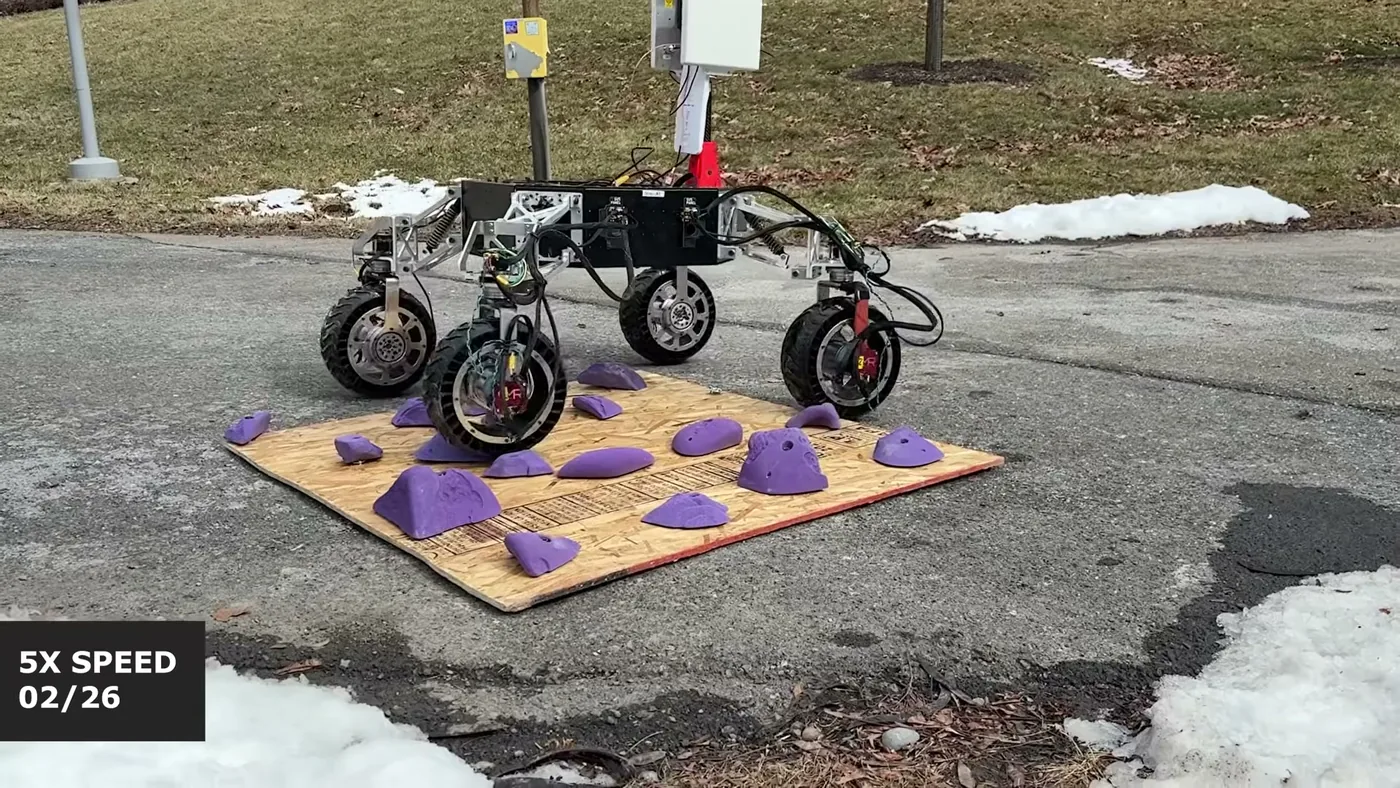
2026, Cerberus. An independent double wishbone with CNC control arms, swerve retained, larger TPU wheels, a differential wrist, a parallel effector with moulded silicone grips holding a 5 kg cache, a quadcopter rebuilt from scratch, YOLO trained on more than 1,000 images, bead-beating lysis with an in-house Raman spectrometer, and three CAN-FD buses merged onto one board S-CORNELL-YOUTUBE-SAR-2026. It produced the best science score of the run and the lowest total.
The team’s about page counts 14 rovers by 2026 while the lineage page names 15, a counting inconsistency worth knowing before quoting either number S-CORNELL-SITE-ABOUT S-CORNELL-ROVERS.
Subsystems
Mobility. The suspension lineage runs from six-wheel rocker-bogie in 2021 and 2023, to a damped rocker in 2024, to damped multi-link independent in 2025, to independent double wishbone in 2026 S-CORNELL-ROVERS S-CORNELL-YOUTUBE-SAR-2026. Drive motors are Maxon units with Maxon planetary gearboxes, and steering is swerve, meaning a drive and a steer actuator per corner. Wheels have been 3D printed since 2023, with TPU and a larger diameter in 2026; 2024 temporarily ran pneumatic off-road tyres on hub motors. No speed, wheel width, wheelbase or mass figure is published.
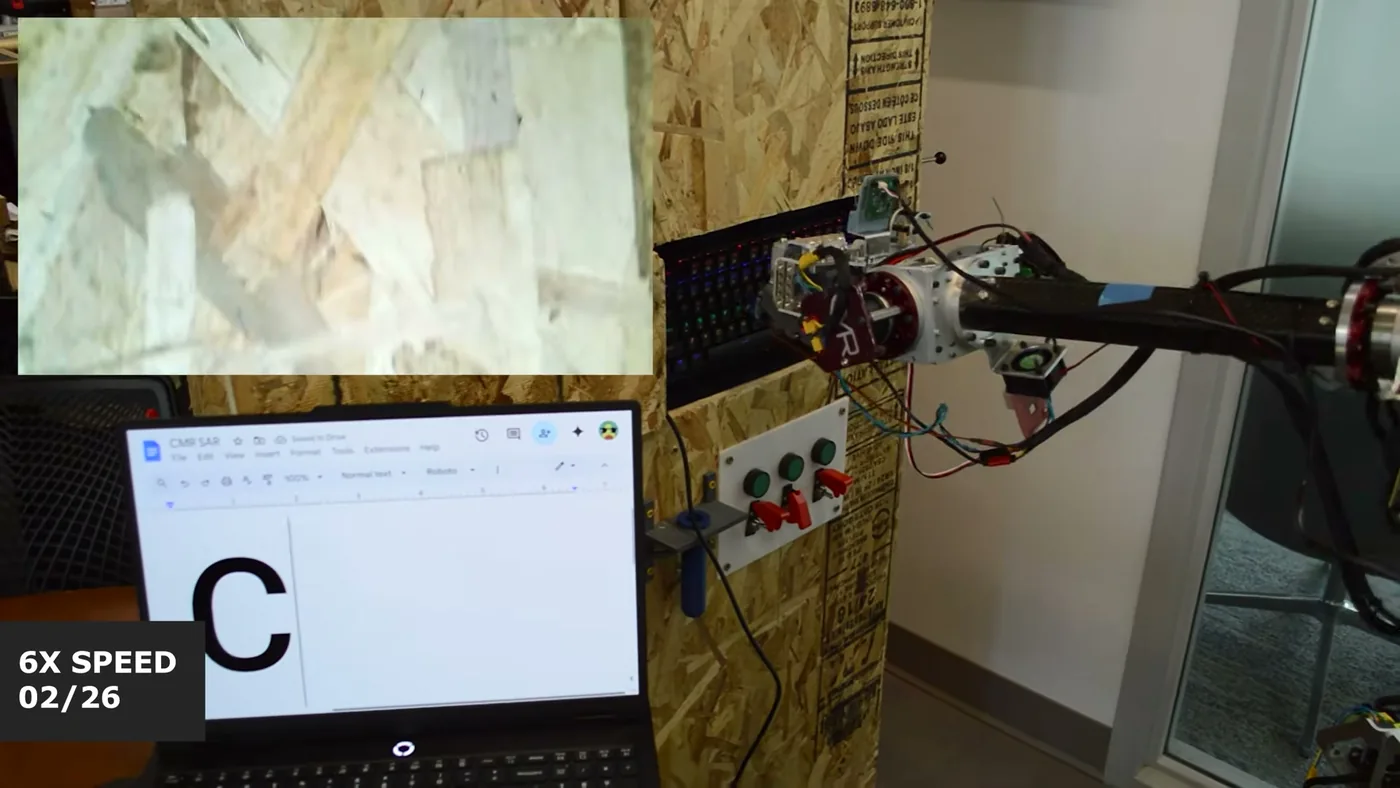
Arm and end-effectors. Six degrees of freedom: base yaw, shoulder, elbow, wrist rotation, wrist twist and a second wrist rotation, in custom aluminium joints with carbon-fibre tubing S-CORNELL-YOUTUBE-SAR-2026. Every joint uses a brushless motor with a strain-wave gearbox, which the team chose to reduce backlash at a high gear ratio, and an absolute magnetic encoder, which allows absolute-position inverse kinematics without homing S-CORNELL-YOUTUBE-SAR-2024 S-CORNELL-YOUTUBE-SAR-2026. The 2026 effector is a parallel jaw with moulded silicone grips, an integrated camera and a laser, and it is stated to hold objects from irregular rocks to a 5 kg cache.
Control is the distinctive part. MoveIt2 provides inverse kinematics for the large arm, and a miniature duplicate arm moved by hand provides a second input path with torque transparency between the small and the large arm S-CORNELL-YOUTUBE-SAR-2025 S-CORNELL-SITE-ABOUT. The team’s claim that a dedicated miniature-arm controller cuts latency has not been independently checked. One caution for anyone reusing the public configuration: the joint-limits file sets every joint to no velocity limit, so the safety limits were never populated S-CORNELL-GITHUB-CURRENT-SOFTWARE.
Science. Sample acquisition in 2026 was an auger drill with the lead screw and the flight each on its own moteus controller S-CORNELL-YOUTUBE-SAR-2026. The assay set changes materially every year: 2026 ran methylene blue for perchlorates, MTT for metabolically active cells, ninhydrin for amino acids and proteins, a Bayer test for alkenes, and a low-concentration acid test for fossil carbonates with carbon dioxide sensing. 2025 ran fluorescamine with an in-house fluorescence spectrometer, ninhydrin and Alamar Blue S-CORNELL-YOUTUBE-SAR-2025. The 2026 instrument suite included in-house Raman with 785 nm as the default in the committed calibration, a fluorescence spectrometer, an Adafruit SCD-30 non-dispersive infrared carbon dioxide sensor, and camera imagery. Soil is split, with one part sealed dry for the judges and the rest mixed, filtered and pumped to a cuvette; 2026 added bead-beating lysis.
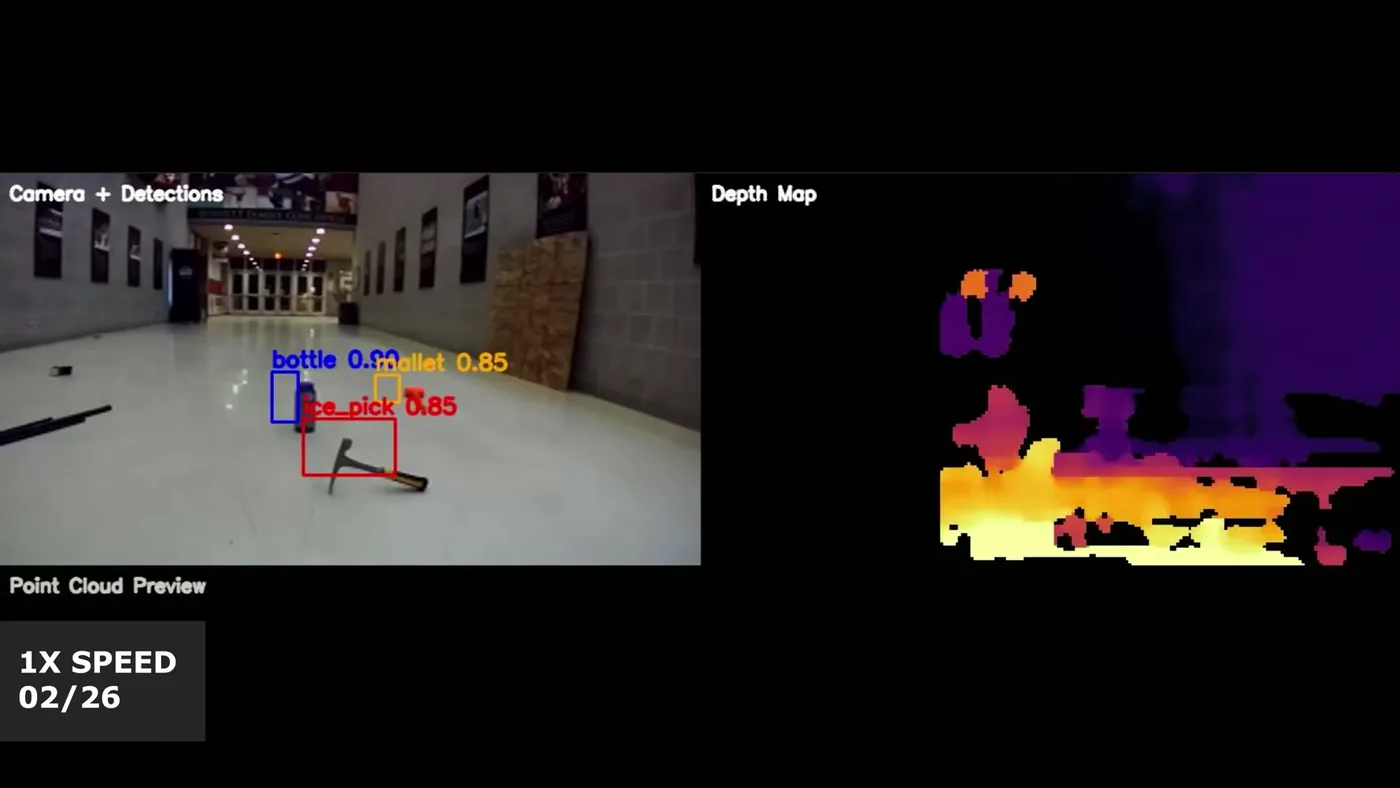
Delivery and the drone. Juno appeared in 2024 as the delivery scout and was rebuilt from scratch as a quadcopter in 2026 S-CORNELL-INFO-SESSION-2024 S-CORNELL-YOUTUBE-SAR-2026. Drone mass, endurance and payload are unpublished. Object detection is a YOLO model trained on more than 1,000 images for a mallet, an ice pick and a water bottle, and the arm is stated to grasp a 5 kg cache with silicone grips.
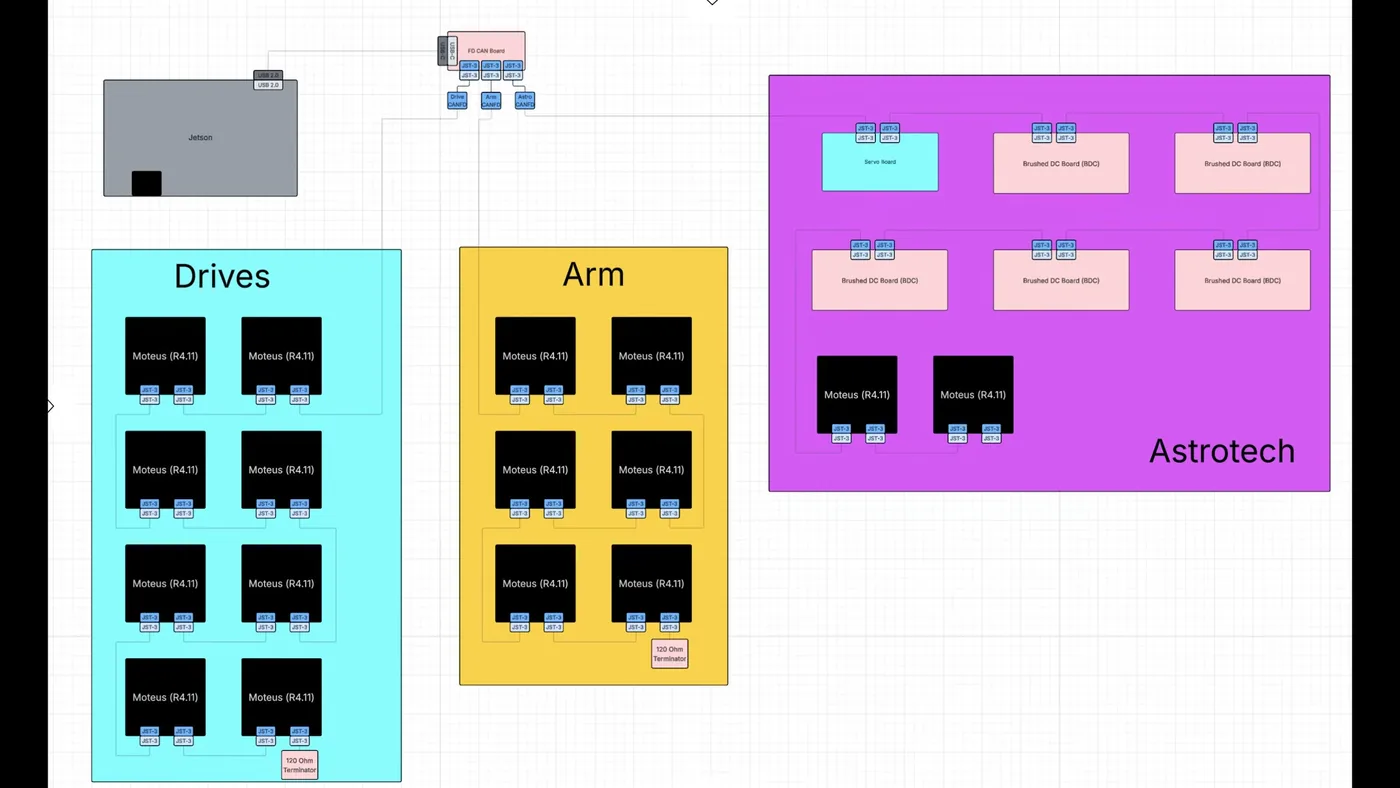
Communications. A point-to-point 5 GHz link built on Ubiquiti Rocket Prism 5AC radios running airOS 8, with a deployable repeater that the team describes as a waypoint against the limits of line of sight S-CORNELL-YOUTUBE-SAR-2026 S-CORNELL-YOUTUBE-SAR-2025. The published link figures come from a 0.2-mile bench test: carrier-to-interference-plus-noise ratios of +22 and +25 dB, noise floors of −100 and −87 dBm, and a 1 Gbit/s local network. Those are bench numbers, not a field record. The ground station uses a Foxglove WebSocket bridge rather than a ROS bridge, with best-effort quality of service and a queue depth of one on camera, point-cloud and inertial topics, explicitly so that a stalled radio link cannot back-pressure the bridge S-CORNELL-GITHUB-CURRENT-SOFTWARE.
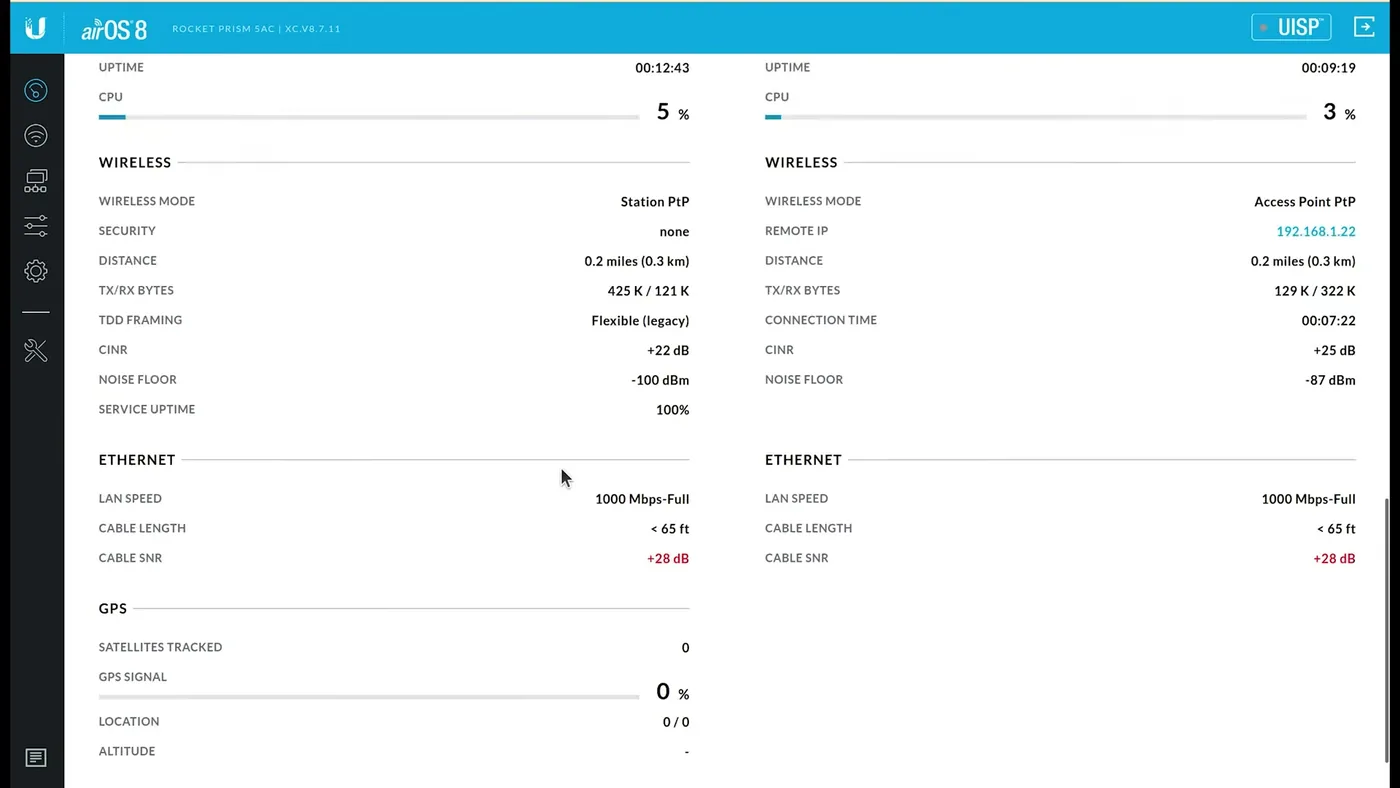
Power and electrical. The public electronics archive holds five board designs from 2024–25 and four from 2025–26: a brushed motor board built on a TI DRV8906 eight-channel driver, a servo board with an STM32G431 microcontroller and TCAN1042 and TCAN1057 CAN transceivers on a 6 V servo rail, an LED board, a power-over-Ethernet board, a spectrometer board and a fan board S-CORNELL-GITHUB-ELECTRICAL-KICAD. Battery chemistry and capacity are unpublished; one committed drive configuration caps the bus at 35 V, which bounds the pack to roughly six to eight cells in series. Thermal control in 2026 is a fan system in the electronics housing with a large extruded heat sink. No E-stop design appears in any source.
Compute, sensors and software. A Jetson Orin Nano runs the payload and the perception stack, with a separate embedded controller owning the drive and arm network. Perception uses ZED stereo for point clouds, obstacle detection and ArUco pose, plus a LiDAR camera, an end-effector camera and several rover camera feeds S-CORNELL-YOUTUBE-SAR-2025 S-CORNELL-GITHUB-CURRENT-SOFTWARE. An inertial sensor and an RTK-GNSS package are present, with the receiver and base station unspecified. The software stack is ROS 2 Humble with MoveIt2, Nav2, Foxglove and ros2_control, built on a custom C++ framework that provides node lifecycle, dependency management, a fault handler and a mockable clock. Autonomy in 2026 ran to GNSS waypoints with path validation and replanning, ArUco pose for precision, and A-star avoidance on ZED point clouds.
Systems engineering and process. This is the strongest part of the team. A published documentation site is regenerated on every push to the main branch. Three continuous-integration workflows run a build and test job in a pinned container, static analysis on every pull request, and a documentation build. Pre-commit hooks enforce formatting, branch protection, merge-conflict checks and line endings, and code ownership is declared S-CORNELL-GITHUB-CODE-DOCUMENTATION S-CORNELL-GITHUB-ORG.
The same record shows the ceiling. The job named for unit tests passes a test filter that matches no test, so the step exists and deselects everything; the integration step runs with a three-attempt retry because the team describes the tests as flaky. The public inventory is two C++ test suites of 4 and 35 cases and three Python files with eight test functions across about 23 packages S-CORNELL-GITHUB-CURRENT-SOFTWARE. The project README still lists autonomous navigation, GPS, arm autonomy, ArUco detection and obstacle detection as unfinished work while the 2026 film demonstrates all five.
Mission performance
2023, 29th of 31. Science 45.24, Delivery 5 and zeros in Equipment Servicing and Autonomy S-URC23-SCORES. A zero in a field-service mission means the entry-level task was not completed, which fits an arm just rebuilt around absolute encoders.
2024, 29th of 34. Science recovered to 78 and the review score to 90, but Equipment Servicing and Autonomy were zero again and Delivery fell to 12 S-URC24-SCORES. Two identical signatures in consecutive years point at arm and controls integration, not at the hardware concept.
2025, 25th of 35. The only year with points everywhere: 87.08 review, 62 science, 30 delivery, 20 servicing and 22.4 autonomy S-URC25-SCORES. Swerve, Maxon drives, Nav2, MoveIt2 and quick-swap effectors landed together, and the total rose by 41 points.
2026, 31st of 36. Science reached 84, a record for the team, while Equipment Servicing and Autonomy returned to zero and the review score fell to 84.31 S-URC26-SCORES. Science and the review score, the two deliverables that are prepared on a desk, held up. Dexterity and autonomous traversal, the two that need field hours, did not.
Across the four seasons the mean total is 177.0. The pattern is not a plateau; it is a sawtooth, with every architecture change buying capability and costing a mission family.
Lessons for a first build
- Custom electronics at scale is achievable and is not a scoring strategy. Five board designs, a merged CAN-FD topology and a full operator interface produced integration quality, not points. A first build should buy proven controllers and spend the saved months on mission rehearsal.
- Pick one controller family and stay with it. The migration path ran from ODrive in 2022 and 2023, to moteus in 2024, to eight plus six plus two moteus units on one board in 2026. Each step reopened arm tuning, and the arm kept blanking.
- Four drive and four steer actuators double the control surface. Three of the last four seasons scored zero in Autonomy, in 2023, 2024 and 2026, and swerve did not change that. Swerve is a real capability and it is not free.
- Two arm input paths is a strong manipulation idea. MoveIt2 inverse kinematics plus a hand-moved miniature arm with torque transparency maps directly onto a servicing mission that needs both precision and speed S-CORNELL-YOUTUBE-SAR-2025.
- A deployable repeater converts a line-of-sight link into a network. It is cheap, and it matters more as the autonomy course radius grows.
- Process has a ceiling without coverage. Three workflows, pre-commit hooks, code ownership and a documentation site can coexist with a test step that runs nothing. A first build should count executed tests, not configured ones, and publish the measured mass every year.
What remains uncertain
Rover mass, dimensions, wheel diameter and width, wheelbase, track, ground clearance and arm reach are not published anywhere. The public robot description mixes mesh scales with joint offsets of about a metre, so no honest reach can be extracted from it. Battery chemistry and capacity, the power budget and the E-stop design are undocumented, and the E-stop is a 2027 requirement. The 2022 score row is missing from the official sheet. The 2026 payload’s Raman data framing is described as assumed until confirmed with the payload subteam, which is an honest flag and a real integration risk. The team’s rovers page also carries an inconsistency, with the 2024 sheet-metal description appearing inside the 2025 entry S-CORNELL-ROVERS.
Team sources
- marsrover.engineering.cornell.edu, the team site.
- Rovers, year by year, the design narrative for each machine.
- About the team, the subteam scope and the mast description.
- cornellmarsrover on GitHub, the software, electronics and documentation projects.
- Terra documentation, the published, continuously rebuilt code documentation.
- 2026 review film, the rover, the radio link, the CAN-FD slide, the operator station and the arm typing.
- 2025 review film and 2024 review film, the earlier architectures.
Sources for this page
- S-CORNELL-INFO-SESSION-2024Cornell Mars Rover, Spring 2024 recruitment / info-session deck (sponsor PDF, 30+ slides)Original
- S-CORNELL-SITE-ABOUTTeam structure.Original
- S-CORNELL-ROVERSCornell Mars Rover, rover history pages (2021 6-wheel rocker-bogie, 2023 3D printed wheels, 2024 damped rocker, 2025 independent suspension + swerve, 2026 double wishbone + swerve)Original
- S-CORNELL-SPONSORSHIP-2023Cornell Mars Rover, 2023–24 Sponsorship Prospectus (9 pp., archived copy)Original
- S-URC22-SCORESURC2022 Official ScoresOriginal
- S-CORNELL-YOUTUBE-SAR-2023SAR 2023, 5:00.Original
- S-CORNELL-YOUTUBE-SAR-2024Cornell Mars Rover, URC SAR 2024 (video, 5:01; Hyperion, moteus R4.11 + Jetson Orin Nano narration)Original
- S-CORNELL-YOUTUBE-SAR-2025SAR 2025, 4:48.Original
- S-CORNELL-YOUTUBE-SAR-2026"Cornell Mars Rover, URC SAR 2026", 5:01. Cerberus.Original
- S-CORNELL-GITHUB-CURRENT-SOFTWARE"The new updated CMR software repo", Python, last push 2026-10-22.Original
- S-CORNELL-GITHUB-ELECTRICAL-KICADPCB design files, last push 2026-10-08.Original
- S-CORNELL-GITHUB-CODE-DOCUMENTATIONDoxygen site for "Terra", the C++ codebase → published at https://cornellmarsrover.github.io/ (verified live).Original
- S-CORNELL-GITHUB-ORG17 source repos; active 2026-10.Original
- S-URC23-SCORESURC2023 Official ScoresOriginal
- S-URC24-SCORESURC2024 Official ScoresOriginal
- S-URC25-SCORESURC2025 Official ScoresOriginal
- S-URC26-SCORESURC2026 Official ScoresOriginal Archived copy