New Haven Robotics (University of New Haven)
New Haven Robotics is a three-year finals programme that produced one strong season and then one collapse. It finished 13th in 2025 with every mission scoring, then 20th in 2026 with Delivery at zero and Equipment Servicing at 9.47. The public record is thin: the team site is a near-empty shell, there is no public code and no design report, and the annual review film is the only engineering evidence. That film is still worth study, because it shows a tracked chassis and two cordless drills used as actuators.
What this team shows
- A very small roster can produce a top-half finish once, but it cannot carry two manipulation missions and a science payload through the same season without a support structure.
- The 2026 rover appears to run on rubber tracks, which is rare in this field and makes the autonomy problem harder because skid-steer odometry becomes less reliable S-UNH-SAR2026.
- Science improved every year, from 69 to 82 to 92, while Delivery and Equipment Servicing fell together in 2026.
- Almost nothing is measured in public: there is no mass, no battery figure, no arm specification and no wheel or track dimension.
Identity and results
New Haven first appears in the 2024 finals and has entered every season since. The 2023 team list carries a “Charger Robotics” entry for the same university, but no score sheet row exists under either name, so that registration is not counted as a finals appearance here S-CENSUS S-URC23-TEAMS.
| Year | Total | Rank | SAR | Science | Delivery | Equipment | Autonomy |
|---|---|---|---|---|---|---|---|
| 2024 | 200.25 | 24 | 89.25 | 69 | 10 | 32 | 0 |
| 2025 | 288.79 | 13 | 91.49 | 82 | 32.3 | 41 | 42 |
| 2026 | 209.77 | 20 | 78.30 | 92 | 0 | 9.47 | 30 |
The total is the sum of the review score and the four mission scores, and all three rows reproduce the published results S-URC24-SCORES S-URC25-SCORES S-URC26-SCORES. The team has never won an award in this window, and no rover name appears in any source reached.
Rover generations
2024: the first finals rover. The team scored 89.25 on the review and 69 in Science, with Delivery 10, Equipment Servicing 32 and Autonomy 0. Half the mission set worked in the first attempt, which is a normal shape for a new programme S-URC24-SCORES.
2025: the best season. Delivery rose to 32.3, Equipment Servicing to 41 and Autonomy to 42, with Science at 82 and the review at 91.49. It is the only year in which every mission scored and the only top-half finish S-URC25-SCORES.
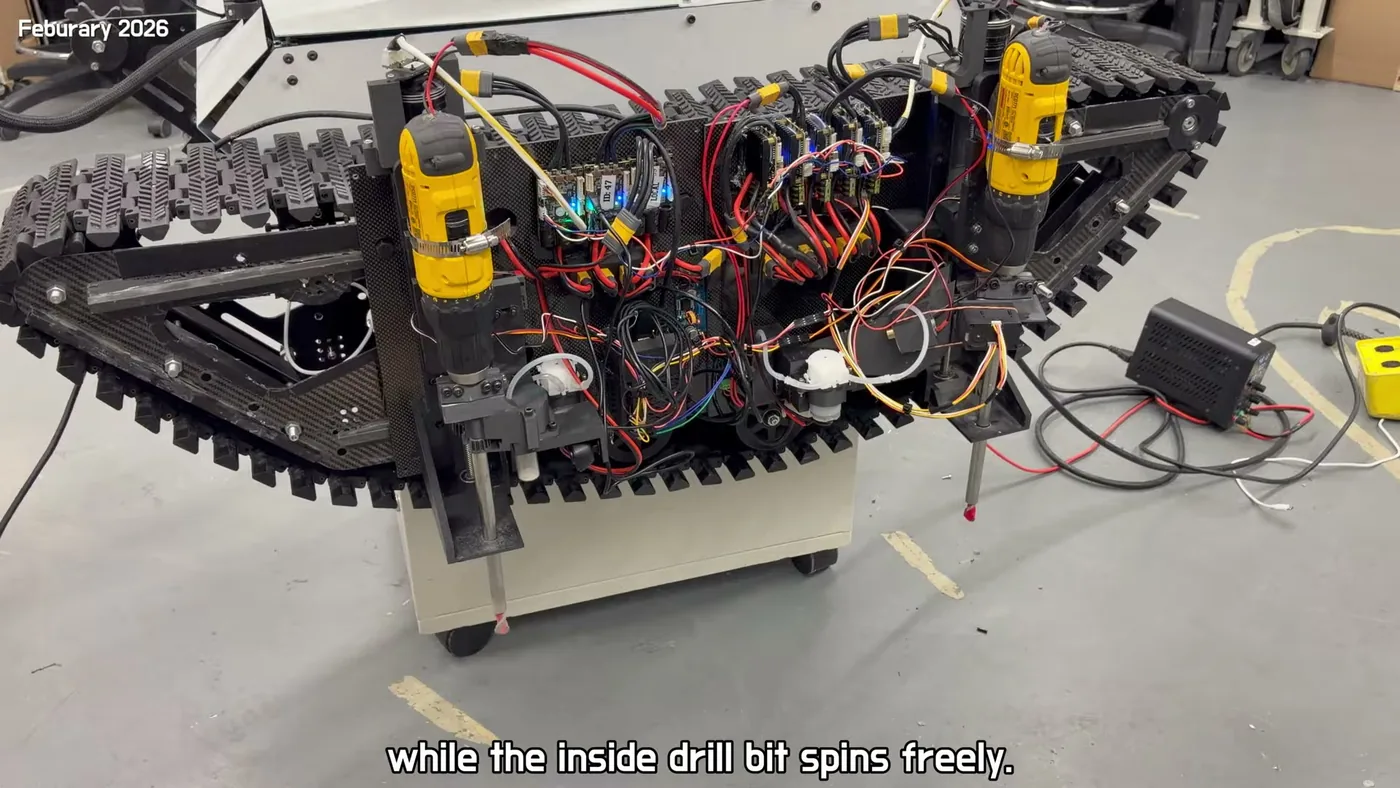
2026: the tracked season. The review film shows a chassis that appears to run on rubber tracks rather than wheels, two cordless drills mounted as actuators, and dense exposed wiring with several small controller boards. Science reached a personal best of 92, but Delivery fell to zero and Equipment Servicing to 9.47 S-UNH-SAR2026 S-URC26-SCORES.
Subsystems
Mobility. The 2026 film is the only evidence, and it shows a tracked platform: rubber tracks running on carbon-fibre side plates, with track shoes visible around the full loop. No wheel or track dimension, motor model or mass is published. If the reading is correct, this is one of very few tracked rovers in the field, and tracks trade speed and efficiency for obstacle climbing and contact area S-UNH-SAR2026.
Manipulation and servicing. Two yellow cordless drills are clamped to the chassis on brackets, with their chucks and bits presented outward. A commercial drill is a cheap way to obtain high-torque rotary actuation with an integrated chuck and battery interface. It is also the kind of substitution that produces high variance in a scored mission, and the 2026 manipulation scores are exactly where the season failed S-UNH-SAR2026.
Science. Science is the team’s strongest and most consistent mission: 69, then 82, then 92 across three seasons. The instruments, the sample-acquisition method and the assay are not published, so the result is the only evidence that the payload works S-URC24-SCORES S-URC25-SCORES S-URC26-SCORES.
Electrical and compute. The visible deck carries exposed harnesses, several small controller boards with status lights, XT60-style power connectors and at least one unenclosed motor controller. There is no potting, no cable management and no cover on the visible deck. The 2026 review credits five members by name, which is the only team-size evidence available S-UNH-SAR2026.
Mission performance
The 2024 season was a reasonable first finals: review 89.25, Science 69, and three missions between 0 and 32 S-URC24-SCORES. The 2025 season was the breakthrough, with 288.79 points and a rank of 13, and it remains the clearest evidence that the team can build a complete rover S-URC25-SCORES.
The 2026 season is a 79-point loss concentrated in two missions. Delivery fell by 32.3 and Equipment Servicing by 31.5 while Science gained 10 and Autonomy lost 12. That pattern is a hardware change that did not survive competition, not a team that forgot how to engineer S-URC25-SCORES S-URC26-SCORES. The failure sits exactly where the film shows the unusual hardware, which is the drill-based manipulation, and not where the team is conventionally strong.
Lessons for a first build
- Treat the review film as a design document. It is the only public record of this rover, and it shows both the distinctive idea and the unenclosed wiring that does not survive a close look. What a team films is part of what it submits.
- Do not change the mobility concept and the manipulation concept in the same year. The 2025 rover scored with four working missions; the 2026 rover changed the platform and lost both mechanical missions while keeping Science.
- A commercial drill is a legitimate actuator and a known weak point. It buys torque and a chuck cheaply. It also introduces a trigger, a gearbox and a battery interface that were not designed for the task, so it needs a bench test that runs longer than a demonstration.
- Protect the science advantage. Science is the one mission that improved every year. A first build should decide which mission it will be reliably good at and defend that budget line.
- Publish one number. A mass, a battery capacity or a track width would let the next team check the rest. The absence of all of them is why this dossier is short.
What remains uncertain
Whether the platform is tracked rests on video frames alone; no text source confirms it. What the drills actually do, whether servicing, sampling or both, is not stated, and neither is whether they caused the 2026 failures. Mass, dimensions, arm geometry, battery, radios and compute are all unpublished. The five named members may be the whole technical team or only the presenters.
Team sources
- robotics.newhaven.edu, the university robotics page.
- 2026 review film, the primary evidence for the 2026 rover.
- 2024 review film, the first finals season.
Sources for this page
- S-UNH-SAR2026"University of New Haven Mars Rover Team URC 2026 SAR", video, 5:01, uploaded 2026-02-27; names five members; frames show rubber tracks and two cordless drills as actuatorsOriginal
- S-CENSUSURC team census, master index (68 teams, 187 team-year rows, tiers, documentation test)Print copy
- S-URC23-TEAMSURC2023 Team ListOriginal
- S-URC24-SCORESURC2024 Official ScoresOriginal
- S-URC25-SCORESURC2025 Official ScoresOriginal
- S-URC26-SCORESURC2026 Official ScoresOriginal Archived copy