Systems engineering and integration
A rover is fielded as one system, and four of its constraints are paid for by the same score: mass, volume, time at the site, and the evidence a report and a video present. Each one crosses subsystem boundaries, so none of them can be owned locally. This page sizes those couplings from published team practice, reduces them to the artefacts a first build can sustain through a seven-page review, and names the interfaces where one subsystem quietly breaks another.
Key takeaways
- Four constraints are paid from one score. Mass costs 5 % of an event’s points per kilogram over 50 kg, volume costs 40 % of a mission if the cube is missed, and the review is 100 of 500 points for showing that the first three were managed.
- The 1.2 m box is a measurement, not a packing problem. The vertical stack of a 6-wheel rover with a 2 m mast lands at ≈1.14 m, which leaves 0.06 m, and three axles on a 1.05 m wheelbase are 1.55 m long, 0.35 m over the limit before any arm.
- Mass follows architecture. WVU took 20 kg out of its rover in one year with a fabrication decision, and the lightest championship rover in the record is 33 kg, so 50 kg is a ceiling at 1.5 times a winning design.
- The review is a compressed exam, not a soft landing. The admitted set is decided inside a few points in a normal year, and documentation explains about 18 % of rank variance, so it is a gate and a bank of points, not a podium predictor.
What the subsystem must do
Systems engineering at URC exists to hold the couplings that no subsystem owns. Mass: 5 % of an event’s points per kilogram over 50 kg per configuration, with a 70 kg ceiling on total fielded parts S-URC27-RULES §2.a.iii. Volume: a 1.2 m cube measured at every weigh-in, with no disassembly permitted and a 40 % penalty if the rover does not fit S-URC27-RULES §2.a.ii. Time: 15 minutes of setup, a 10-minute teardown, and as little as 10 minutes between two missions S-URC27-RULES S-URC27-RULES §1.a.ii §1.a.iv. Evidence: 100 of 500 points for a page-limited report and a five-minute video showing that the first three were under control.
The syllabus is published almost verbatim, as a list of what the milestone reviews look for: project management, systems engineering, systems development life cycle, work breakdown structure, schedules and Gantt charts, organisational chart, and test plan S-URC-RECTOPICS. None of that is optional decoration; it is the scored description of the process, and the team that already owns the artefacts scores them without writing anything in February.
The numbers that size the design
The rule rows are sourced. The alignment, allocation and correlation rows are computations from published team figures and official score sheets.
| Quantity | Value | Basis |
|---|---|---|
| Mass limits | 50 kg per configuration, 70 kg total fielded parts, 5 % per kilogram per event | Judges round down, so 50.9 kg records as 50 kg S-URC27-RULES §2.a.iii |
| Stow envelope | 1.2 m cube, any orientation, no disassembly, 40 % penalty | Measured at every mission inside the 15-minute setup S-URC27-RULES §2.a.ii |
| Vertical stack, 6 wheels and a 2 m mast | ≈1.14 m, leaving a 0.06 m margin | Wheels and axle 0.51 m, chassis 0.16, arm 0.12, mast 0.30, antennas 0.05, by inference from published geometry |
| Plan-view length | 1.55 m on a 1.05 m wheelbase with 0.25 m overhangs | 0.35 m over the limit; 1.2 times the square root of two is 1.70 m of diagonal envelope |
| Arm as a line item | 9.4–10.4 kg, or 19–24 % of a 50 kg rover | WVU 5-DoF arm S-WVU-SAR2025 |
| Worked allocation | 37.5 kg of estimates plus 15 % growth is 43.1 kg, so the design target is ≤48.5 kg | A template rather than a measurement, with 1.5 kg kept for scale error |
| Lightest championship rover | 33 kg, WVU 2023, 425.35 points and first place | The rover carried a 5-DoF arm with 8 kg at full extension S-WVU-SAR2023 |
| Review weight | 100 of 500 points; 2026 split 40 report, 48 video, 12 judges, seven pages and five minutes | The 2027 split is unpublished, so 2026 is the model S-URC26-SAR |
| Documentation against rank | Pearson r = −0.419 over 162 team-years, r² ≈ 0.18 | Documentation explains about 18 % of rank variance |
Design space, in one table
| Decision | Options | Recommended for a first build |
|---|---|---|
| Process | a full life-cycle model · internal gates with dated exit artefacts · a one-year winter cycle · informal | An internal gate chain with dated exit artefacts, labelled in the same language the review panel uses |
| Requirements management | spreadsheet matrix · machine-readable manifest · the robot model as truth · formal systems modelling · narrative | One spreadsheet plus one printable traceability figure, because nothing larger fits in seven pages |
| Interface control | a document per discipline · a register map · an envelope drawing · a bench electrical replica · none | Interface control document at the preliminary review, frozen at the critical review, plus a bus map |
| Mass method | CAD roll-up · catalogue plus scale · design to a cap · weigh at the end | Design to a cap at concept, CAD at the preliminary review, and a scale at integration |
| Modularity | front-half chassis swap · payload insert · one integrated rover · end-effector swap only | One integrated rover plus a two-bolt end-effector swap; treat the 70 kg allowance as reserve, not architecture |
| Stow strategy | geometry first · fold the wheels · hinge the chassis · telescope the mast · a diagonal fit | Geometry first, with the mast as the only thing that folds, decided while the wheel diameter is still free |
| Test programme | a ladder of tests · finite-element analysis · simulation first · a bench replica · a mock lander · a road shake | A ladder plus a bench replica plus a mock lander, with operator hours logged |
| Review production | write to the published rubric · storyboard the video · write the report last · pre-screen the systems award separately | A package written to the rubric page by page, a video storyboarded to its weights, and the systems award targeted on its own |
The 1.2 m box is a measurement, not a packing problem
The rule is unusually strict. The rover may be placed in any orientation and may be folded or articulated, but it may not be disassembled to fit, and that includes wheels, antenna and any other protruding system S-URC27-RULES §2.a.ii. A mast that unbolts and rides in the crate is therefore illegal at the weigh-in, which is the single most common packaging misconception in the field.
| Band in the vertical stack | Height |
|---|---|
| Wheels and axle height, at a 0.51 m wheel or wheg | 0.51 m |
| Chassis deck and electronics box above the wheel top | ≈0.16 m |
| Arm parked along the deck | ≈0.12 m |
| Mast, collapsed | ≈0.30 m |
| Antennas and gimbal above the mast | ≈0.05 m |
| Total | ≈1.14 m |
The 0.06 m that is left is the whole problem. Wheels and axle height spend 43 % of the cube and the mast spends 25 %, so a design that wants a 3 m mast has to add segments, tilt the mast, or give up height somewhere else. Length is worse than height: three axles on a 1.05 m wheelbase with a 0.25 m overhang at each end is 1.55 m, 0.35 m too long.
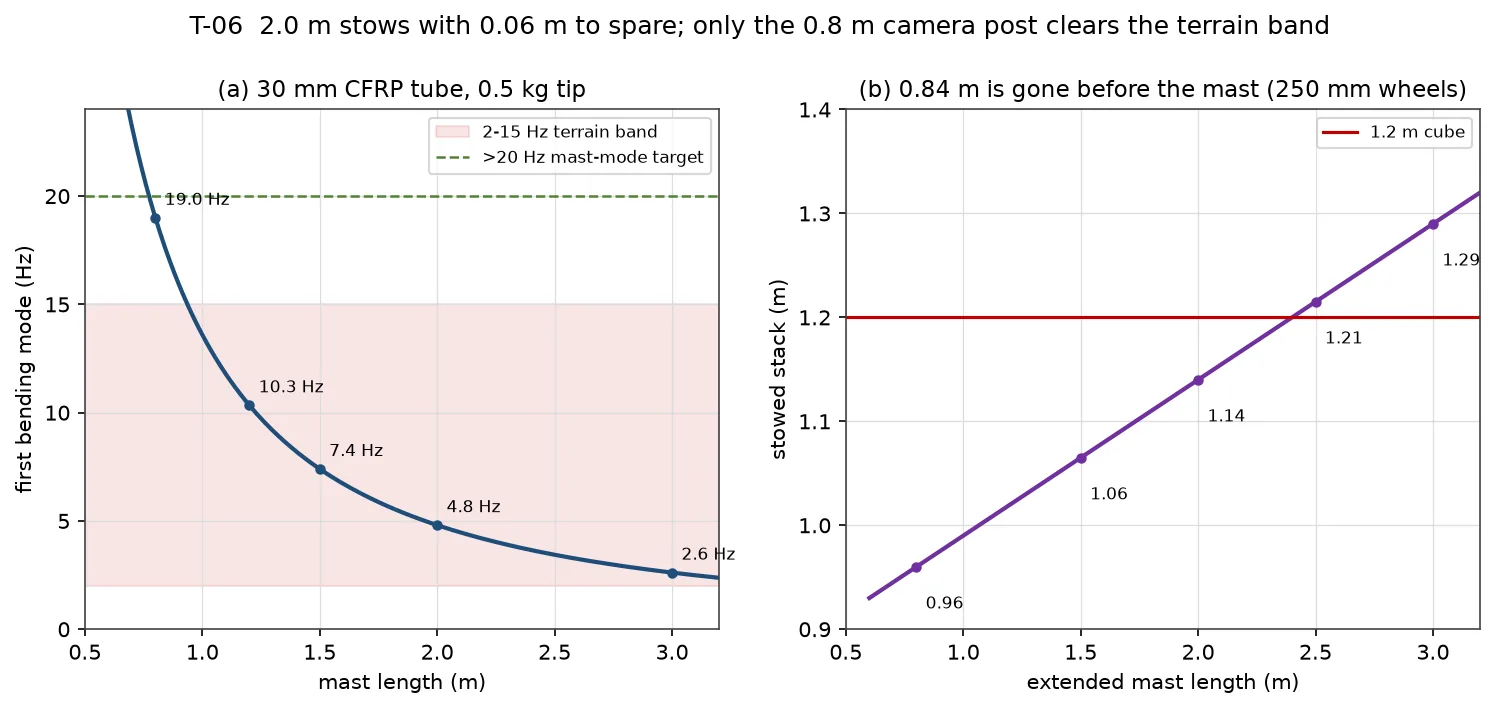
Three escapes exist. Shorten the wheelbase, which is what a 20 inch wheg does. Hinge the chassis at a central bearing, which costs a bearing, a harness across a moving joint and a lock. Or prove a diagonal fit: the rule permits any orientation, and 1.2 times the square root of two is 1.70 m of envelope in plan and 2.08 m in space, which is legal and almost never documented.
The sharpest trend in the record is that the two best-resourced teams independently removed folding from their stow strategy in 2026. WVU went from 24 inch folding whegs to 20 inch rigid ones, citing fewer points of failure S-WVU-SAR2026, and Missouri S&T moved to a compacted suspension that no longer needs to fold S-MST-SITE-ATHENA. A fold is a hinge, a lock, a tolerance stack and a failure mode that appears at the weigh-in, in front of judges, on a clock. Geometry designed to fit is cheaper than a mechanism designed to shrink, and the fold that remains should be the mast’s: single, over-centre and needing no separate hardware.
Mass follows architecture, and the schedule is the real budget
A 33 kg rover won the 2023 championship with a 5-DoF arm carrying 8 kg at full extension S-WVU-SAR2023. Those 20 kg came off in one year from a fabrication decision, not a diet: semi-monocoque sheet metal and composite wheels replaced tube-and-printed construction. Mass is therefore recorded rather than negotiated.
No URC team publishes a mass budget or a centre-of-gravity table, so the discipline rests on a handful of figures: WVU’s 33 kg, its predecessor at about 53 kg, Northeastern at about 46 kg, and a 24.4 kg rolling chassis that can be rebuilt from Monash’s public robot description S-WVU-SAR2023 S-NEU-NEWS-2026 S-MONASH-GH-NOVA. The arm is the largest single line anyone publishes, at 9.4–10.4 kg for a 5-DoF unit S-WVU-SAR2025.
A workable allocation for a first rover, given as structure rather than as numbers, is 37.5 kg of component estimates plus a 15 % growth allowance, which lands at 43.1 kg and is held to a ≤48.5 kg gate with 1.5 kg kept for scale error. The weigh-in plan is the part teams forget: weigh the bare chassis, then each subsystem, then the integrated rover, at three points, and record the scale, the date and the configuration. The number that matters is the heaviest legal configuration, because the judges weigh at every mission and round down.
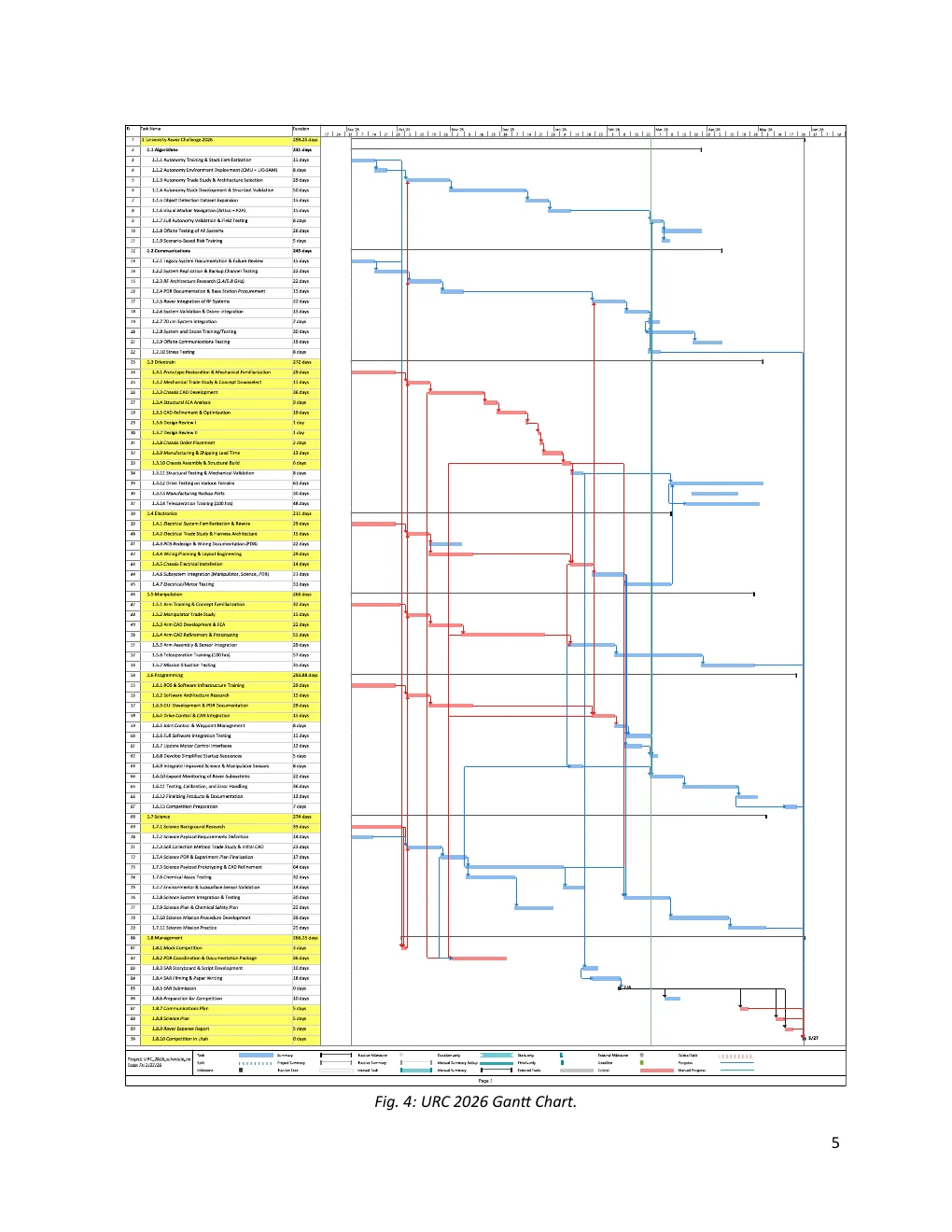
The schedule evidence is a ratio rather than a date list. WVU’s 2026 plan released procurement in December, assembled in January, filmed in February, and spent March to May testing, which is roughly 3:1 test-to-build in the second half of the year S-WVU-INCOSE2026. A team that builds until May has inverted the ratio and will arrive with an untested rover and an unwritten review. Backfit to 2027, integration is complete by mid-February, the software freeze falls on 2027-04-10 and the mechanical freeze on 04-24.
The review is a compressed exam
The System Acceptance Review decides admission, and in a normal year it decides it inside a few points. The distribution is narrow enough that a mid-field package is a risk even with a good rover.
| Year | Finalists | Lowest admitted | Median | Highest | Standard deviation |
|---|---|---|---|---|---|
| 2022 | 26 | 80.60 | 88.42 | 94.71 | 3.71 |
| 2023 | 31 | 85.61 | 89.31 | 94.54 | 2.71 |
| 2024 | 34 | 84.04 | 89.87 | 97.80 | 3.57 |
| 2025 | 35 | 86.90 | 90.33 | 97.27 | 2.54 |
| 2026 | 36 | 75.86 | 86.77 | 96.75 | 6.39 |
The population is teams that recorded mission scores, so the lowest column is the lowest admitted score rather than a cut line; scores of teams that were not admitted are not published S-URC22-SCORES S-URC26-SCORES. Two readings matter for planning. In 2023 to 2025 the standard deviation was 2.5–3.7 points, so a team five points below the field median was outside the admitted set on that evidence. And 2026 is not comparable with the years before it: the lowest admitted score fell by about nine points while the highest held near 97, which is consistent with a substantially updated rubric rather than with a weaker field.
A high review score is real and moderate. Across 162 team-years the correlation with final rank is r = −0.419, where a negative value means a higher review score goes with a better finish, and r² ≈ 0.18 means documentation explains about a fifth of the variance while mission execution carries the rest. The team with the highest review score won the event once in five years, in 2025. The review is a gate and a bank of 100 points.
The 2026 rubric is the model used here, at 40 report, 48 video and 12 judges, seven pages and five minutes, because the 2027 split is unpublished. The finalist set is counted two ways, with 38 packages pre-screened and 36 finalists carrying mission scores, the difference probably being packages submitted without a mission run. Content past the page or time limit is not read, and reused material from a previous year is a disqualification risk, which makes the format a design constraint rather than a presentation preference.
The systems award is a separate instrument. The INCOSE Foundation award ran for the first time in 2026, independent of competition scoring: the 38 finalist reports were pre-screened on a 100-point, eight-category rubric, 13 teams scored 80 or more, and each finalist then did a 30-minute interview worth 78 points plus 22 from on-site observation, combined 50/50 with a threshold of 75 S-URC-INCOSE. It is a second reason to hold the artefacts, and a separate narrative.
What top packages do, that a first build can copy
Five practices are visible across the four public WVU packages, which scored 94.35, 97.80, 93.17 and 96.75, and across the Missouri S&T and Michigan public record. These are documented practices, not proven causes; the sample is far too small to claim that.
- Every architecture diagram is colour-coded new against reused, with a legend that tags each changed component S-WVU-SAR2026.
- The Gantt occupies its own page, work-package numbered, owner-labelled and dated to the week.
- The budget is a table to work-package level 2, with cost categories that match the work breakdown.
- Testing is a ladder with named facilities and measured numbers, not adjectives: a rock garden, a replica lander, 750 m line of sight and 164 m without it, 30° slopes, a 10 kg end-effector lift.
- Each mission gets the same four-part structure: what the mission demands, what the design does about it, what has been tested, and what remains.
Interfaces that bite
- Every subsystem. Systems engineering owes an allocation and a requirement identifier, and needs measured mass, current, geometry and interface deltas in return. Without both, subsystems optimise locally and the rover arrives at 55 kg.
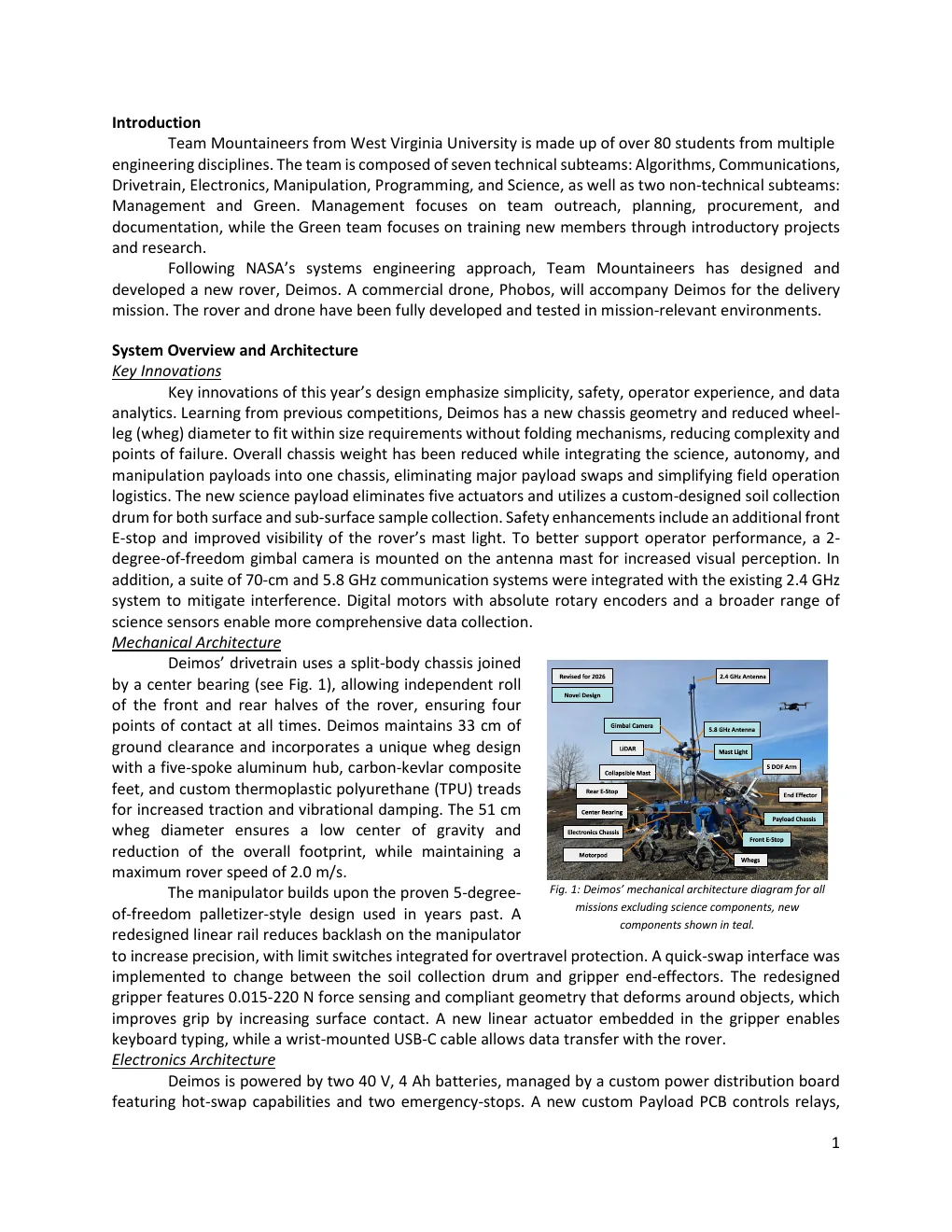
- Arm. A 1.5 m reach requirement fights a 0.12–0.15 m parked height, so the reach trade and the stow trade have to be made together, with the parked pose drawn at concept.
- Mobility. Wheel diameter is a four-way coupling of climbing, centre-of-gravity height, stow height and mass. WVU’s change from 24 inch to 20 inch moved all four at once, so someone has to own the number.
- Communications. The link requirement comes from mission geometry, so the range test at 750–850 m with line of sight and 164–300 m without it has to precede the review video.
- Power and operations. One red button must stop all power draw across power, compute, communications and arm S-URC27-RULES §2.a.v, which is a system function rather than a feature of a power board. Systems engineering owns the setup-clock budget; operations owns whether the clock is achievable.
Failure modes
Six of the eleven documented integration failures in the record are process failures rather than hardware failures, which makes them the cheaper half to prevent.
| Failure | What happened | Prevention |
|---|---|---|
| Transport shock | Parts were found damaged on arrival in Utah in 2026 S-UMICH-AERO-2026 | Shake the packaged rover before departure, then repeat the power-on and link checks |
| Connector or link failure | Rovers that work in the motel parking lot and fail at the site because of a loose wire S-URC-ADVICE | Strain relief, latched connectors, and a post-transport check as a procedure |
| Mechanism on the signal path | Missouri S&T lost Delivery in 2024 to a rover-side signal-stack mechanism S-MST-NEWS2024 | Lock the mechanism and test the stack on a shaker |
| Single arm axis | Delivery was lost again in 2024 to an arm vertical axis S-MST-NEWS2024 | One-fault tolerance on the vertical axis, and an axis check in the setup procedure |
| Staged-mission time-out | A 15-point Delivery score in 2023 and 2024 because Stage 1 was not cleared S-MST-NEWS2023 | Rehearse the clock as a requirement; the stage gate turns a slow start into a 15 |
| Missing budget or envelope | A 5 % per kilogram penalty, and 40 % for the cube S-URC27-RULES S-URC27-RULES §2.a.ii §2.a.iii | The allocation, the weigh-in plan and a physical 1.2 m mock box |
Shortlist for a first build
| Item | Choice | Why |
|---|---|---|
| Requirements | One spreadsheet and one printable traceability figure | Nothing larger fits in seven pages |
| Interfaces | Interface control document at the preliminary review, frozen at the critical review, plus a bus map | The best artefact in the field is a machine-readable protocol manifest S-MST-GH-ROVECOMM |
| Mass | Design to a cap, CAD at the preliminary review, a scale at integration, ≥1.0 kg in reserve | Judges round down, so the reserve is real headroom |
| Packaging | Geometry first, a 1.2 m mock box before metal is cut, and the mast as the only fold | Two top teams removed their folds in 2026 S-WVU-SAR2026 S-MST-SITE-ATHENA |
| Modularity | One integrated rover and a two-bolt end-effector swap | The 70 kg allowance is reserve, not a second rover |
| Schedule | Integration complete by mid-February, film in February, freezes in April | A rover integrated in March cannot produce a February video |
Open problems
- What is the real mass of a 2027-class rover? No team publishes a mass budget or a centre of gravity, so four rover masses, two of them inferred, are the entire evidence base. A short survey of ten teams at the event would close it.
- Is a tilted or diagonal stow accepted in practice? The rule permits any orientation and no team documents using it. A measured tilted fit in a mock box, plus a written question to the organisers, settles it.
- What rubric applies in 2027? Both the review rubric and the systems-award rubric are unpublished. Re-reading them monthly from December 2026 is the only defence.
- Is the 15-minute setup achievable with a fold and a weigh-in? No team publishes a measured setup time. Timing ten setups produces the distribution, which is the design input.
- What thermal qualification practice exists? No team document describes an environmental test at 37.8 °C in full sun. Logging enclosure temperature against ambient on the hottest field day, and publishing it, would create the first.
Further reading
- WVU Team Mountaineers publishes four years of review packages, which is the richest evidence for this page.
- Missouri S&T shows the compacted-suspension route out of the packaging problem.
- Northeastern is the closest published mass to the limit, at about 46 kg in 2026.
- Mass and power builds the full 50 kg budget that this page only allocates.
- Interfaces and couplings works the arm-reach, mast-height and wheel-diameter chains with numbers.
- System Acceptance Review sets out what the milestones demand, and Review, judging and awards covers the published weights.
Sources for this page
- S-URC27-RULESUniversity Rover Challenge 2027 – Requirements and GuidelinesOriginal Archived copy
- S-URC-RECTOPICSURC Recommended Topics (study list)Original
- S-WVU-SAR2025Team Mountaineers System Acceptance Review 2025 (rover "Daedalus"): 2.4 GHz 90° sector + 3 m rover mast, 70 cm HAM packet radios, 433.25 MHz amateur-TV analog video, 750 m LOSOriginal
- S-WVU-SAR2023Team Mountaineers System Acceptance Review 2023 (rover "Wanderer"): Cambium PTP 450 900 MHz link, 850 m LOS / 300 m NLOS, 2 m telescoping mast, drone 900 MHz + 2.4 GHzOriginal
- S-URC26-SARURC2026 System Acceptance Review Requirements + SAR Q&AOriginal
- S-WVU-SAR2026Team Mountaineers System Acceptance Review 2026 (rover "Deimos"): tri-modal 2.4 GHz + 5.8 GHz + 70 cm, gimbal camera on antenna mast, 750 m LOS / 164 m NLOS high-noise test, antenna + radio budget linesOriginal
- S-MST-SITE-ATHENAAthena (2026) rover page, compact suspension, 3D-printed wheels, hub motors, STM32/CAN controllers, simulator arm, LiDAROriginal
- S-NEU-NEWS-2026"Lighter, faster and more agile. Meet Northeastern's new Mars rover", states the 2026 rover is ~46 kg (101 lb), 10 % lighter than 2025Original
- S-MONASH-GH-NOVAMonashNovaRover/nova, "The Monash Nova Rover mono-repo" (Apache-2.0; default branch main; 2,389 files; last push 2026-10-23)Original
- S-WVU-INCOSE2026INCOSE URC 2026, Team MountaineersOriginal
- S-URC22-SCORESURC2022 Official ScoresOriginal
- S-URC26-SCORESURC2026 Official ScoresOriginal Archived copy
- S-URC-INCOSEINCOSE Foundation, Excellence in Systems Engineering Award (URC)Original
- S-UMICH-AERO-2026"MRover Student Team Takes Inaugural Award at International Competition" (includes the INCOSE judges' comment on the winner)Original
- S-URC-ADVICEURC Advice (judges' systems-engineering lessons)Original Archived copy
- S-MST-NEWS2024MRDT Newsletter Winter 2024–25 (PDF, 7.5 MB), URC 2024 review with failure forensics, 2025 design update, 88 active membersOriginal
- S-MST-NEWS2023MRDT Winter 2023 Newsletter (PDF, 4.2 MB), URC 2023 review (belt break, Stage-1 delivery failure, rain delay) and 2024 design intentOriginal
- S-MST-GH-ROVECOMMRoveComm_Base README, the full RoveComm manifest.json documentation: every board IP, command, telemetry packet and enum (drive, arm, auger, Raman, PMS, nav, camera, signal stack, drone GPS)Original