Autonomy: astronaut assistance
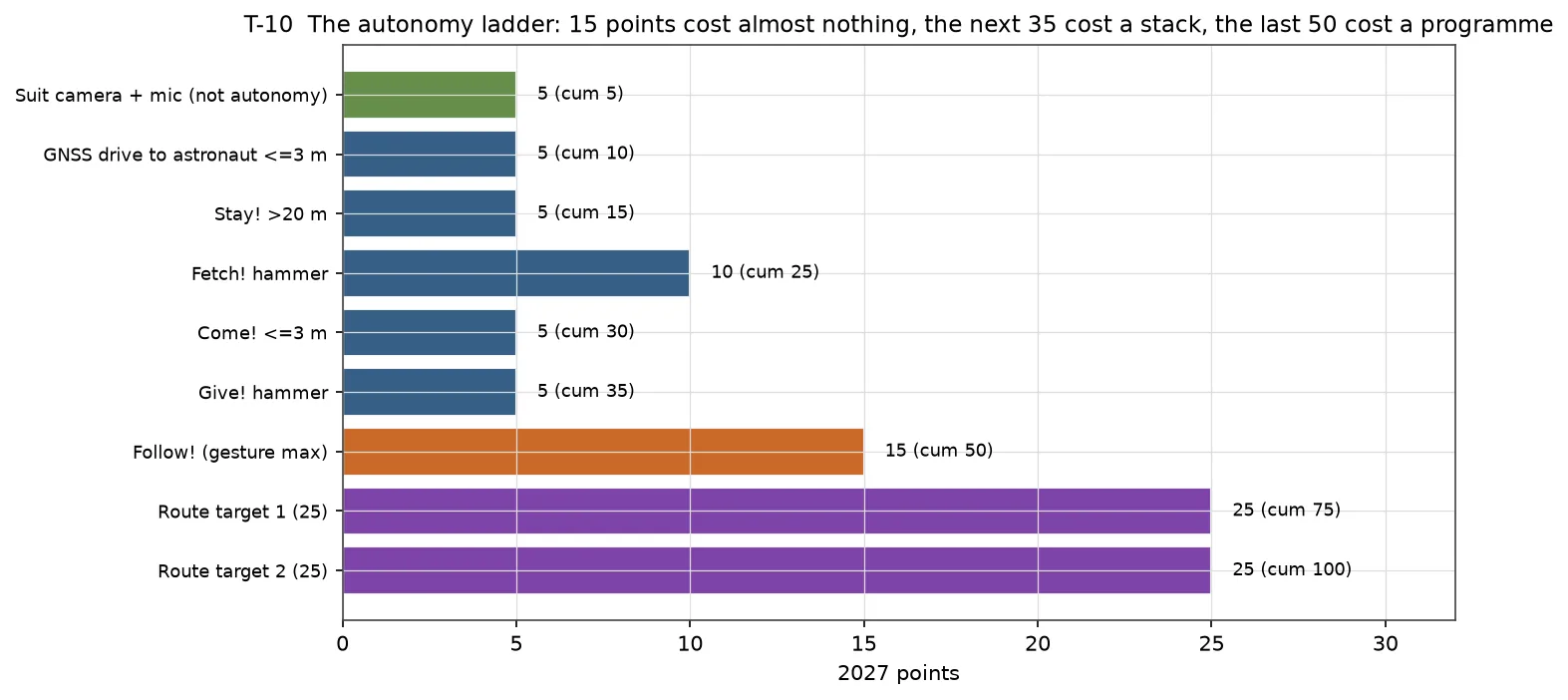
The astronaut-assistance sub-mission is half of the Autonomy score and the only part of URC 2027 where a person stands inside the control loop. A team member in a suit walks, stops, walks away and holds out a hammer, and the rover answers with five commanded behaviours. Forty-five of the fifty points require autonomy; only the suit itself is manual.
Key takeaways
- The interaction is new; the geometry is not. The Mars Society ran suited-astronaut tasks for nine years, and the 2011–2013 version required delivery within 1 m of a suited figure from a GPS fix accurate to ±25 m. Only the 15-point Follow! has no precedent at all.
- Follow! is a ladder, not a modality. Gesture, then audio, then a sign or a device button: a rung that fails cannot subtract points, so the floor is 5 and the ceiling 15 S-URC27-QA AUQ6.
- The rules give geometry away. The astronaut’s GNSS point, the guaranteed 20 m standoff with the astronaut in the field of view, and a two-way link that is encouraged all convert hard perception into easy localisation.
- The minimum is 30 of 50 without person-following or a hammer grasp; 40 with Fetch!; 50 with gesture Follow!.
What the sub-mission physically demands
| Demand | Number | Basis |
|---|---|---|
| Suit | Team-provided, covering neck, wrists and ankles, with closed-toe shoes, a camera and a microphone monitored in C2, and a helmet the astronaut can remove alone | S-URC27-RULES S-URC27-QA §1.e.iv AUQ12 |
| Heat | The rules cite 37.8 °C ambient; the June daily maximum at the site averages 33.3 °C and reaches 40.7 °C | S-URC27-RULES S-OPENMETEO-ARCHIVE §3.d.iii |
| Drive to the astronaut | Autonomous, stopping within 3 m of the GNSS point | S-URC27-RULES §1.e.v |
| Follow! | Follow a walking person on natural terrain and stop within 3 m when the person stops; one modality, 15 points maximum | S-URC27-RULES §1.e.vi |
| Stay! | No motion while the astronaut moves more than 20 m away | S-URC27-RULES §1.e.vii |
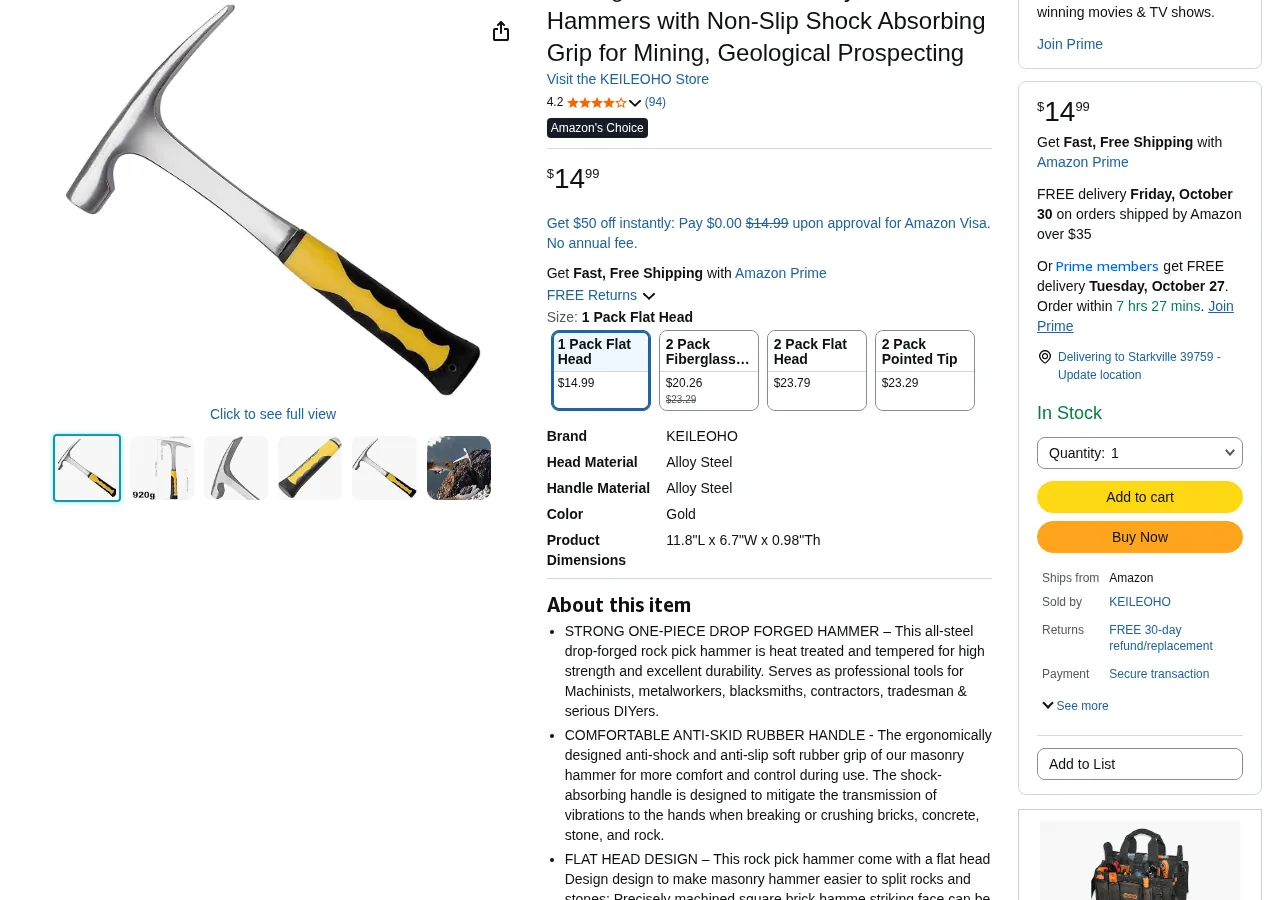
| Fetch! | Detect, grasp and lift a 0.91 kg, roughly 300 mm one-piece steel hammer lying on the ground; a teleoperated pickup scores zero | S-URC27-RULES S-URC27-TASKHW §1.e.viii |
| Come! | Autonomous drive to the astronaut and a stop within 3 m, with the astronaut at least 20 m away and in the field of view | S-URC27-RULES S-URC27-QA §1.e.ix AUQ7 |
| Give! | Place the object on the ground, or drop it | S-URC27-RULES §1.e.x |
| Command order | Follow, Stay, Fetch, Come, Give | S-URC27-QA AUQ13 |
| Time | Inside a 40-minute mission shared with route finding; no separate clock for this sub-mission | S-URC27-RULES §1.e.i |
| Safety | No points penalty for contact, but an astronaut E-stop ends the mission; avoidance is highly recommended | S-URC27-QA AUQ1 |
| Human-robot safety frame | ISO 13482 protective stop and speed-and-force limits are good practice, although URC does not require compliance | S-ISO-13482 |
The nine-year precedent
There is no precedent for the commanded interaction, but there is a long one for the geometry.
| Precedent | What it required | Year |
|---|---|---|
| Emergency Navigation | Deliver a container within 1 m of a simulated distressed astronaut, identified by the presence of a space suit; the astronaut may have strayed from the last known position | 2008 |
| Astronaut Assistance | Deliver within 1 m of two to five suited astronauts, with GPS accurate to only ±25 m, so visual acquisition was mandatory, and up to half of them out of line of sight | 2011–2013 |
| Astronaut Assistance, evolved | The same, plus collecting equipment and returning samples, including small hand implements such as a screwdriver, a hammer or a wrench | 2014–2016 |
| Delivery sign reading | Read signs carried by astronauts or placed in the field | 2017–2026 |
| Commanded interaction | Follow, Stay, Fetch, Come and Give | 2027, new |
Reading the precedent correctly. Thirty-five of the fifty points rest on capabilities the field exercised before 2017: approaching a suited figure, stopping close, and handling a hand implement. The precedent is about geometry and perception, not about autonomy level. The 2008–2016 tasks were largely teleoperated, whereas 2027 requires autonomous operation for 45 of the 50 points, so the history de-risks the problem rather than the implementation.
What 2022–2026 adds
There was no astronaut task in this window, but its parts were trained.
| Practice | Evidence | Use in 2027 |
|---|---|---|
| ArUco detection with visual servoing and marker-proximity stops | West Virginia validated the combination in 2026 S-WVU-SAR2026 | The sign channel and the route posts become nearly free |
| Object detection with an explicit class | Missouri S&T trained a rock-pick class at 0.60 confidence S-MST-DOCS-CONSTANTS | Fetch! is a class the field already trains |
| Ground-object detection benchmarked by mean average precision | West Virginia reported the 80th percentile across mallet, keyboard, water bottle and rock hammer S-WVU-SAR2026 | Sets a realistic bar for the hammer |
| A reached-goal radius tighter than the rule | Missouri S&T uses 1.5 m with 10 seconds of stationary GNSS averaging S-MST-DOCS-CONSTANTS | A 3 m stop is comfortable if the terminal discipline exists |
| Operator practice as a published standard | West Virginia requires a minimum of 100 hours of practice S-WVU-SAR2026 | The single most useful planning number in this sub-mission |
| A detector that works indoors and fails in the field | Missouri S&T could not locate a specific rock through its cameras in 2023 S-MST-NEWS2023 | Every detector is unproven until it runs outdoors, in sun, at range |
The design insight worth acting on
The rules hand over geometry in three places. The astronaut’s GNSS point is provided for the 5-point drive, so the approach is a waypoint drive and visual acquisition only has to work over the last 25 m, exactly as it did in 2011–2016. Fetch! and Come! guarantee that the astronaut is at least 20 m away and in the field of view, so the rover has a known bearing to look along. Because the astronaut may carry electronics but may not deploy anything S-URC27-QA AUQ26, and because a two-way astronaut-to-C2 link is encouraged S-URC27-QA AUQ5, a suit-carried GNSS beacon would turn Come! and the initial drive into waypoint problems, leaving person detection needed only for Follow!.
That is a large reduction in perception risk for 5–10 points, at the cost of a small radio and a battery in the suit. Two things have to be answered before it can be designed in: whether URC accepts a beacon-derived position as satisfying the autonomous drive, and how the beacon is declared in the communications documentation, which is due 2027-04-30 S-URC27-RULES §2.c.ii. The beacon is a hypothesis to test, not a settled design.
Follow! is a ladder, not a modality
Because the four methods are alternatives and the rules permit switching mid-mission S-URC27-QA AUQ6, they form a fallback ladder rather than a choice. The ladder attempts gesture first, falls back to audio, then to a sign or a device button. A rung that fails cannot subtract points, so the worst case is the 5-point device and the best is 15.
| Rung | Points | Effort for a first build | Implementation |
|---|---|---|---|
| Device button | 5 | About 1.5 person-weeks | Wearable button on the suit, received by the rover |
| Printed sign | 5 | About 1 person-week | ArUco sign, reusing the detection needed for route posts |
| Audio | 10 | About 3.5 person-weeks | Suit microphone to C2 to rover command |
| Gesture | 15 | About 6–10 person-weeks | Visual recognition, promoted only after an outdoor test with zero false positives |
The effort figures are planning estimates from the astronaut-interaction study, by inference; no URC source measures effort.
Which subsystem options serve it
| Decision | Option A applies when | Option B applies when |
|---|---|---|
| Suit | Coverall, cooling vest, analogue 5.8 GHz video pod, LoRa button and a printed ArUco sign, which secures the 5 suit points and a 5-point Follow! | An IP-camera suit pod when the C2 already runs an IP video stack and someone owns the Linux integration |
| Follow! modality | Gesture first, only after 90 % true-accept and zero false positives at 6–8 m in sun on the real suit | Audio when the gesture test has not been run, and never a device alone |
| Audio path | Suit microphone to C2 to rover command as the primary route | A direct microphone only if the astronaut is within a few metres and the rover is quiet |
| Person perception | A YOLO-class detector with depth for range and bearing, and pose estimation for gesture | The astronaut’s own camera, which AUQ24 permits, when the rover’s view is occluded |
| Fetch grasp | A wide jaw of 100 mm or more, or a hook on the shaft, with a wrist camera and a vertical lift of 100 mm before retracting | A scoop or under-slide only if the hammer lies on flat ground, which it may not |
| Stay! implementation | An explicit hold state that disables the planner and asserts zero velocity | A GNSS hold point only if it is proven not to creep on a slope |
| Arrival and mode signalling | An LED driver on the authoritative mode topic, with a sunshade, tested at noon | A C2 indication in addition, which is recommended but not required S-URC27-QA AUQ18 |
Minimum viable versus stretch
- The minimum that scores: a suited team member with a working camera and microphone (5) plus the four short behaviours of drive to the GNSS point (5), Stay! (5), Come! (5) and Give! (5). None of them needs person-following or a hammer grasp, but Come! still needs the astronaut’s position at 20 m, which is either a beacon or a person detector. With a sign or device Follow! (5) the total is 30 of 50.
- The credible level: add Fetch! (10) for 40 of 50, which needs hammer detection and a grasp, both 2026-class capabilities.
- The stretch: 50 of 50, adding gesture Follow! for 15 and earning the full margin.
Risks to retire early
| Risk | Why it is real | The test that retires it | Lead time |
|---|---|---|---|
| The wrong person is followed | A judge or spectator can stand near the astronaut, and AUQ10 allows the astronaut to stand close to the rover | A fiducial panel on the suit and a requirement that the team’s own marker is present before closing distance: zero wrong-person locks in 20 runs with a bystander crossing | 4 months |
| A gesture false positive | Natural arm swing read as a command, or a bystander waving | Two-of-three confirmation plus a rest-pose gate: 90 % true-accept and zero false positives in 10 minutes of field noise | 4 months |
| A command is not recognised | Wind at a June mean of 7.3 m/s, distance, a small sign or a gloved button | The fallback ladder with timeouts, oversized buttons and a microphone near the mouth: every rung passes its own bench test and Follow! completes in 3 minutes | 3 months |
| A command is recognised twice | A repeated trigger re-arms the follow controller after Stay! | Command identifiers with a latch that ignores duplicates within 2 seconds: 20 of 20 single-transition runs | 3 months |
| The hammer is not detected or the grip fails | 0.91 kg and low profile on gravel, with Missouri S&T’s rock-detection failure as the cautionary case | Fifty automated grasps on five ground poses: 45 of 50, and no drop over a 20 m carry | 4 months |
| Stay! creeps | Suspension wind-up or a planner tick | A hold state that disables the planner, with an encoder zero-motion check over the full walk | 3 months |
| Suit heat and astronaut distress | June conditions of 33–41 °C under a coverall | A cooling vest, hydration and a timed suit trial in sun: 30 minutes without distress and a helmet removable in under 10 seconds | 3 months |
| The suit feed is not on screen | Five points depend on the C2 display rather than on a recording | An always-visible window and a check with the C2 judge before the clock starts | 1 month |
| A hands-off violation | A reflex grab during a near-collision S-URC27-QA AUQ21 | The autonomy key out of reach and fault-injection drills: zero control touches across 10 injected near-misses | 2 months |
| Communications documentation omission | The suit pod, the command device and any repeater are all communications devices S-URC27-RULES §2.c.ii | A device list owned by the communications lead: every device listed with its licence and power | 2027-04-30 |
What is not published
- Whether a suit-carried GNSS beacon is an acceptable basis for the autonomous drive to the astronaut.
- Whether voice guidance from the astronaut to C2 counts as human assistance while driving.
- Whether an inertial gesture is legal, since the rule says visual recognition and the Q&A permission names cameras.
- Any measured gesture success rate, stopping distance or speech-recognition false-accept rate at URC.
Further reading
- Astronaut interaction and the EVA suit works the suit, the gestures and the safety envelope.
- Software stack and autonomy covers the behaviour tree and the hold state.
- Autonomy: route finding shares the 40-minute clock and the same localisation.
- Missouri S&T, West Virginia and Monash carry the perception and operator-practice evidence.
Sources for this page
- S-URC27-QAURC2027 Questions & Answers (updated through 2026-10-11)Original Archived copy
- S-URC27-RULESUniversity Rover Challenge 2027 – Requirements and GuidelinesOriginal Archived copy
- S-OPENMETEO-ARCHIVEOpen-Meteo historical weather API (ERA5 reanalysis), query at 38.4062 N, 110.7912 W for June 2015–2025: daily temperature_2m_max (mean 33.3 °C, the analysis 38.9, max 40.7), wind_speed_10m_max (mean 7.28 m/s, the analysis 12.31, gust max 25.6), wind_gusts_10m_max, precipitation_sum; 330 June days; 10.3 % of days ≥ 37.8 °COriginal
- S-URC27-TASKHW2027 task hardware resolved from the rulebook's own hyperlinks (keyboard, display, hammer, hose)Print copy
- S-ISO-13482ISO 13482:2014 "Robots and robotic devices, Safety requirements for personal care robots", Edition 1 (2014-02): scope covers mobile servant, physical assistant and person carrier robots; earthbound only; does not apply to robots travelling faster than 20 km/hOriginal
- S-WVU-SAR2026Team Mountaineers System Acceptance Review 2026 (rover "Deimos"): tri-modal 2.4 GHz + 5.8 GHz + 70 cm, gimbal camera on antenna mast, 750 m LOS / 164 m NLOS high-noise test, antenna + radio budget linesOriginal
- S-MST-DOCS-CONSTANTSBinder §05 "Autonomy Constants Reference & Tuning Guide", every tuned constant with typical value (drive PID, slope damping, waypoint radii, YOLO model paths/confidences, A*/Stanley parameters, GPS antenna offsets)Original
- S-MST-NEWS2023MRDT Winter 2023 Newsletter (PDF, 4.2 MB), URC 2023 review (belt break, Stage-1 delivery failure, rain delay) and 2024 design intentOriginal